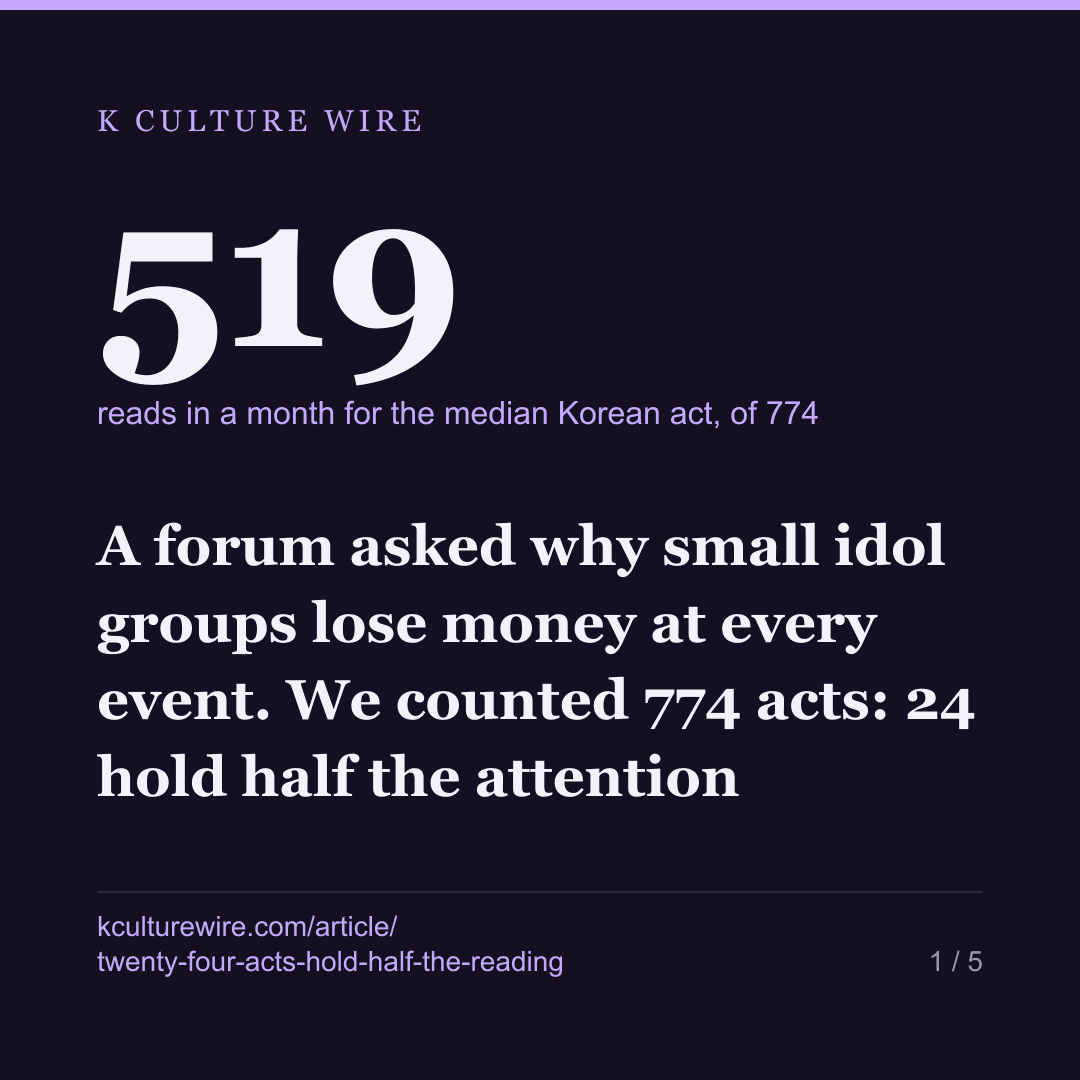
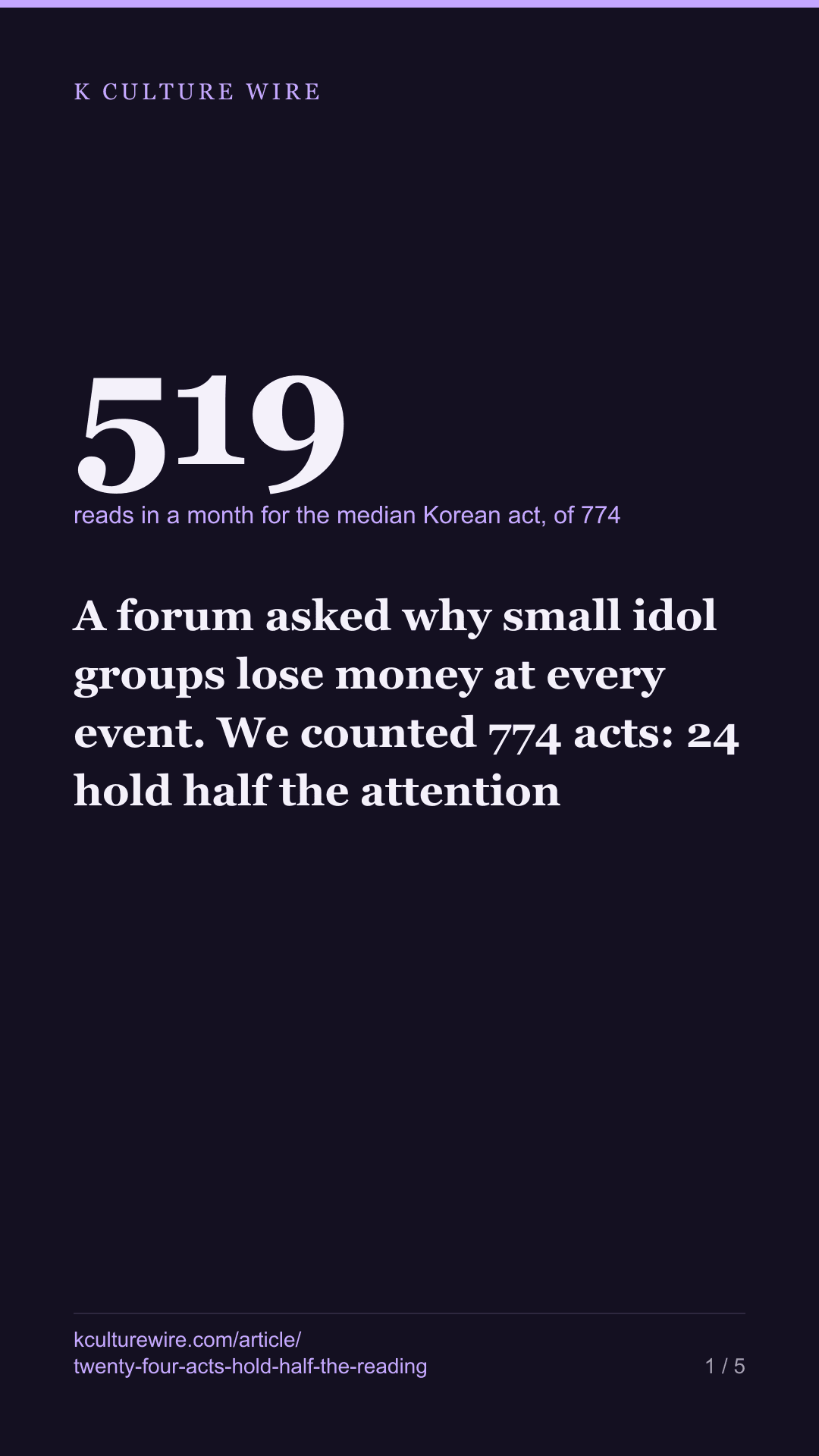
A forum asked why small idol groups lose money at every event. We counted 774 acts: 24 hold half the attention
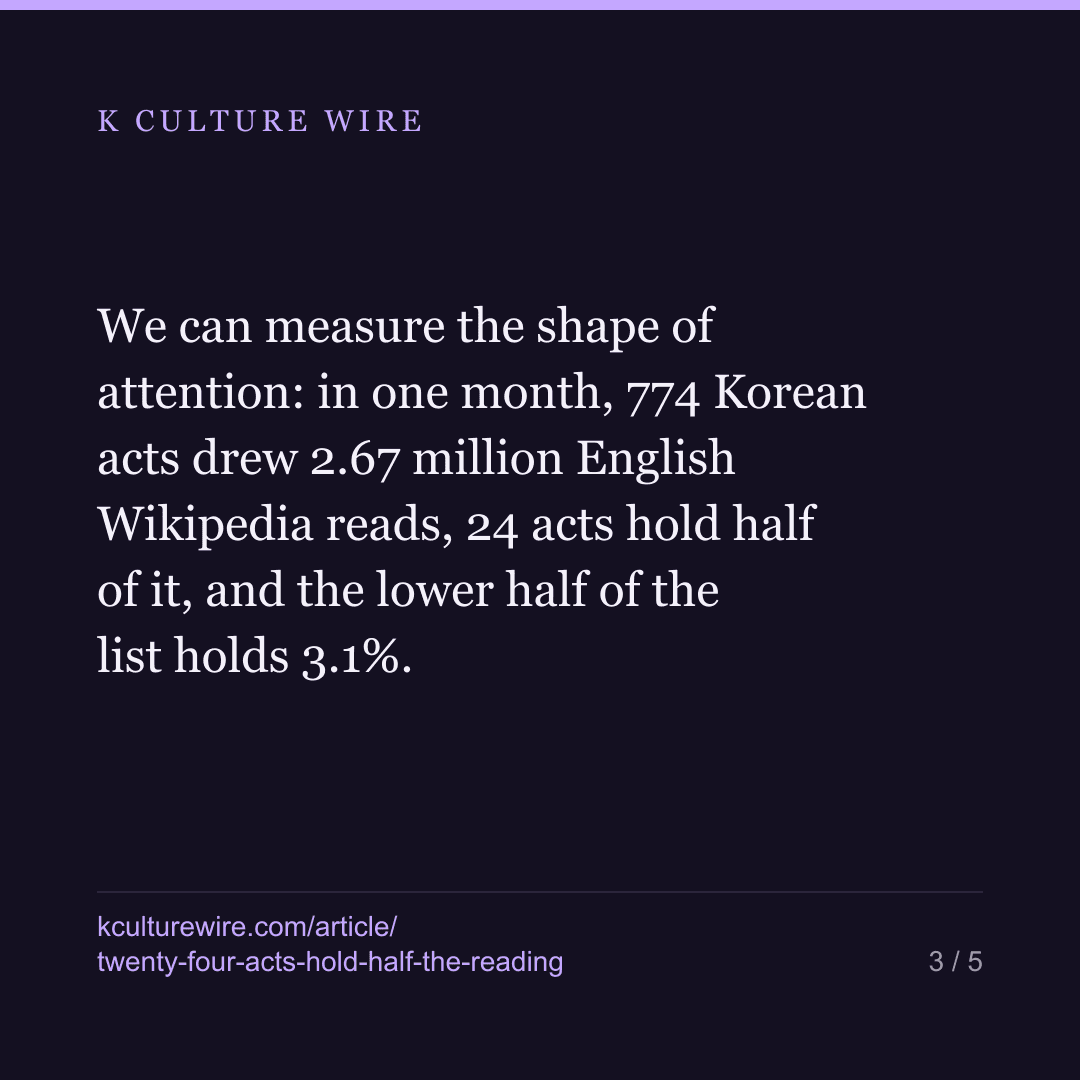
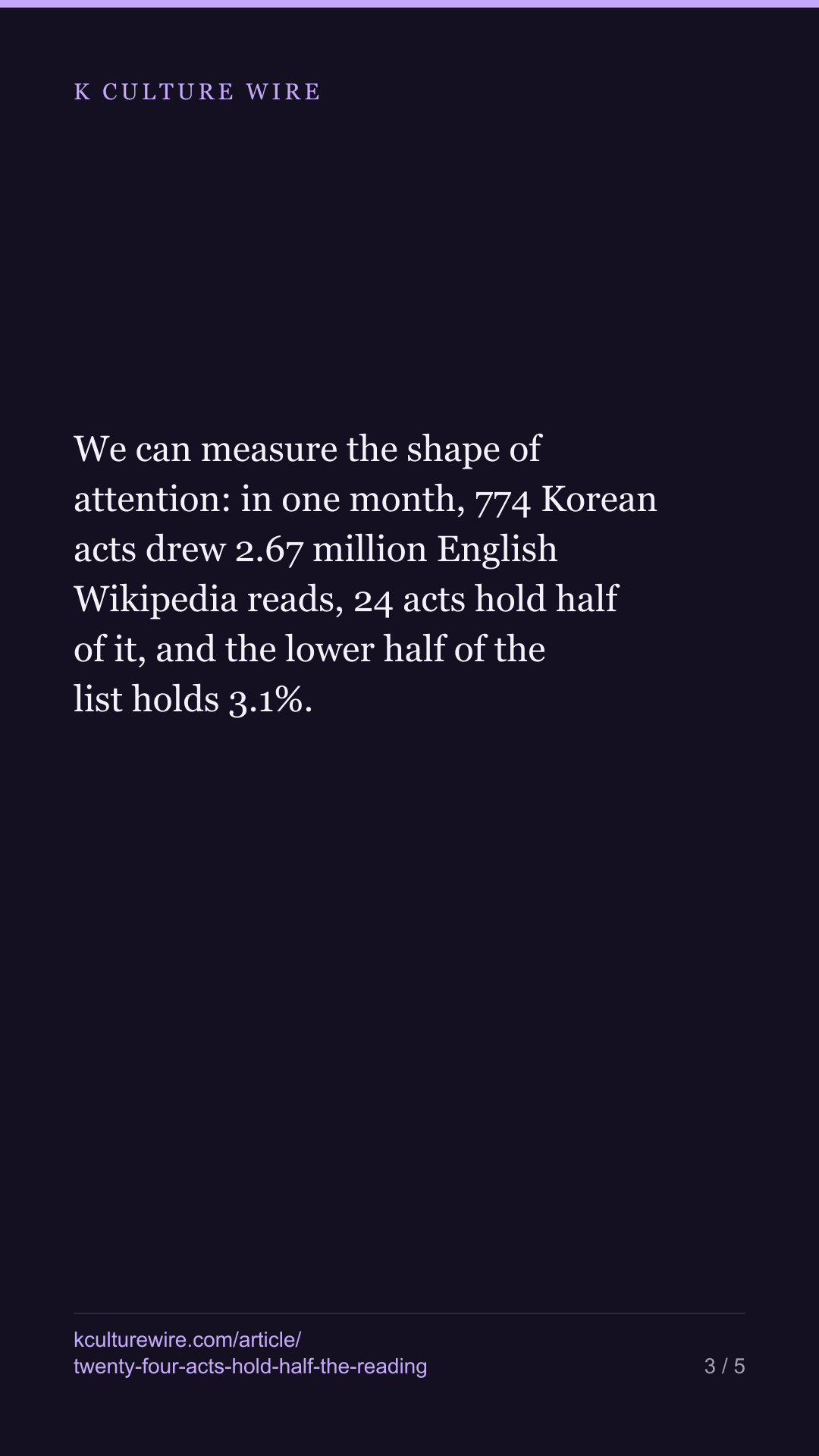
We cannot measure event economics and do not claim to. We can measure the shape of attention: in one month, 774 Korean acts drew 2.67 million English Wikipedia reads, 24 acts hold half of it, and the lower half of the list holds 3.1%.
The table this is written from: /attention-share
A Korean gaming forum ran a thread this week with a plain title: why lesser-known idol groups are said to lose money on every event they play. Twenty replies, the usual mix of insiders and guessing.
We cannot answer it. We hold no fee data, no ticket data and no attendance data for any Korean act, and nothing below is a claim about anybody’s finances. But the thread is reaching for something that is measurable — the distance between the acts everyone has heard of and everyone else — so we measured that.
24 acts of 774
In the single month of August 2026, 774 Korean music acts drew 2,670,482 reads on English Wikipedia between them. Counting down from the most-read:
| The most-read | Share of the month’s reading |
|---|---|
| Top 1 of 774 | 9.7% |
| Top 3 | 18.0% |
| Top 5 | 22.9% |
| Top 10 | 33.5% |
| Top 20 | 47.0% |
| Top 50 | 64.6% |
| Top 100 | 78.4% |
| Top 200 | 89.8% |
Twenty-four acts hold half of it — 3.1% of the list. BTS alone accounts for 9.7%, more than the bottom 387 acts put together.
That last comparison is worth stating twice, because the symmetry is easy to miss: the top 3.1% of the list and the bottom 50% of the list hold the same share of the month’s reading, 3.1% each.
The median act was looked up 519 times
Not 519 thousand. 519. In a month, in English, worldwide.
That number is the one that makes the forum thread legible. Whatever the economics of playing an event are, the act in the middle of this list is attempting them at a level of outside recognition of about seventeen page-opens a day — and a page-open is not a person, since one reader returning three times counts three. The act at the top is attempting the same thing at 260,085 reads a month.
We are not saying the second act earns more. We are saying they are not doing the same job.
Two counts, and the one place they disagree
A single month could be a fluke — a comeback lands, an act spikes, the shape distorts. So we ran the same measurement on a different act set over a different window, collected separately: 380 acts, twelve months, act pages only.
| The most-read | One month, 774 acts | Twelve months, 380 acts | Gap |
|---|---|---|---|
| Top 1 | 9.7% | 9.8% | 0.0 points |
| Top 10 | 33.5% | 36.4% | 2.9 points |
| Top 20 | 47.0% | 49.9% | 3.0 points |
| Top 100 | 78.4% | 84.9% | 6.5 points |
At the very top they are almost identical — 9.7% against 9.8%, which is closer than we expected and not something we arranged. Further down they drift, by up to 6.5 points at the top hundred.
We are printing the drift rather than the flattering row, and the reason for it is structural rather than interesting: the twelve-month set contains fewer acts, so “the top hundred” is a larger slice of a shorter list. What survives both counts is the finding. Roughly a tenth of everything sits on one act, and about half of everything sits inside the top twenty, whether you look at one month or twelve.
What we are not saying
A Wikipedia read is not money. An act can be read rarely and tour profitably, playing rooms that fit its audience; an act can be read constantly and lose money on a production that does not. We have no data that would let us tell those cases apart, and this article does not try.
What the count does establish is that the two ends of Korean music are not operating in the same conditions of recognition, and that the middle is much closer to the bottom than to the top. Anyone arguing about the economics is arguing about that shape, whether or not they have seen it as a number.
The full table, the most-read 25, and the side-by-side of both counts are on the data page: how lopsided attention on Korean acts is.
Where these numbers come from
Sources
- Wikimedia Foundation — Pageviews REST API — en.wikipedia, all-access, agent=user, monthly. Main count: the single month 2026-08 across 774 acts. Check count: twelve months 2025-09 to 2026-08 across 380 acts. · https://wikimedia.org/api/rest_v1/
- Wikidata — SPARQL — Korean music acts by P31/P279* of musical group, musical ensemble, girl group or boy band, with South Korea by P495, P17 or P740. · https://query.wikidata.org/sparql
What we checked
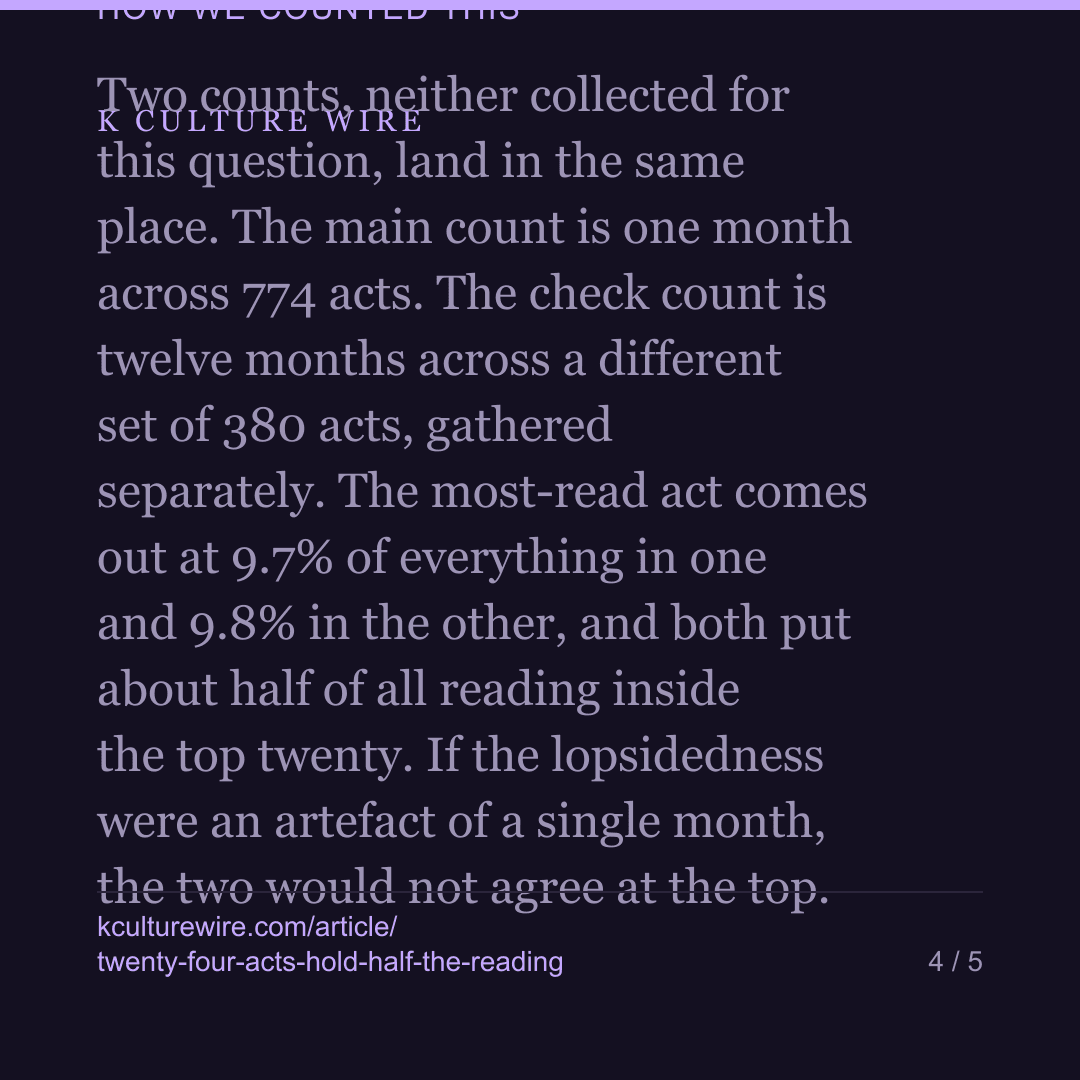
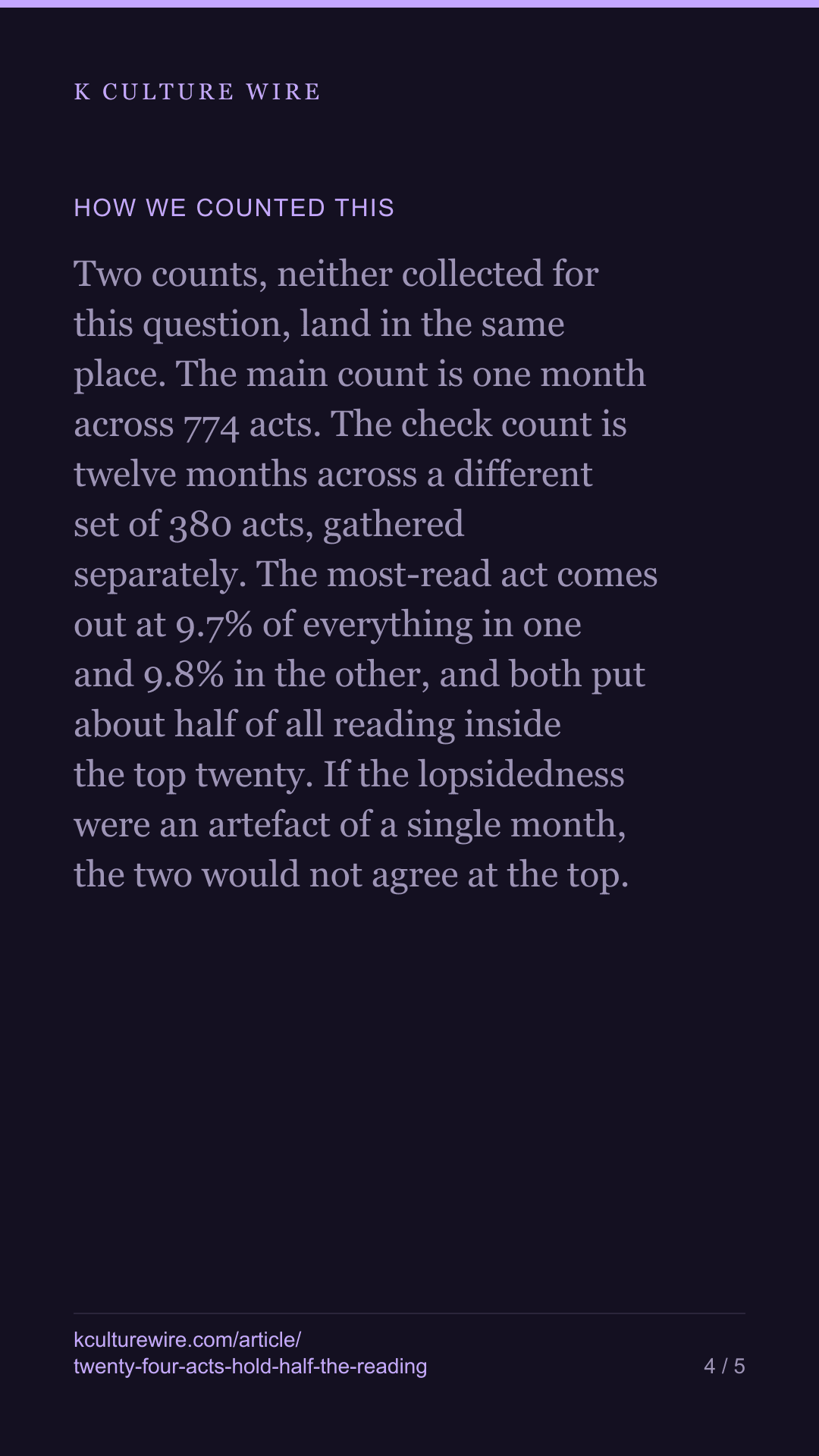
- Two counts, neither collected for this question, land in the same place. The main count is one month across 774 acts. The check count is twelve months across a different set of 380 acts, gathered separately. The most-read act comes out at 9.7% of everything in one and 9.8% in the other, and both put about half of all reading inside the top twenty. If the lopsidedness were an artefact of a single month, the two would not agree at the top.
- The two counts do drift apart further down the list, by up to 6.5 points at the top hundred, and the page prints the gap rather than the flattering figure. The reason is structural: the twelve-month set holds fewer acts, so any fixed count of acts is a larger slice of a shorter list. We say so on the page instead of only publishing the pair that matches.
- Nothing was re-collected to produce this. Both figures are recomputed from data already on disk, which means the two counts cannot have drifted apart through a fresh fetch of a changing source. The 73 acts whose reading could not be retrieved were dropped by the original collection and are still dropped here, not counted as zero.
The data behind this
Written from the same data
Take this away — 10 cards
The figures in this article, as images. Free to repost with the address on them.
If you work in this business
Everything on this page is measured from the same weekly Netflix lists, per market and per title. We publish the pages free; what we sell is the same measurement cut to one company's catalogue — including the figures behind /attention-share.
What a company sheet contains, and what it cannot tell you →