One Wikipedia writes Korean titles first — not the biggest
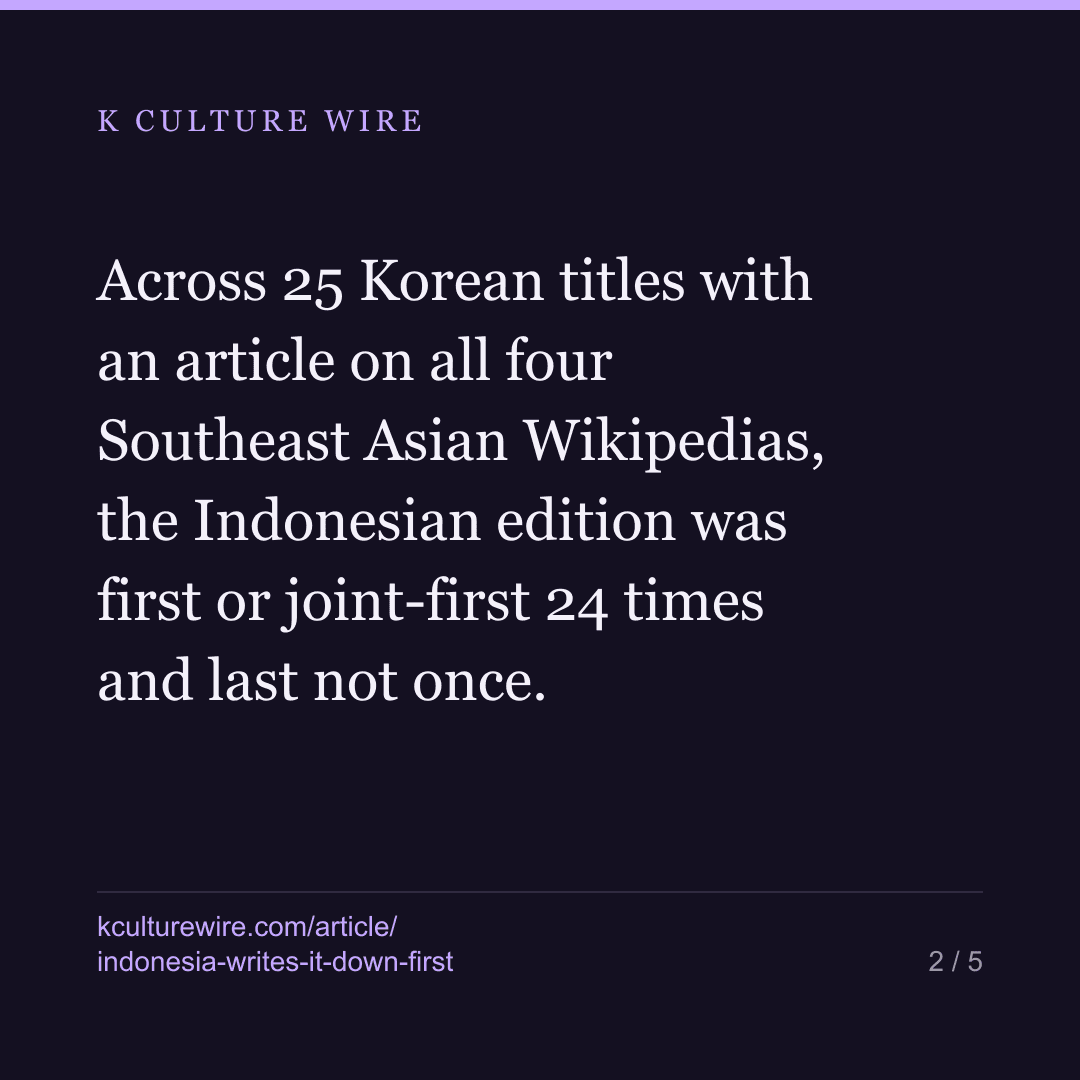
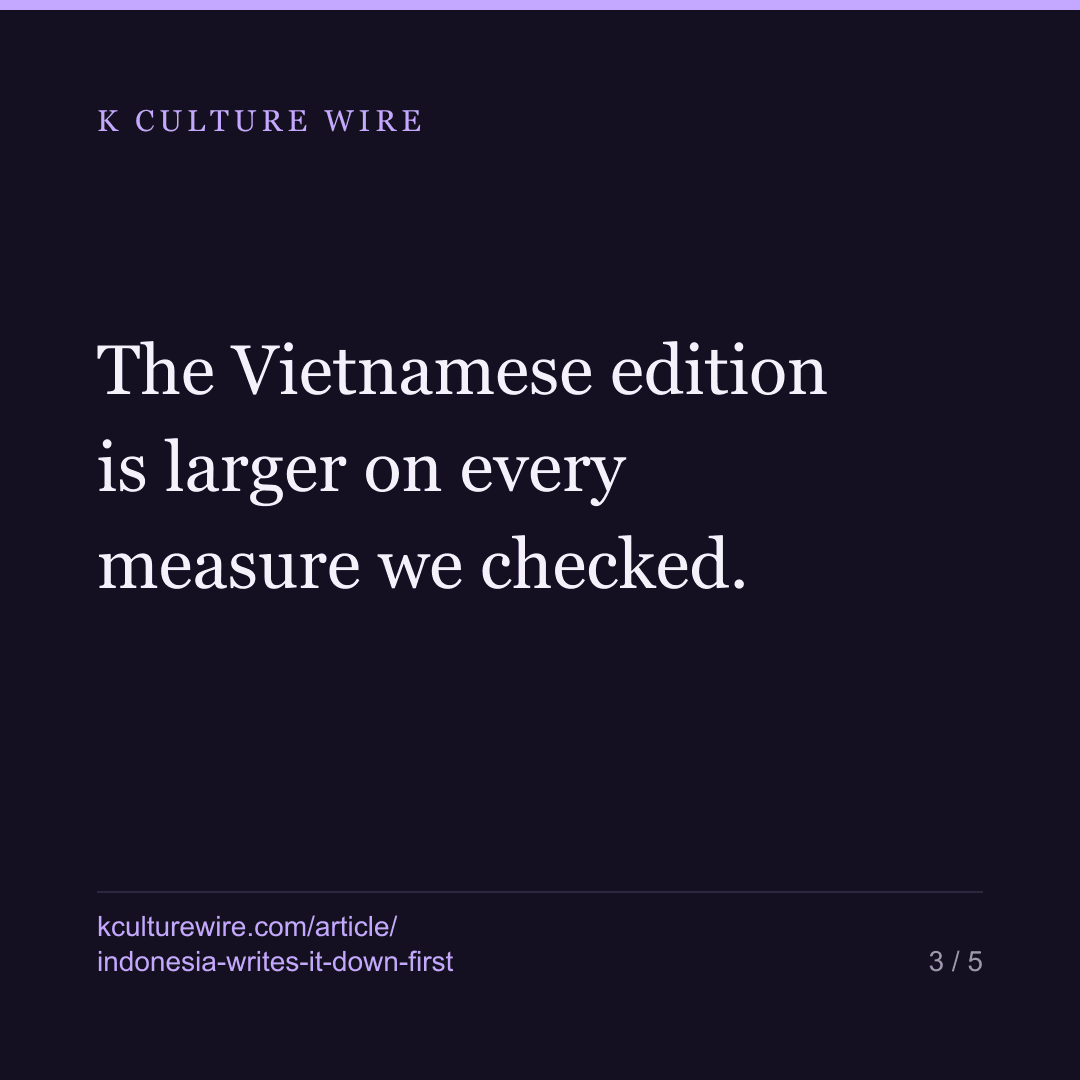
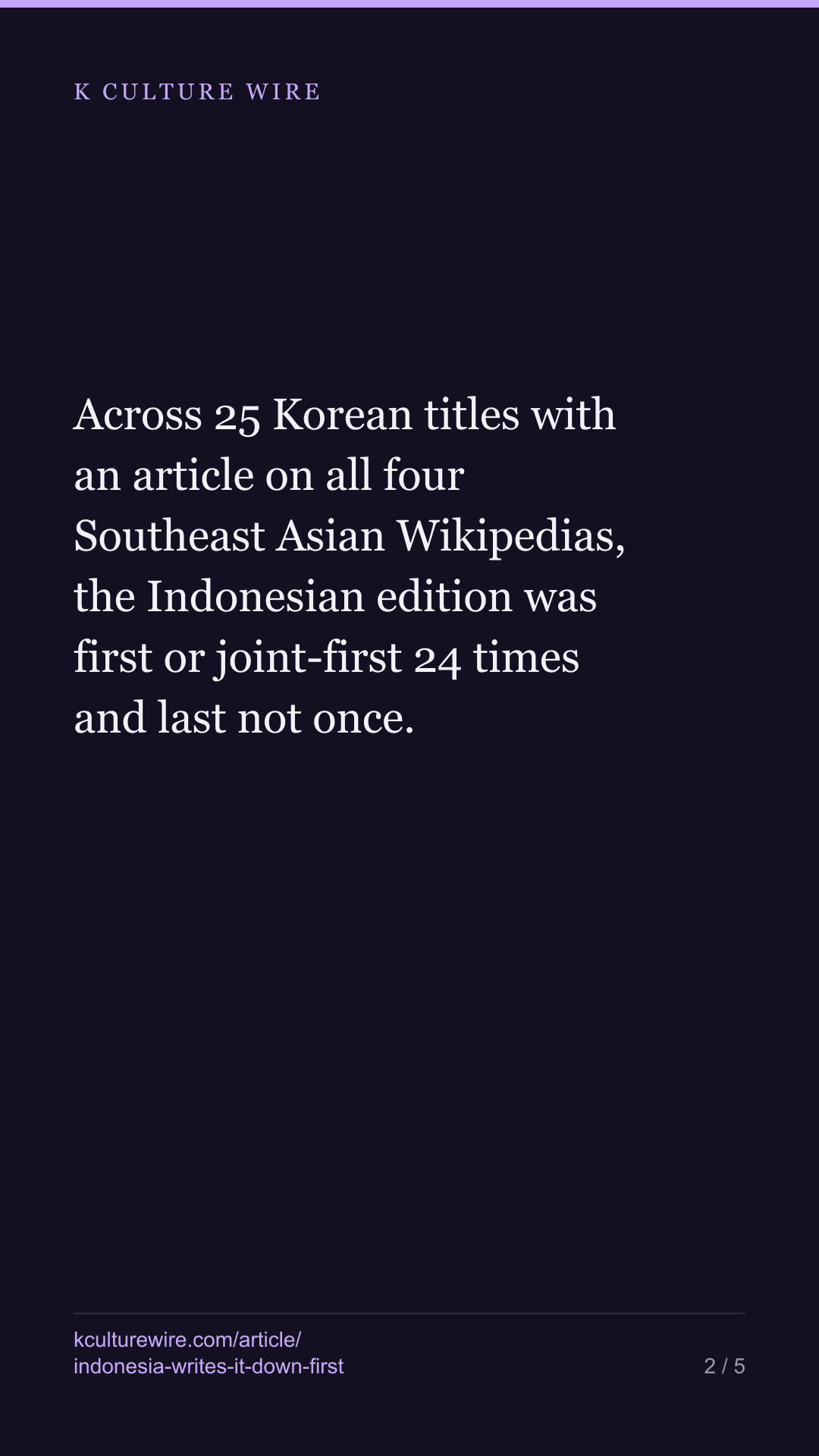
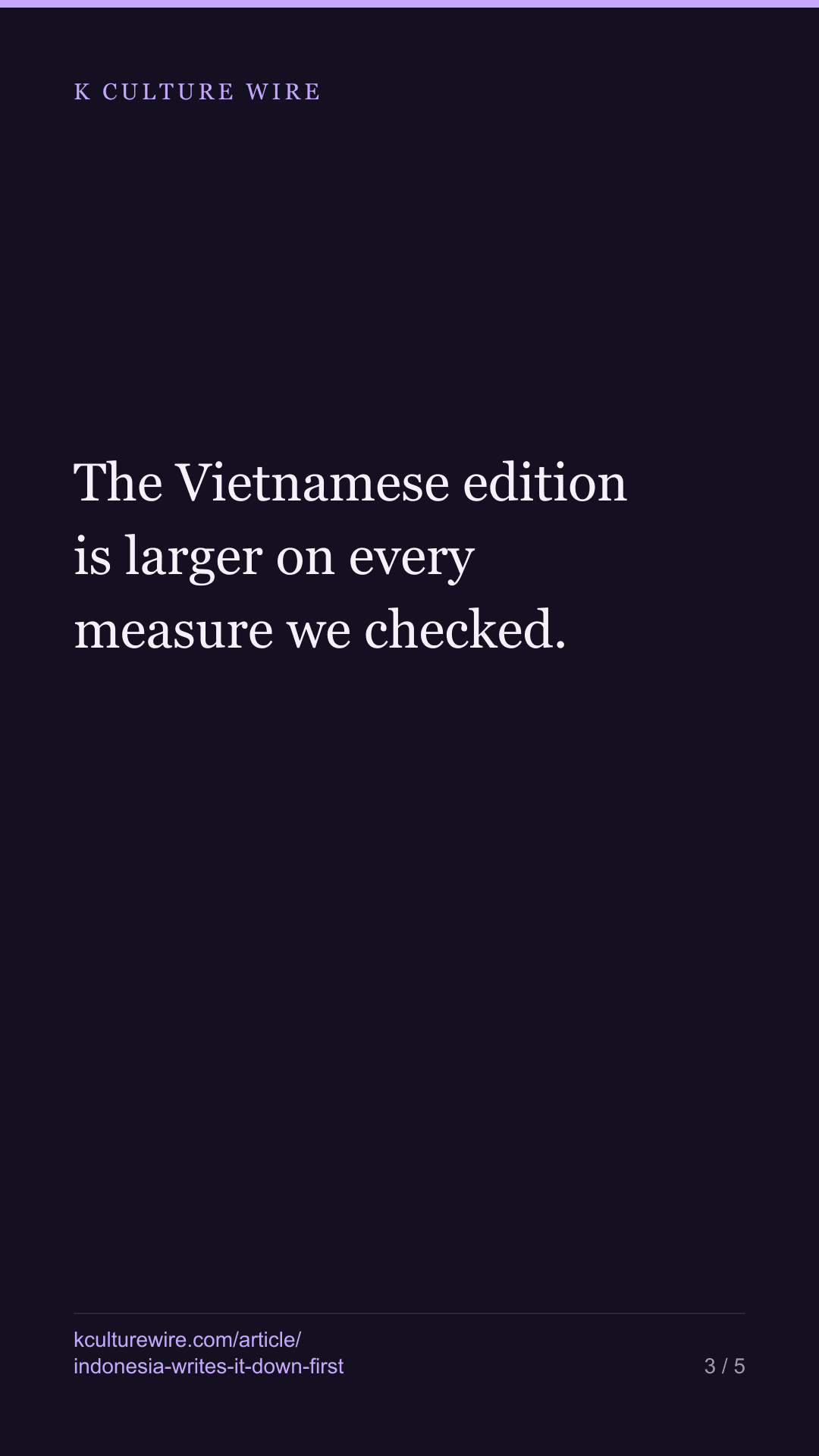
Across 25 Korean titles with an article on all four Southeast Asian Wikipedias, the Indonesian edition was first or joint-first 24 times and last not once. The Vietnamese edition is larger on every measure we checked.
The table this is written from: /written-down-first
A Korean drama is released. Four Southeast Asian Wikipedias will eventually carry an article about it. We wanted to know which one gets there first.
For 25 titles that have an article on all four, the answer is the same almost every time. The Indonesian Wikipedia wrote first, or tied for first, on 24 of them. It came last on none.
| Wikipedia | First or joint-first | Came last | Median place |
|---|---|---|---|
| Indonesian | 24 of 25 | 0 | 1st |
| Vietnamese | 8 of 25 | 1 | 2nd |
| Thai | 1 of 25 | 12 | 3rd |
| Malay | 1 of 25 | 12 | 3rd |
Seven of the 25 are ties, which is why the first column adds up to more than 25. The one title where the Indonesian edition was not first or joint-first is Reborn Rich, where the Vietnamese article came earlier.
The obvious explanation is wrong
A bigger encyclopaedia with more editors should cover anything sooner. That is the first thing to check, and it does not survive contact with the numbers.
| Wikipedia | Articles | Active editors | Total edits |
|---|---|---|---|
| Vietnamese | 1,304,001 | 4,726 | 75,384,273 |
| Indonesian | 790,784 | 4,690 | 29,552,153 |
| Malay | 440,840 | 2,018 | 6,913,168 |
| Thai | 186,434 | 2,963 | 13,172,524 |
The Vietnamese Wikipedia is the largest of the four on all three measures — it has two thirds again as many articles as the Indonesian one, and two and a half times as many edits. It writes about Korean titles first eight times out of 25.
We can rule that explanation out. We did not measure what replaces it, and we are not going to guess in print.
The order is not just about who is first
If only the first place were fixed and the rest were noise, the median place of the other three would be similar. They are not: Vietnamese sits second, Thai and Malay share third. Ten of the 25 titles arrive in the exact order Indonesia, Vietnam, Thailand, Malaysia; eight more swap only the last two.
The gap from the first edition to the last is a median of 8 months. It runs from 0 — Squid Game, which all four wrote up in September 2021 — to 83 months. That longest case is Signal: Indonesia wrote it up, Vietnam followed two months later, Malaysia nine months later, and Thailand nearly seven years after that.
| Title | Order of arrival | Spread |
|---|---|---|
| Signal | Indonesia · Vietnam +2 · Malaysia +9 · Thailand +83 | 83 months |
| Itaewon Class | Indonesia · Vietnam +4 · Malaysia +17 · Thailand +31 | 31 months |
| The King: Eternal Monarch | Indonesia · Vietnam +5 · Malaysia +8 · Thailand +31 | 31 months |
| Hotel del Luna | Indonesia · Vietnam +1 · Malaysia +4 · Thailand +29 | 29 months |
| Squid Game | Indonesia · Vietnam · Thailand · Malaysia | 0 months |
Remove any single title from the 25 and the median gap stays at 8 months. We check every median we publish that way now, after one of ours moved by most of its own size and had to be corrected twice in a day; the method is here.
We checked our own dates before we used them
This whole article rests on one number per article: the date of its first revision. That number is less solid than it looks.
A first-revision date says when an article has existed under its current name. Move an article or merge it into another and the earlier revisions travel with it, leaving behind a date that can be years too recent. Nothing in the data marks this. The date simply looks wrong and reads fine.
We found it by accident. The Korean Wikipedia’s article on Squid Game reports a first revision of January 2025, for a title from 2021.
The test turned out to be free. If we already know which months an article was read, and it was read before its own first revision, then the article existed earlier and the date has been erased. We ran that on every date we had: 153 dates could be tested, and none of them failed. A further 83 could not be tested at all, because those articles have no month with any reading in our data.
The Korean Wikipedia is not in this article, and that is why. Its dates fail the one case we can see, and we hold no Korean pageview data to check the rest against. An edition we cannot test is not an edition we will publish.
What this does not tell you
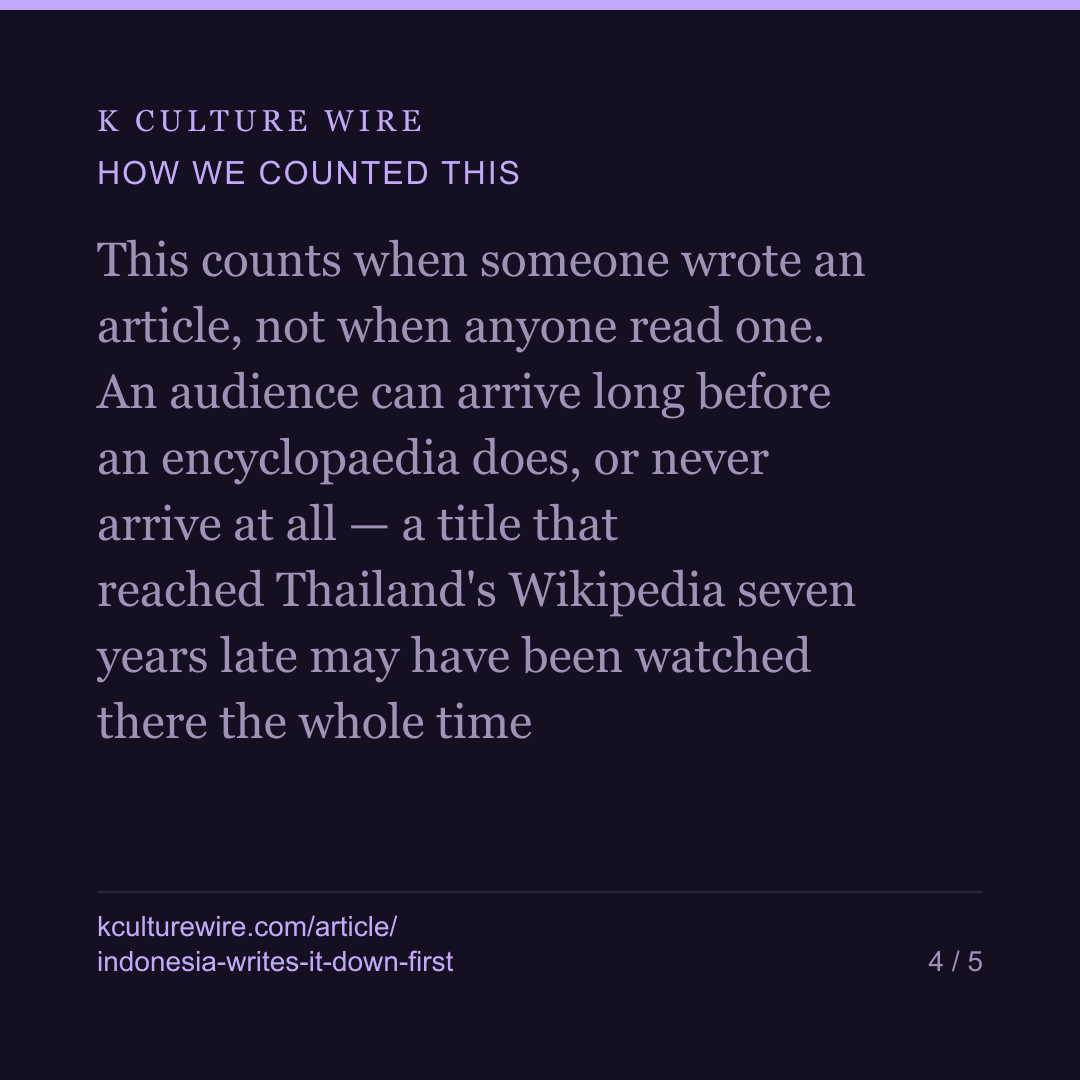
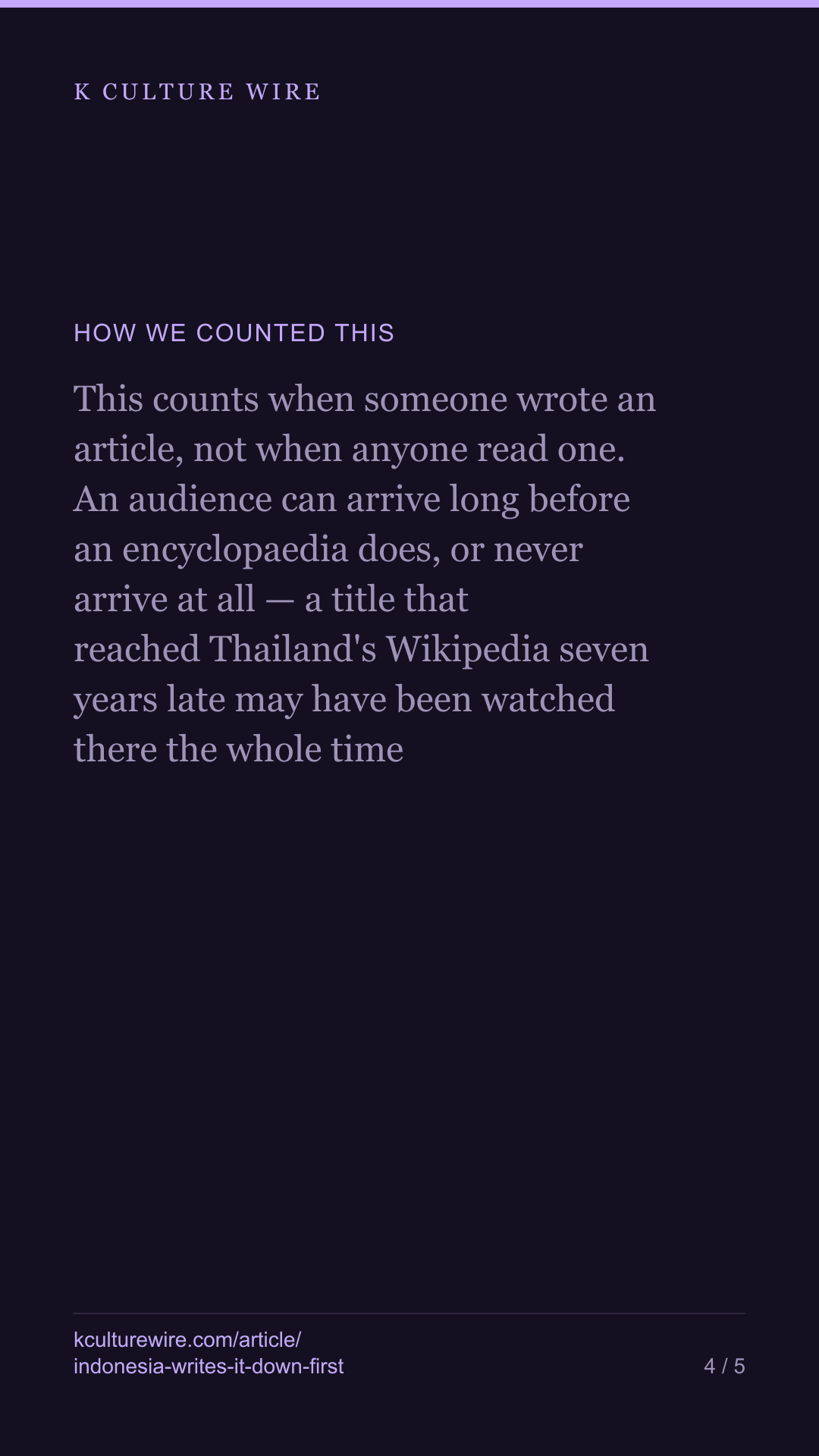
This counts when someone wrote an article, not when anyone read one. An audience can arrive long before an encyclopaedia does, or never arrive at all. A title that reached Thailand’s Wikipedia seven years late may have been watched there the whole time.
It also covers 25 titles, not 59. A title with no article on one of the four editions is left out completely rather than counted as arriving late — counting it would make an edition look slow for a title it never covered at all.
And it says nothing about why. We know the order is not explained by how big the encyclopaedia is. That is one explanation removed, not an explanation found.
Where these numbers come from
Sources
- Wikipedia — action=query&prop=revisions&rvdir=newer — the first revision of each article · https://www.mediawiki.org/wiki/API:Revisions
- Wikimedia — Pageviews API, human traffic only, monthly — used to test each first-revision date · https://wikimedia.org/api/rest_v1/
- Wikimedia — meta=siteinfo&siprop=statistics — articles, active editors and total edits per edition · https://www.mediawiki.org/wiki/API:Siteinfo
What we checked
- This counts when someone wrote an article, not when anyone read one. An audience can arrive long before an encyclopaedia does, or never arrive at all — a title that reached Thailand's Wikipedia seven years late may have been watched there the whole time
- It covers 25 titles, not 59. A title with no article on one of the four editions is left out completely rather than counted as arriving late, because counting it would make an edition look slow for a title it never covered at all
- It says nothing about why. We know the order is not explained by how big the encyclopaedia is. That is one explanation removed, not an explanation found
The data behind this
Written from the same data
Take this away — 10 cards
The figures in this article, as images. Free to repost with the address on them.

If you work in this business
Everything on this page is measured from the same weekly Netflix lists, per market and per title. We publish the pages free; what we sell is the same measurement cut to one company's catalogue — including the figures behind /written-down-first.
What a company sheet contains, and what it cannot tell you →