A Korean title’s run at home leans the odds, not the gate
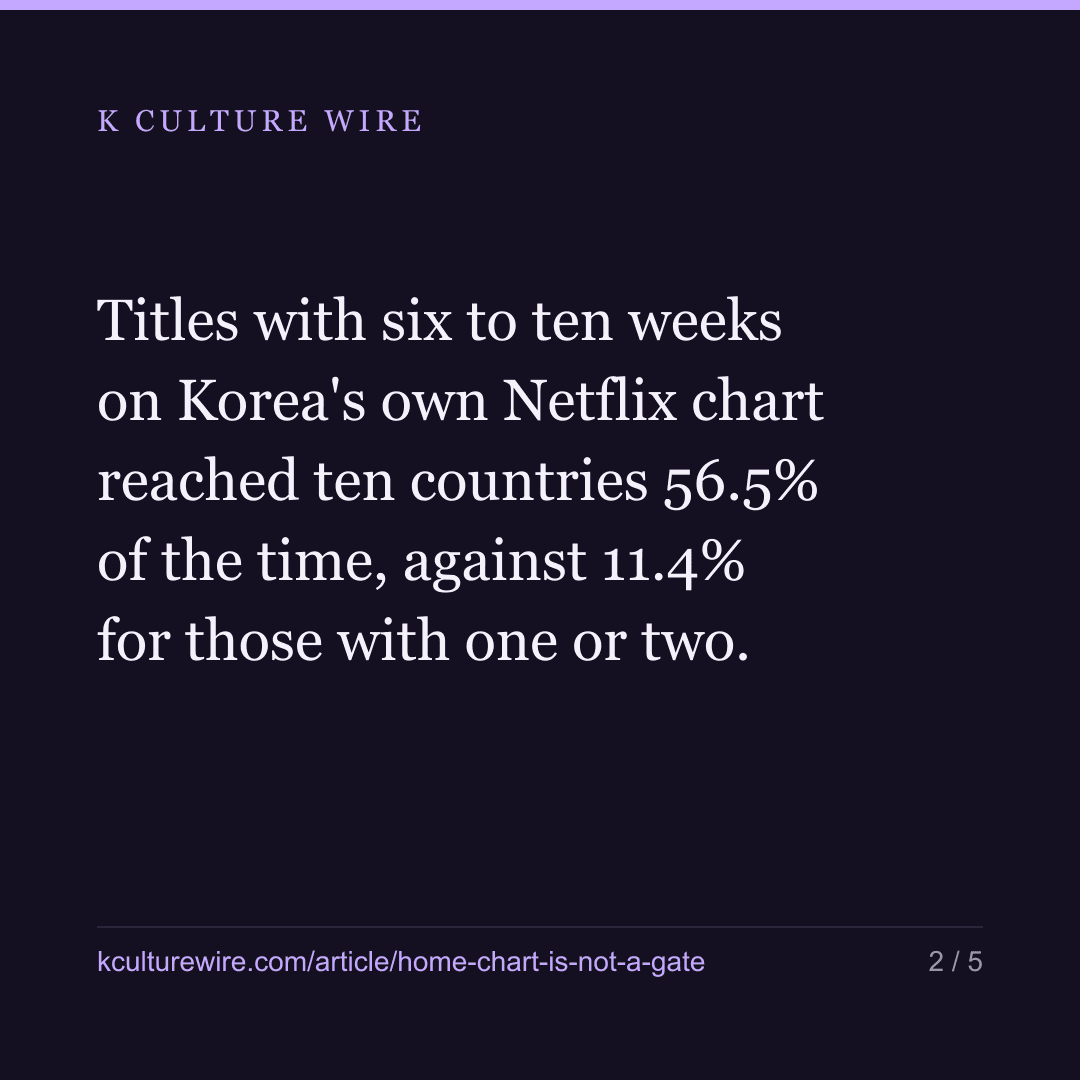
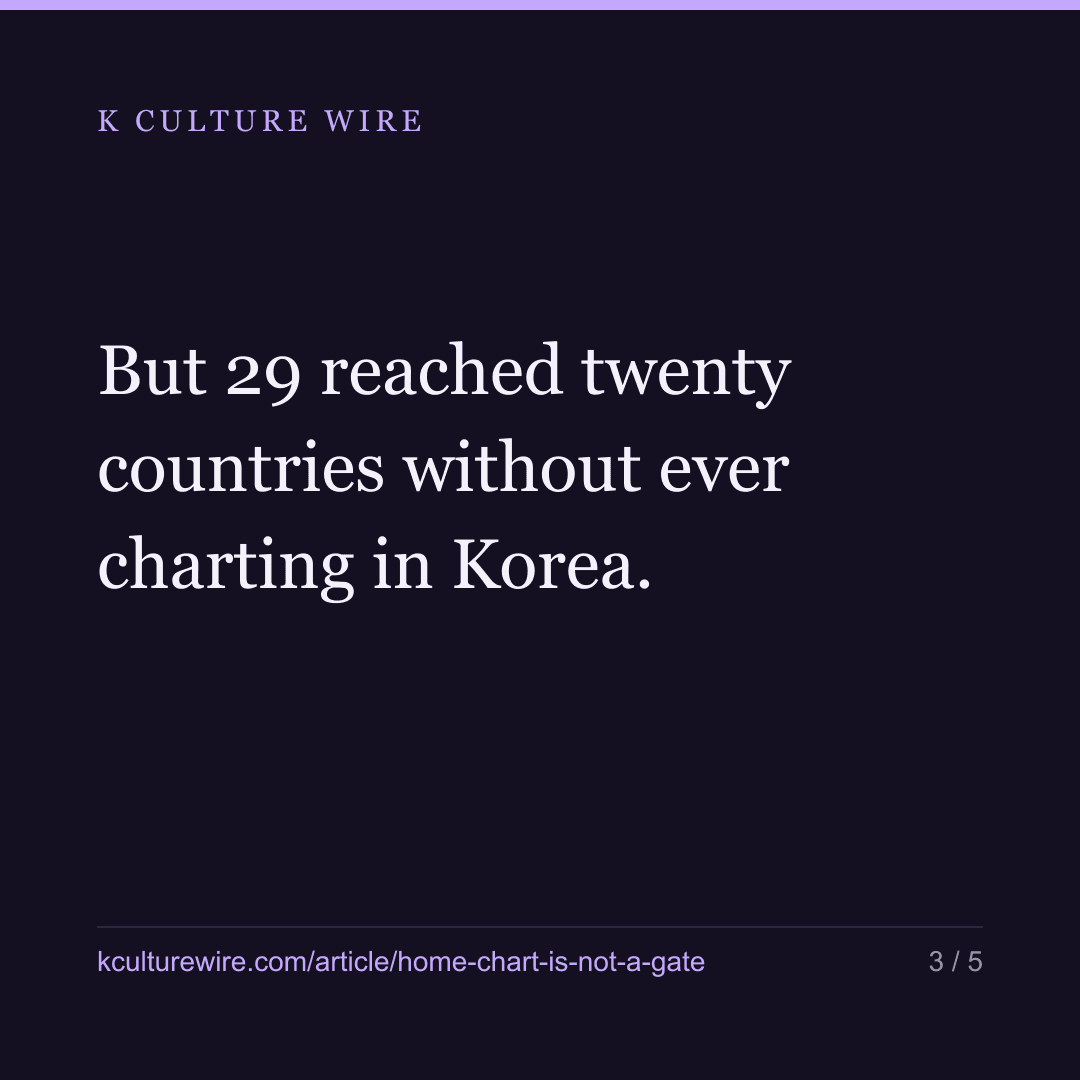
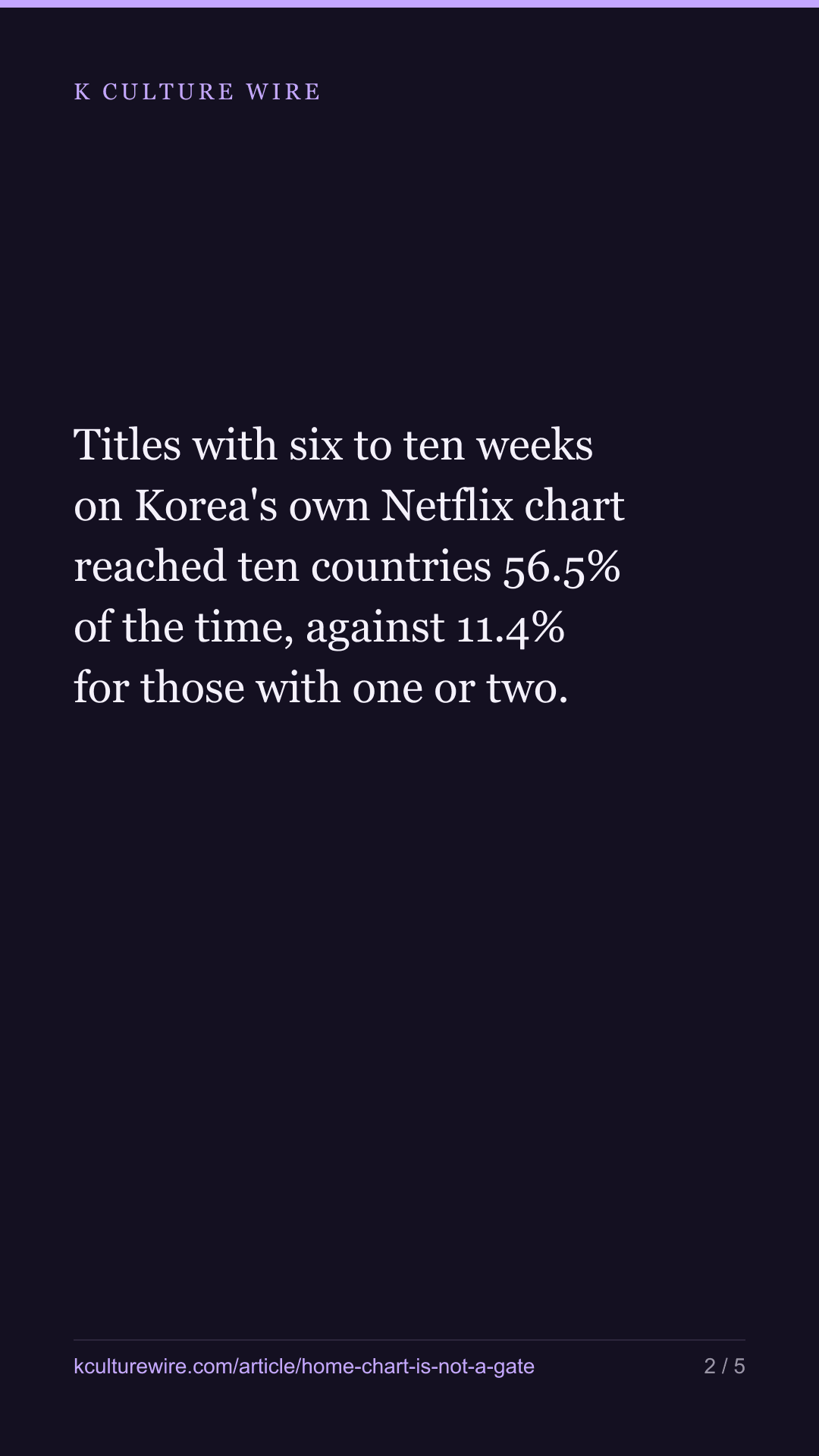
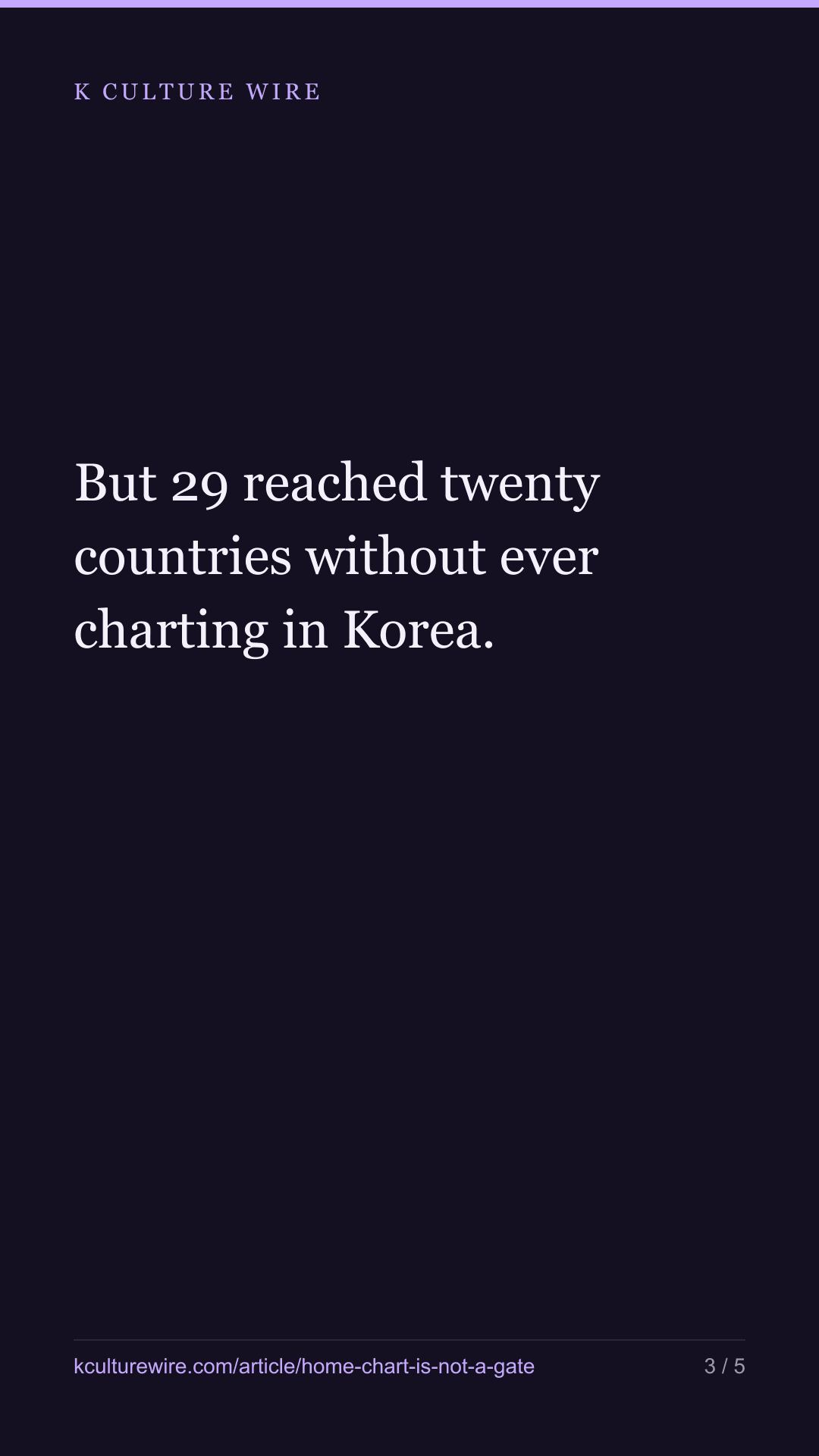
Titles with six to ten weeks on Korea's own Netflix chart reached ten countries 56.5% of the time, against 11.4% for those with one or two. But 29 reached twenty countries without ever charting in Korea.
The table this is written from: /home-abroad
Anyone selling a Korean show abroad has heard the same shorthand: it did well at home, so it will travel. Anyone buying has heard it too. It is a testable claim, and Netflix publishes enough to test it — a weekly top 10 for 93 markets, including Korea’s own.
We took the 973 Korean titles that appear on any of those lists between 2021-07-04 and 2026-08-16, counted how many places each took on Korea’s chart, and asked how far it went afterwards.
The home run does lean the odds
| Weeks on Korea’s chart | Titles | Reached 10+ countries | Never left Korea |
|---|---|---|---|
| 1–2 | 233 | 10.7% | 67.8% |
| 3–5 | 173 | 24.9% | 45.7% |
| 6–10 | 147 | 55.8% | 19.0% |
| 11 or more | 39 | 64.1% | 23.1% |
A title with one or two weeks at home reached ten countries about one time in nine. A title with six to ten weeks did it more than half the time. That is a real difference and it is worth knowing.
It is a slope, not a door
The first version of this piece said threshold. It was wrong, and the way it was wrong is worth showing, because it is the most common way a table like this gets misread.
The median number of foreign countries per title goes 1 → 19 between the 3–5 band and the 6–10 band. That looks like a door swinging open at six weeks. But the median only records where the middle title sits; when a group crosses from “most titles go nowhere” to “most titles go somewhere”, the median leaps while the underlying distribution barely changes pace. The share reaching ten countries tells the honest version: 10.7% → 24.9% → 55.8% → 64.1%. Nothing snaps. It leans.
And format leans harder
Series stay on charts longer than films nearly everywhere, so a band cut on run length might be sorting formats under another name. We split every band rather than argue about it.
| Weeks on Korea’s chart | Films | Reached 10+ | Series | Reached 10+ |
|---|---|---|---|---|
| 1–2 | 174 | 6.3% | 59 | 23.7% |
| 3–5 | 107 | 9.3% | 66 | 50.0% |
| 6–10 | 42 | 38.1% | 105 | 62.9% |
| 11 or more | 10 | 40.0% | 29 | 72.4% |
Both effects are real, and the format effect is the bigger one. In the 3–5 band a series reached ten countries 52.3% of the time against 8.0% for a film — a wider gap than the entire home-chart range for films. A film that ran six weeks in Korea travelled less often than a series that ran three. If you are going to read one column, read the format.
We also checked whether long home runs simply belong to older titles, which would make this a story about the calendar. They do not: the median first week is 2023-07-09 for the 1–2 band, 2023-12-10 for 3–5 and 2024-03-17 for 6–10. The band that travels most is the newest of the three.
The home chart is not a gate
29 titles reached twenty or more countries without ever appearing on Korea’s own top 10.
| Title | Countries | Chart places abroad | Format |
|---|---|---|---|
| Oasis | 82 | 253 | Series |
| Young Lady and Gentleman | 54 | 351 | Series |
| Outlaw | 53 | 80 | Film |
| That Night | 50 | 115 | Series |
| Happy Ending | 47 | 60 | Film |
These are not marginal abroad. Oasis held a top 10 place in 82 different countries. It is simply absent from the list at home — which is a fact about Korea’s chart, not about the title. Korea’s own top 10 is crowded with titles that never leave, and a show can be squeezed out of it while doing perfectly well elsewhere.
The comparison we did not make
Of the 973 titles, 592 charted in Korea and 381 never did. The obvious move is to put those two groups side by side and report which travels further. We did not, and the reason is worth stating rather than burying: the 381 are in our data only by virtue of having charted somewhere abroad. A title that charted in neither place is invisible to us entirely. Comparing the two groups would answer a question we had already decided by the way we built the list.
So the bands above are cut inside the 560 that did chart at home, where the comparison is honest, and the 384 appear only in the section above — as named cases, not as an average.
What a seller can take from this
The home run is a prior, not a filter. Six weeks at home roughly quintuples the odds of reaching ten countries against one or two weeks — but a fifth of the titles in that band still never leave, and thirty titles cleared twenty countries with no home run at all. Any process that uses the domestic chart as a gate is discarding titles that travel.
Every figure here is on the table behind this piece, band by band, with the films and series columns left in: the home-and-abroad table. The per-market picture — how much of each country’s chart Korean titles take, and how many different titles that is — sits at catalogue depth, where every one of the 93 markets now has its own page.
What this does not say: that these titles are good, or that anyone watched them. A top 10 is a rank list. It records what held a place against the other titles in that country that week, and nothing else.
What changed on 3 September 2026
Two of the five titles in the table above should not have been there.
Dangerous Liaisons is not a Korean title — it is the 2022 French film. Neither is Breathless, a Spanish series. We took both out of our Korean list on 25 August, and said so in the pieces we corrected at the time. This table kept them for nine more days.
That is the part worth naming. Removing a wrong row from the data is not the end of the work: the row had already been copied into an article, and the article does not update itself. Both titles were standing here as examples of Korean titles that travel abroad without charting at home, which is the one thing this article is about — so they were the worst two rows in it to have wrong.
| Was | Now | |
|---|---|---|
| Korean titles read | 976 | 973 |
| Charted in Korea (unchanged) | 592 | 592 |
| Never charted in Korea | 384 | 381 |
| Reached 20+ countries without charting at home | 32 | 29 |
The two rows are replaced by the next two the data holds — That Night (50 countries, 115 chart places) and Happy Ending (47 and 60). A check now compares every figure in this piece against the counted data on each build, so a row that drifts from it turns the build red. The finding does not depend on which titles fill the table: 29 titles still reach twenty or more countries without ever appearing on Korea’s own top 10.
Where these numbers come from
Sources
- Netflix — Tudum weekly Top 10 country lists, 2021-07-04 to 2026-07-26 — 265 weeks across 93 markets · https://www.netflix.com/tudum/top10
- Wikidata — Country of origin (P495 = Q884) and item numbers, used to decide which chart titles are Korean · https://query.wikidata.org
What we checked
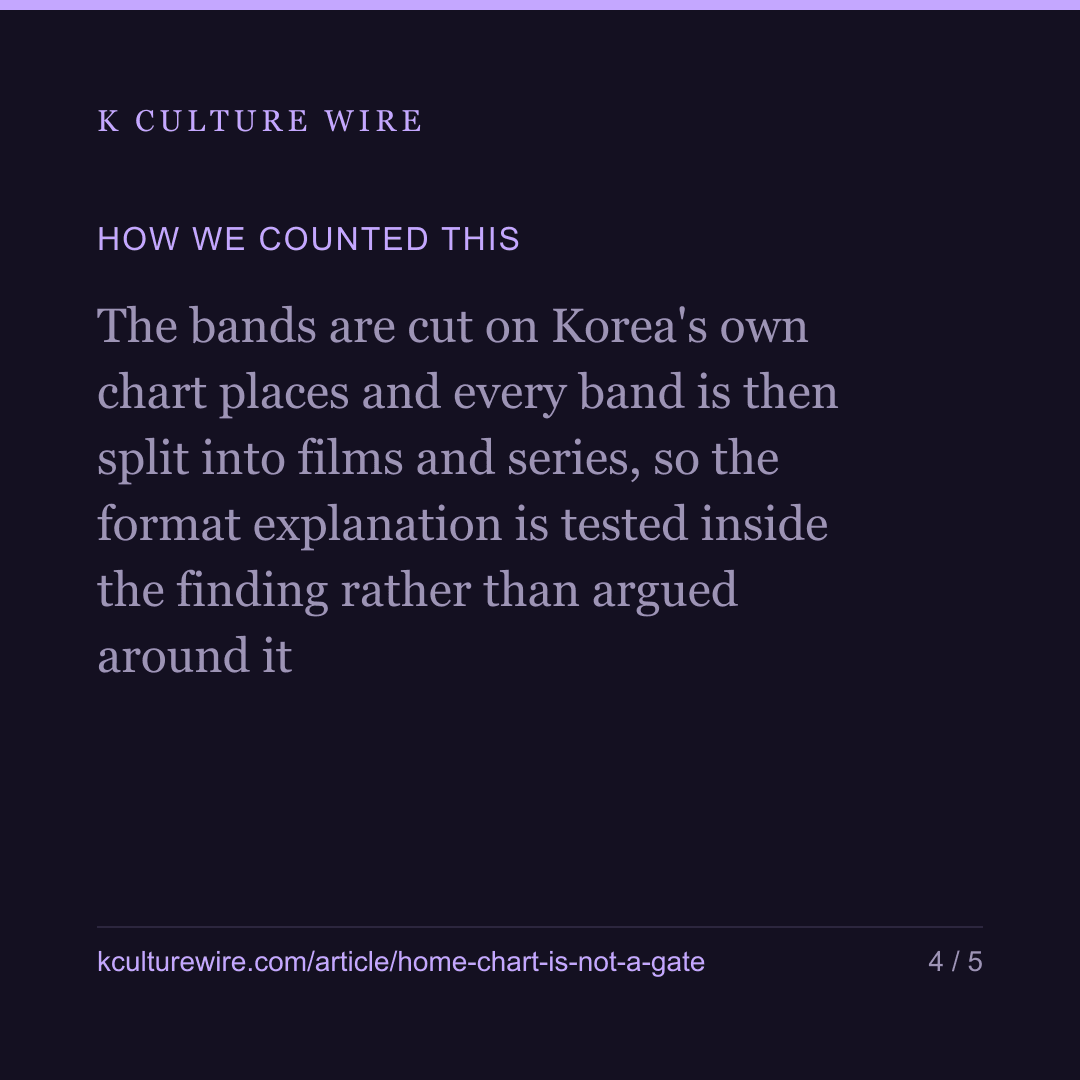
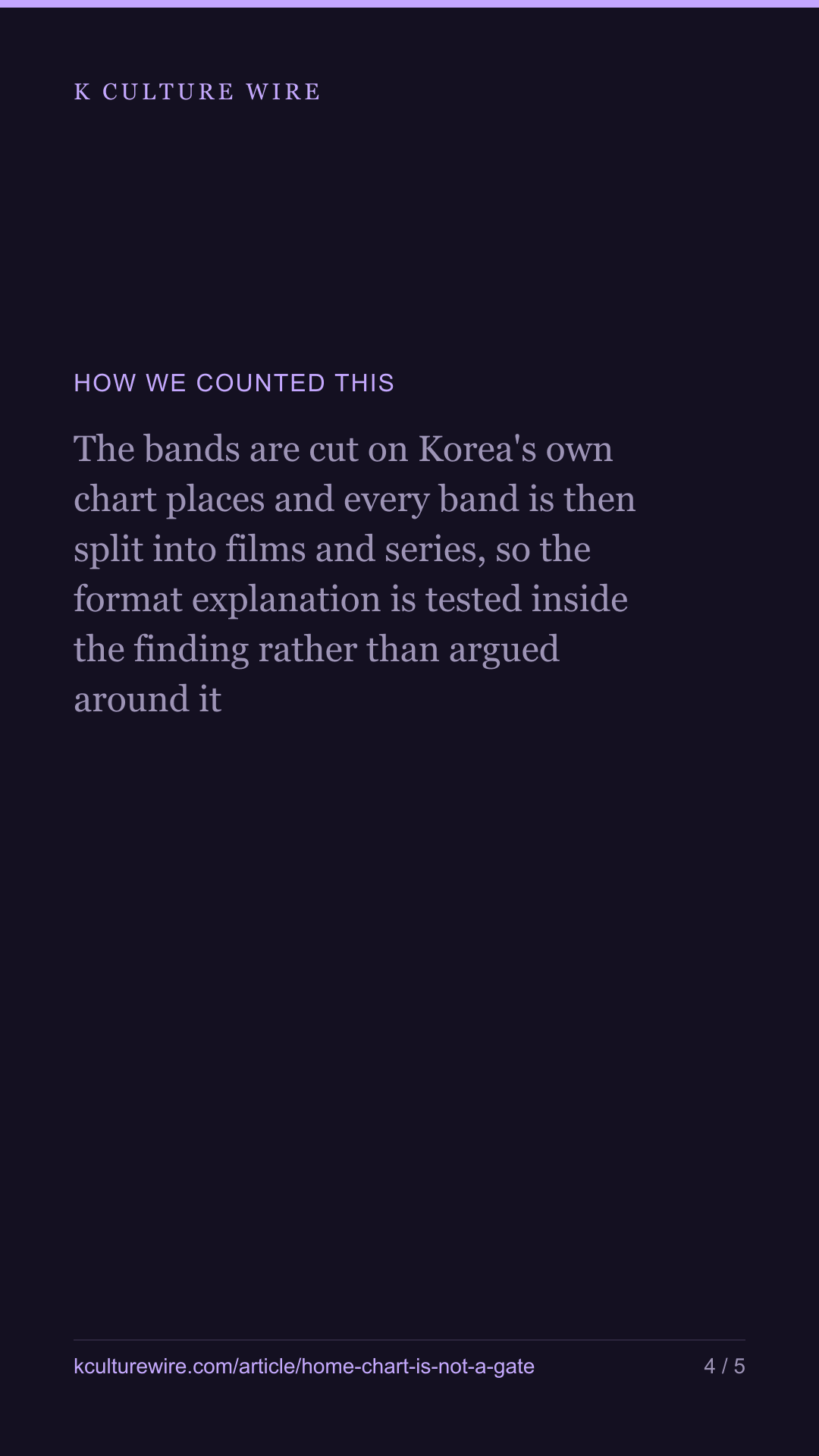
- The bands are cut on Korea's own chart places and every band is then split into films and series, so the format explanation is tested inside the finding rather than argued around it
- The collector refuses to write its file unless the middle band falls between the first and third — the claim is a slope, and a slope that stops being ordered is not a slope
- Titles that never charted in Korea are reported separately and never averaged against titles that did, because that group exists only by virtue of having charted abroad
- First-week medians are reported per band to test whether long home runs simply belong to older titles; they do not — the 6-10 band is the most recent of the four
What we left out, and why
- Viewing. A top 10 is a rank list. A title outside it is invisible here at any level of watching, and nothing in this piece measures hours
- Cause. A title can hold a chart place because people keep starting it or because nothing displaced it, and we cannot separate those
- The word threshold. The median country count jumps from 1 to 19 between two bands, but that is the median crossing the middle of a distribution — the share reaching ten countries moves 11.4 to 25.5 to 56.5, which is a slope
- Russia, whose list Netflix stopped publishing in February 2022
- Consecutive weeks. A title with six home places may have taken them across two separate runs; we counted places, not streaks
The data behind this
Written from the same data
Take this away — 10 cards
The figures in this article, as images. Free to repost with the address on them.
If you work in this business
Everything on this page is measured from the same weekly Netflix lists, per market and per title. We publish the pages free; what we sell is the same measurement cut to one company's catalogue — including the figures behind /home-abroad.
What a company sheet contains, and what it cannot tell you →