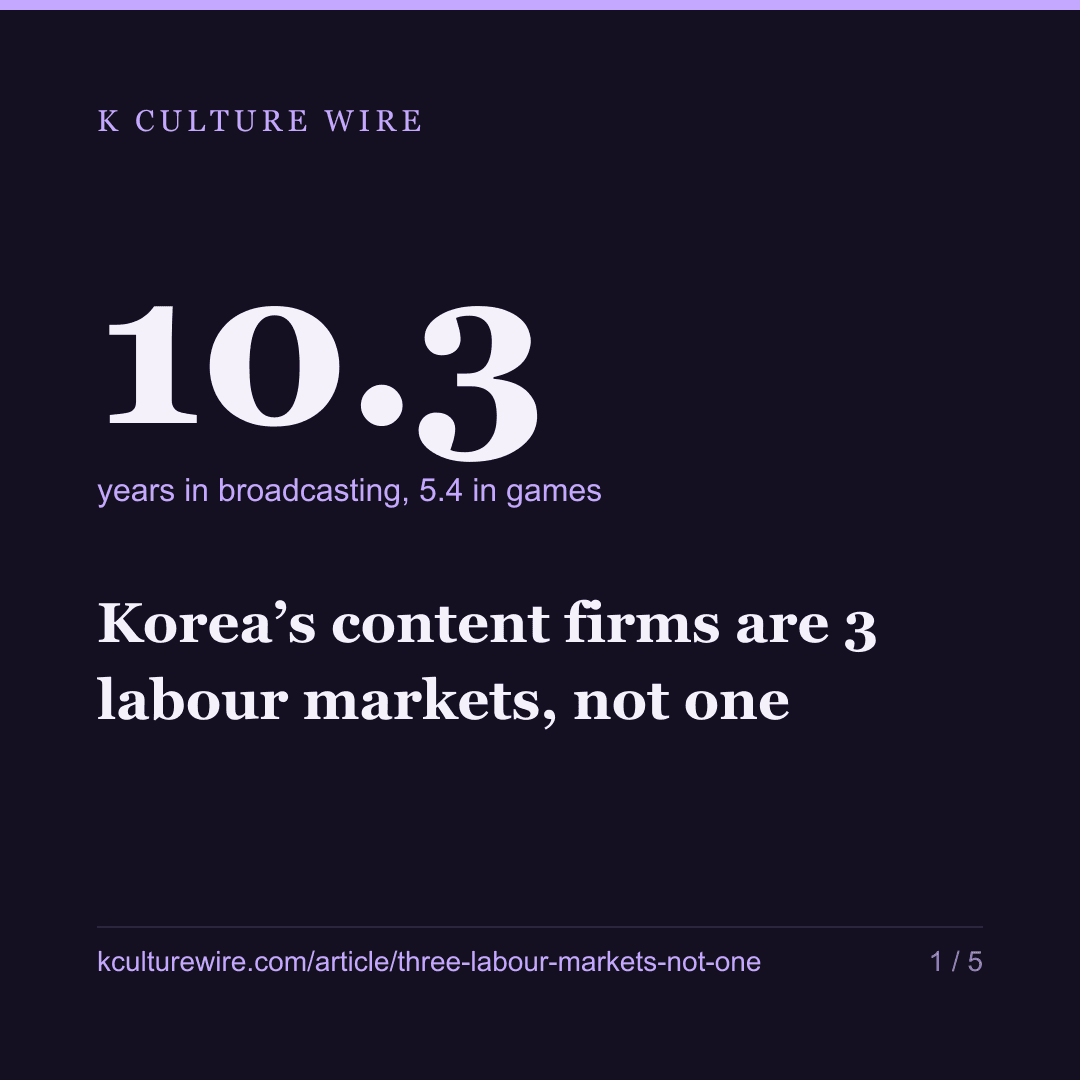
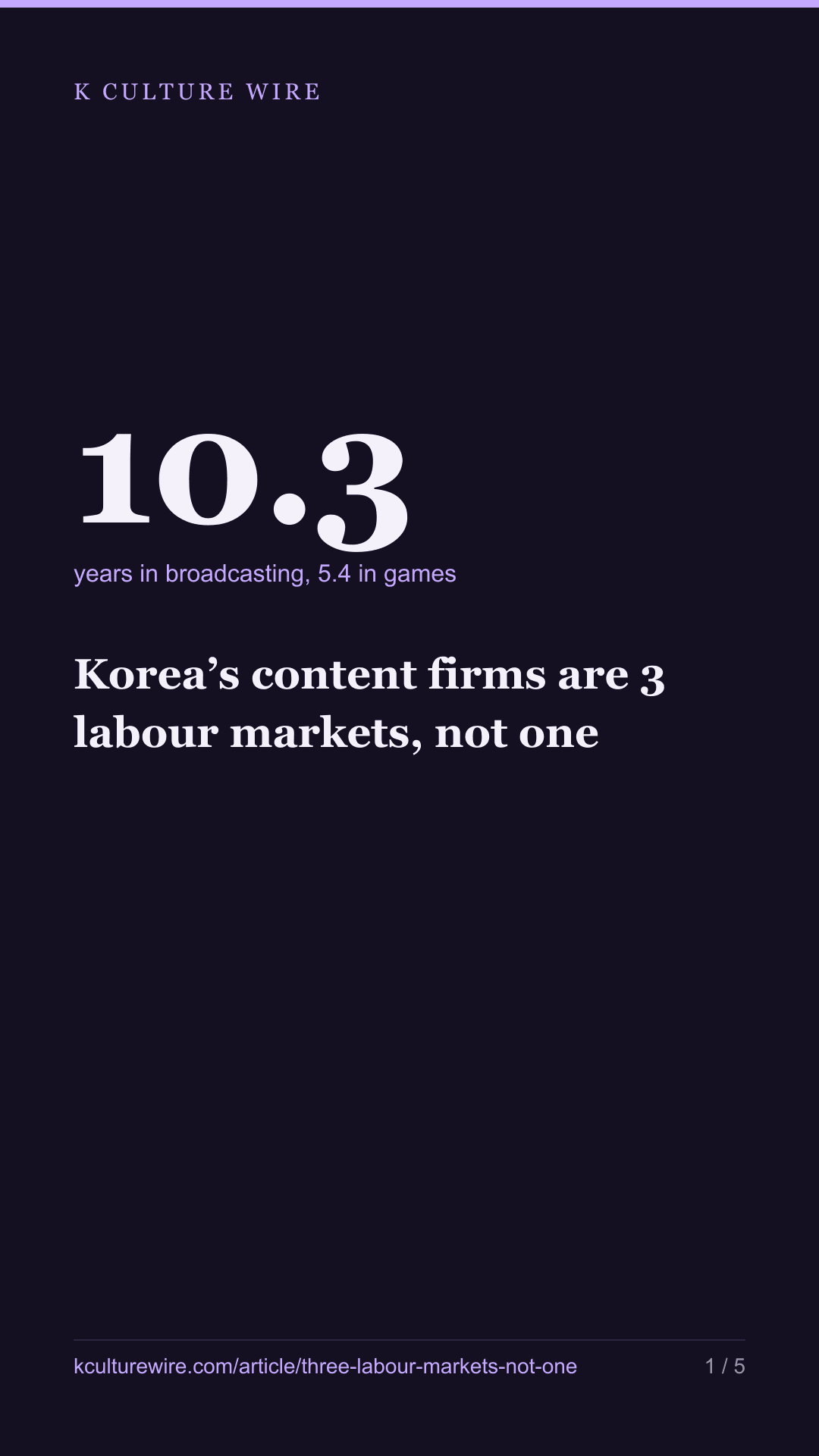
Korea’s content firms are 3 labour markets, not one
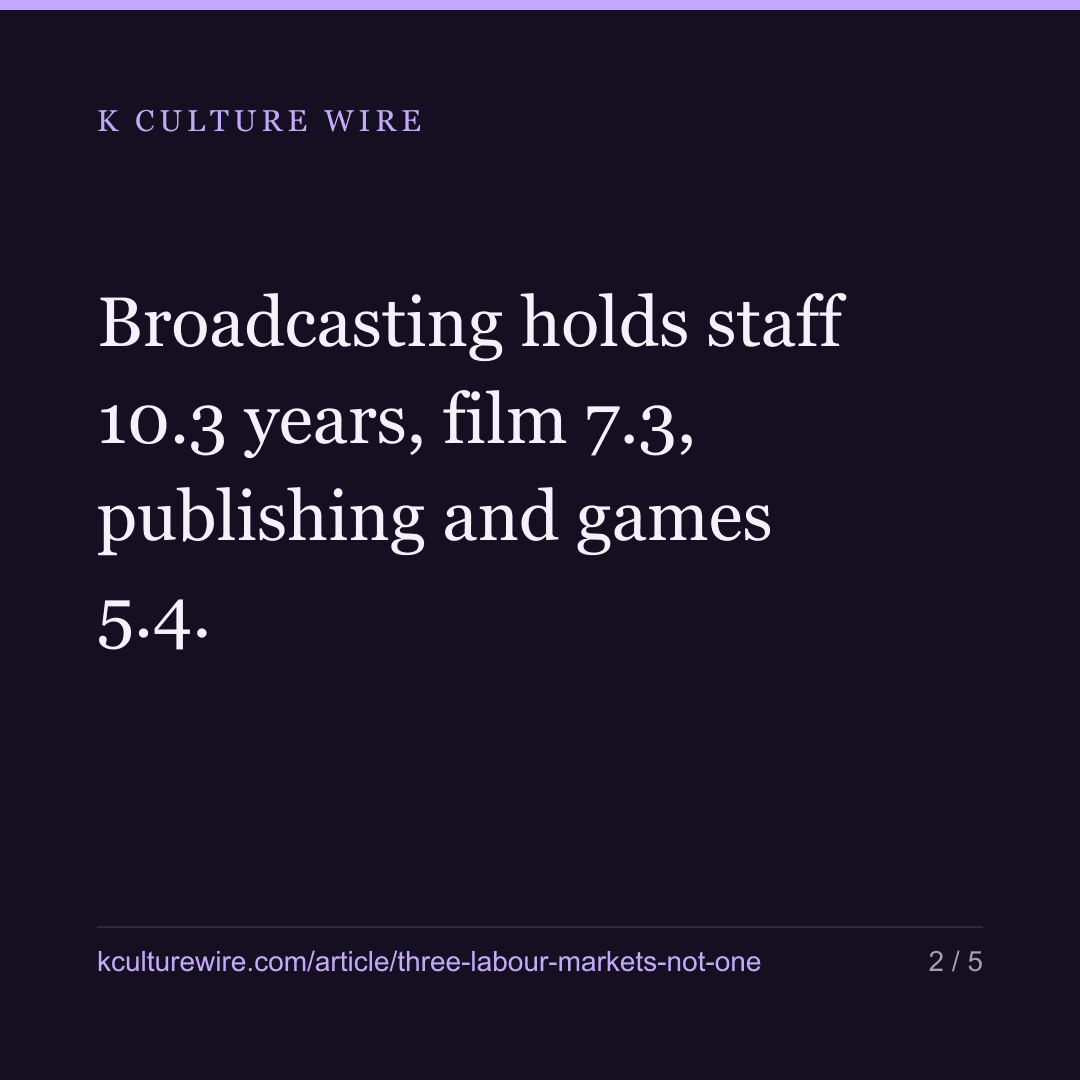
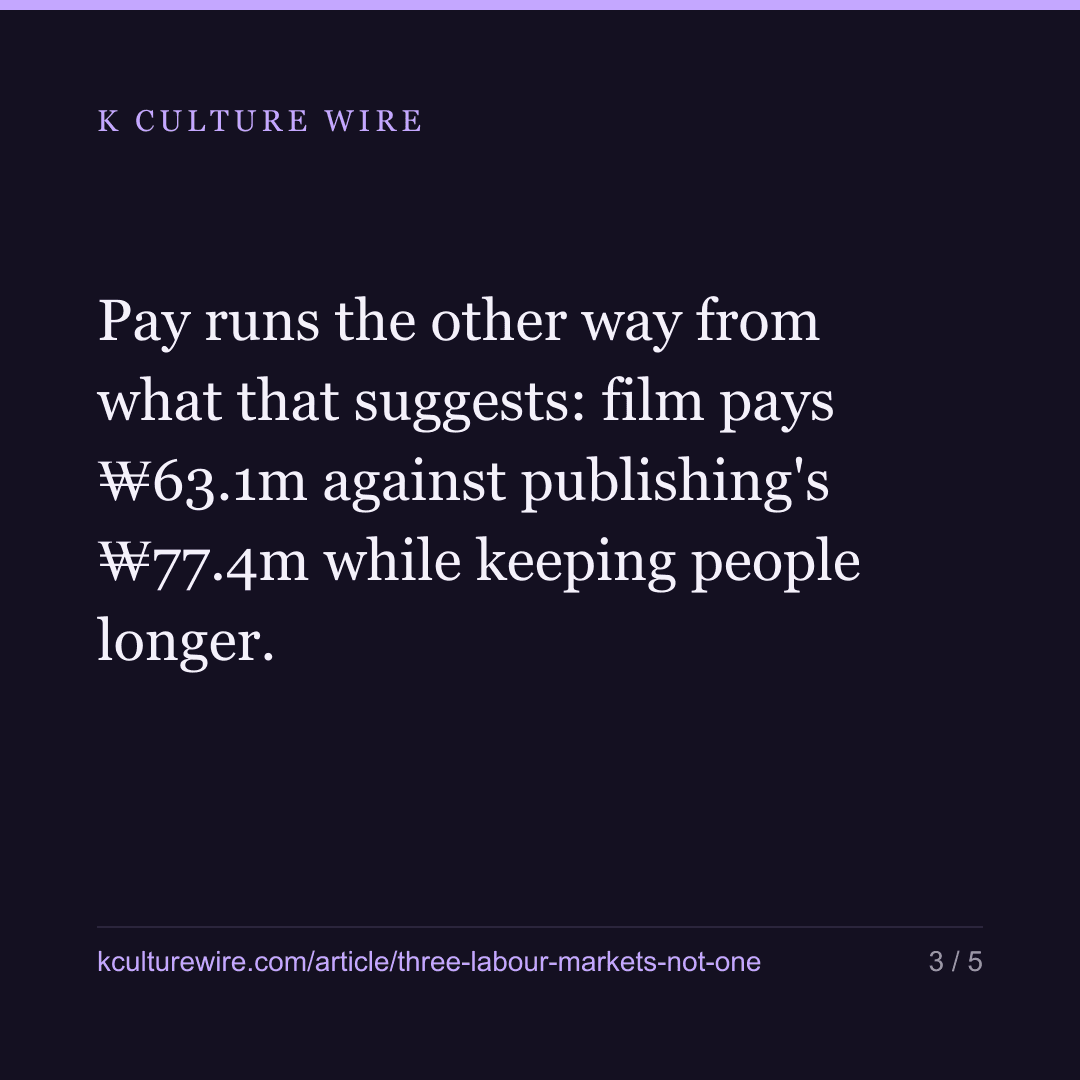
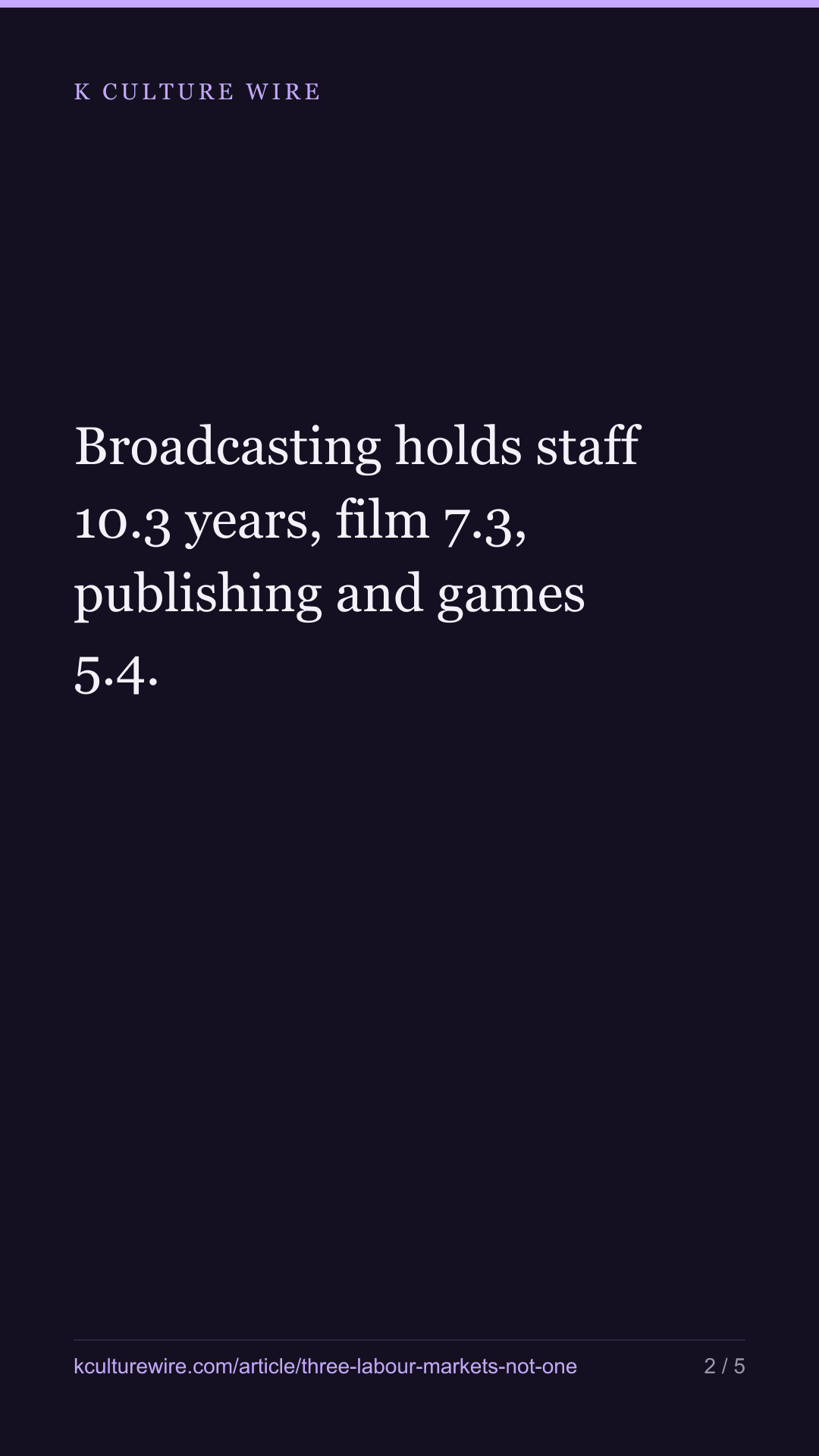
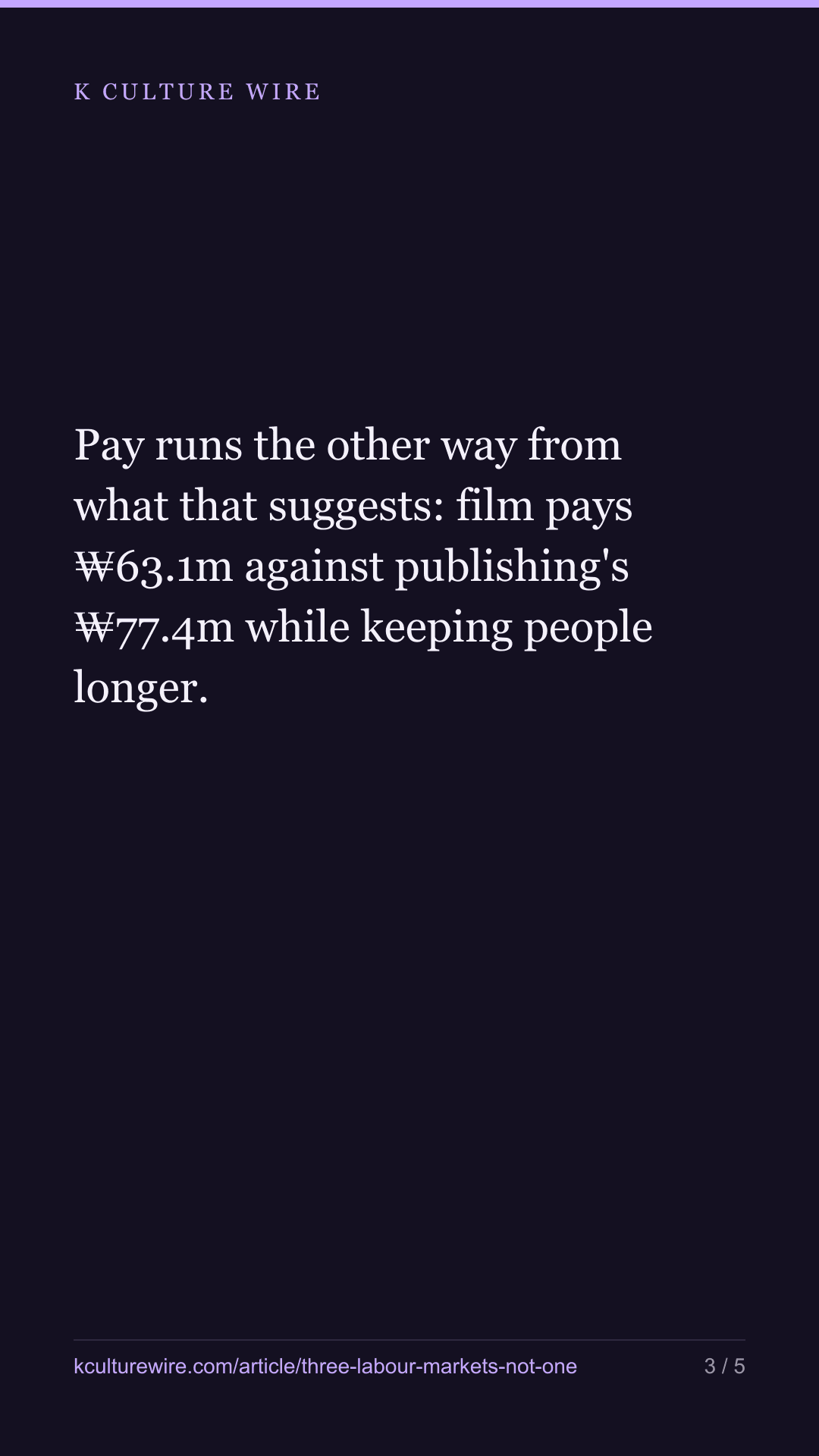
Broadcasting holds staff 10.3 years, film 7.3, publishing and games 5.4. Pay runs the other way from what that suggests: film pays ₩63.1m against publishing's ₩77.4m while keeping people longer.
The table this is written from: /industry
Korea’s listed content companies are usually discussed as one sector. Their own filings say otherwise. Split the 248 of them by the industry code each company reports for itself, and three workforces appear that have almost nothing in common.
| Companies | Staff | Median tenure | Pay | Women | Company age | |
|---|---|---|---|---|---|---|
| Broadcasting | 12 | 6,393 | 10.3 yrs | ₩87.0m | 47.5% | 31.5 yrs |
| Film, video and audio | 40 | 10,540 | 7.3 | ₩63.1m | 56.9% | 25.7 |
| Publishing (includes games) | 196 | 51,876 | 5.4 | ₩77.4m | 34.1% | 22.5 |
| All 248 together | 248 | 68,809 | 6.2 | ₩76.1m | 38.8% | 23.9 |
| Whole listed market | 2,779 | 1,865,198 | 11.3 | ₩95.1m | 28.0% | 43.5 |
Broadcasting keeps people almost twice as long as publishing and games, and it is the only one of the three that comes near the wider market’s 11.3 years.
Pay does not follow tenure here
The obvious story would be that the industry with the longest tenure pays best and the shortest pays worst. It is not what the filings show.
Film has the second-longest tenure and the lowest pay — ₩63.1m against publishing’s ₩77.4m, while keeping staff two years longer. Whatever holds people in film production, it is not the salary line, and whatever moves people out of games, it is not a pay gap in the other direction.
All three sit below the listed-market average of ₩95.1m. The content sector does not pay a premium in either direction; it pays less than the market across all three of its parts.
The confound we are not hiding
Look at the last column. These companies are young. Publishing averages 22.5 years of corporate existence against the market’s 43.5, and a company that has existed for 22 years cannot produce a 30-year employee.
So part of the tenure gap is arithmetic, not behaviour. We tested how much across the fourteen largest entertainment and game firms in an earlier piece and found tenure and company age correlate at only 0.30 — enough to matter, not enough to explain the gap. We report age beside tenure rather than adjusting for it, because an adjustment would hide exactly how much of the difference is structural.
The women’s column is the sharpest split
Film is 56.9% women. Publishing and games is 34.1%. That is a 22.8-point gap inside one sector, and both ends sit above the listed market’s 28.0%.
It is also the one figure here that cannot be explained by company age or firm size, and we do not have anything in these filings that explains it. It is stated because it is large, not because we can account for it.
What this is not
These are 248 listed companies. Most Korean content production is private — the studios behind much of what reaches a Netflix Top 10 file nothing here at all. Tenure is what the filing says, not a measure of whether people want to stay. And “publishing” is a filing category: Korean game companies report under it, which is why the largest group by staff is named for a form and not for a medium.
Three markets by tenure and pay. By gender the split inside the sector is larger still. Read the 22.8-point gap inside one industry →
Where these numbers come from
Sources
- Financial Supervisory Service (Korea), DART — Annual report employee disclosures (직원 등의 현황), filing year 2025, for every listed company that reports both headcount and tenure · https://dart.fss.or.kr
What we checked
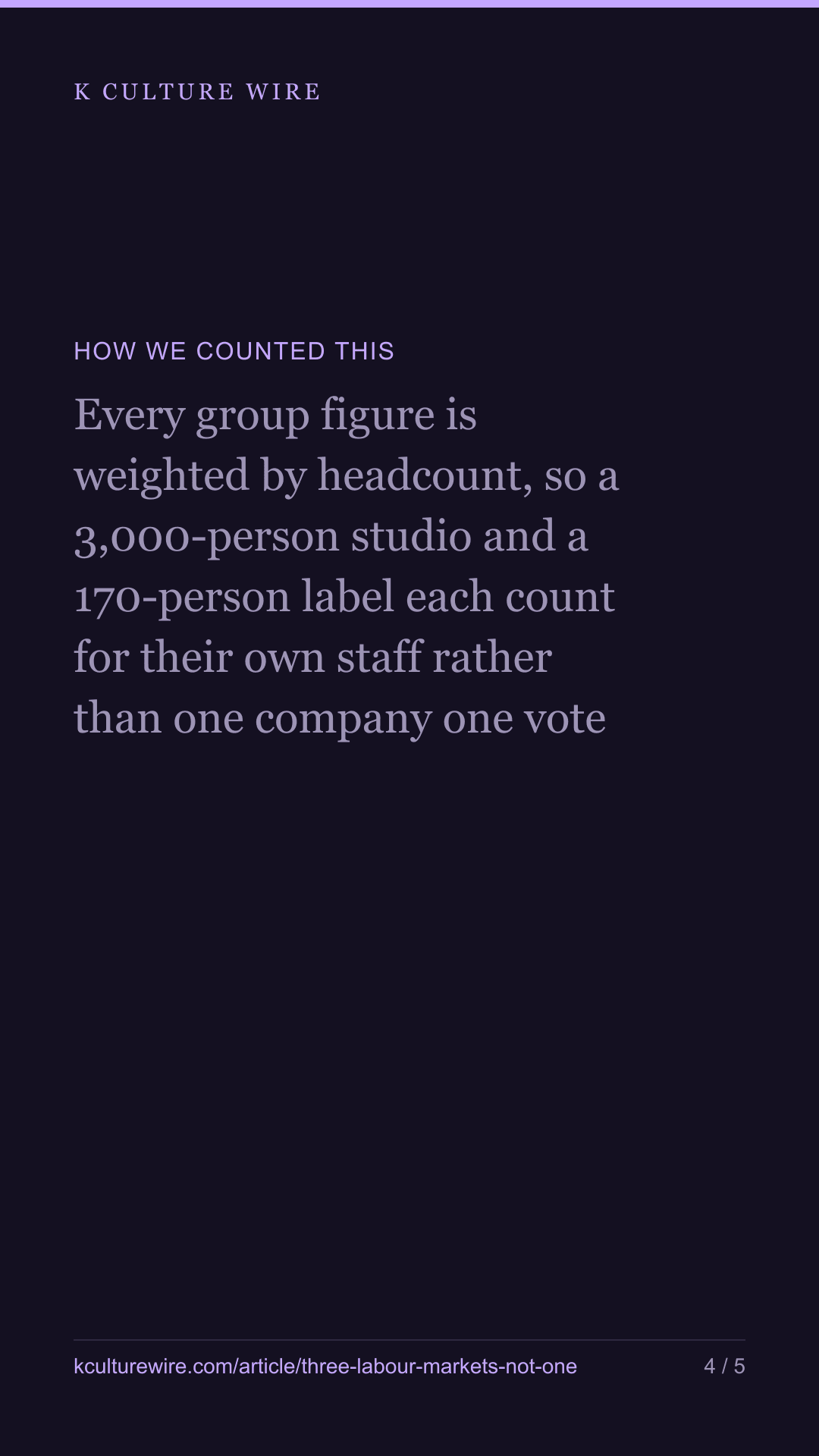
- Every group figure is weighted by headcount, so a 3,000-person studio and a 170-person label each count for their own staff rather than one company one vote
- The three groups are split by each company's own reported industry code, not by our reading of what it does. Korean game companies file as publishing, which is why that group is named for the filing and not for games
- Pay is averaged over companies that disclose pay only. Leaving non-disclosing companies in the denominator averages their staff in at zero, which is what we were doing until 7 August 2026
- The market baseline is the same field on the same filing for all 2,779 listed companies that report both, covering 1,865,198 workers
What we left out, and why
- Any claim about the Korean content industry as a whole. This is 248 listed companies. Much of Korean production is private and files nothing
- Any claim that tenure measures satisfaction, or that pay measures skill. Both are what the filings say and nothing more
- Any adjustment for company age. We report it beside tenure instead, because a company that has existed 22 years cannot show 30-year tenures and that limit belongs next to the number, not folded into it
The data behind this
Written from the same data
Take this away — 10 cards
The figures in this article, as images. Free to repost with the address on them.
If you work in this business
Everything on this page is measured from the same weekly Netflix lists, per market and per title. We publish the pages free; what we sell is the same measurement cut to one company's catalogue — including the figures behind /industry and /workforce.
What a company sheet contains, and what it cannot tell you →