Titles · music
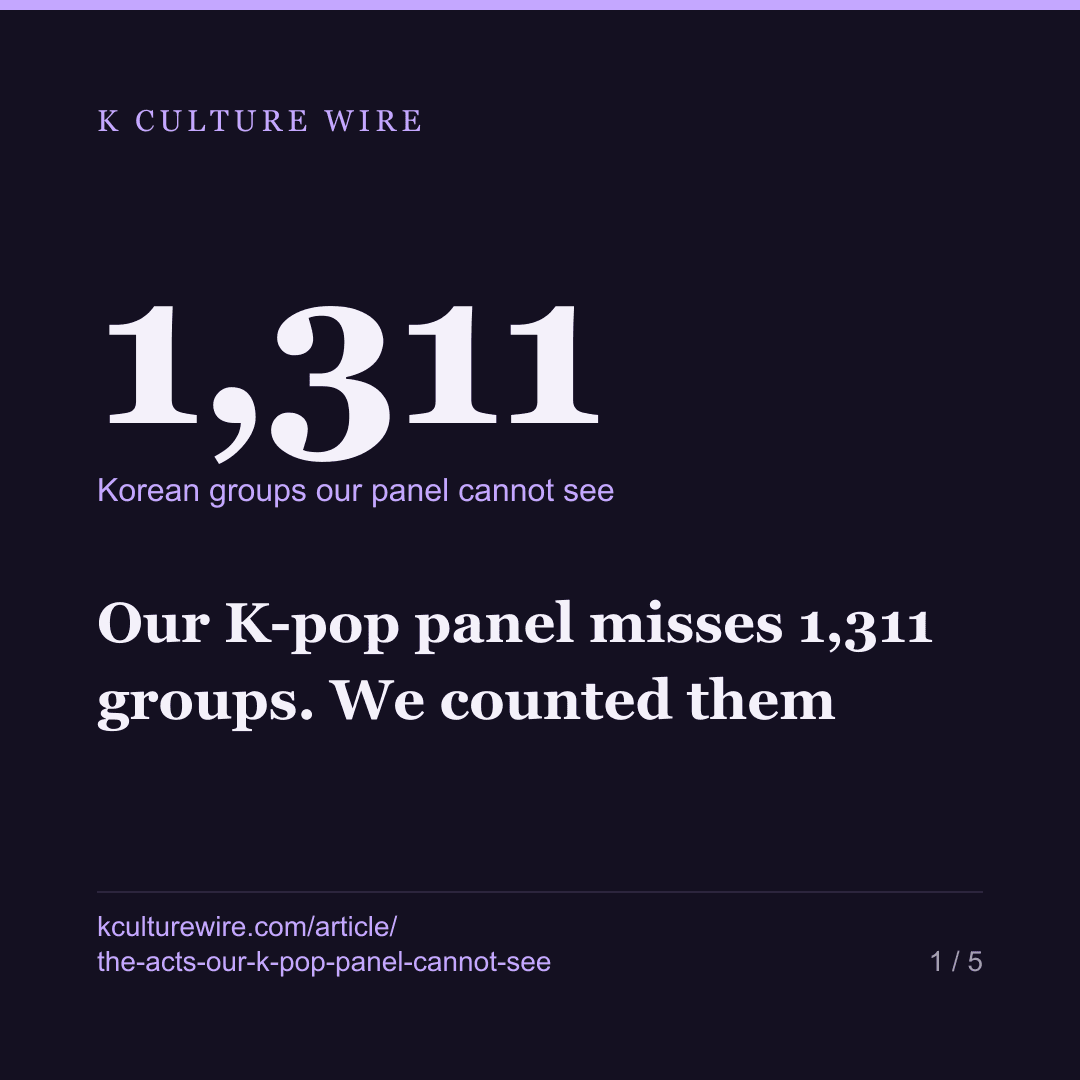
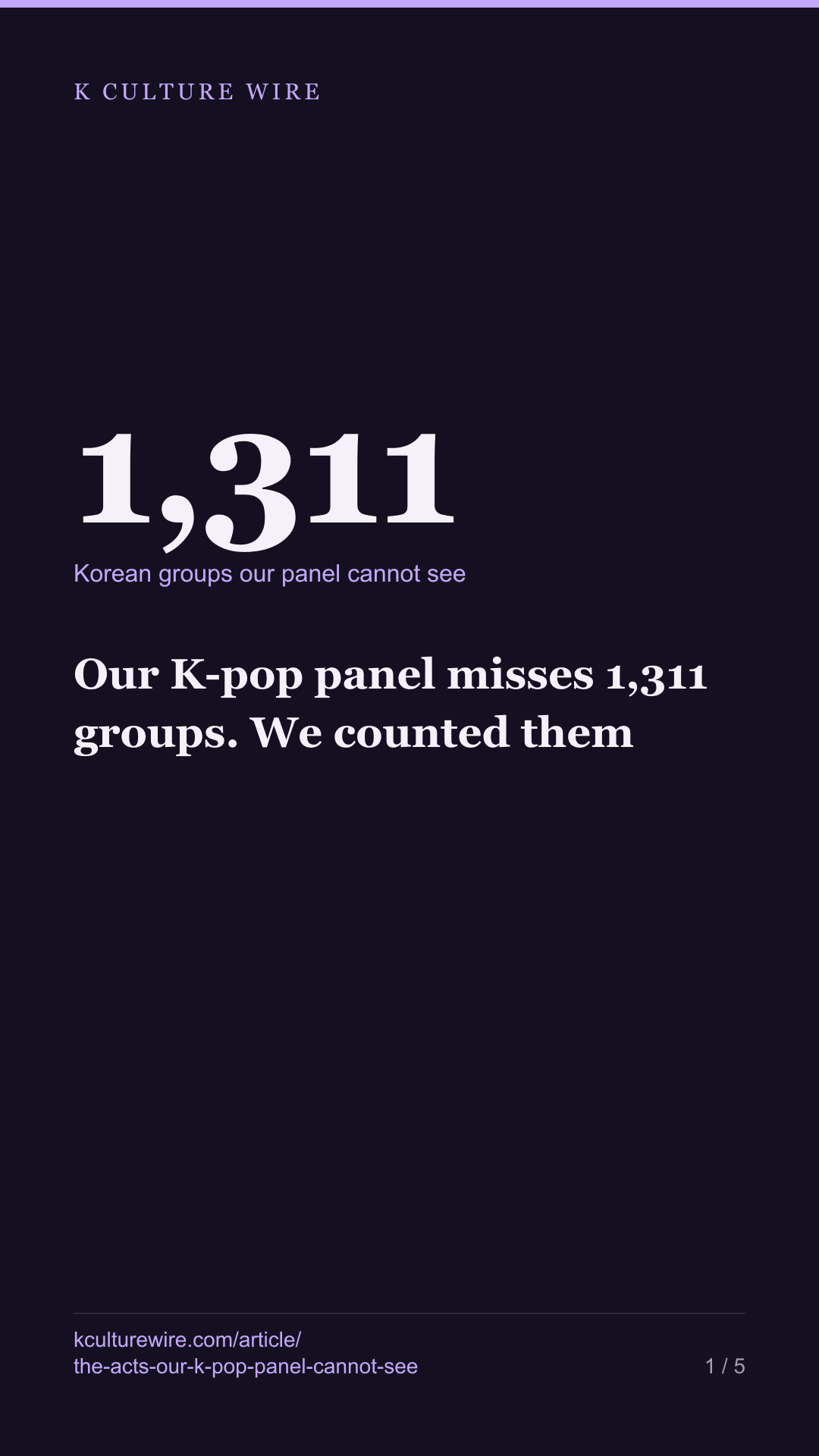
Our K-pop panel misses 1,311 groups. We counted them
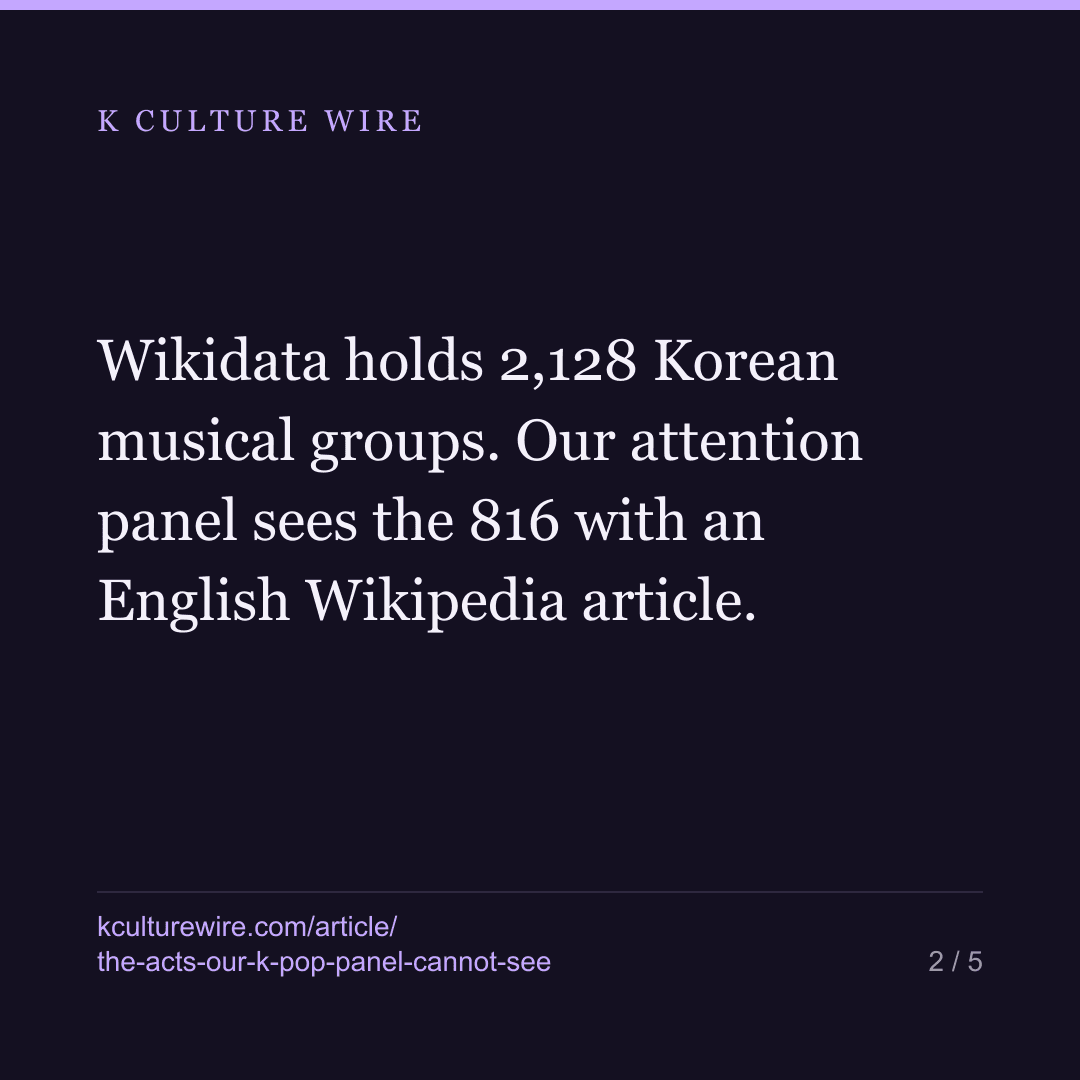
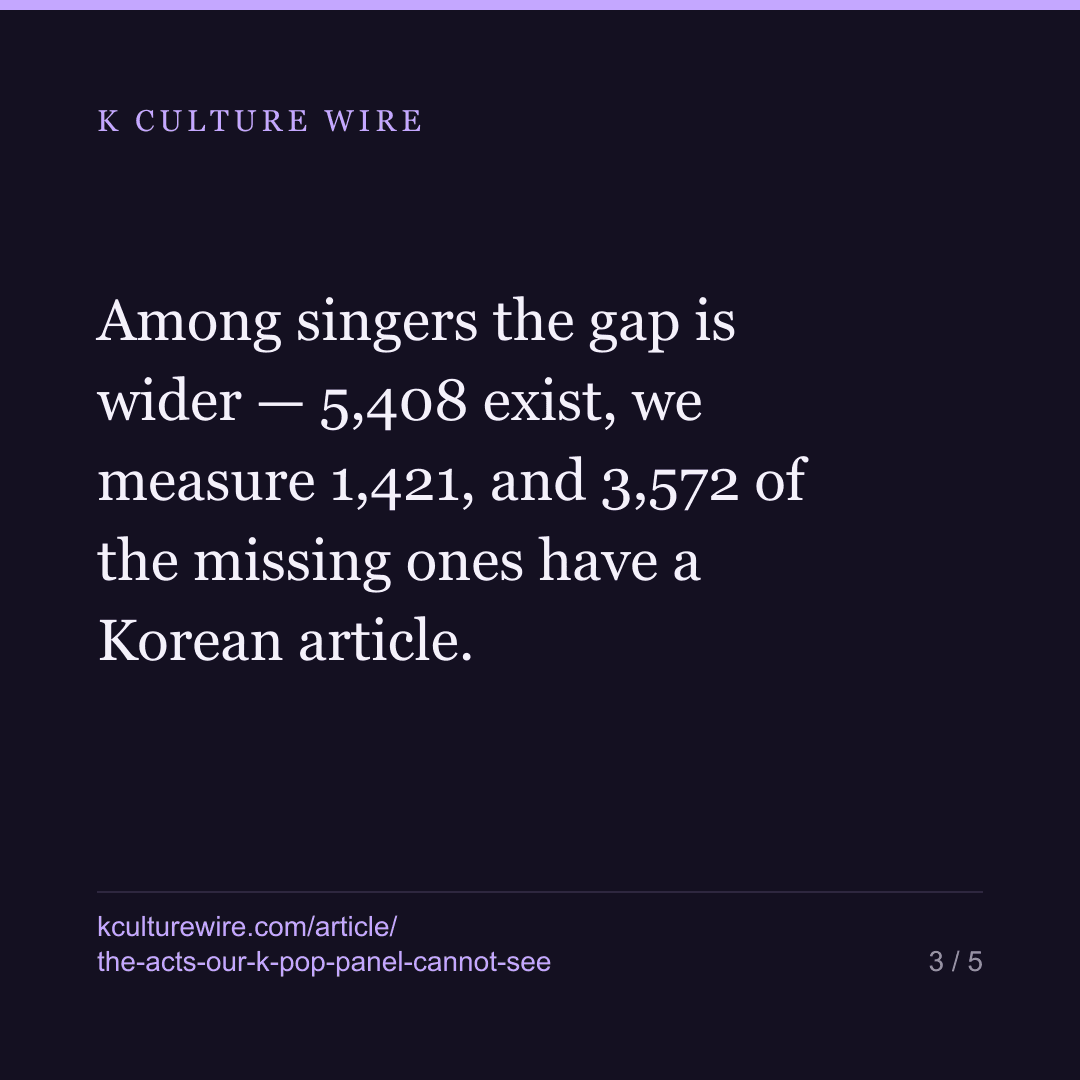
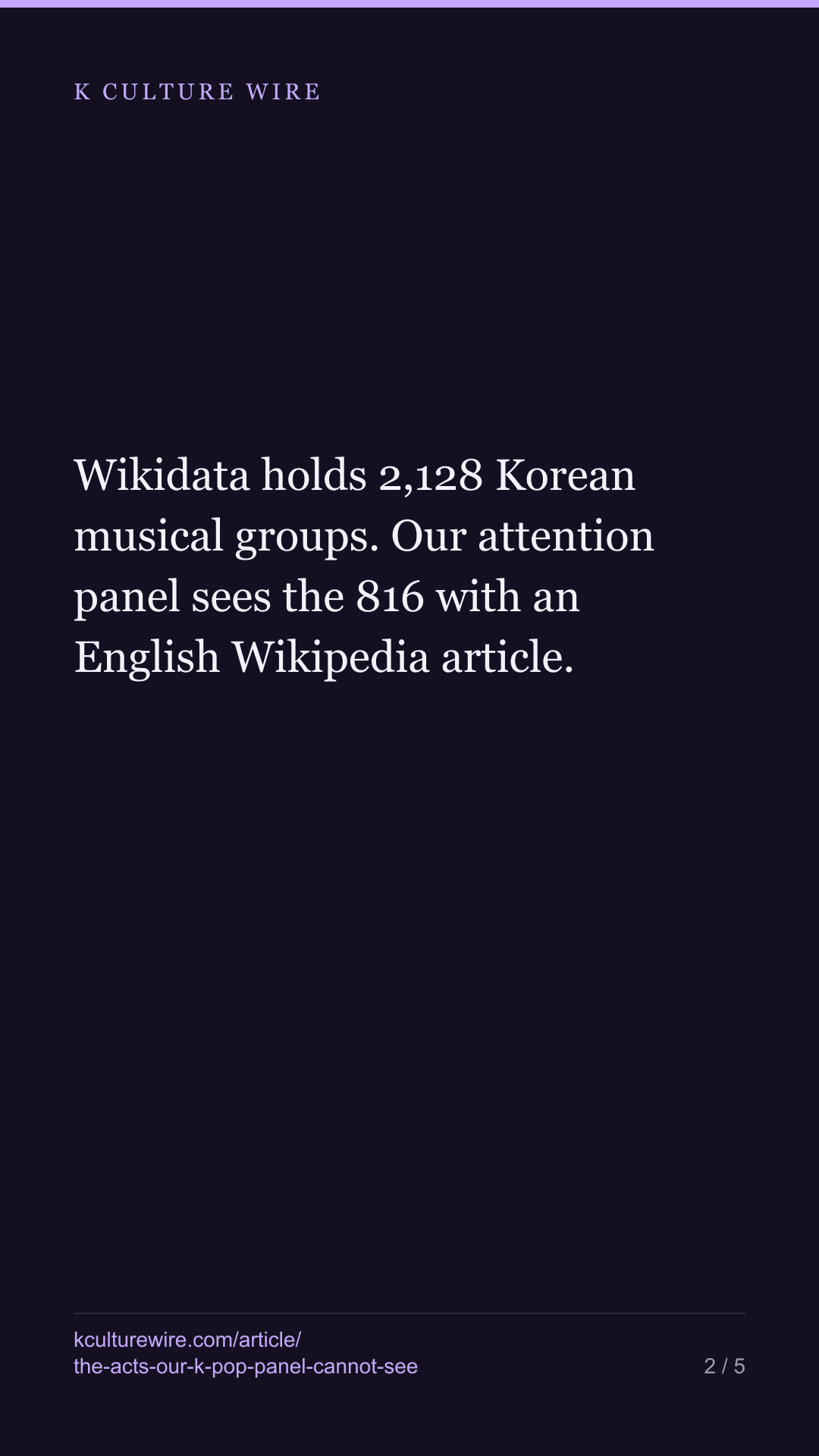
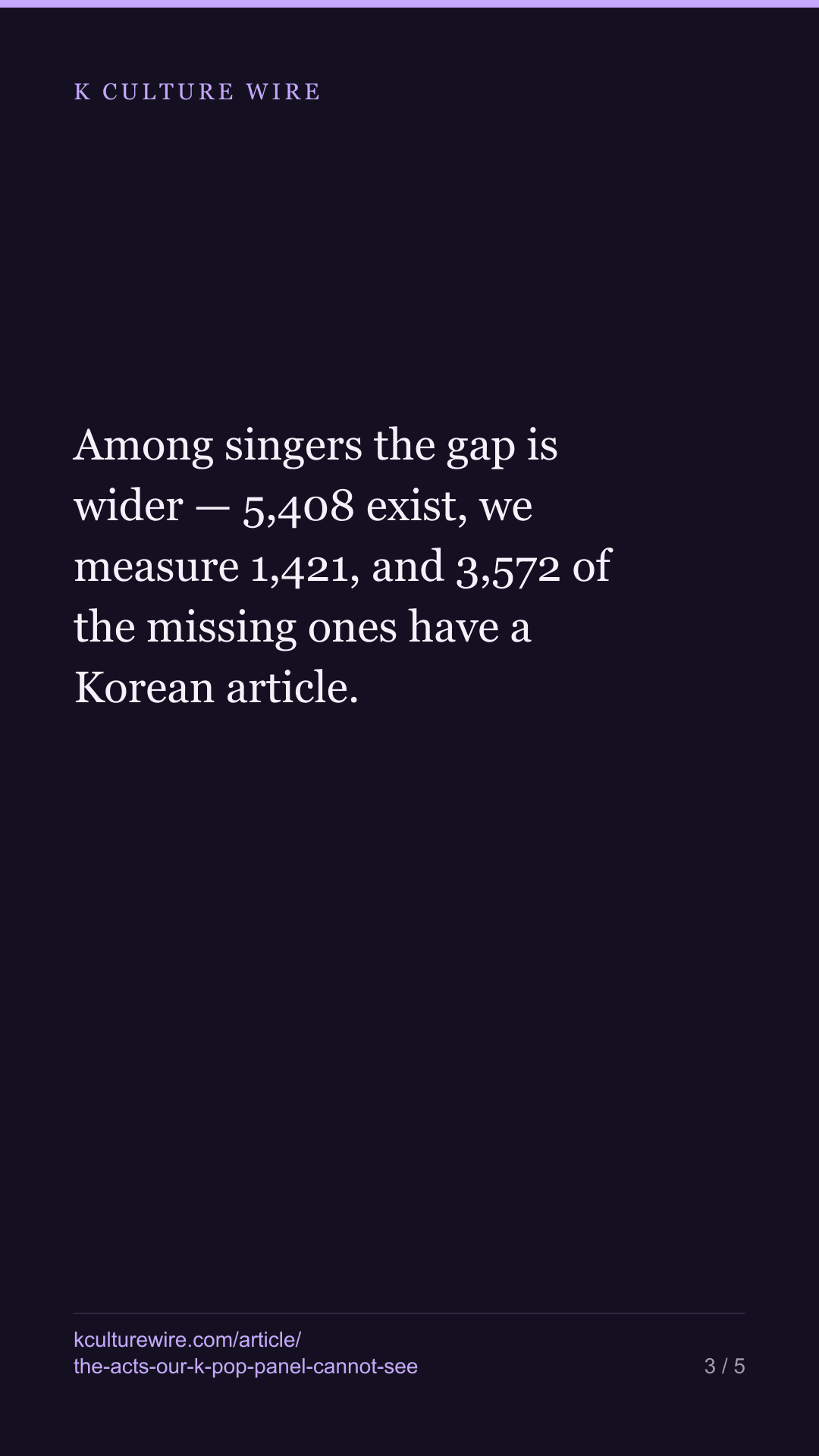
Wikidata holds 2,128 Korean musical groups. Our attention panel sees the 816 with an English Wikipedia article. Among singers the gap is wider — 5,408 exist, we measure 1,421, and 3,572 of the missing ones have a Korean article.
The table this is written from: /kpop-attention
Our K-pop attention panel has 2,372 rows — 822 groups and 1,550 people. It is built from English Wikipedia pageviews, so an act with no English Wikipedia article produces no row at all.
Until today our data page said of that gap: “they are invisible — and we cannot say how many there are.”
The first half was true. The second half was us not trying. Wikidata records Korean acts whether or not English Wikipedia does, and it can be counted.
The size of the blind spot
| In Wikidata | Exists | We measure | We miss | Share missed |
|---|---|---|---|---|
| Musical groups | 2,133 | 822 | 1,311 | 61.5% |
| Singers | 5,415 | 1,425 | 3,990 | 73.7% |
| Rappers | 362 | 251 | 111 | 30.7% |
| Composers | 242 | 95 | 147 | 60.7% |
| Musicians | 316 | 274 | 42 | 13.3% |
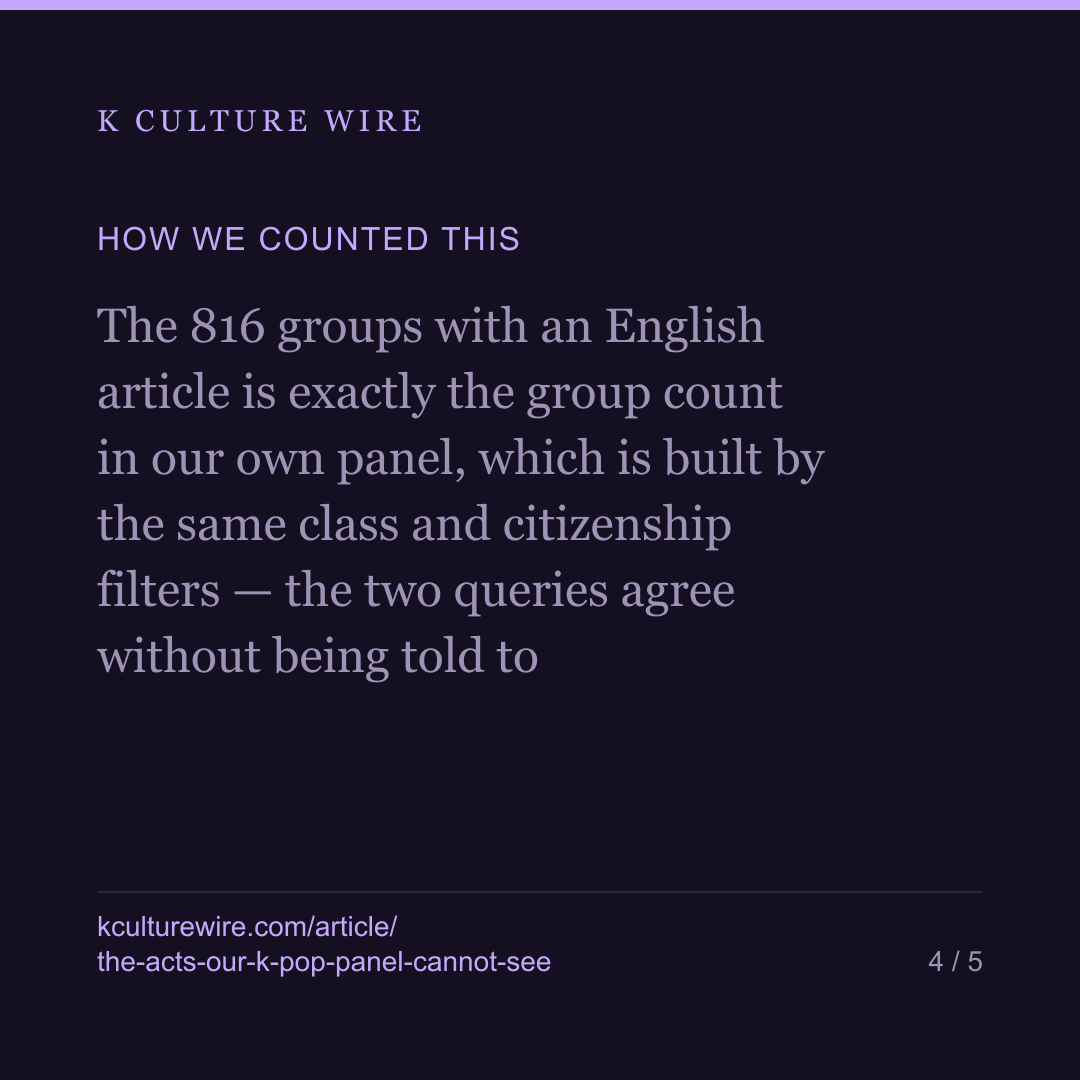
The group row is the cleanest test of the method, because our panel’s own group count is 816 — the same number, arrived at independently by the query that builds the panel. The two agree without being told to, which is what makes the 2,128 usable as a denominator.
The occupation rows overlap — a person can be a singer and a composer both — so they are never added together. Each row is its own comparison.
Most of the missing are not obscure to Koreans
Of the 3,990 singers we cannot see, 3,570 have a Korean Wikipedia article. They are documented, they are just documented in Korean. The same holds for 110 of the 147 missing composers and 79 of the 111 missing rappers.
That matters for what our attention numbers mean. A panel built on English pageviews is not a panel of Korean music; it is a panel of Korean music that has been written up in English, and the two diverge most exactly where a reader might most want the difference explained.
The gap is not the same size everywhere
| Share we miss | |
|---|---|
| Singers | 73.7% |
| Musical groups | 61.5% |
| Composers | 60.7% |
| Rappers | 30.7% |
| Musicians | 13.2% |
Rappers and musicians are covered two to five times better than singers. We can show that and we cannot explain it from these counts. A plausible reading is that “singer” is the catch-all label that Wikidata applies across decades of Korean popular music while “rapper” attaches mostly to a narrower and more recent group, but that is a story about how Wikidata labels people, and testing it would need debut years attached to every item — a different query, and one we have not run.
What we can say is that the blind spot is structured, not random. Any figure we publish about attention is a figure about the covered part, and the covered part is a different shape in each occupation.
One cell we left empty
We wanted the same Korean-article breakdown for groups. That query returned HTTP 504 three times
and we stopped. The cell in our data file is null, not 0, because those are different facts and a
zero there would say we had looked and found none.
What changed on the page
/data no longer says we cannot count this. It says how many, per category, and it says the figure
is a floor — anyone missing from Wikidata as well is still uncounted, and we have no way to reach
them at all.
This is the second time this week a limitation we had written down turned out to be measurable once we tried. The first was the claim that our source file repeats rows, which turned out to be seasons charting separately. A stated limitation is not a finished one, and the sentence that admits it is exactly the sentence nobody goes back to check.
Where these numbers come from
Sources
- Wikidata — Korean musical groups (P31/P279* from Q215380 with P495 = Q884) and people with Korean citizenship (P27 = Q884) in four music occupations — singer Q177220, rapper Q2252262, composer Q639669, musician Q753110 — counted with and without an English Wikipedia sitelink · https://query.wikidata.org
- Wikimedia — Pageviews API (en.wikipedia, all-access, user), the source our attention panel is built from · https://wikimedia.org/api/rest_v1/
What we checked
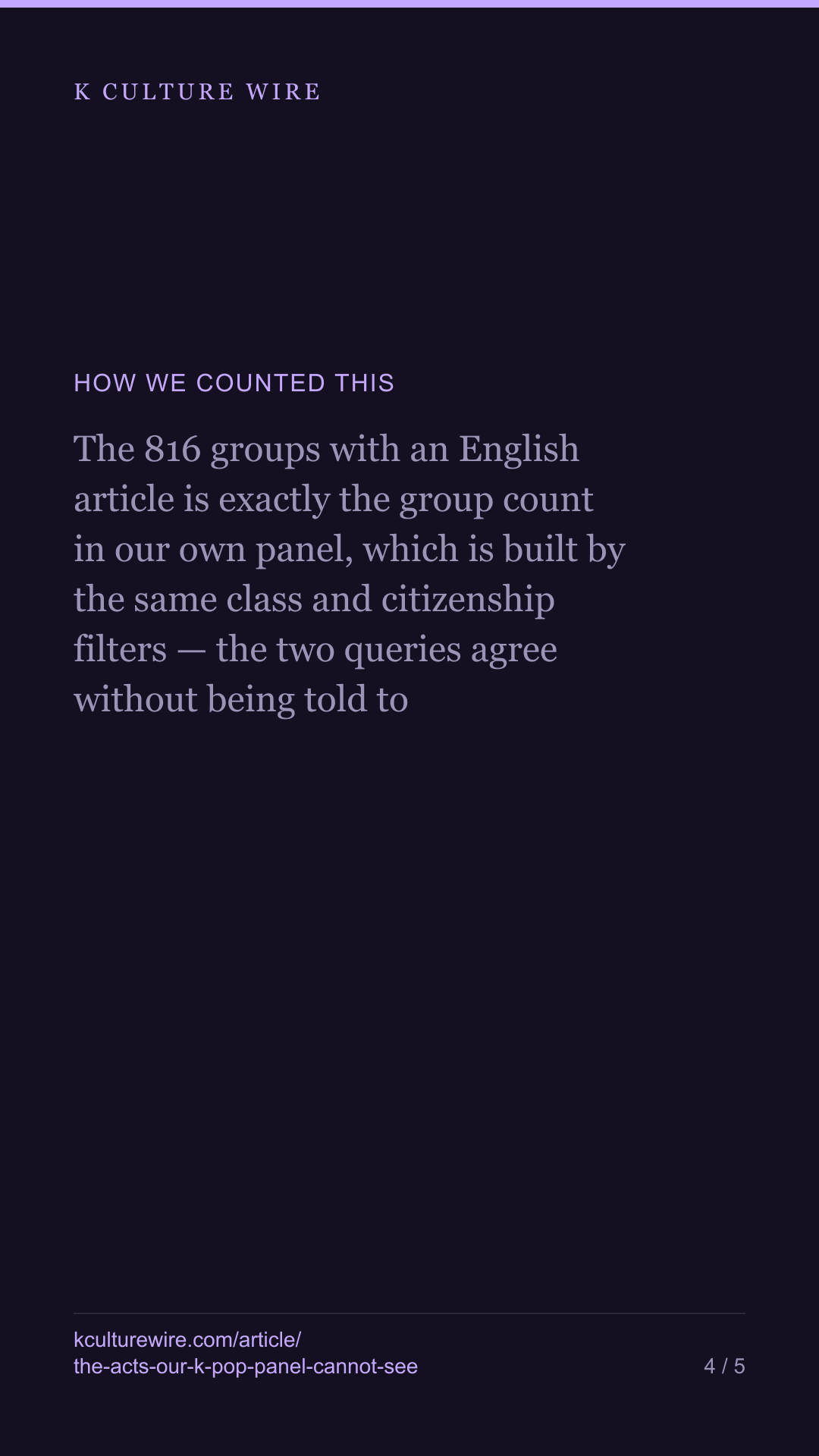
- The 816 groups with an English article is exactly the group count in our own panel, which is built by the same class and citizenship filters — the two queries agree without being told to
- The occupation queries use the same four Wikidata occupation codes as the pageviews collector, so the comparison is against our real selection rule rather than a similar one
- Occupation rows overlap, since a person can be both singer and composer, so they are reported separately and never summed
What we left out, and why
- Any total across the occupation rows. They overlap and adding them would double-count people
- The number of Korean groups that have a Korean Wikipedia article but no English one. That query returned HTTP 504 on three attempts and we are leaving the cell empty rather than filling it with an estimate
- Anyone Wikidata does not hold either. Every figure here is a floor on what we miss, not a total
- Any claim about why coverage differs by occupation. We can show the pattern; we cannot measure the cause from these counts
The data behind this
Written from the same data
Take this away — 10 cards
The figures in this article, as images. Free to repost with the address on them.
If you work in this business
Everything on this page is measured from the same weekly Netflix lists, per market and per title. We publish the pages free; what we sell is the same measurement cut to one company's catalogue — including the figures behind /kpop-attention and /data.
What a company sheet contains, and what it cannot tell you →