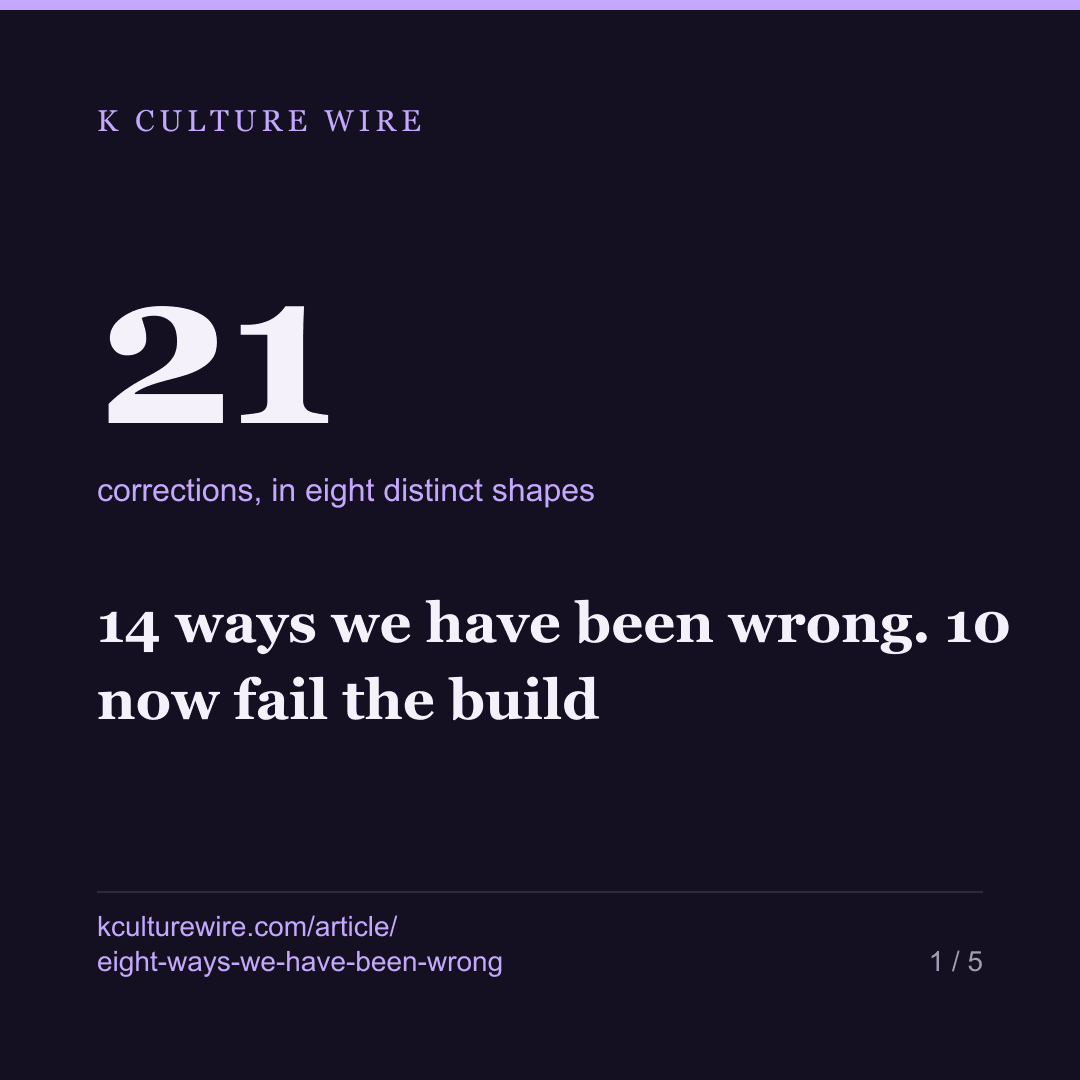
14 ways we have been wrong. 10 now fail the build
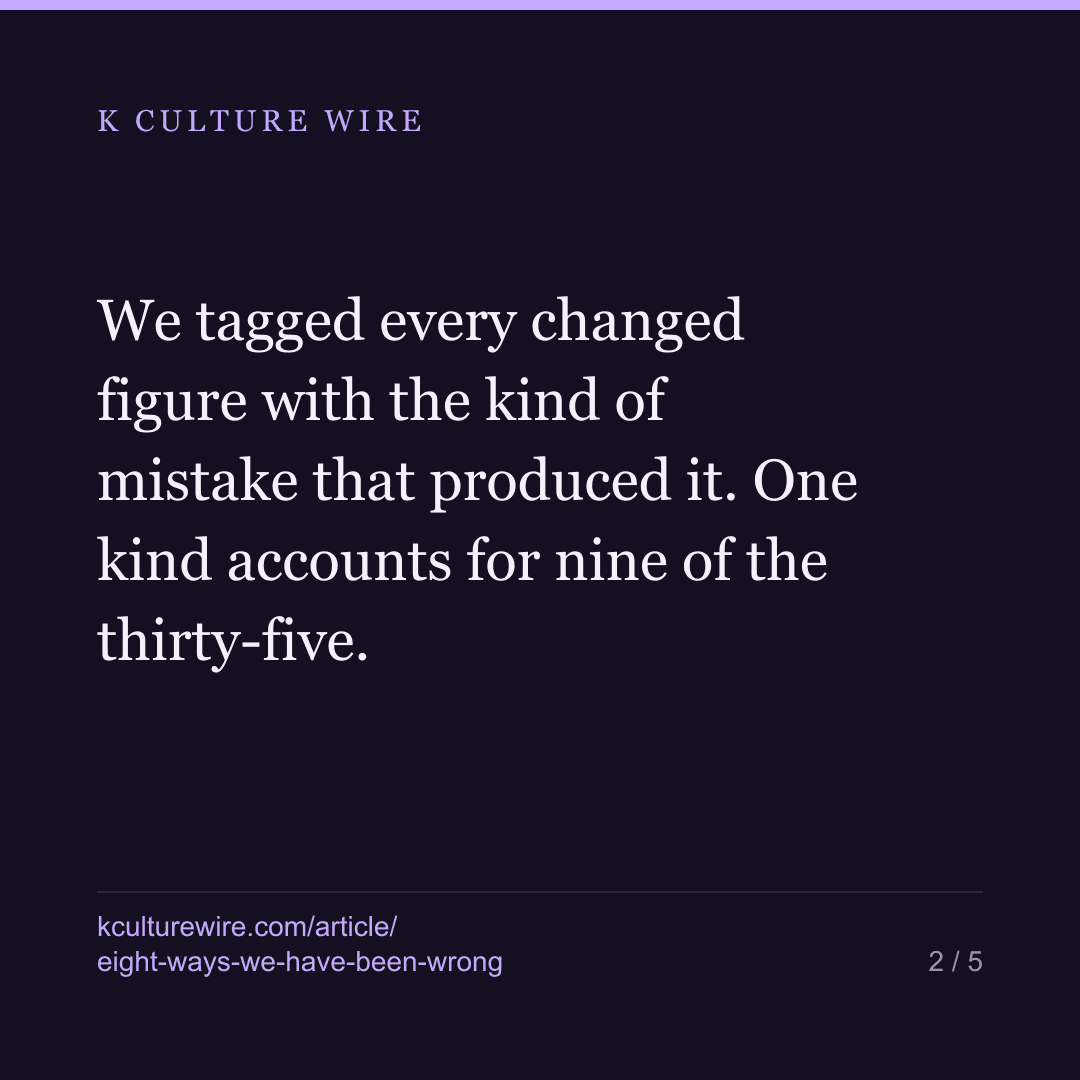
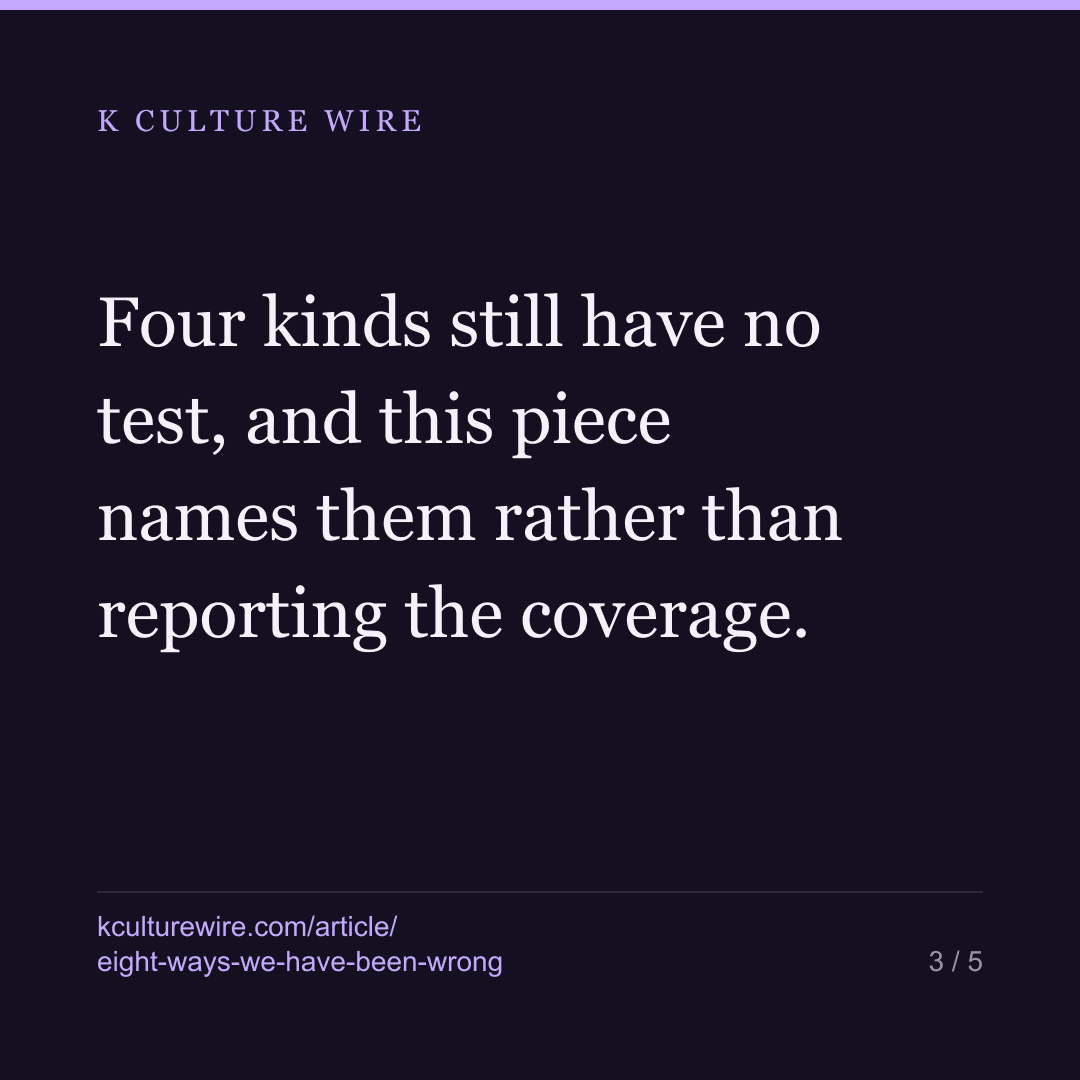
We tagged every changed figure with the kind of mistake that produced it. One kind accounts for nine of the thirty-six. Four kinds still have no test, and this piece names them rather than reporting the coverage.
The table this is written from: /corrections
We keep a record of every figure we have published and had to change. As of today it holds 36 corrections — 13 on data pages and 23 in articles.
Counting them was never the interesting part. What we wanted to know was whether they were thirty-two separate accidents or a few repeating shapes. So each one carries a tag for the kind of mistake that produced it.
There are sixteen kinds.
What went wrong, and how often
| Cause | Pages | Articles | Guarded by a test |
|---|---|---|---|
| Matched a Korean title by name alone | 5 | 4 | yes |
| A sentence about the data that was never measured | 1 | 2 | yes |
| Our attribution query contradicted our own panel | 1 | 2 | yes |
| A limitation written down and never tested | 1 | 2 | yes |
| A rule deciding which titles count was fixed upstream | 1 | 2 | yes |
| A KOSIS table classifies on two levels, we read one | 1 | 1 | yes |
| A comparison computed on a group selected by the outcome | 1 | 1 | yes |
| The set of titles a figure was measured over was widened | 0 | 3 | not yet |
| Companies without pay data left in the denominator | 1 | 0 | yes |
| A property that records who took part, read as where a thing is | 1 | 0 | not yet |
| Our corrections article miscounted the corrections | 0 | 1 | yes |
| A value with no row in the table that counts it | 0 | 1 | yes |
| The same word computed two ways — median | 0 | 1 | not yet |
| A window short enough to make its own highest month the peak | 0 | 1 | not yet |
| Netflix and Wikidata spell the same title with different letter case | 0 | 1 | yes |
| People de-duplicated by name alone, merging different people who share one | 0 | 1 | yes |
One cause produced nine of the thirty-six. Titles entered our Korean panel because their English name matched a Korean work, and foreign works with the same name came in with them. That single flaw moved figures on five pages and in four articles, and it is the reason the panel now carries two independent columns saying how sure we are of each row.
The ninth kind, found today
A rule that decides what counts was wrong, and every figure measured through it moved with it.
Our test for whether a Netflix title is Korean matched the title text against Wikidata labels in any language. Wikidata carries an item’s labels in dozens of languages, so titles written in Arabic, Hebrew, Cyrillic and Japanese script matched Korean items and were counted as Korean works. There were 23 of them, holding 212 chart places.
They are local titles, and the way to see it is that Netflix does not translate titles in these lists. Squid Game holds 445 chart places across ten Arab markets under its Latin name. Only 10 of the 1,530 distinct titles on Egypt’s chart are written in Arabic script, and 4 of Israel’s 1,825 in Hebrew. If the lists were localised those shares would be near total.
We nearly reached for a weaker argument first — that none of the 23 ever charted anywhere in Asia — and it does not hold: 141 genuinely Korean titles never charted in Asia either, two of them with more than 200 chart places. The script rule is the one that survives.
Korea’s share of world chart places moved from 37,962 places to 37,750. Both round to 7.7%, which is the number we publish most often, so the headline figure did not move at all — and that is exactly the kind of error that survives a long time if nobody checks the rule itself rather than the output.
This kind is different from the eight above it in one way worth naming: the articles were not wrong about what they were given. The writing was faithful to a measurement that was not.
Where the tests are, and where they are not
Twelve of the sixteen kinds now fail the build if they recur. Four do not, and naming them is the point of this section:
- the set of titles a figure was measured over being widened after publication, which moved every count measured through it;
- the same word computed two ways — median as the upper-middle value on one page and the average of the two middle values everywhere else;
- a window short enough to make its own highest month look like a peak;
- a property that records who took part being read as a record of where a thing is.
We are publishing the gap rather than the coverage, because a list of missing tests is worth more to someone deciding whether to trust these numbers than a sentence about taking accuracy seriously. The four above are a work list, not a claim.
The half that had no test now has one
When this piece first went out, four of the eight kinds then known failed the build if they recurred and four did not.
The four missing tests were written the same afternoon. Here is what each one actually does, which matters more than the fact that it exists.
- Our attribution query contradicting our own panel. Every title in the panel is now checked against the query that decides whether a Korean work carries that name. If the query names no Korean work, the build stops. Titles the query has never heard of are counted separately and not treated as foreign — not knowing and knowing-otherwise are different facts.
- Two-level classification in a government table. For every year, the parts must sum to the published total. Reading one level and not the other leaves a residual, and that residual is what we once printed as a real category. Anything above 0.5% of the total now fails.
- Denominators that quietly include what they should exclude. The data must carry the headcount the pay average was actually divided by, separately from the total headcount, and the page must say the difference out loud. We cannot recompute the average from company rows we do not hold — so instead we made silence impossible.
- Sentences about the data that were never measured. The narrow version of this is the one that works: a claim that something is empty in every year is checkable, and each one now needs a signature naming what measures it.
That last test taught us something about tests. The first version flagged 77 sentences and most of them were good ones — “nothing here says why”, “nothing here is a ranking”, the disclaimers we write on purpose. A check that punishes those would have pushed us to delete the honest sentences to make the build pass. We narrowed it to claims of emptiness, which is the shape the actual mistake had, and it went from 77 findings to one — a correction notice quoting the old wrong sentence, which is signed and stays.
Why the tag matters more than the count
A correction that only fixes the number leaves the mechanism in place. Twice this week the same mechanism produced a second error before we had named it: the title-matching flaw moved eight figures across two days, and our own corrections article then miscounted those corrections.
So a correction is not finished here until three things are true — the number is fixed, everything quoting it has been swept, and something exists that would catch it happening again. The third is the one people skip, and it is the only one that changes anything.
The fourth new kind of mistake appeared today, which is the honest note to end on: this is a record of what we have met so far, not an inventory of what can go wrong.
Where these numbers come from
Sources
- K Culture Wire — Our own corrections record — every changed figure on a page or in an article since 6 August 2026, each tagged with the cause that produced it and, where one exists, the check that now guards against it · https://www.kculturewire.com/corrections
What we checked
- The counts here are read from the corrections file the corrections page is built from, so this article cannot drift from that page
- Every guard named is a script that exists in the repository; the check behind this article fails if a named guard is missing
- The four unguarded causes are counted from the same file, so the gap cannot be understated by leaving one out
What we left out, and why
- Mistakes we caught before publishing. This record starts at the moment a wrong figure was readable by someone else; the ones we caught in drafting are not corrections and counting them would flatter us
- Any claim that fourteen is the number of ways we can be wrong. It is the number we have met so far, and four of the thirteen were named only on 22 August, when we read six corrections that had been recorded without a cause
- Severity ranking. A one-word label error and a 14% overcount are both listed as one correction each, because we have no honest way to weigh them against each other
The data behind this
Written from the same data
Take this away — 10 cards
The figures in this article, as images. Free to repost with the address on them.
If you work in this business
Everything on this page is measured from the same weekly Netflix lists, per market and per title. We publish the pages free; what we sell is the same measurement cut to one company's catalogue — including the figures behind /corrections and /data.
What a company sheet contains, and what it cannot tell you →