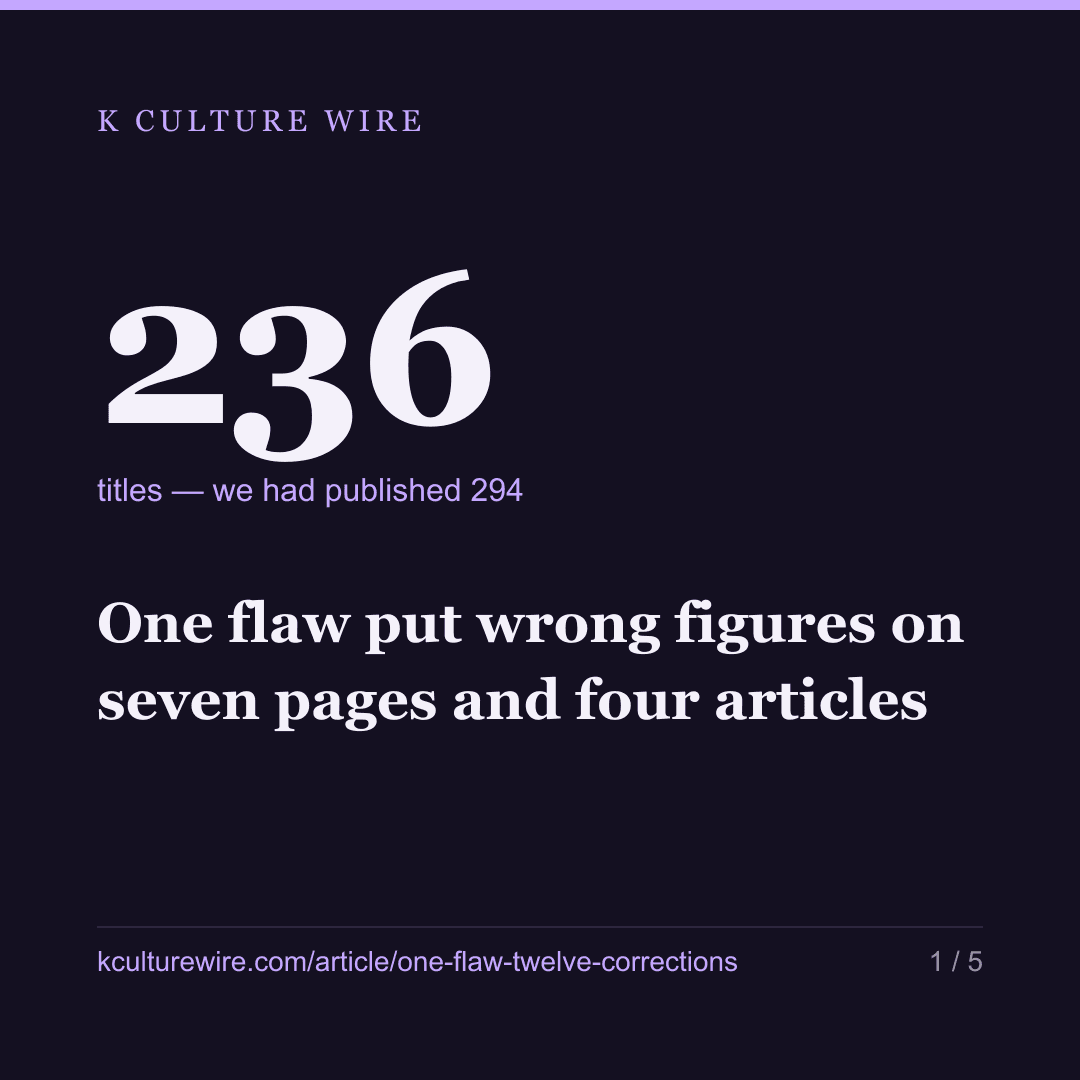
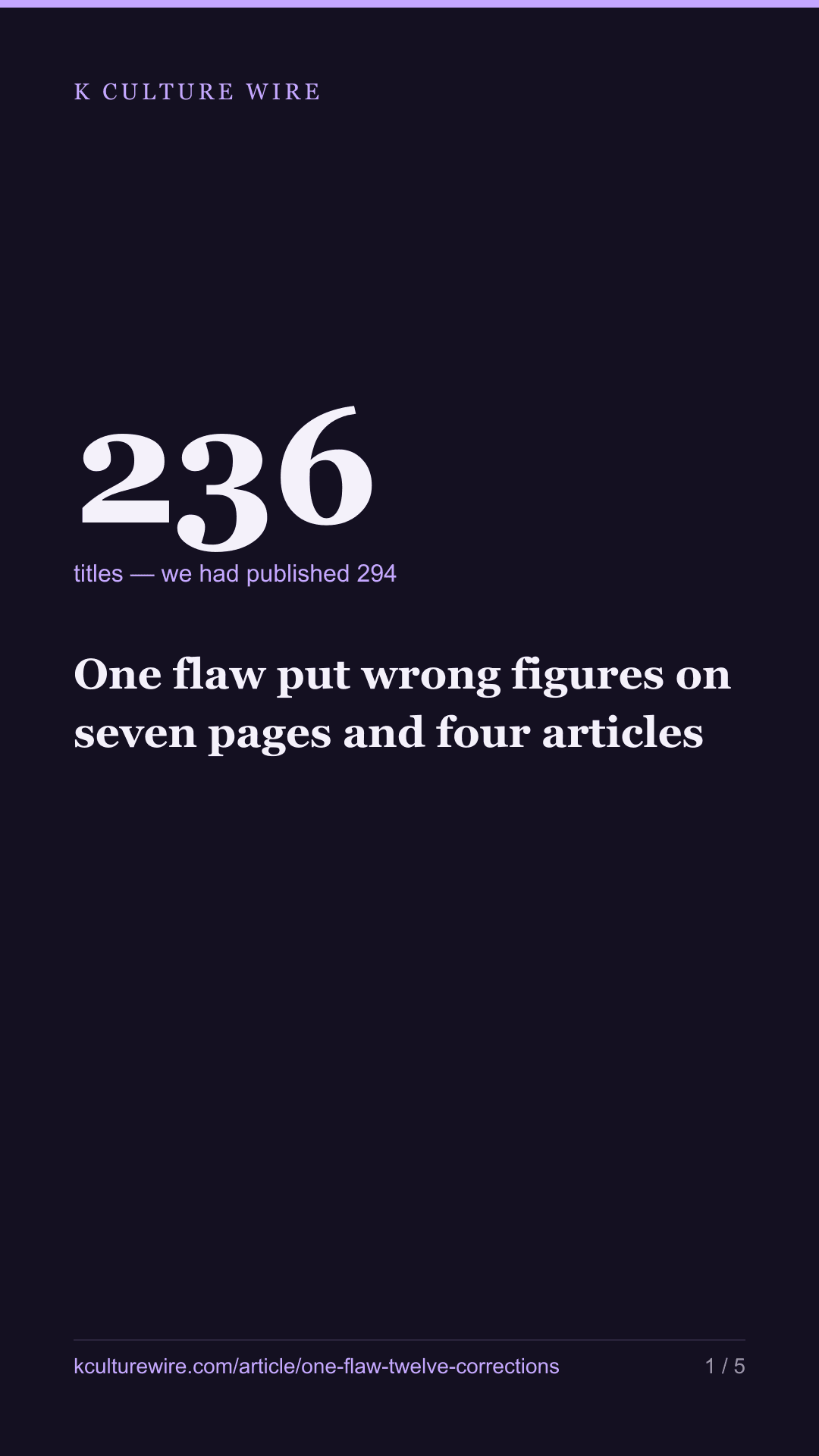
One flaw put wrong figures on seven pages and four articles
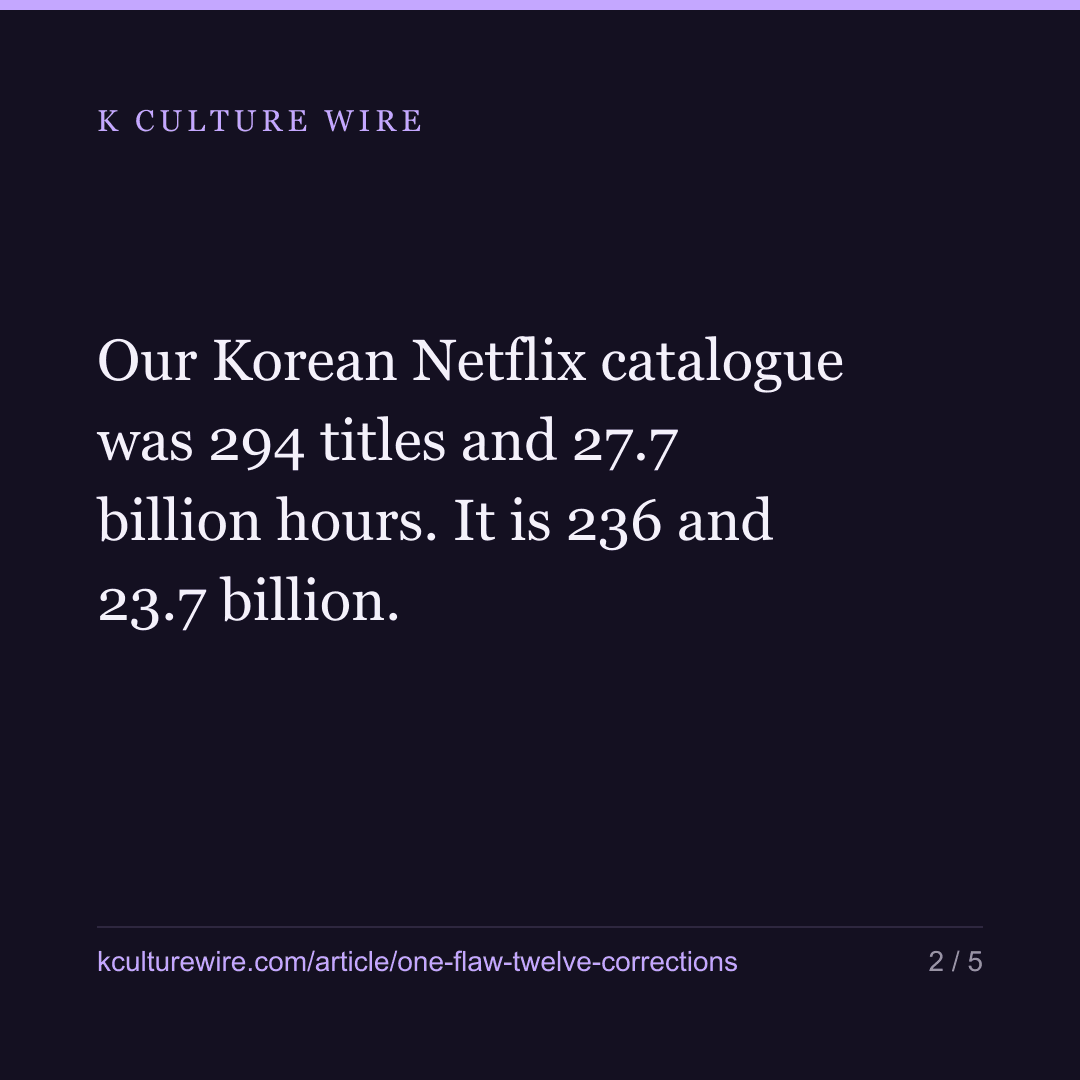
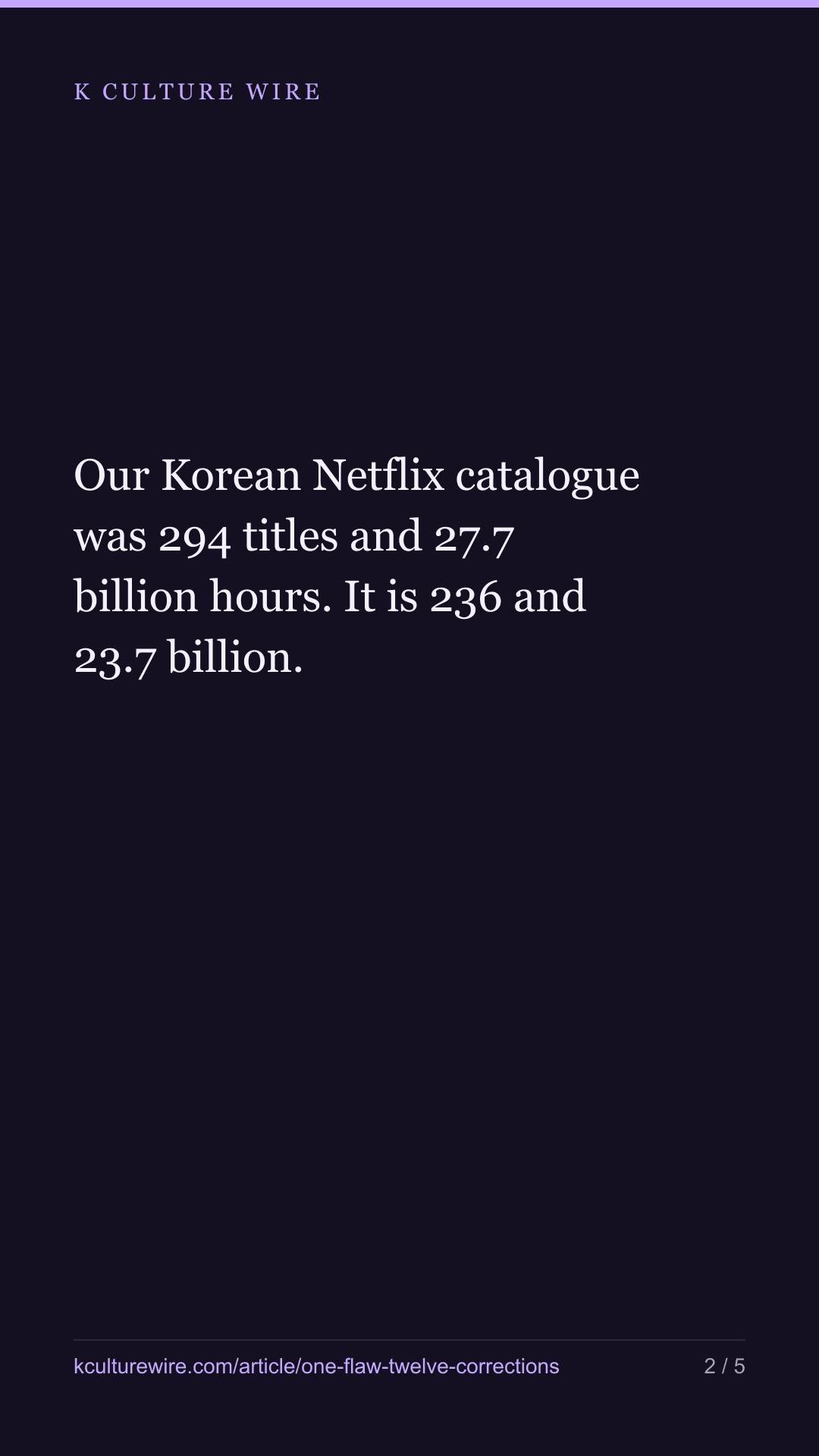
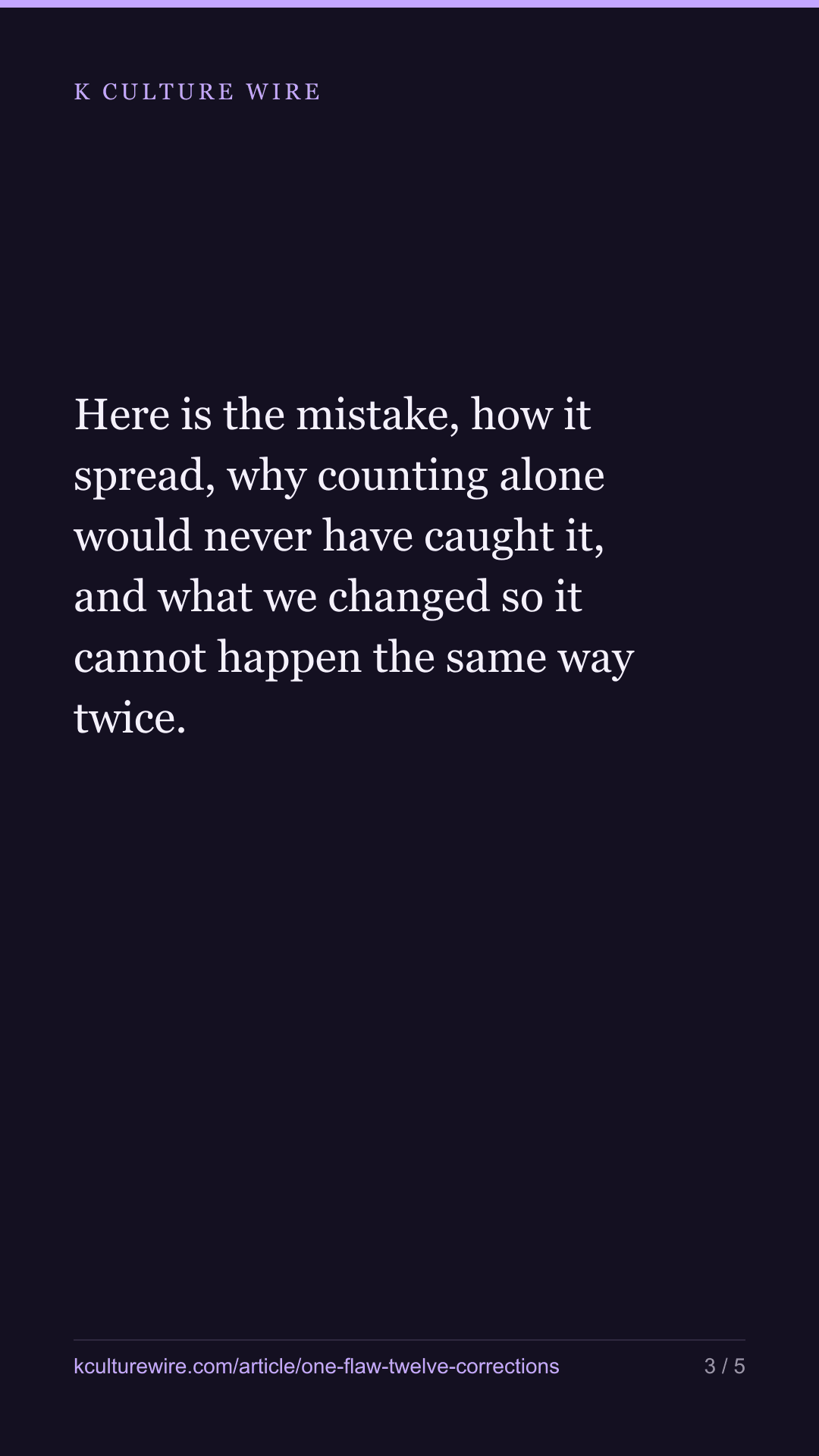
Our Korean Netflix catalogue was 294 titles and 27.7 billion hours. It is 236 and 23.7 billion. Here is the mistake, how it spread, why counting alone would never have caught it, and what we changed so it cannot happen the same way twice.
The table this is written from: /watched
On 7 August 2026 we changed eleven published figures. Seven were on data pages, four were inside articles. Eight of the eleven came from one flaw, and it had been live for days. The other three were separate mistakes that surfaced only because the flaw made us re-read everything.
| Page | Was | Now | Cause |
|---|---|---|---|
| /watched | 294 titles · 27.7bn hours | 236 titles · 23.7bn hours | the flaw |
| /titles and /reach | 448 titles | 405 titles | the flaw |
| /screen-split | built on the 294 | built on the 236 | the flaw |
| /staying-power | listed Teach You a Lesson as a Korean title | removed | the flaw |
| Front page | included two Chinese dramas | removed | the flaw |
| /tv-exports | terrestrial 65.7% of exports | 81.5% | a different mistake |
| /industry | content pay ₩75.6m | ₩76.1m | a different mistake |
Those “now” figures are what they became that morning, not what they are today. The panel moved again on 8 August, from 405 titles to 397, for a different reason — see the correction at the top of this piece and the current catalogue. We do not rewrite this table when later numbers move, because it is a record of one day.
The flaw
Netflix does not publish a country of production. To build a Korean panel you have to decide which chart rows are Korean, and the obvious method is to take a list of Korean works from Wikidata and match it against the charts by title text.
That works until two countries make something with the same name, which they do constantly. Teach You a Lesson is Chinese. Hunger is Thai. Forgotten Love is Polish. The Empress is German. Each of them matched a Korean work with the identical English name, and each of them was counted as Korean.
Fifty-two titles were in our catalogue that should not have been. They carried four billion viewing hours with them.
Why counting would never have found it
This is the part worth keeping.
Every total looked healthy. 294 titles is a plausible number. 27.7 billion hours is a plausible number. Nothing was zero, nothing was negative, no check failed, and the figures moved smoothly week to week. A monitor watching for anomalies would have watched this for a year without a flicker.
The error was found because somebody read a page and thought that title does not look Korean. Not a threshold, not an alert — a person recognising a name. We have said before that things which fail loudly are the easy ones; this is the other kind.
The part that surprised us
Fixing the source was maybe a third of the work. The wrong figures had been quoted.
Two of our own articles cited the 294-title catalogue as background. A third used it to compute a
different statistic entirely. /screen-split was built on the same base. /industry had an
unrelated error — non-disclosing companies left in a denominator — that only surfaced because we were
already re-reading everything.
A correction is not finished when the cause is fixed. It is finished when everything that repeated the number has been swept, and something exists to stop it recurring. Eight figures moved because one rule was wrong; only one of them was the rule’s own page. A sweep that stopped there would have left seven standing.
What changed so it cannot happen the same way
The rule lives in one file now. It had been copied into two build scripts, so fixing one left the
other wrong. That is now scripts/lib/korean-netflix-titles.mjs, and everything that needs the
judgement calls it.
The rule got a real test. Netflix splits its global chart by a title’s primary language, and a Korean work belongs on the Non-English side. Restricting to that removed the 52 automatically rather than by inspection. Nine more came out by hand after we read the largest titles one at a time.
Hand-made data files were converted to scripts. Seven data files on the site had no build script — they had been produced once and edited since. A file nobody generates cannot follow a rule change.
And a check now looks at the output rather than trusting the rule. Putting the rule in one place does not stop the next script from failing to call it, which is exactly what happened later the same day when a new collector we wrote re-introduced the same foreign titles. A check now reads every roster we produce and fails the build if a known foreign title is in it.
What is still wrong
215 of the 421 titles in the Southeast Asia panel have never reached a global Top 10, so the language test cannot be applied to them at all. They are in the panel on a name match — the same weak key that caused all of this — and we cannot tell you what share of them is foreign, because we have not read all 215.
That number is now printed on the pages that use it, and there is a check that fails our build if it stops being printed. It is the honest state of the thing: one flaw found and fixed, and a second, larger version of the same flaw that we can measure the size of but not yet close.
What changed on 3 September 2026
We added the chart week of 23 August 2026. One title entered the Southeast Asia panel with it.
| Was | Now | |
|---|---|---|
| Titles in the panel | 420 | 421 |
| Titles that cannot be language-verified | 214 | 215 |
⚠ Read the correction note at the head of this piece beside that. It records the panel moving from 421 to 420 on 25 August, when we removed three titles that were never Korean. The panel is 421 again today, and it is not the same 421: one of those three is still gone, and a new title charted. A count that returns to its old value has not returned to its old contents, and we would rather say that than let the two numbers look like a round trip.
Where these numbers come from
Sources
- Netflix — Top 10 weekly lists (Tudum), global and per-country, 265 weeks from 2021-07-04 to 2026-07-26. The global lists carry a language category; the country lists do not · https://www.netflix.com/tudum/top10
- Wikidata — Country of origin (P495 = Q884), used to match chart titles to Korean works by name · https://query.wikidata.org
What we checked
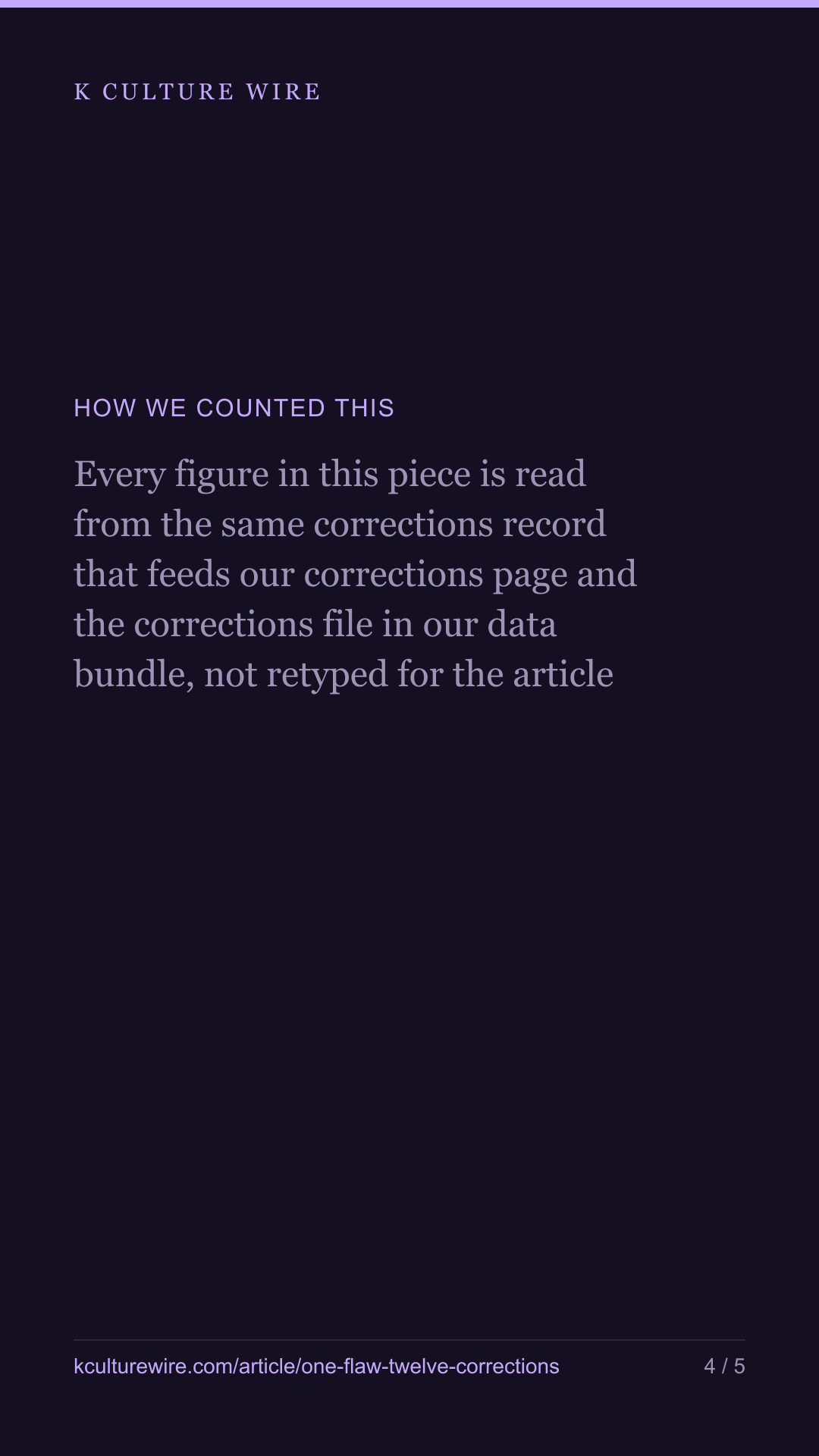
- Every figure in this piece is read from the same corrections record that feeds our corrections page and the corrections file in our data bundle, not retyped for the article
- The seven page corrections and four article corrections are counted separately because they are stored separately — pages in a data file, articles in each article's own front matter
- Each correction carries the cause it came from, so the eight traced to the title-matching flaw are counted rather than asserted
- The before and after figures are the ones actually published, not reconstructions
What we left out, and why
- Any claim that the corrected figures are final. They are the best we can currently show, and 215 of 421 titles in the Southeast Asia panel still cannot be language-verified at all
- Any suggestion that we found this because our process is good. We found it because one title on a page looked wrong to a person reading it
The data behind this
Written from the same data
Take this away — 10 cards
The figures in this article, as images. Free to repost with the address on them.
If you work in this business
Everything on this page is measured from the same weekly Netflix lists, per market and per title. We publish the pages free; what we sell is the same measurement cut to one company's catalogue — including the figures behind /watched and /titles and /staying-power.
What a company sheet contains, and what it cannot tell you →