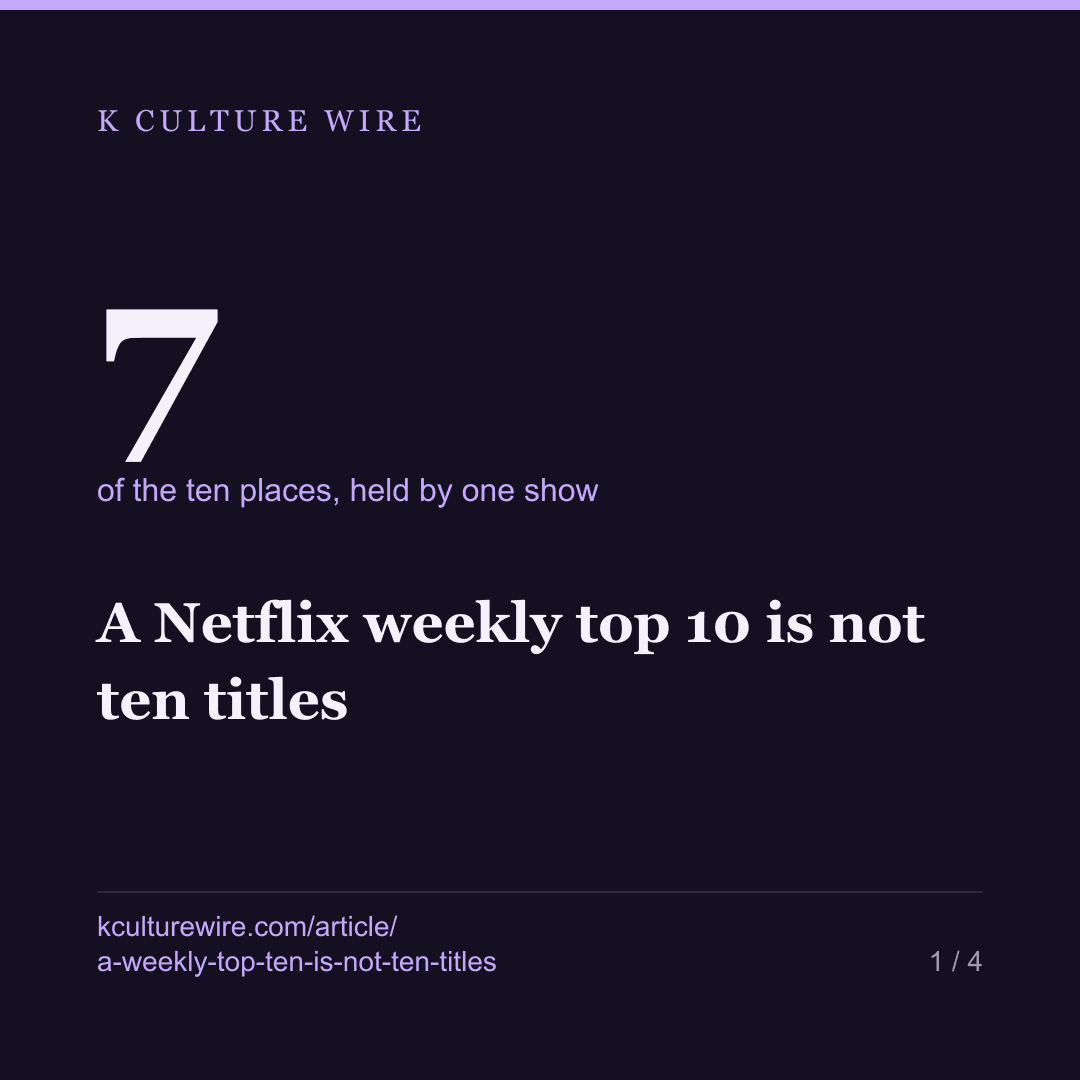
A Netflix weekly top 10 is not ten titles
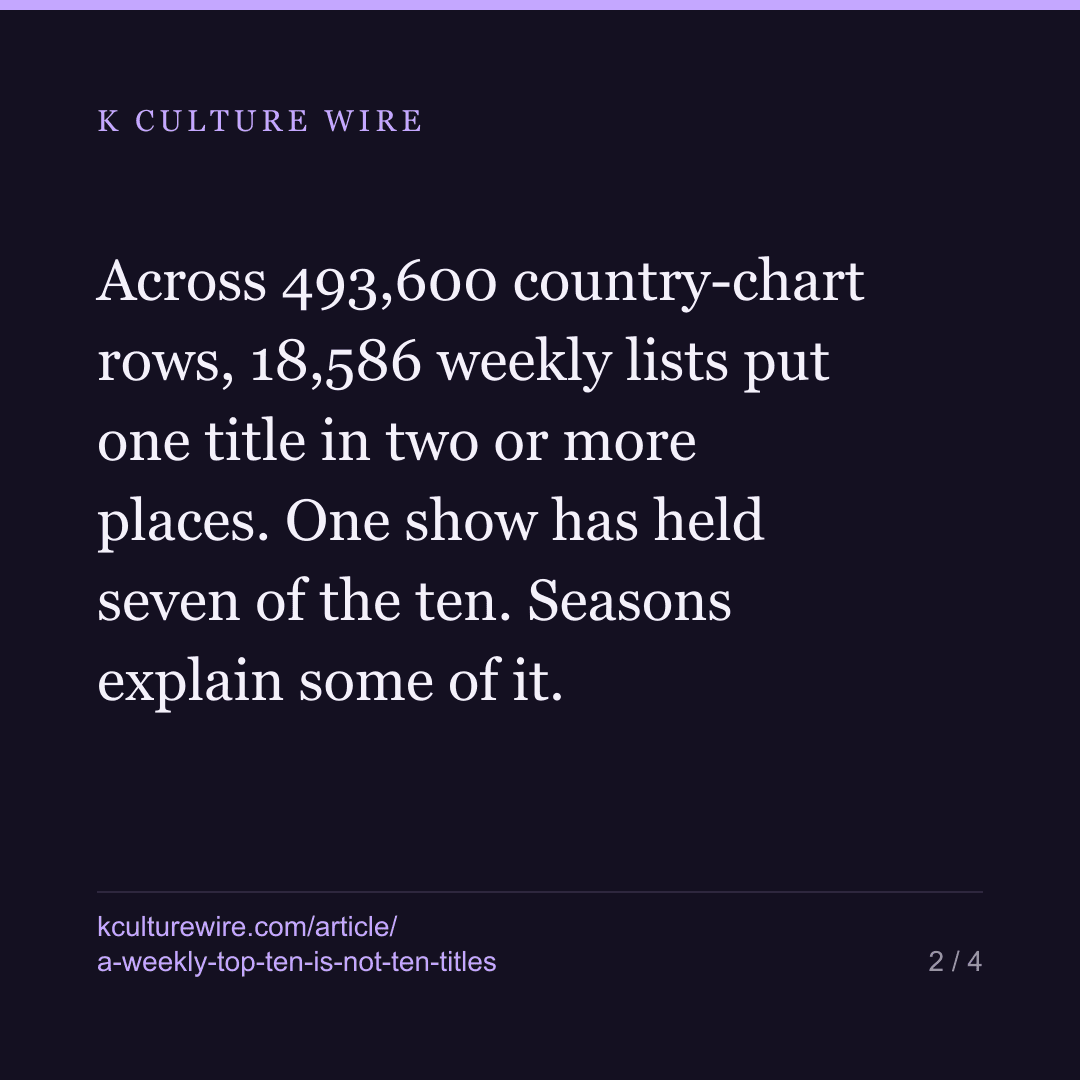
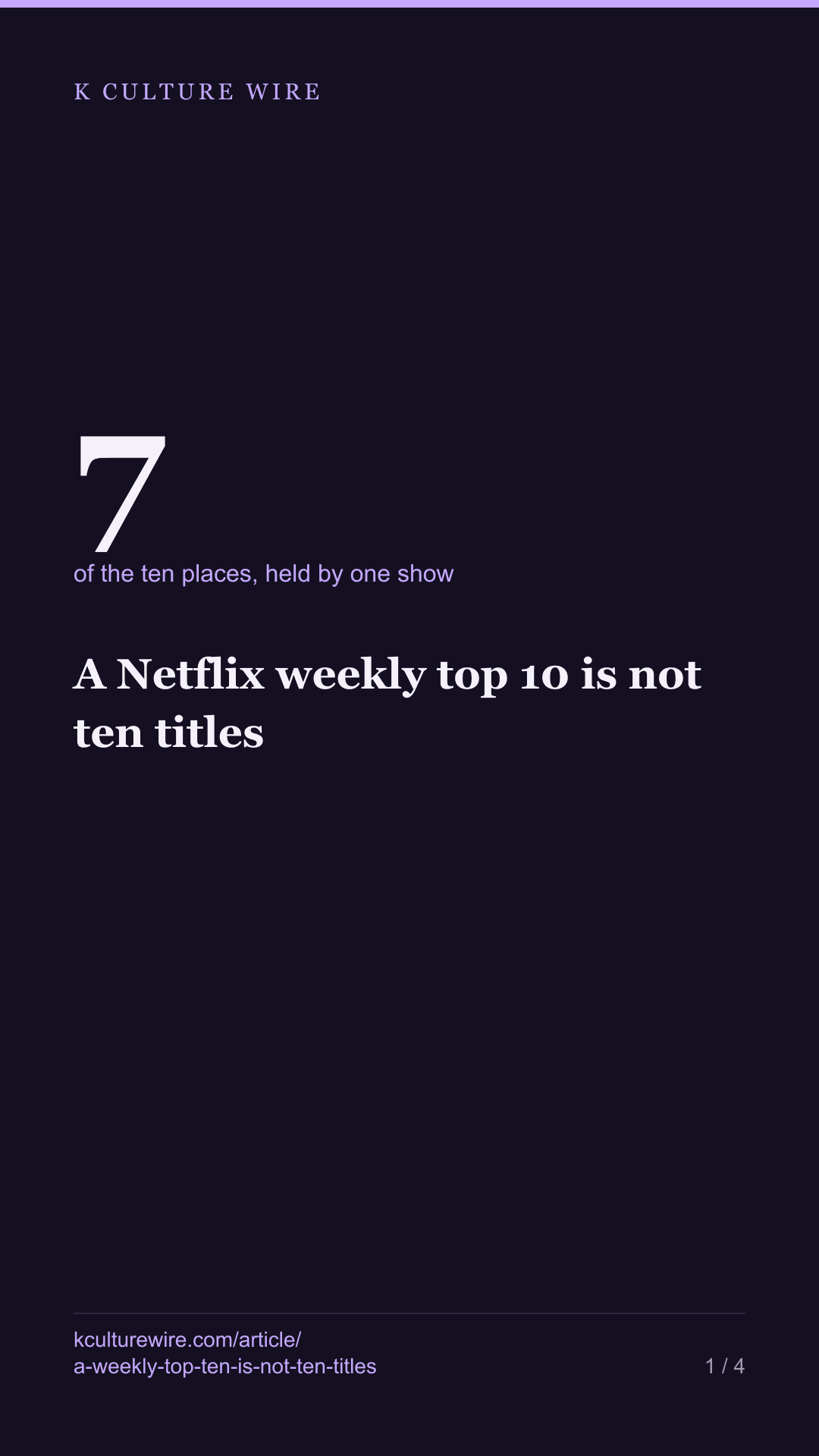
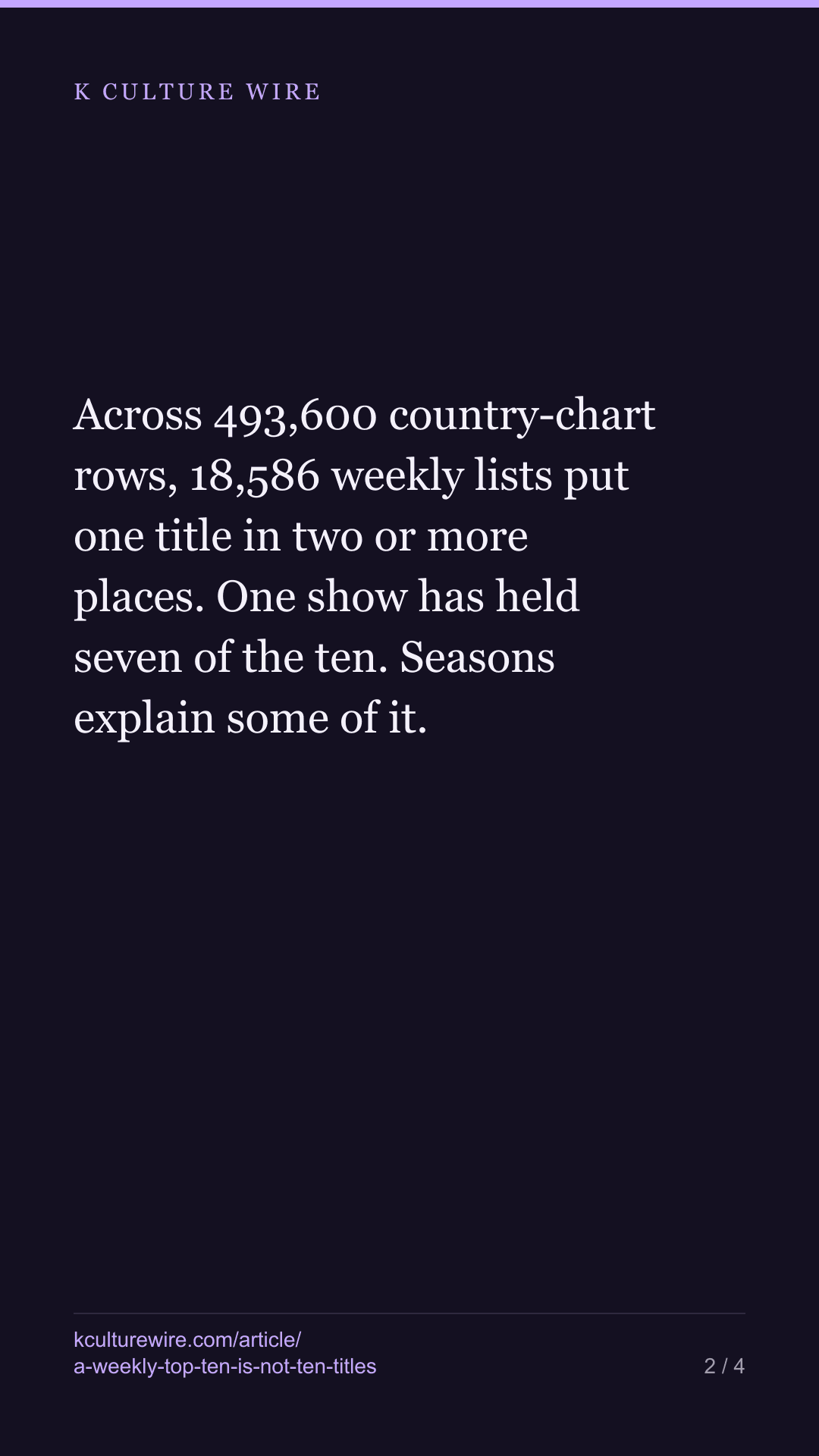
Across 493,600 country-chart rows, 18,586 weekly lists put one title in two or more places. One show has held seven of the ten. Seasons explain some of it.
The table this is written from: /titles
Netflix publishes a top ten for each country each week, split into films and television. We hold 493,600 of those rows, from July 2021 to July 2026.
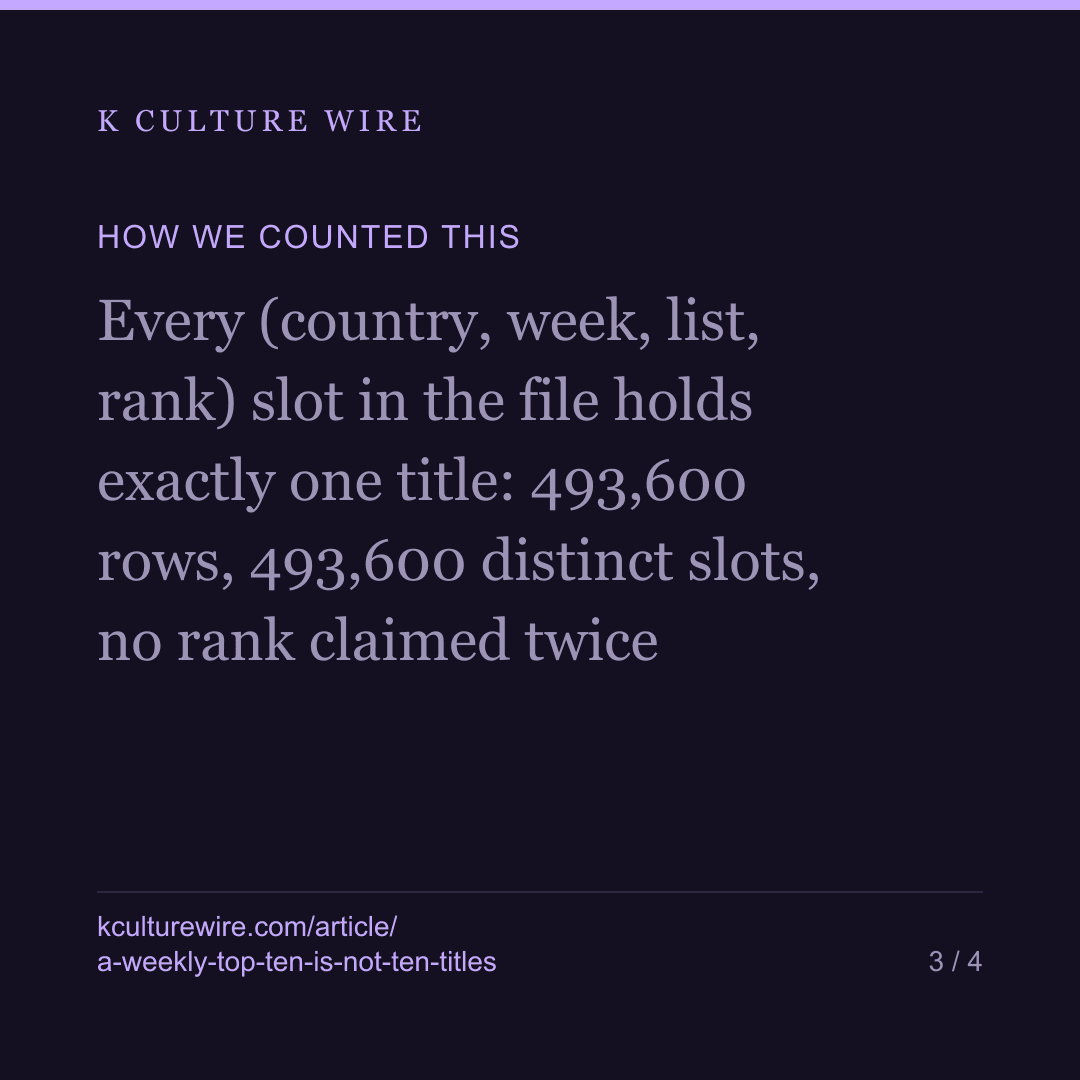
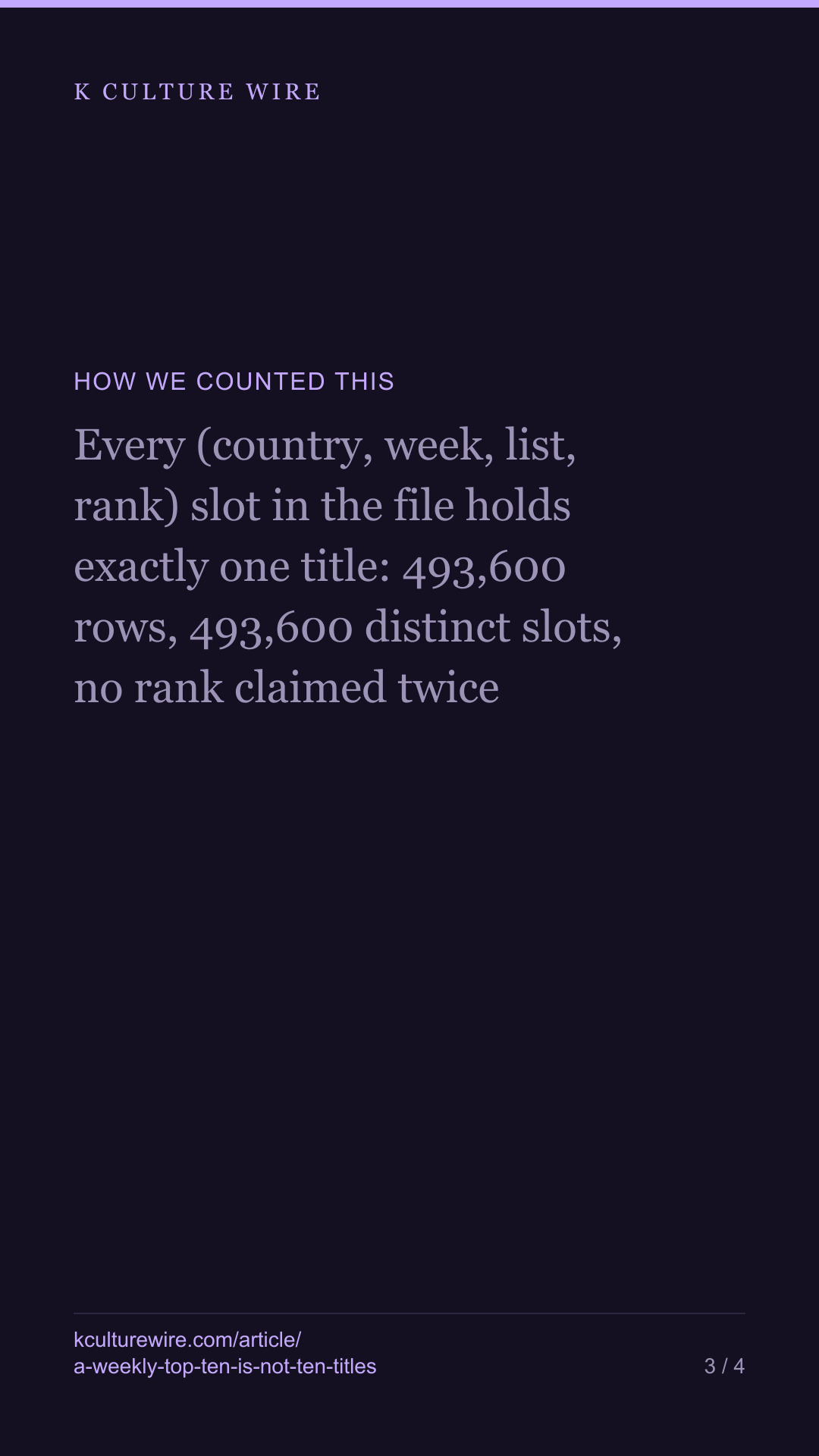
The file is clean in the way people usually check for. Every combination of country, week, list and rank appears exactly once — 493,600 rows, 493,600 slots, no rank ever claimed by two titles. No row is a byte-for-byte copy of another, so nothing here is a download that ran twice.
It is not clean in the way that matters for joining. A title is not a key.
One name, several places
Take the title, the country, the week and the list — the four things you would naturally join on — and 18,586 of those combinations hold more than one row. That is 26,093 rows more than there are distinct titles-in-a-list, or 5.29% of the file.
| Places one title held in a single weekly ten | Times |
|---|---|
| 2 | 13,264 |
| 3 | 3,629 |
| 4 | 1,251 |
| 5 | 395 |
| 6 | 44 |
| 7 | 3 |
It reaches 419 titles across 94 countries. Friends took seven of Jordan’s ten television places in the week of 9 April 2023, and seven again the week of 22 May 2022; it took seven of Latvia’s the week of 11 September 2022. The Rookie held six of the Bahamas’ ten for four consecutive weeks in July 2025.
Seasons explain almost all of it
Netflix charts seasons separately and prints the season in its own column. Add that column to the key and the 26,093 extra rows fall to 25. Seasons account for 26,068 of them — 99.9%.
That is a fact about the product, not an error in the file. A viewer finishing one season and starting the next is two things happening, and Netflix counts them as two. But it means the sentence “the show spent 40 weeks on the chart in Jordan” is not a number you can read off a row count, and neither is “the country’s ten most-watched shows”. In the weeks above, Jordan’s ten most-watched shows were four.
We are exposed to this ourselves. Our Southeast Asia panel of Korean titles reads 34,172 rows out of this file, covering 32,993 distinct title-country-weeks. Count rows and you get 1,179 more than there are weeks, an overstatement of 3.5%, concentrated on the titles with the most seasons — Squid Game occupies three places in a single country’s list in the weeks after its last season landed. Every figure we publish counts distinct weeks for exactly this reason, which is also why our numbers will not match a row count taken from the same file.
The twenty-five that are left
Strip the seasons out and 25 pairs survive: same title, same country, same week, same list, no season on either row. They are not seasons and they are not duplicate downloads. They are two different films with the same name in one top ten.
| Title | Pairs | When |
|---|---|---|
| Inheritance | 21 | 23 June 2024, across Latin America and the Caribbean |
| The Mummy | 3 | August 2022, Latvia and Lithuania |
| Cheaper by the Dozen | 1 | 14 December 2025, Trinidad and Tobago |
Netflix’s own weeks-on-chart column separates 23 of the 25. In Chile that week, one Inheritance sat at rank 2 in its fourth week on the chart and the other at rank 3 in its first. In Mexico they were ranks 2 and 5, again a fourth week beside a first. A title cannot be in its first and its fourth week at the same time, so these are two works.
The remaining two match on weeks-on-chart as well, and the file carries no year, no runtime and no identifier. We can say two works are there. We cannot say which two, and we have not guessed.
Why this is the whole problem in miniature
Most of our work on this data is spent on one question: does a name identify a work? Netflix does not publish a country of production, so we match titles against Wikidata by name, and we measure how often that name is shared with a foreign work rather than assume it is not.
The usual objection to that worry is that it is an artefact of joining two datasets that were never meant to meet. These 25 rows say otherwise. The collision happens inside Netflix’s own file, with no join at all — one country, one week, one list of ten, and the same six letters printed twice for two different films.
If a name cannot separate two films in a single top ten, it cannot separate a Korean film from a foreign one across five years and ninety-four countries either. That is why our panel carries a second column saying how sure we are, and why we publish the queue of titles we have not settled instead of quietly settling them.
Where these numbers come from
Sources
- Netflix — Top 10 weekly country lists (Tudum), every country Netflix publishes, 2021-07-04 to 2026-07-26. Each row carries week, country, list (Films or TV), rank, title, season and weeks-on-chart · https://www.netflix.com/tudum/top10
What we checked
- Every (country, week, list, rank) slot in the file holds exactly one title: 493,600 rows, 493,600 distinct slots, no rank claimed twice
- No row in the file is a byte-for-byte repeat of another row, so nothing here is a download that ran twice
- Adding season to the key takes the repeated titles from 26,093 rows to 25, which is what identifies seasons as the cause rather than a guess about it
- The 25 remaining pairs were checked on Netflix's own weeks-on-chart column, which differs within 23 of them
What we left out, and why
- Hours. Netflix publishes viewing hours for its global list only; the country lists carry rank and nothing else, so everything here is counted in rows, slots and weeks
- Any claim about which Inheritance or which Mummy is which. The file gives no year, no runtime and no identifier, so we can say two works are present and not which two
- The two remaining pairs whose weeks-on-chart also match. We cannot separate them with anything in the file and we are not going to separate them with a guess
The data behind this
Written from the same data
Take this away — 8 cards
The figures in this article, as images. Free to repost with the address on them.
If you work in this business
Everything on this page is measured from the same weekly Netflix lists, per market and per title. We publish the pages free; what we sell is the same measurement cut to one company's catalogue — including the figures behind /titles and /reach.
What a company sheet contains, and what it cannot tell you →