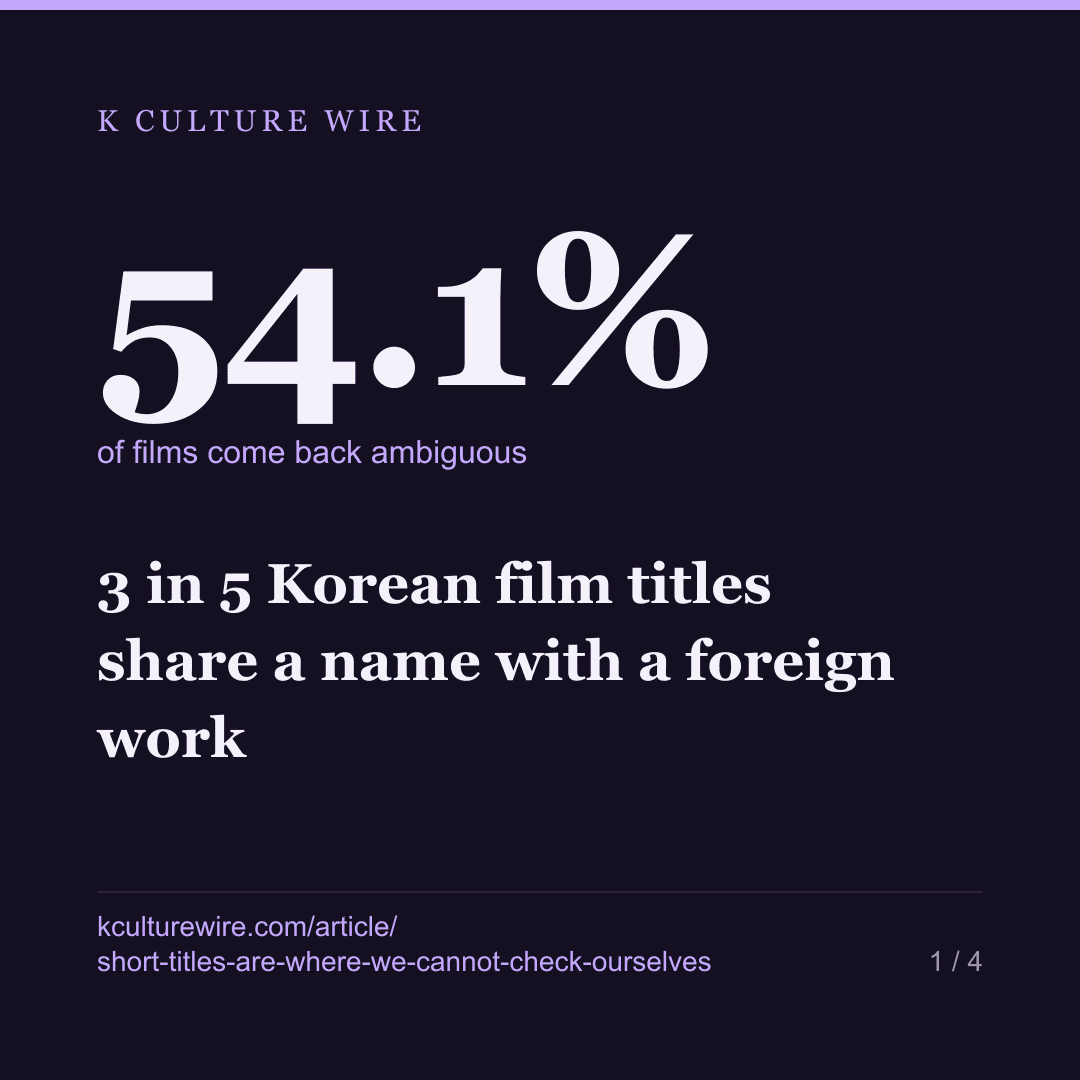
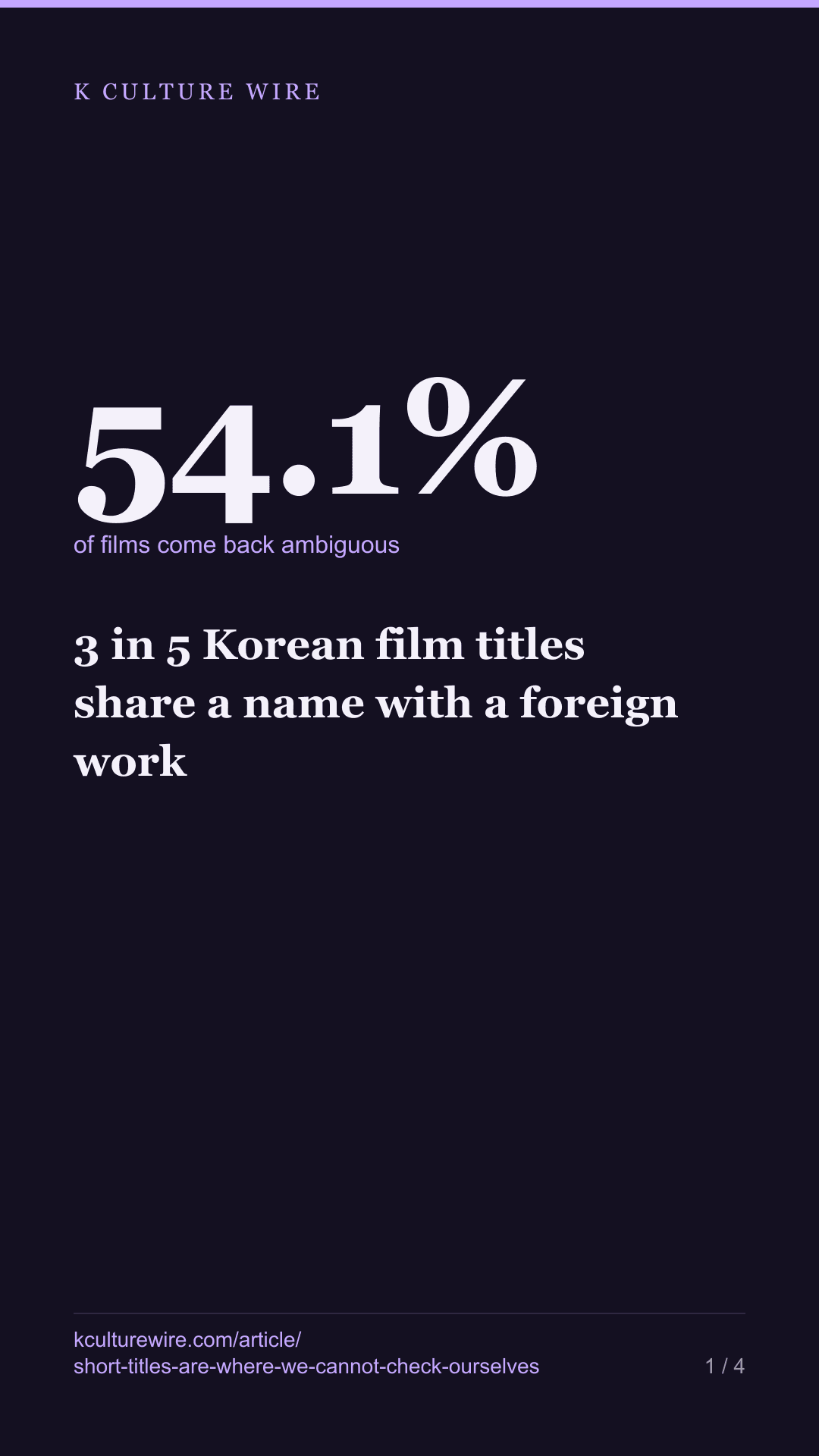
3 in 5 Korean film titles share a name with a foreign work
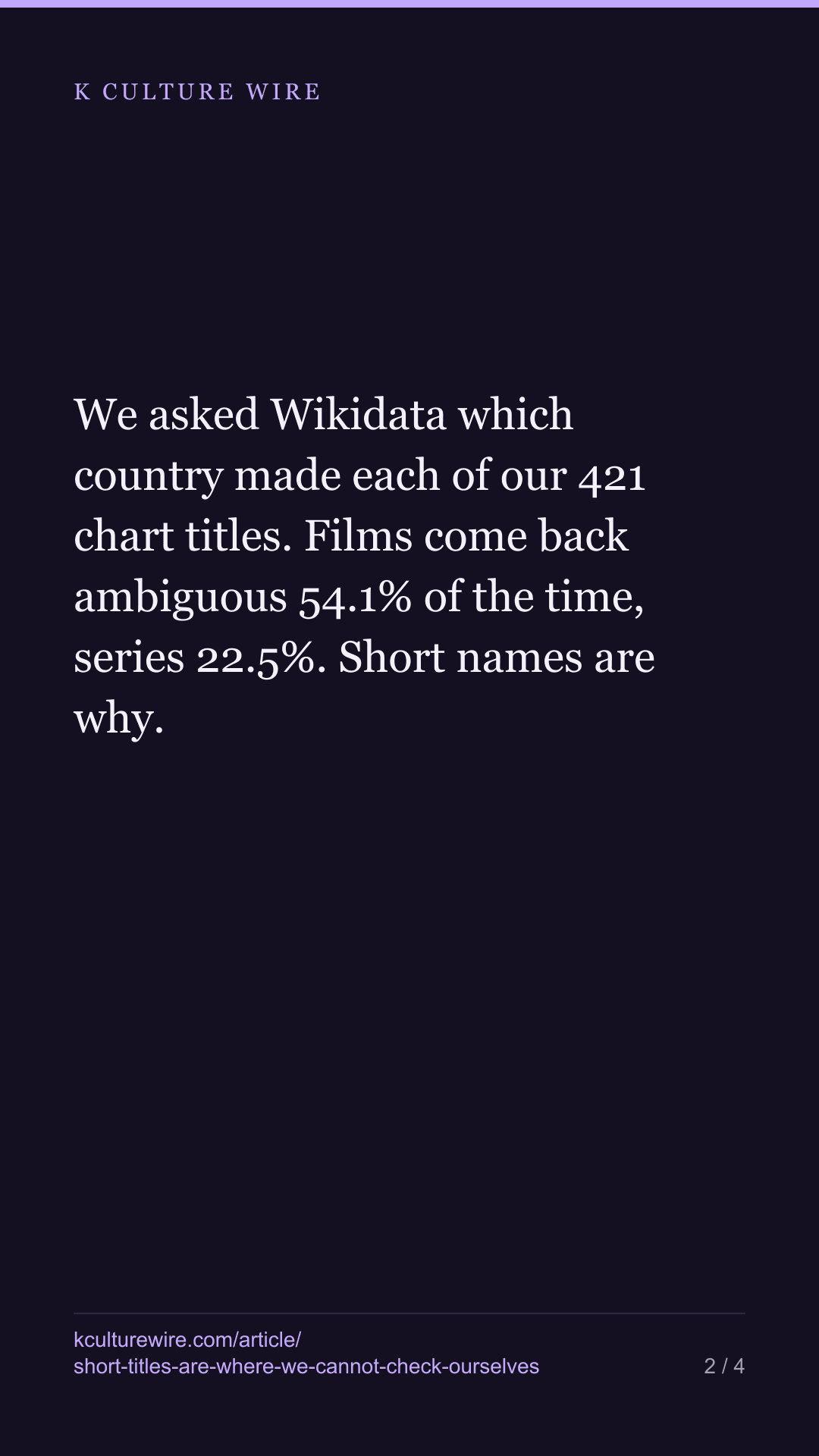
We asked Wikidata which country made each of our 421 chart titles. Films come back ambiguous 54.1% of the time, series 22.5%. Short names are why.
The table this is written from: /titles
Our Southeast Asia panel holds 421 Korean titles. A title is in it because its English name matches a Korean work in Wikidata. That rule can fail in exactly one way: another country made something with the same name.
So we asked, for every title in the panel, which countries produced a film or series carrying exactly that label.
| Titles | Name shared with a foreign work | |
|---|---|---|
| Series | 249 | 22.5% |
| Films | 172 | 54.1% |
| Whole panel | 421 | 35.4% |
More than half of our film titles cannot be settled by name. For series it is fewer than one in four. Anyone using our film numbers is standing on much softer ground than anyone using our series numbers, and until now we had not said so, because we had not measured it.
The reason is length, mostly
Sort the same 421 titles by how many words are in the name and the pattern is not subtle.
| Words in the title | Titles | Name shared |
|---|---|---|
| One | 102 | 71.6% |
| Two | 139 | 38.8% |
| Three | 96 | 13.5% |
| Four or more | 84 | 10.7% |
A one-word title is more than six times as likely to collide as a four-word one. Carter, Karma, Hunt, Believer, Ballerina — each of those is a Korean work, and each is also the name of something else, often several things.
Korean films get short names. The median film title in the panel is two words and 39% of them are a single word; the median series title is three words and only 14.1% are one word. Series arrive with names like Extraordinary Attorney Woo and When Life Gives You Tangerines, which nothing else in the world is called.
But length is not the whole gap
Hold the length fixed and the films are still worse.
| Words | Series shared | Films shared |
|---|---|---|
| One | 57.1% (35) | 79.1% (67) |
| Two | 30.2% (86) | 52.8% (53) |
| Three or more | 7.8% (128) | 23.1% (52) |
At every length, a Korean film’s title is roughly 20 points more likely to be shared than a Korean series’ title of the same length. Short film names are not just short, they are drawn from a smaller and more common pool — one-word abstractions, single names, ordinary nouns.
This means our film panel is the part of our data most likely to contain something that is not Korean, and it is the part we can least easily check. It is also the smaller side: 172 titles against 249, and 476 chart-weeks against 1,878.
A second ruler we had not used
Wikidata tells us a collision is possible. It cannot tell us which work actually charted. For that we had one instrument sitting unused: Netflix’s own South Korea chart.
A Korean title normally also plays in Korea. Of the 149 shared titles, 75 have never appeared on Netflix’s Korean top ten in five years. Twenty of those charted in exactly one country in the world, and fourteen of the twenty are films.
That list contains the clearest miss we have found since the title-matching correction:
- Impetigore charted for five weeks in Indonesia and nowhere else on earth. It is an Indonesian horror film. Wikidata has a Korean work of the same name, so our rule took it.
- The Lord Musang King charted for one week, in Malaysia. It is Malaysian.
- Wildflower charted for thirteen weeks, in the Philippines, in no other country, ever.
One of those three is no longer in the panel. Between this piece first publishing and this revision we removed eight titles, Wildflower among them, for a reason stronger than the queue: our own attribution query returned no Korean work at all for those exact names. Impetigore and The Lord Musang King stayed, because Wikidata does list a Korean work of each name. Both are still in the queue and both, we think, are the Indonesian and Malaysian films.
Why we have not simply deleted the eighty-four
Because the same test also flags titles that are obviously Korean.
Vagabond charted eight weeks in Vietnam and nowhere else, including not in Korea. It is a Korean drama. Smugglers and Keys to the Heart are Korean films; neither ever reached Korea’s own top ten. A Korean title can miss the Korean chart for reasons that say nothing about where it was made: it was released before July 2021 and had its run before this data begins, it was a cinema film Netflix never streamed domestically, or it simply lost its week at home to something bigger.
Absence from the Korean chart is a reason to look, not a verdict. The measurement produces a queue: 20 titles that charted in one country only, 19 more concentrated above half in a single country, 36 that spread widely but never touched Korea. We will work down it and every removal will appear on our corrections page with the evidence that moved it.
What this changes about reading us
Two things, and we would rather you took them from us than found them yourself.
Our series figures are the solid half. 22.6% name ambiguity, and the biggest series in the panel are Netflix originals whose names are unique.
Our film figures carry real risk of contamination, concentrated in one-word titles that charted briefly in a single country. Those are also the smallest entries — the median flagged title stayed two weeks — so the risk sits in the tail rather than the top. It is still there.
The one thing we can say without hedging is the size of what we do not know, which is what this piece is. A panel that reported 421 titles and said nothing else would be a cleaner-looking number and a worse one.
Every panel here carries its verification columns with it. Read what is in the data and what is missing from it →
What changed on 2 September 2026
We re-collected the Netflix files on 25 August 2026 and recounted. The film side moved from 476 chart-weeks to 475; every other figure here came back the same.
The finding did not change. The film panel is still the smaller side and still the part we can least easily check.
What changed on 3 September 2026
One of our source files had gone stale. The Korea-signal table was still the 8 August build, so it still counted Dangerous Liaisons — the French film we removed on 25 August — and it had not picked up titles that charted after that date. Rebuilding it moved the panel from 397 titles to 420, and every figure in this piece was recounted on the new panel.
What moved: film name-ambiguity from 58.1% to 54.1%, series from 23.6% to 22.6%, the whole panel from 37.5% to 35.5%. The review queue is now 20 one-country titles, 19 concentrated in one country and 36 that spread widely without touching Korea.
The finding did not change. Short names are still where we cannot check ourselves, and the film half of the panel is still the soft half — by a wider margin than the series half, exactly as before.
What changed on 3 September 2026
We added the chart week of 23 August 2026. It had been in our archive since the evening of 2 September while this panel still stopped at 16 August, so our own week pages and this piece were reading two different end dates. One title entered the panel with the new week.
| Was | Now | |
|---|---|---|
| Titles in the panel | 420 | 421 |
| Series | 248 | 249 |
| Films | 172 | 172 (unchanged) |
| Series with a shared name | 22.6% | 22.5% |
| Whole panel with a shared name | 35.5% | 35.4% |
| Three-word titles | 95 | 96 |
| Three-word titles with a shared name | 13.7% | 13.5% |
| Three-or-more, series | 7.9% (127) | 7.8% (128) |
| Panel rows read | 35,524 | 35,526 |
Three sentences here were stale for a different reason, and we would rather name that than let a new week cover it. The film-and-series comparison near the end still read 160 titles against 237, and 475 chart-weeks against 1,870 — figures from the 397-title panel this piece was first published against, left behind when the panel was rebuilt on 25 August. They are now 172 against 249, and 476 chart-weeks against 1,878. The films line said three in five cannot be settled by name, which was fair at 58.1% and is not at 54.1%; it now says more than half. And the gap between films and series was described as roughly 25 points when the three lengths give 22, 23 and 15; it now says roughly 20.
The finding did not change. Film titles are still the soft side of this panel, at every title length, and short names are still why.
Where these numbers come from
Sources
- Netflix — Top 10 weekly country lists (Tudum), every country Netflix publishes, 2021-07-04 to 2026-07-26. Our Southeast Asia panel is Singapore, Malaysia, the Philippines, Thailand, Indonesia and Vietnam · https://www.netflix.com/tudum/top10
- Wikidata — For every chart title, the countries of origin (P495) of every film or TV series carrying exactly that English label · https://query.wikidata.org
What we checked
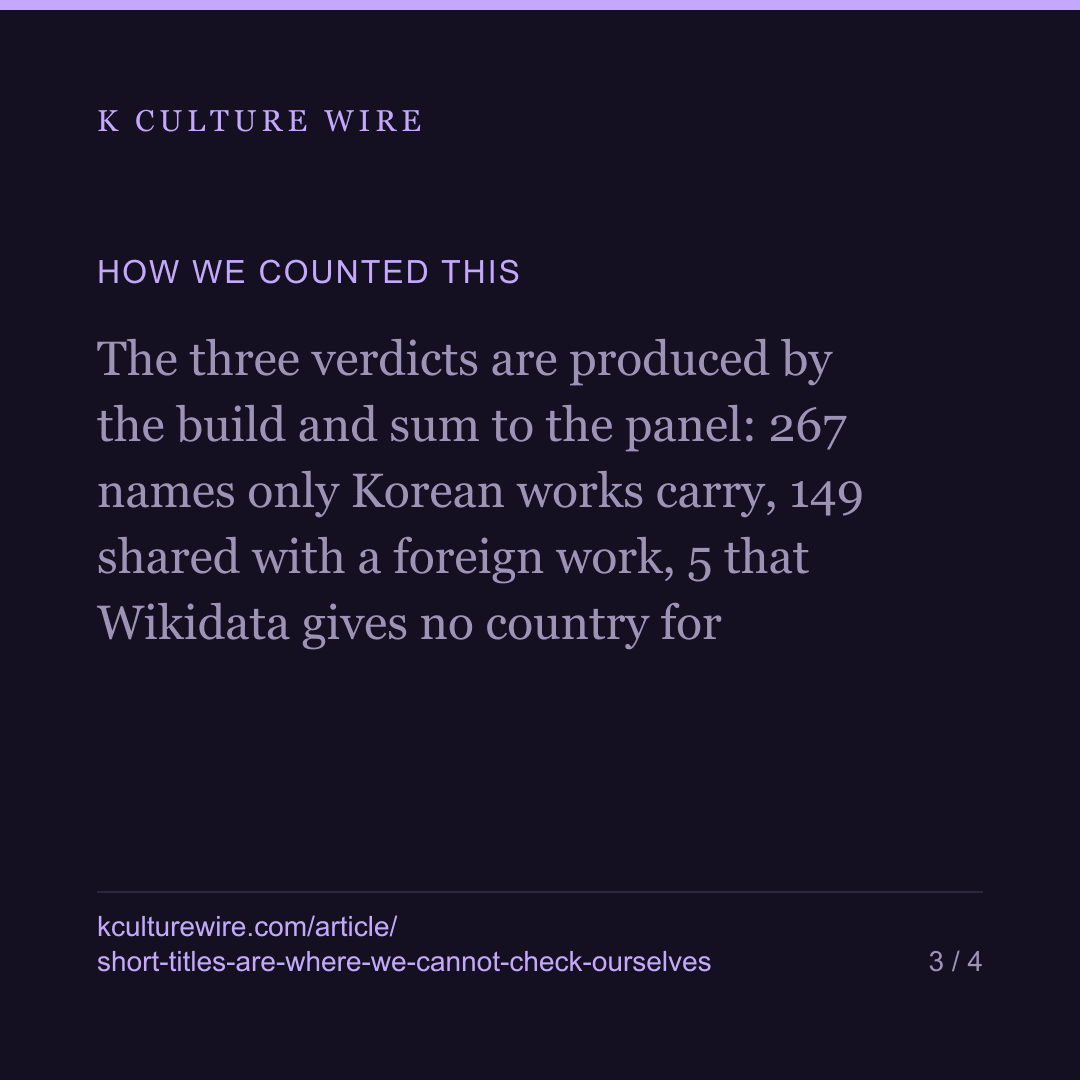
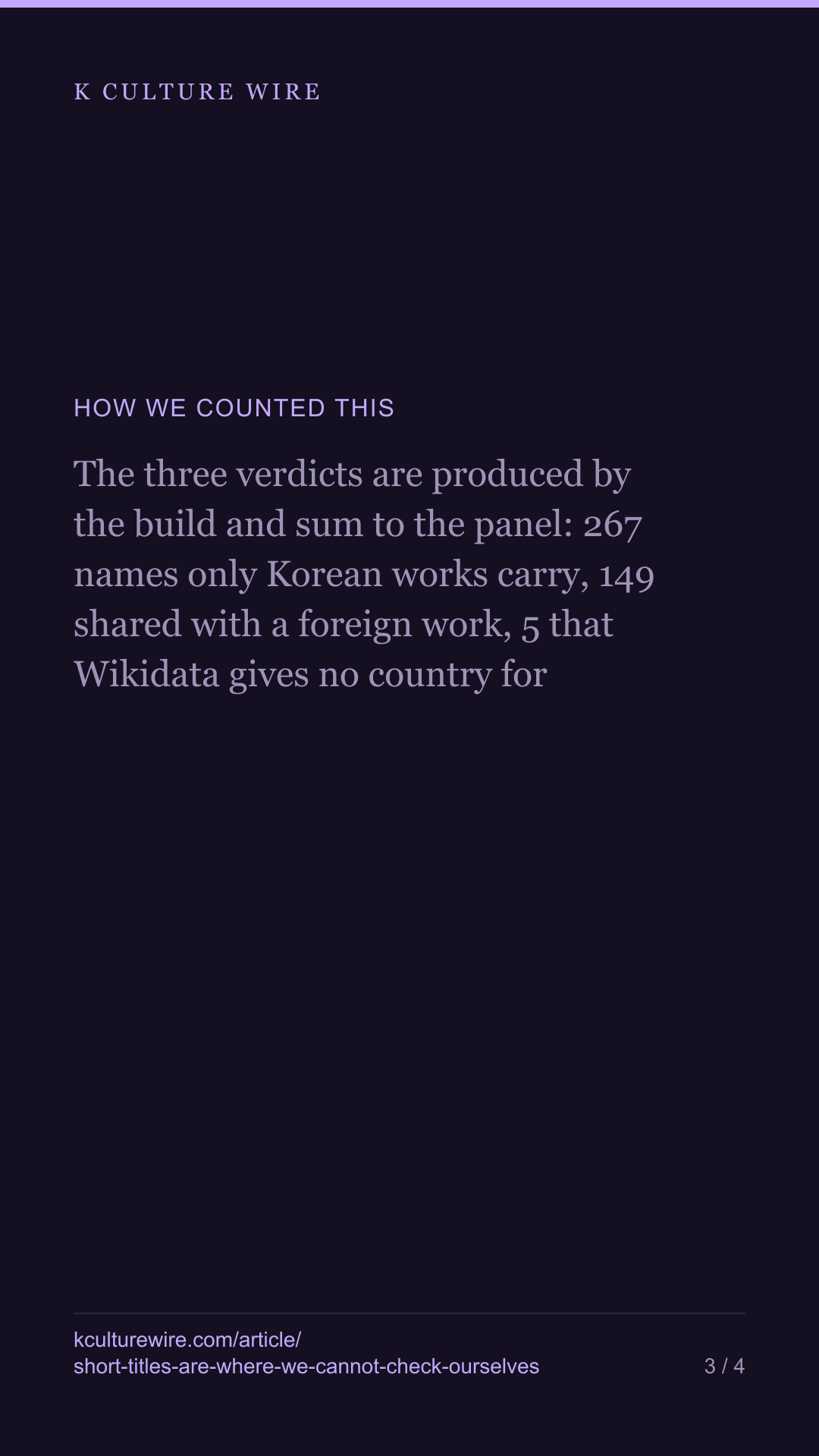
- The three verdicts are produced by the build and sum to the panel: 267 names only Korean works carry, 149 shared with a foreign work, 5 that Wikidata gives no country for
- Word counts are taken from the chart title as Netflix publishes it, so The Glory is two words and D.P. is one
- The South Korea comparison uses Netflix's own Korean country chart over the same weeks, counted as distinct weeks per country rather than rows, because the source file repeats 1,239 of 35,526 panel rows
What we left out, and why
- Any claim that a shared title is the wrong title. Shared means the name alone cannot settle it, and for most of these the Korean work is plainly the one that charted
- Any correction to the panel itself. Nothing has been removed on the strength of this measurement; what it produces is a queue for human review, and any removals will appear on our corrections page with the evidence
- Hours. Netflix publishes viewing hours for its global lists only, so everything here is counted in titles and chart-weeks
The data behind this
Written from the same data
Take this away — 8 cards
The figures in this article, as images. Free to repost with the address on them.
If you work in this business
Everything on this page is measured from the same weekly Netflix lists, per market and per title. We publish the pages free; what we sell is the same measurement cut to one company's catalogue — including the figures behind /titles and /screen-split.
What a company sheet contains, and what it cannot tell you →