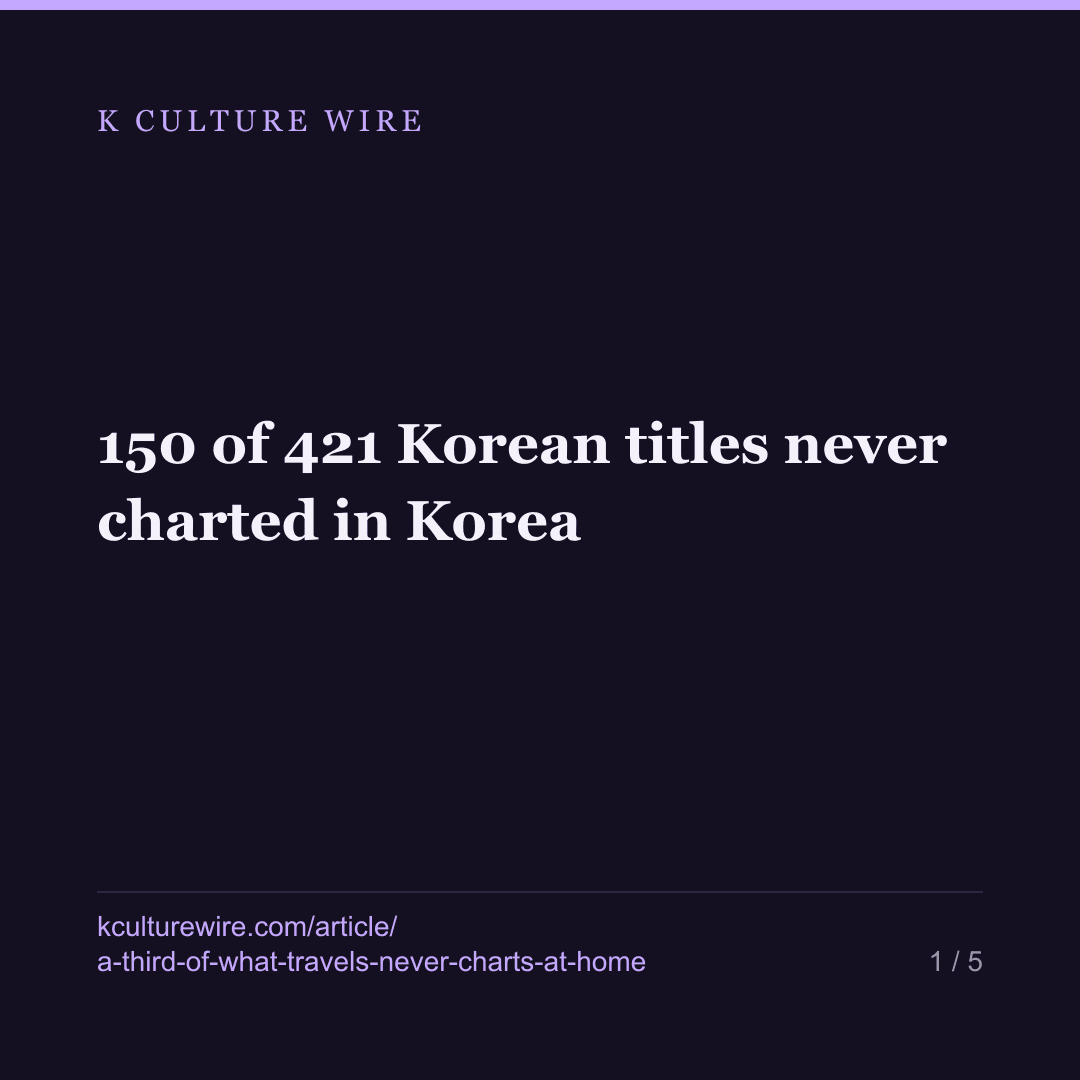
150 of 421 Korean titles never charted in Korea
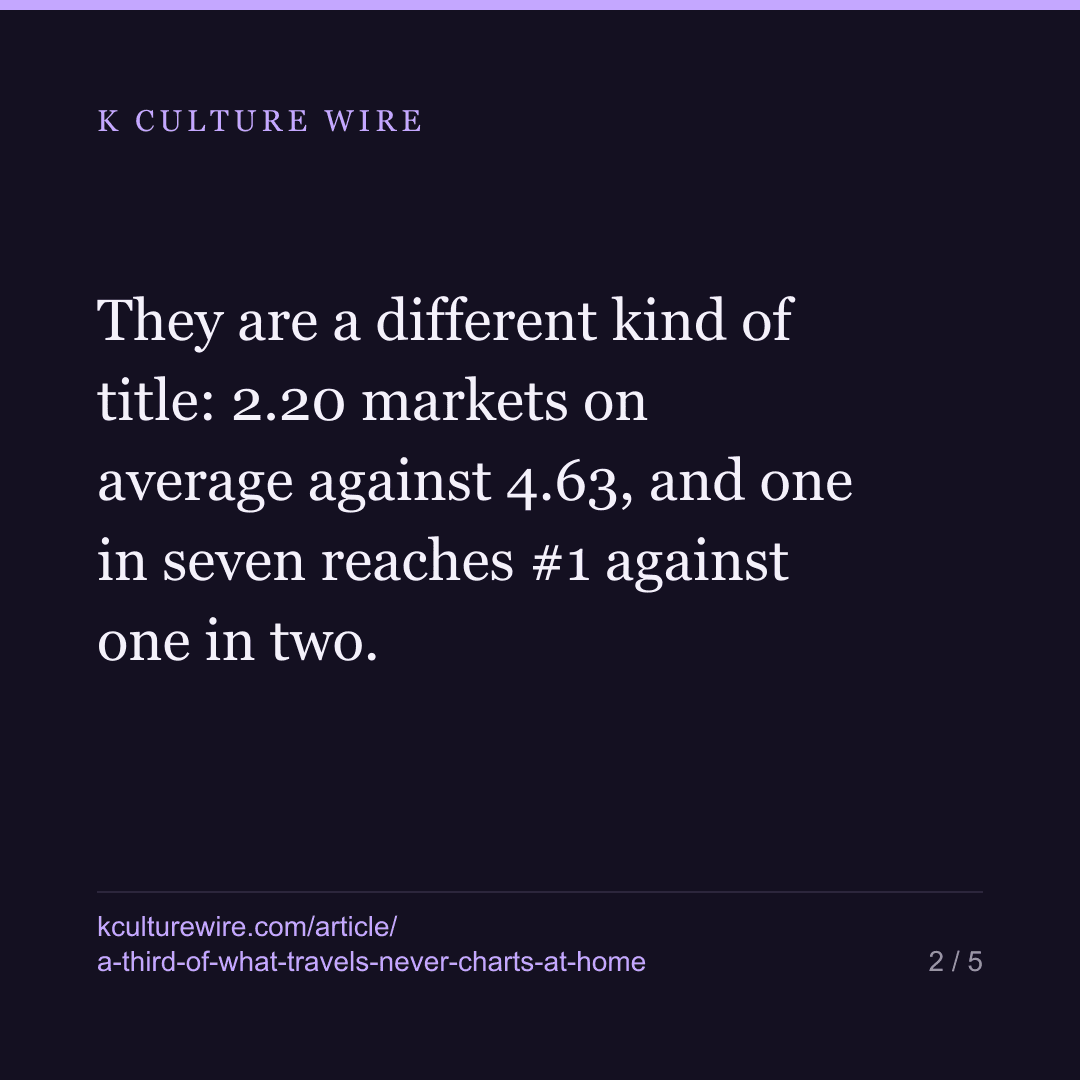
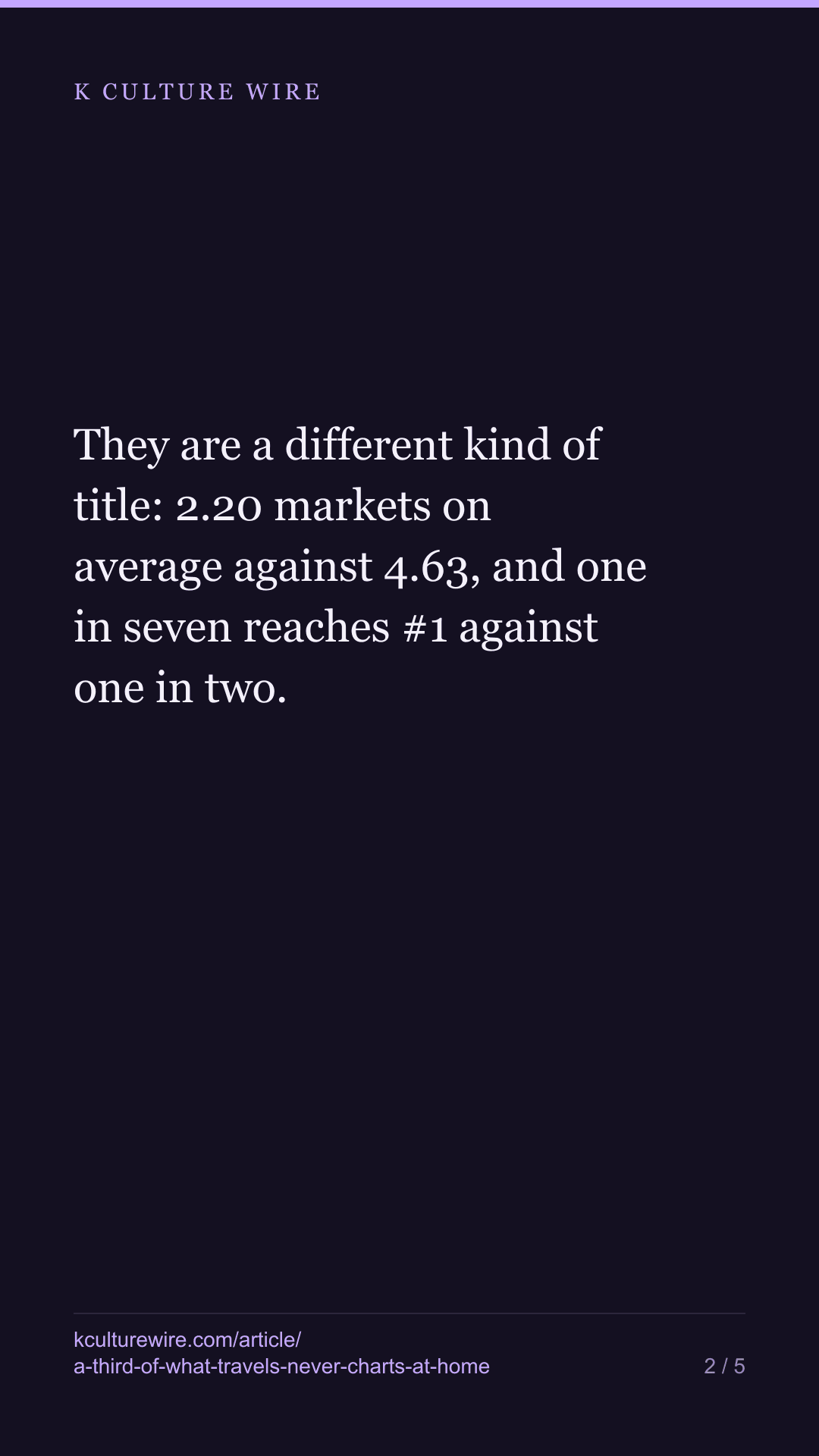
They are a different kind of title: 2.20 markets on average against 4.63, and one in seven reaches #1 against one in two. Netflix's Korean chart is not a smaller version of the regional one — it is a different chart.
The table this is written from: /titles
Of the 421 Korean titles that have reached a Netflix Top 10 somewhere in Southeast Asia since 2021, 150 have never once appeared on Netflix’s Top 10 in Korea.
That is 35% of the panel, and it is not a rounding of the tail. It is a structurally different group.
| Titles | Avg. markets reached | Avg. weeks | Reached #1 | |
|---|---|---|---|---|
| Also charted in Korea | 271 | 4.62 | 6.8 | 49.4% |
| Never charted in Korea | 150 | 2.20 | 3.4 | 15.3% |
A title that plays at home reaches more than twice as many Southeast Asian markets and is three and a half times as likely to reach number one in one of them.
The relationship is real but loose
Weeks on Korea’s chart and markets reached in Southeast Asia correlate at r = 0.51 across the 397. That is strong enough to be the main story and weak enough that the exceptions are the interesting part.
| Weeks on Korea’s chart | Titles | Avg. Southeast Asian markets |
|---|---|---|
| None | 140 | 2.21 |
| 1–3 | 75 | 3.43 |
| 4–9 | 156 | 4.96 |
| 10 or more | 40 | 5.53 |
Read down the right-hand column and the ladder is clean. Read the ends and it breaks: 15 titles reached all six Southeast Asian markets without ever charting in Korea, and 84 of the 134 single-market titles never charted at home either.
Put the other way: 8.1% of the titles that swept the region skipped the Korean chart entirely, and 62.7% of the single-market titles did.
What the exceptions are
The titles that travel without charting at home are mostly broadcast dramas. Young Lady and Gentleman and The Penthouse: War in Life each held eleven weeks across all six Southeast Asian markets; neither appears on Korea’s Netflix chart at all. Dr. Romantic and Sell Your Haunted House are the same shape.
This is not a mystery, and it is the reason we will not call these titles unpopular in Korea. They aired on Korean television. A KBS or SBS drama at nine in the evening is watched on the broadcaster, not on Netflix, so it never competes for a Netflix chart slot at home — while abroad, Netflix is the only place it exists.
The reverse case is smaller and more surprising: titles that hold Korea’s chart for weeks and reach exactly one Southeast Asian market. Guardian: The Lonely and Great God charted fourteen weeks in Korea and one market abroad. Nocturnal held thirteen at home and two weeks in one market.
Films skip home more than series do
52.3% of the films in this panel never charted in Korea, against 24.2% of the series. A Korean film often has its domestic life in cinemas, arrives on Netflix months later, and by then the domestic audience has seen it — while for a Southeast Asian viewer the Netflix release is the release.
That is a distribution fact, not a taste fact, and it is why a chart comparison across countries is harder to read than it looks.
Why this matters for anyone using the numbers
Netflix’s Korean chart is not a smaller version of its regional charts. It is a different chart, because it competes with a domestic television industry the other markets do not have.
Anyone using Korean Netflix performance as a proxy for how a title did in Korea will be wrong in a predictable direction: they will undercount broadcast drama and overcount Netflix originals. We use it here for exactly one purpose — as a second signal on whether a title with an ambiguous name is the Korean work — and even for that we treat absence as a reason to look, never as an answer.
And 140 is a floor, not a count of failures. It includes every title released before July 2021, which had its domestic run before this data starts. We cannot separate those out, so the honest reading of the 35% is: at most that many skipped Korea’s chart, and some of them never had the chance.
If a title can travel without playing at home, how much of the rest of the panel can we even check? Read the half we cannot verify by language →
What changed on 3 September 2026
One of our source files had gone stale. The Korea-signal table was still the 8 August build, which means it still counted Dangerous Liaisons — the 2022 French film we removed on 25 August after confirming against Wikidata that no Korean work carries that name. Rebuilding it moved the panel from 397 titles to 420, because the newer build also picks up titles that charted after 8 August.
The figures above were all recounted. The ones that moved: 140 titles that never charted in Korea became 150, the share went from 35.3% to 35.7%, and the film-versus-series gap went from 51.9% against 24.1% to 52.3% against 24.2%.
The finding did not change. About a third of what travels never charts at home, and the never-charted titles are still a different kind of title rather than a smaller version of the same one. We are printing the old and new figures side by side because a number that moves without saying so is a number no one should trust.
What changed on 3 September 2026
We added the chart week of 23 August 2026. One title entered the panel with it, and it had charted in Korea, so the denominator grew and the never-charted count did not.
| Was | Now | |
|---|---|---|
| Titles in the panel | 420 | 421 |
| Never once on the Korean chart | 150 | 150 (unchanged) |
| Also charted in Korea | 270 | 271 |
| Also charted — average markets | 4.63 | 4.62 |
| Also charted — share that hit #1 | 49.6% | 49.4% |
| Titles with 1–3 Korean weeks | 74 | 75 |
| Those titles — average markets | 3.46 | 3.43 |
| Single-market titles | 133 | 134 |
| Single-market titles never charted at home | 63.2% | 62.7% |
The finding did not change and the headline count did not move: 150 titles travelled without ever charting at home. The share is 35.6% of 421 rather than 35.7% of 420, which is the same third.
Where these numbers come from
Sources
- Netflix — Top 10 weekly country lists (Tudum), 2021-07-04 to 2026-07-26. The Southeast Asia panel is Singapore, Malaysia, the Philippines, Thailand, Indonesia and Vietnam; the home comparison is Netflix's South Korea list over the same weeks · https://www.netflix.com/tudum/top10
- Wikidata — Country of origin (P495 = Q884) to identify Korean works, and the same attribution query we publish elsewhere to exclude titles no Korean work carries · https://query.wikidata.org
What we checked
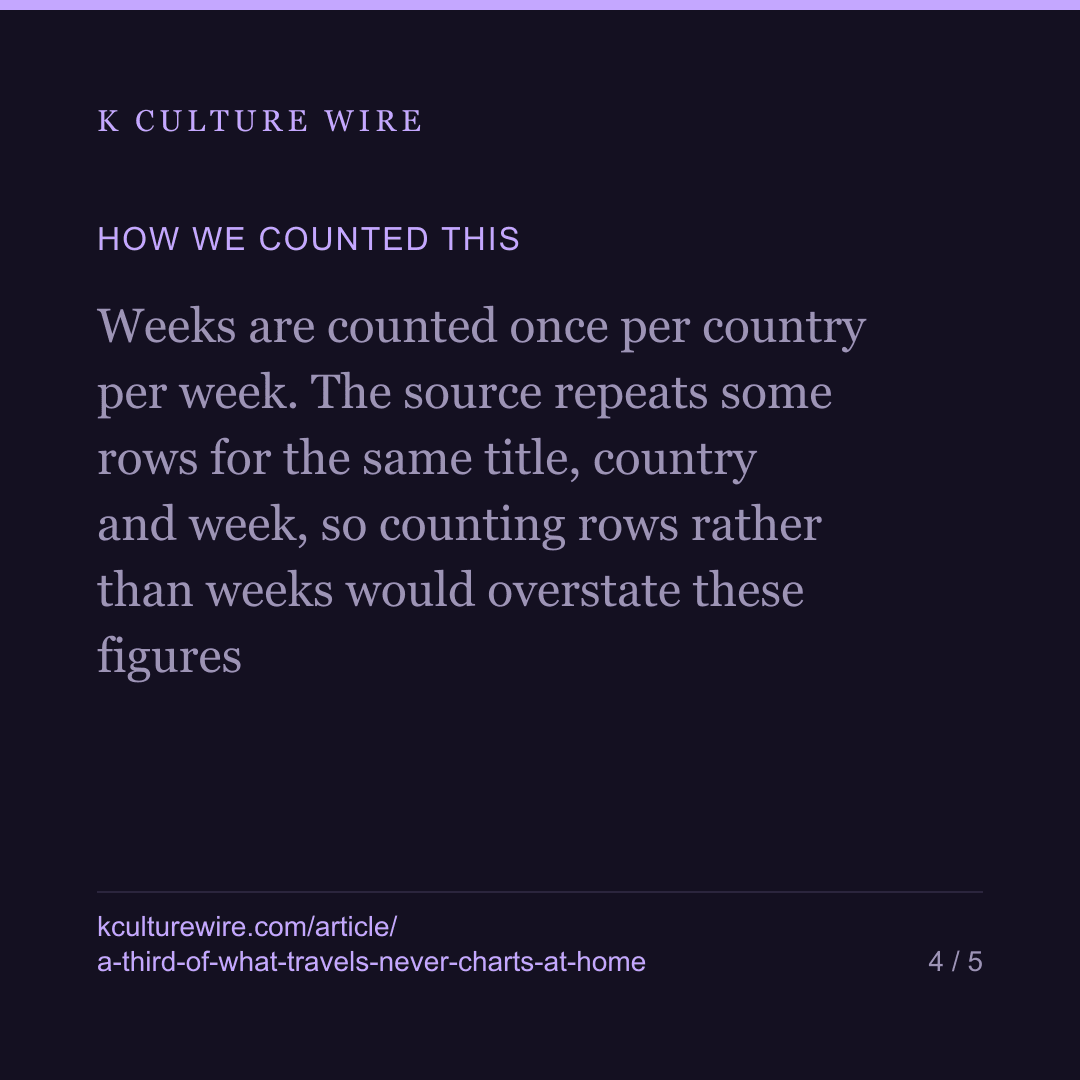
- Weeks are counted once per country per week. The source repeats some rows for the same title, country and week, so counting rows rather than weeks would overstate these figures
- Both sides of the comparison are the same instrument over the same 265 weeks: Netflix's own country lists. Nothing here mixes a Netflix figure with a broadcaster figure
- The panel is the corrected 397, after removing eight titles our attribution query says no Korean work carries
What we left out, and why
- Any claim that a title absent from Korea's chart was unpopular in Korea. Netflix's chart measures Netflix. A drama airing on KBS at nine in the evening can be watched by millions of Koreans and never appear
- Titles released before July 2021. They had their domestic run before this data begins, and their absence from the Korean chart means nothing
- Viewing hours. Netflix publishes hours for its global list only, so everything here is titles and chart-weeks
The data behind this
Written from the same data
Take this away — 10 cards
The figures in this article, as images. Free to repost with the address on them.

If you work in this business
Everything on this page is measured from the same weekly Netflix lists, per market and per title. We publish the pages free; what we sell is the same measurement cut to one company's catalogue — including the figures behind /titles and /reach.
What a company sheet contains, and what it cannot tell you →