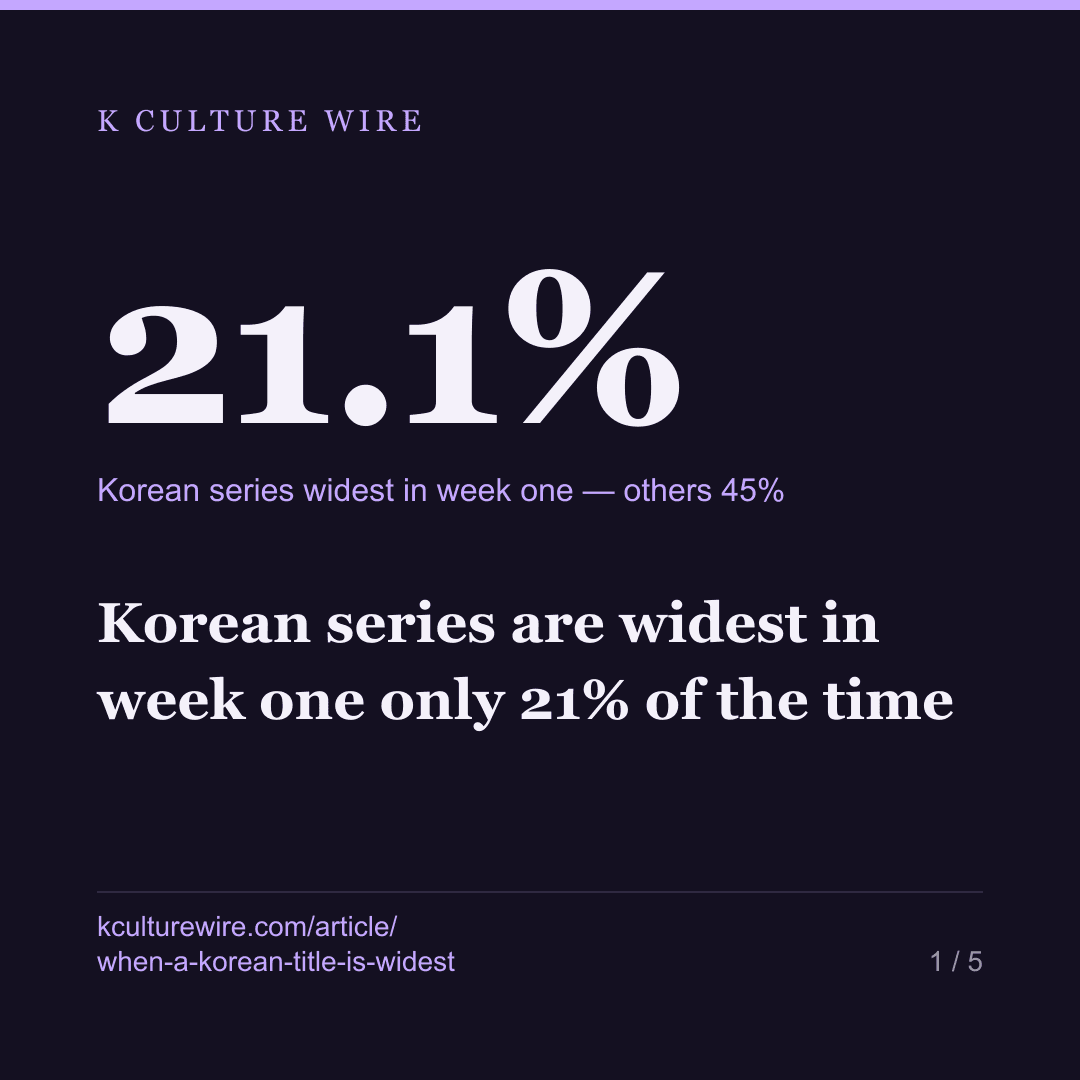
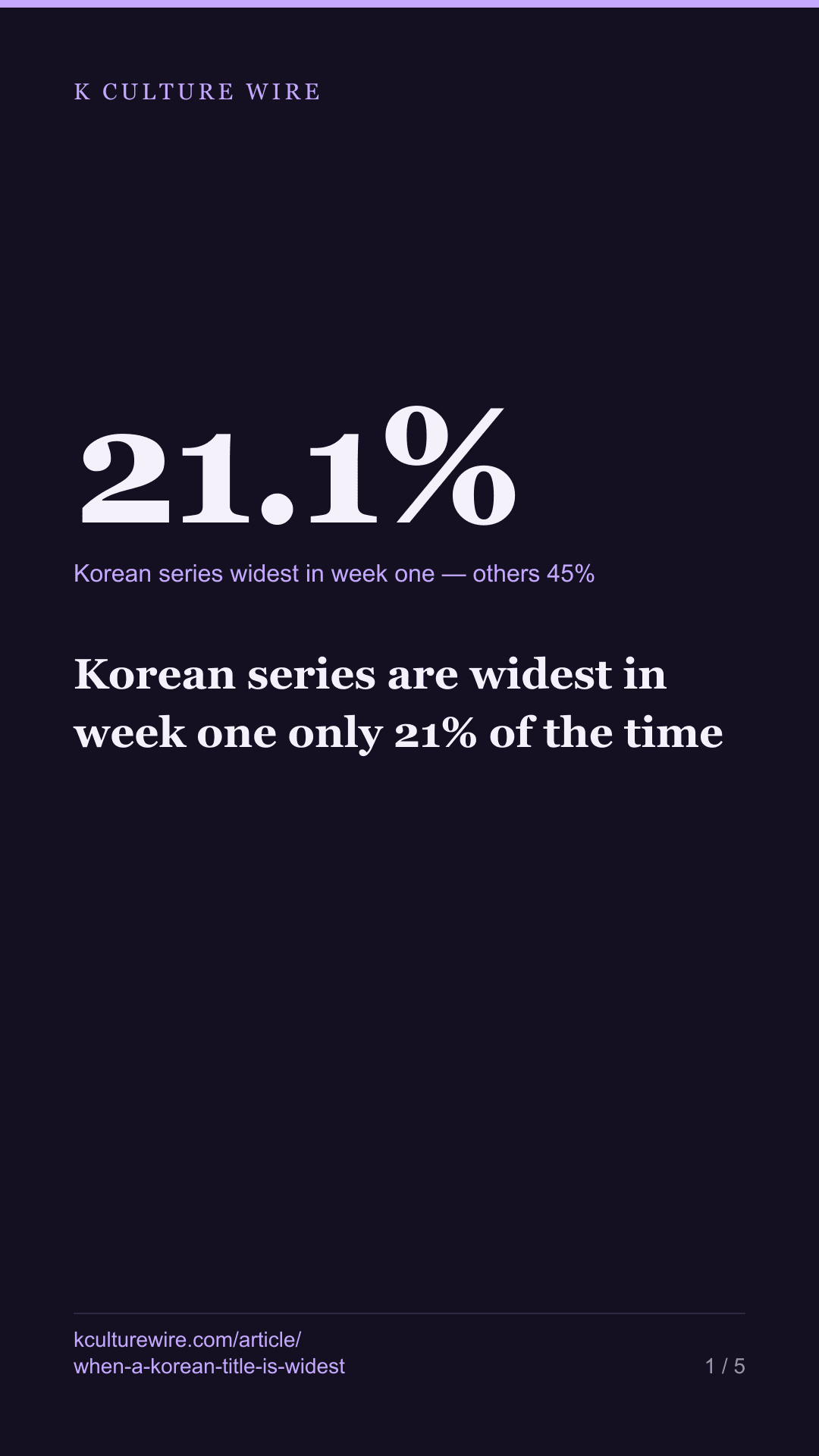
Korean series are widest in week one only 21% of the time
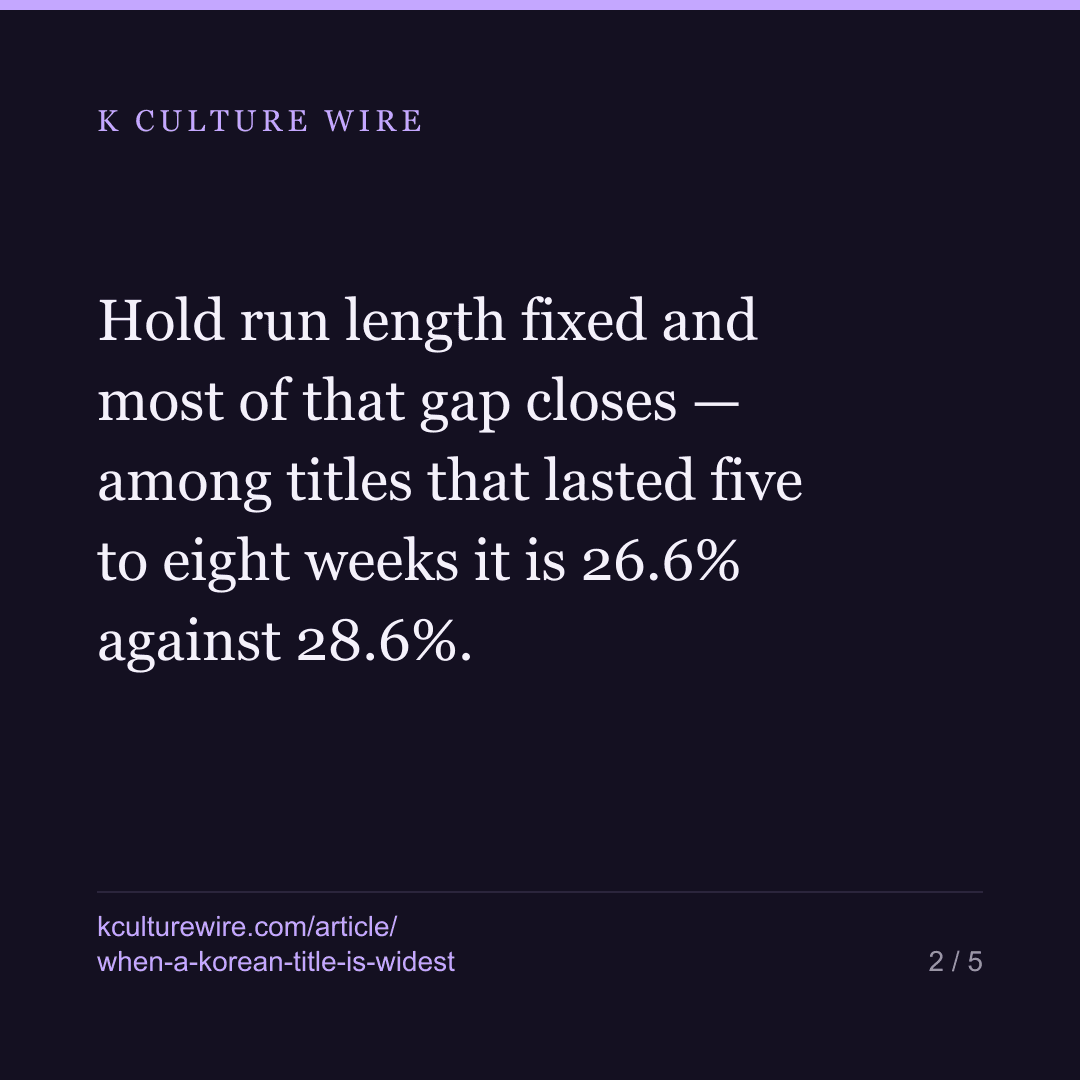
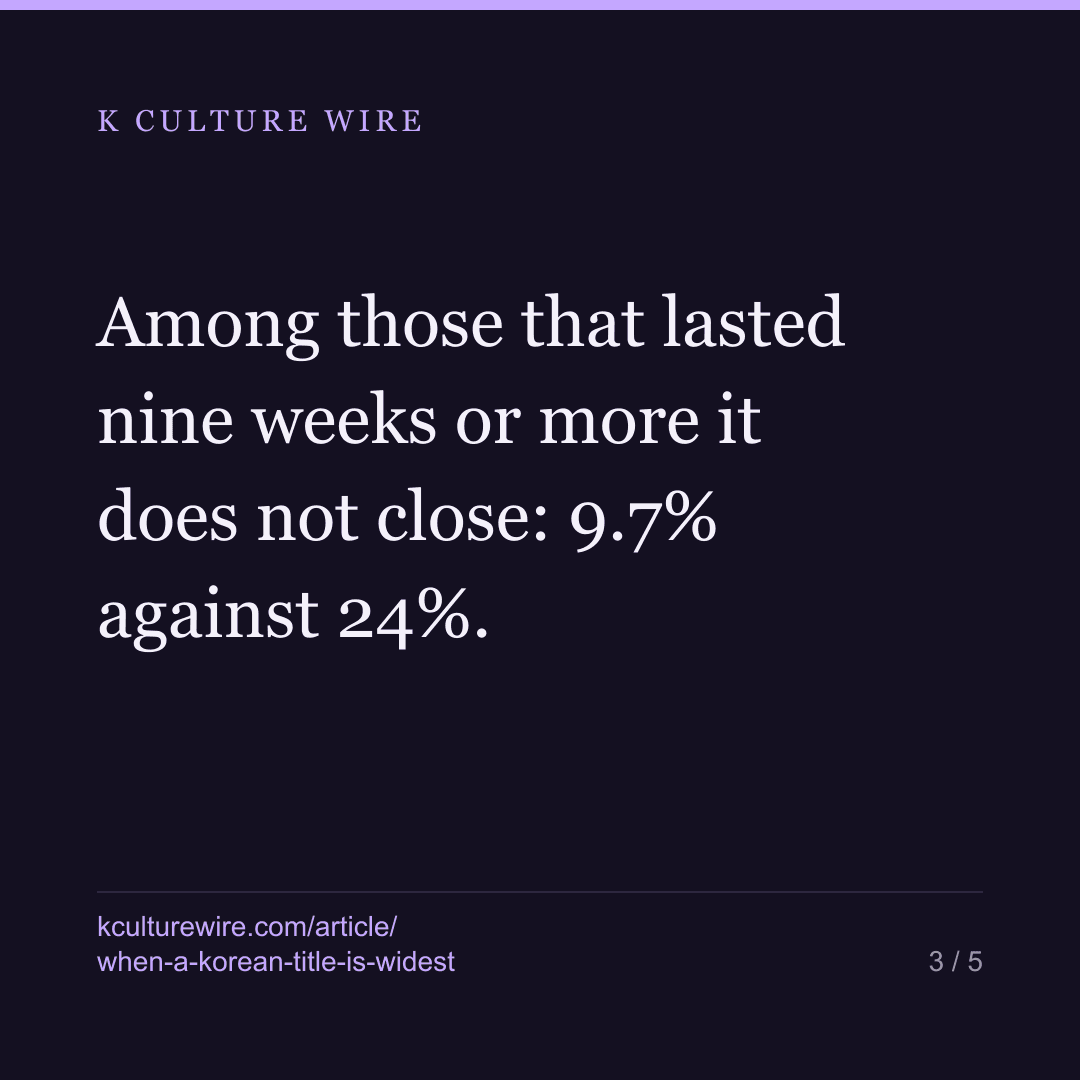
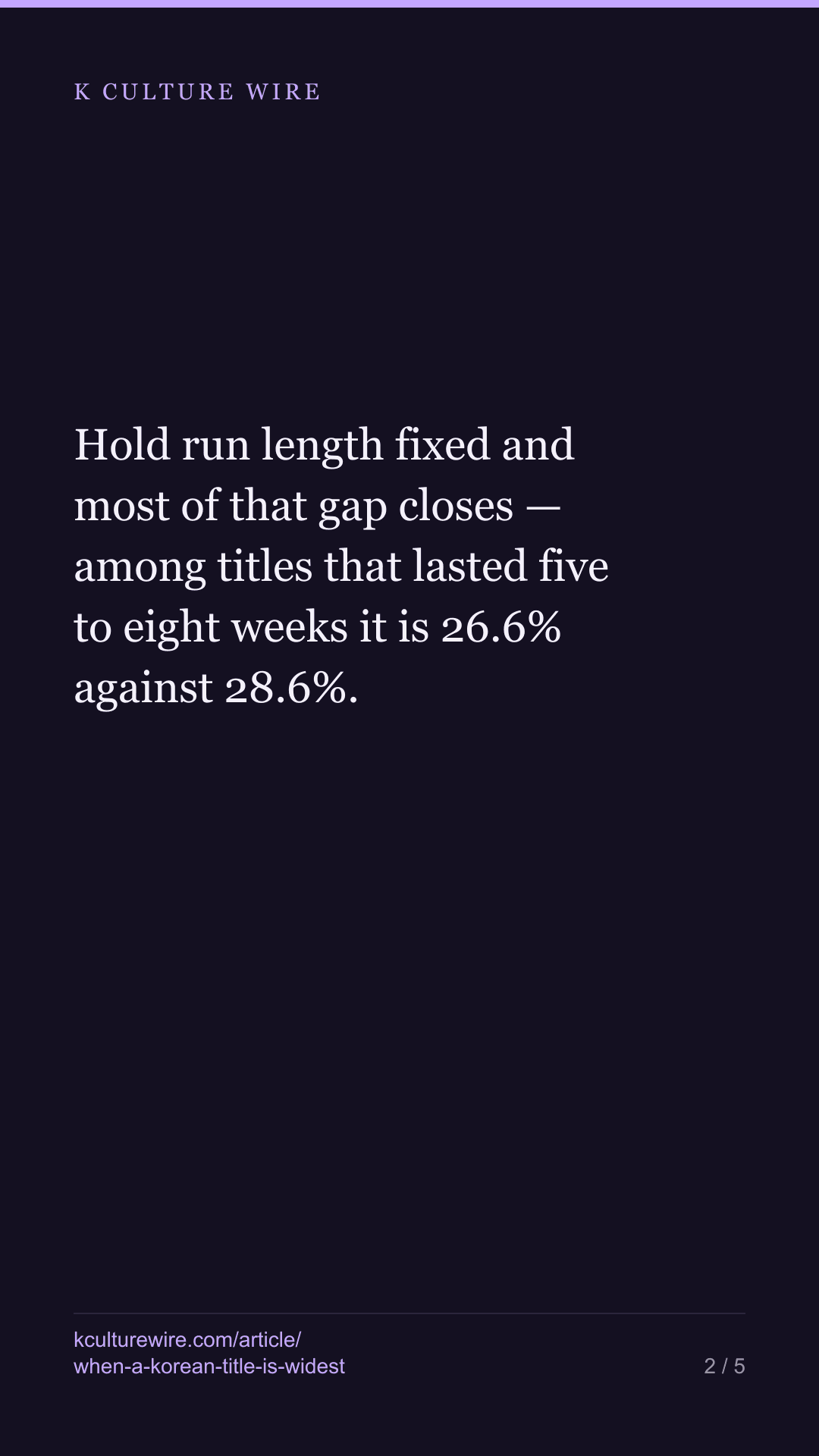
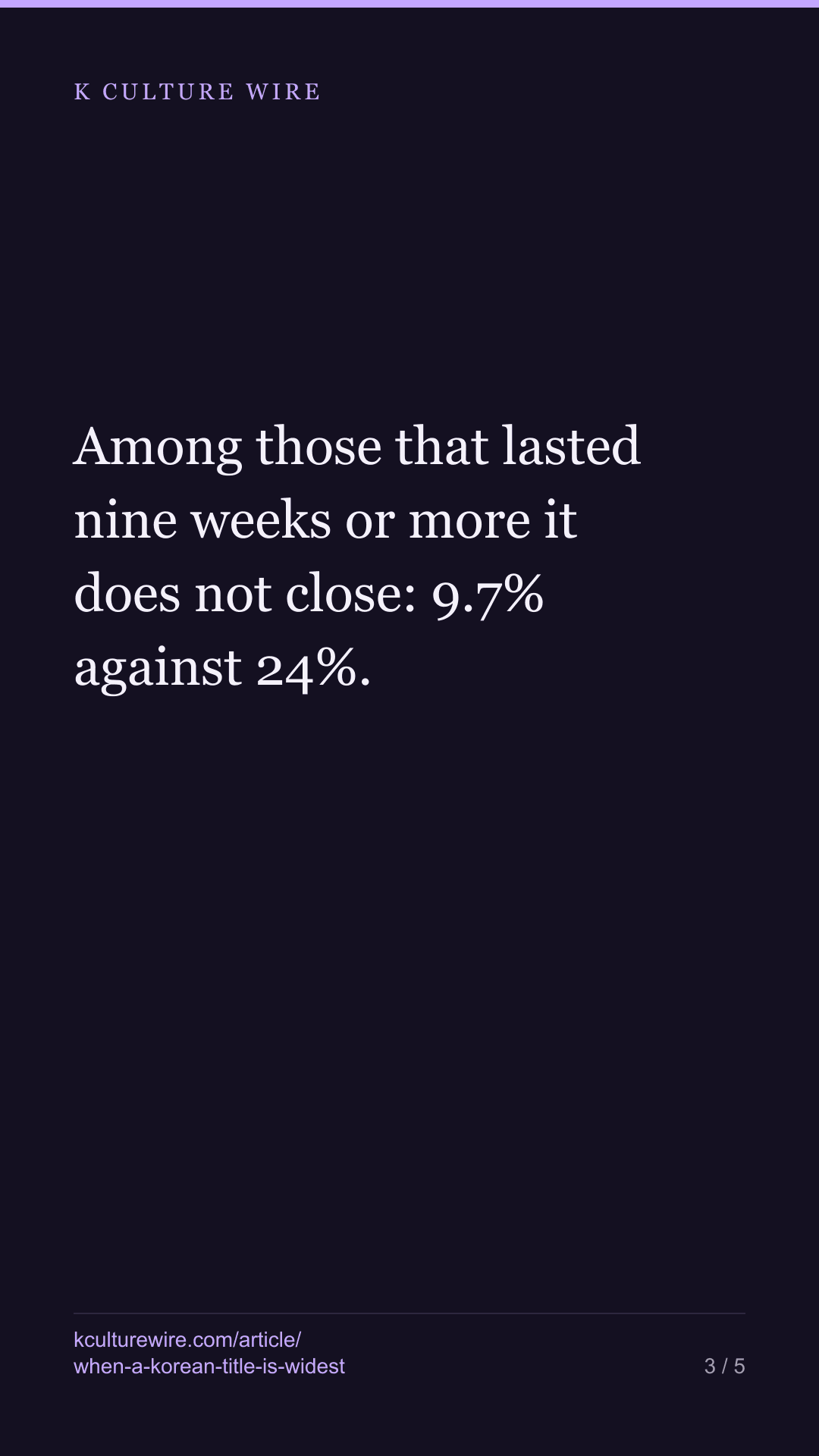
Hold run length fixed and most of that gap closes — among titles that lasted five to eight weeks it is 26.6% against 28.6%. Among those that lasted nine weeks or more it does not close: 9.7% against 24%.
The table this is written from: /time-to-peak
A title that travels sits on several country charts at once, and that number rises and then falls. The week it is highest is the week the title is at its widest — and that is the week everything behind it has already done its work.
We have measured what an opening position buys and how long a title holds. This is the other timing question: when does a title reach its widest, and is there anything left to push after that?
Almost never in week one, if it is Korean
| Titles | Median peak week | Widest in week 1 | Widest by week 4 | |
|---|---|---|---|---|
| Korean series | 213 | 2 | 21.1% | 80.8% |
| Every other series | 2,006 | 2 | 44.6% | 91.9% |
| Korean films | 117 | 2 | 29.9% | 83.8% |
| Every other film | 3,233 | 2 | 36.7% | 78.7% |
Other series are at their widest on the first Monday 44.6% of the time. Korean series manage it 21.1% of the time — less than half as often.
That is a large gap and the obvious explanation is not the interesting one.
Most of it is length, and we can show that
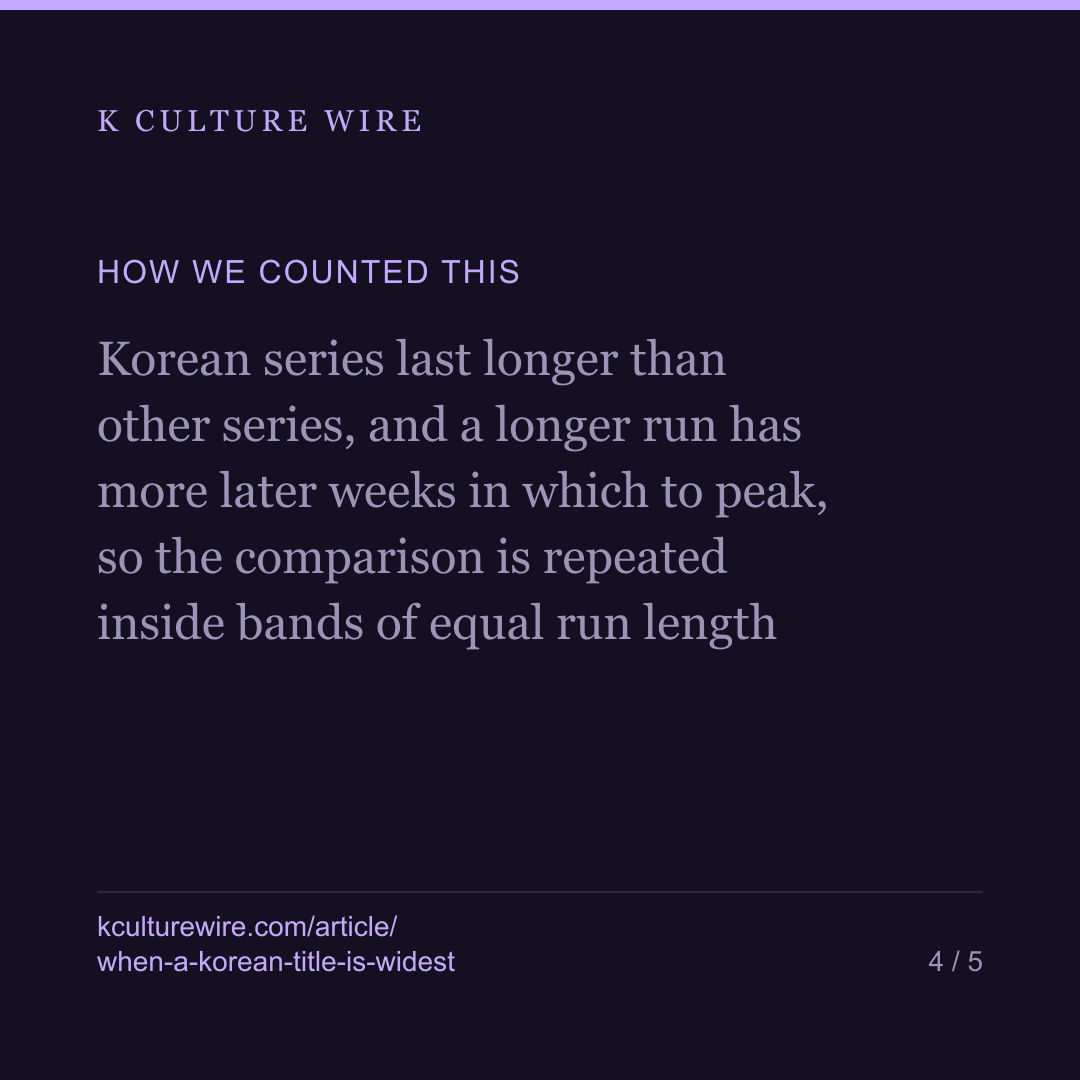
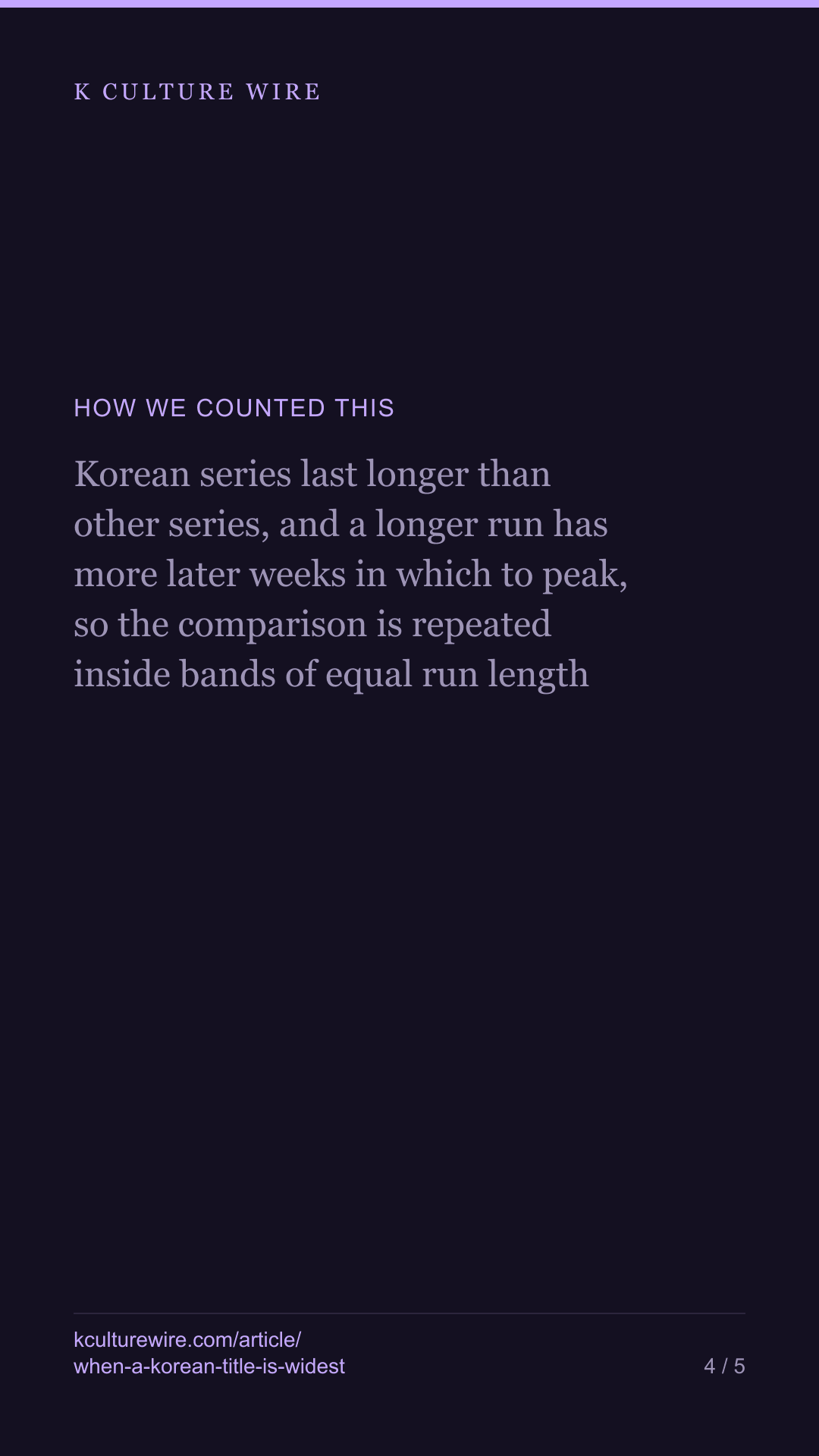
Korean series last longer than other series — 3.72 weeks against 2.71. A longer run has more later weeks in it, so peaking late is partly just having a late to peak in.
So the same measurement, inside bands of equal run length:
| Weeks on a chart | Korean series | Every other series |
|---|---|---|
| 1–2 weeks | 50% (6 titles) | 83.5% (467) |
| 3–4 weeks | 40.9% (22) | 45.8% (511) |
| 5–8 weeks | 25.9% (81) | 28.5% (568) |
| 9 weeks or more | 11.5% (104) | 23.7% (460) |
The gap narrows sharply, and in the middle it nearly disappears. Among titles that lasted five to eight weeks, Korean series peak in week one 25.9% of the time and other series 28.5% — a difference of two points, which is nothing.
So most of the raw 21.1%-against-44.6% gap is length: Korean series are concentrated in the long bands, where everybody peaks late.
But it does not vanish everywhere. Among titles that lasted nine weeks or more, Korean series peak in week one 11.5% of the time against 23.7% for other series — still twice apart, on 103 titles against 458. The long Korean series really do keep widening after their first week in a way that other long series do not.
⚠ The top band is six Korean titles. We are printing it because leaving a row out of a table is its own kind of claim, but nothing should be read from it.
What this is worth knowing for
Eight in ten Korean series have reached their widest point by week four. That is the window. Inside it, the median Korean series is widest in week two, not week one — so a push timed to the first Monday is timed to a week that, four times in five, is not the widest one.
After week four there is very little left: the remaining fifth is spread across everything from week five to week 34.
What this cannot tell you
Width is a count of charts, not of people. A title can be in more countries and be watched less, and a title one place outside a top 10 is invisible here at any level of viewing.
It also cannot say what made a title widen. A marketing push, a holiday, a dubbing release and a cast member in the news all look identical in a rank table. The peak week is when it happened, not why.
And this is a distribution, not a rule. Some Korean series are widest in week one; some are widest in week thirty-four. The table says how often, not what will happen to any one title.
What changed on 3 September 2026
Our list of Korean titles had been frozen at 8 August. We rebuilt it, it went from 397 titles to 420, and one title we had been counting as Korean (Dangerous Liaisons, the 2022 French film) is not. 16 figures in this piece moved with it. None of them changed what the piece found. The ones a reader is most likely to have quoted:
| Was | Now | |
|---|---|---|
| Korean series measured | 215 | 213 |
| Korean series widest in week one | 20.9% | 21.1% |
| Every other series, same figure | 44.7% | 44.6% |
| Korean films measured | 119 | 117 |
Every table above is now generated from the counted file rather than typed out, and a check reads each figure back out of that file on every build. We print what moved rather than swapping it quietly: one wrong number makes the correct ones beside it worth doubting.
Where these numbers come from
Sources
- Netflix — Tudum weekly Top 10 country lists, 499,180 rows read, 2021-07-04 to 2026-08-16, 93 markets, Russia excluded · https://www.netflix.com/tudum/top10
- Wikidata — Korean titles identified by item number and country of origin, using the same single rule as the rest of this publication · https://query.wikidata.org
What we checked
- Korean series last longer than other series, and a longer run has more later weeks in which to peak, so the comparison is repeated inside bands of equal run length
- Only titles that reached at least five countries are measured, because a title in one or two markets is at its widest almost by definition
- Titles still on a chart in the final week are removed, since their peak week is not yet known, and the number removed is published
- Every non-Korean title on the same charts is measured the same way, and films and series are never mixed
What we left out, and why
- Russia, excluded across this publication because Netflix withdrew and the remaining weeks are not comparable
- 7,677 titles that reached fewer than five countries, and 159 still on a chart in the last week we hold
The data behind this
Written from the same data
Take this away — 10 cards
The figures in this article, as images. Free to repost with the address on them.
If you work in this business
Everything on this page is measured from the same weekly Netflix lists, per market and per title. We publish the pages free; what we sell is the same measurement cut to one company's catalogue — including the figures behind /time-to-peak.
What a company sheet contains, and what it cannot tell you →