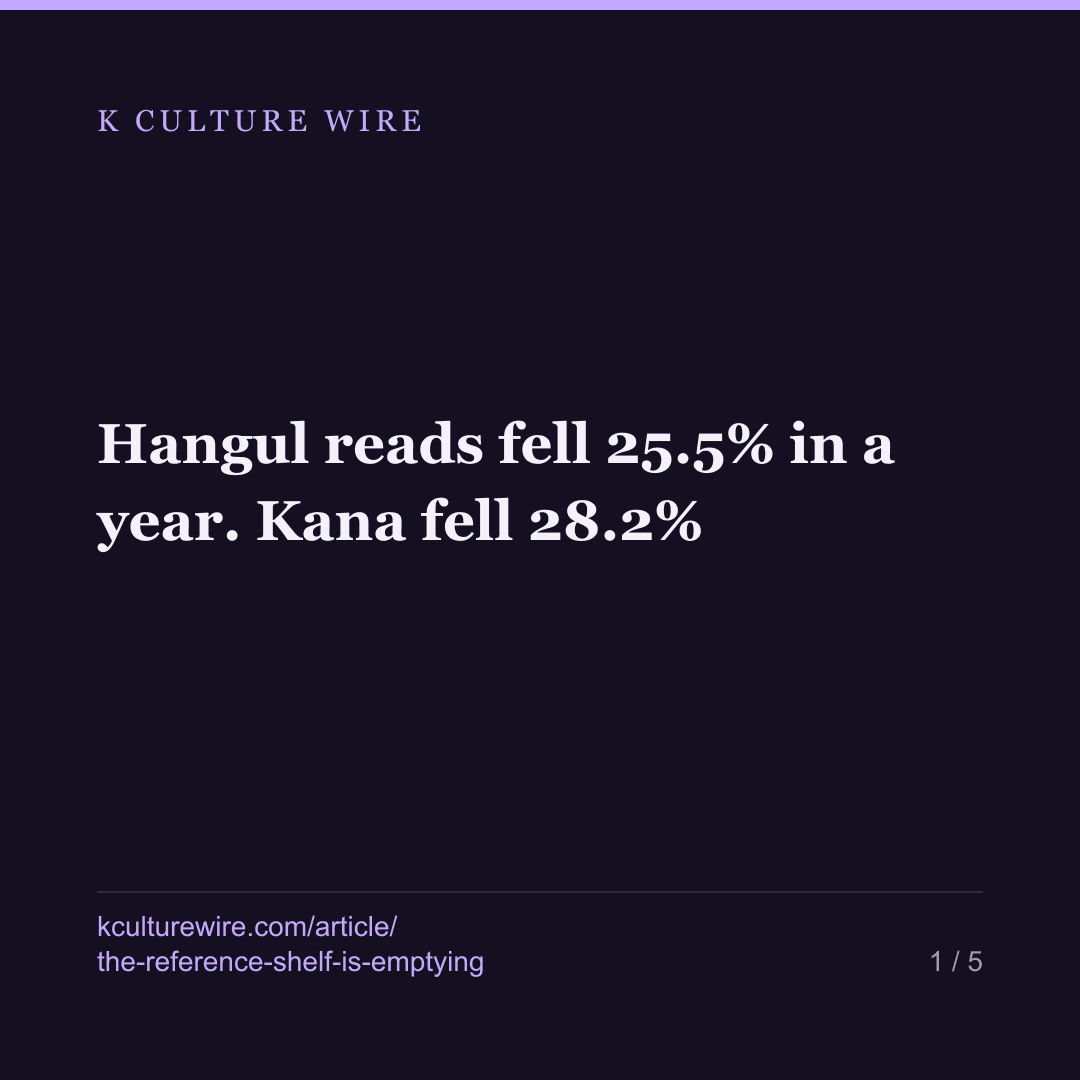
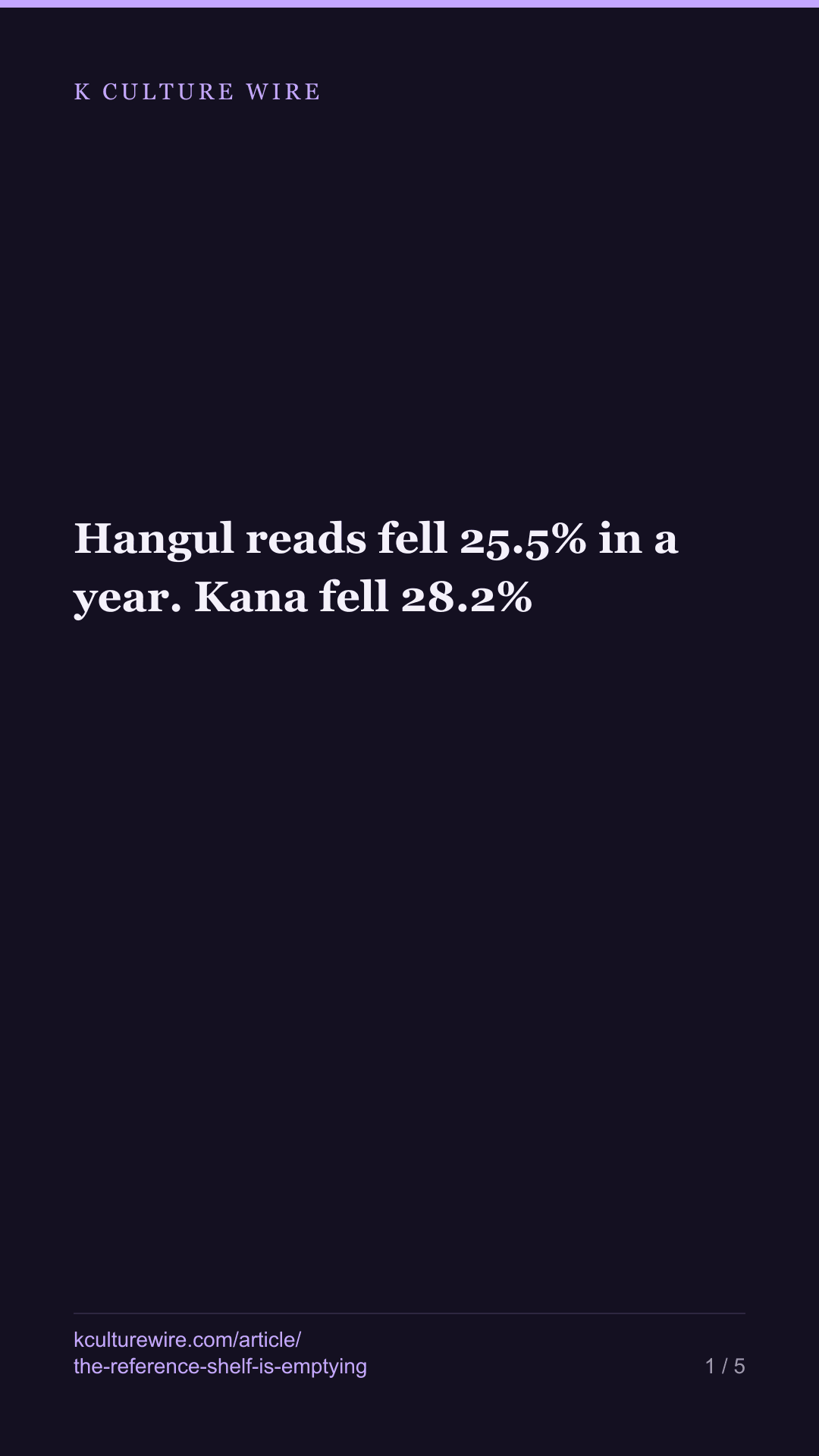
Hangul reads fell 25.5% in a year. Kana fell 28.2%
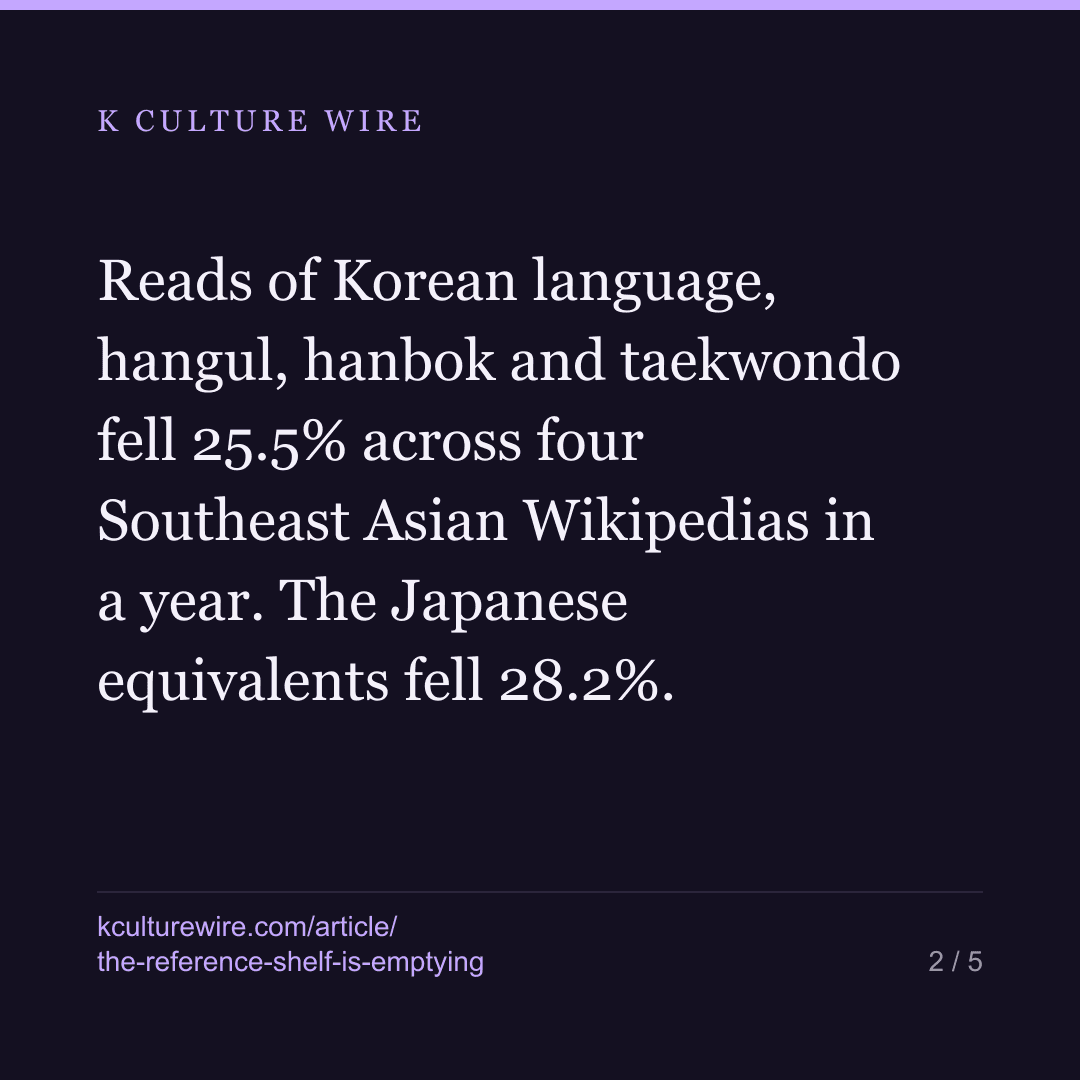
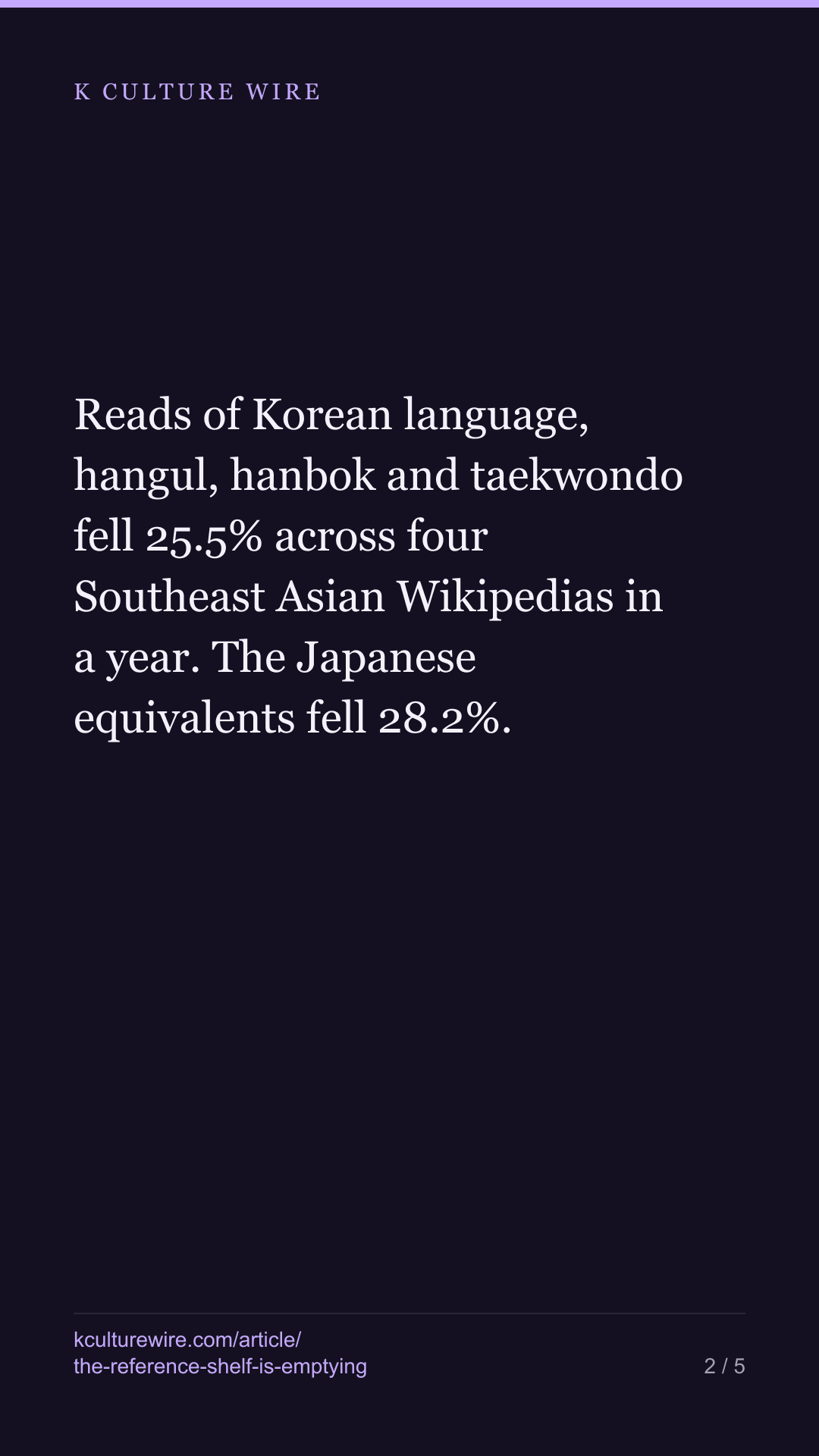
Reads of Korean language, hangul, hanbok and taekwondo fell 25.5% across four Southeast Asian Wikipedias in a year. The Japanese equivalents fell 28.2%. Two other genres we measured could not be used at all, and we say why.
The table this is written from: /what-kind-fell
Southeast Asia is reading less about Korea than it did a year ago. We have measured that on several pages now. The question we had not answered is whether it is true of everything Korea makes, or whether it depends on what.
So we split the articles into three kinds — music, screen, and a third we called language and craft: the Korean language, hangul, hanbok, taekwondo. Then, beside each Korean article, we put a Japanese one of the same kind. Not to rank them. To find out whether a fall is something happening to Korea or something happening to that shelf of the encyclopaedia.
Only one of the three genres survived the check we run before publishing a median. That one is language and craft, and it says something we did not expect.
Both sides fell, by almost the same amount
| Article | First 12 months | Last 12 months | Change |
|---|---|---|---|
| Korean language | 168.3 | 95.4 | −43.3% |
| Taekwondo | 165.9 | 121.8 | −26.6% |
| Hanbok | 40.7 | 30.8 | −24.4% |
| Hangul | 67.1 | 62.7 | −6.5% |
| Korean median | −25.5% | ||
| Japanese language | 296.0 | 236.5 | −20.1% |
| Karate | 87.3 | 56.1 | −35.7% |
| Kana | 19.9 | 13.0 | −34.8% |
| Kimono | 49.7 | 35.7 | −28.2% |
| Manga | 113.9 | 112.7 | −1.1% |
| Japanese median | −28.2% |
Figures are reads per million reads of each Wikipedia, summed across the Indonesian, Vietnamese, Thai and Malay editions, first twelve months of the window against the last twelve.
The Japanese articles are a control, not a competitor. Had they held steady while the Korean ones dropped, the fall would be about Korea, and that would be the story. They did not hold steady. They fell slightly further. Whatever moved, moved both.
What kind of article this is
The articles in this genre have something in common that the music and screen ones do not. Nobody opens Hangul because they are a fan of hangul. They open it to find out what it is — how the letters work, who made them, why the blocks are shaped that way. The same goes for Kana, Hanbok, Kimono, Karate, Taekwondo.
This is the reference shelf: the articles you go to when you have encountered something and want to know what it was. And across four countries, over two years, it is being opened less — for Korea and for Japan alike, by roughly a quarter.
We can rule out one explanation with the control we have: this is not Southeast Asia turning away from Korea specifically. We cannot tell you what it is instead. A reader who once opened an encyclopaedia article may now be asking somewhere else entirely, and we have no way to see that from inside Wikipedia’s own numbers.
The two genres we could not use
We measured three. Two of them produced numbers that look like findings and are not.
| Genre | Korea | Japan (control) |
|---|---|---|
| Music | −10.8% (4 articles) | +14.5% (3 articles) |
| Screen | −4.3% (4 articles) | +22.9% (4 articles) |
Korean music down while Japanese music is up is the kind of gap that writes its own headline. We are not going to print it, because it does not survive the check.
Each of those medians rests on three or four articles. Before publishing any median we remove one observation, recompute, and repeat for each — a jackknife, a method from 1949. If removing a single article moves the answer by more than half its own size, the sample is too small for that median to be a finding. For Korean music the swing is 1.13 times the figure itself. For Japanese screen it is 4.12. Take one article out of either and the comparison can reverse.
We are showing those rows rather than dropping them, because dropping them would turn this page into a claim about Korean music that we cannot support. The honest version is: we looked, and our sample is not good enough to say.
What this does not tell you
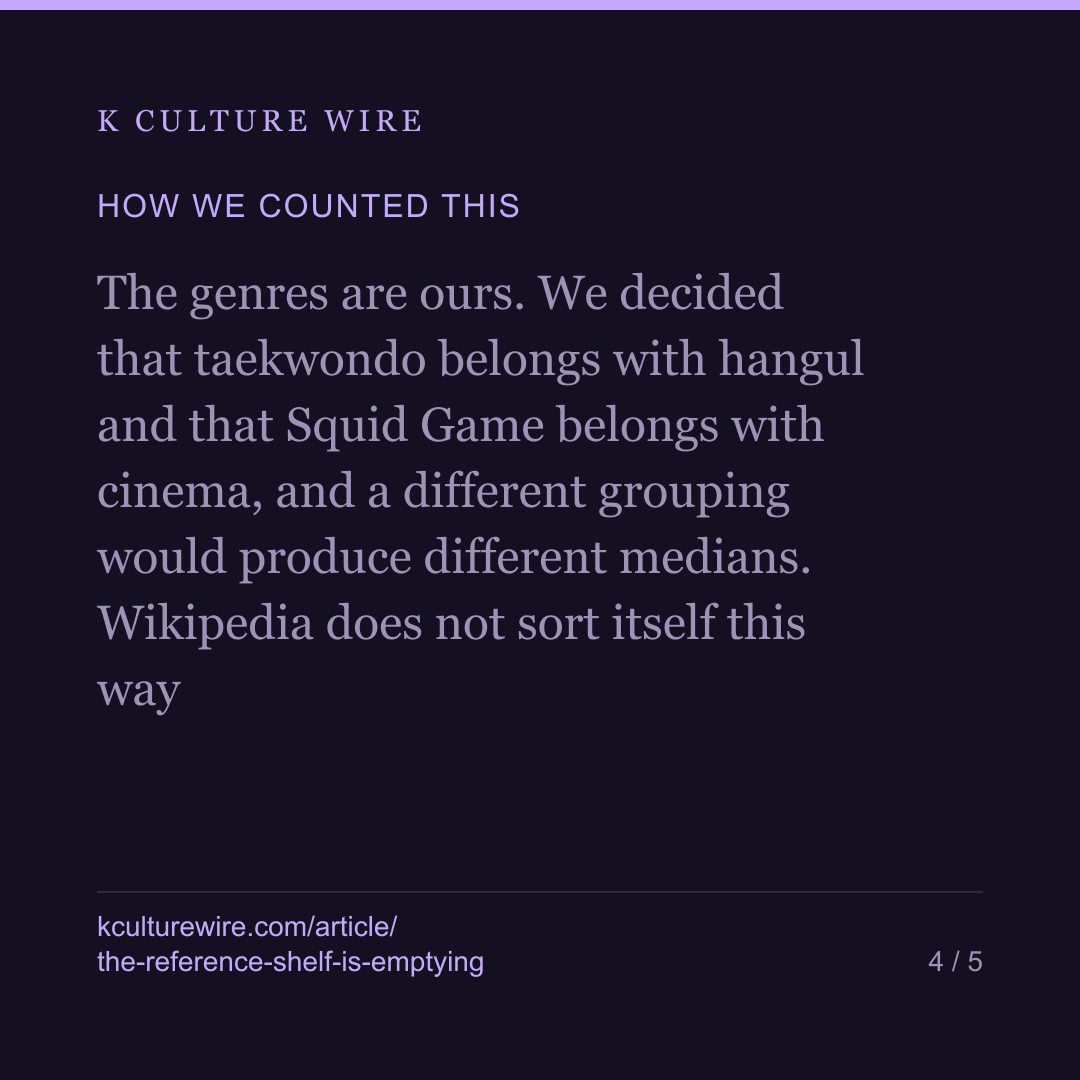
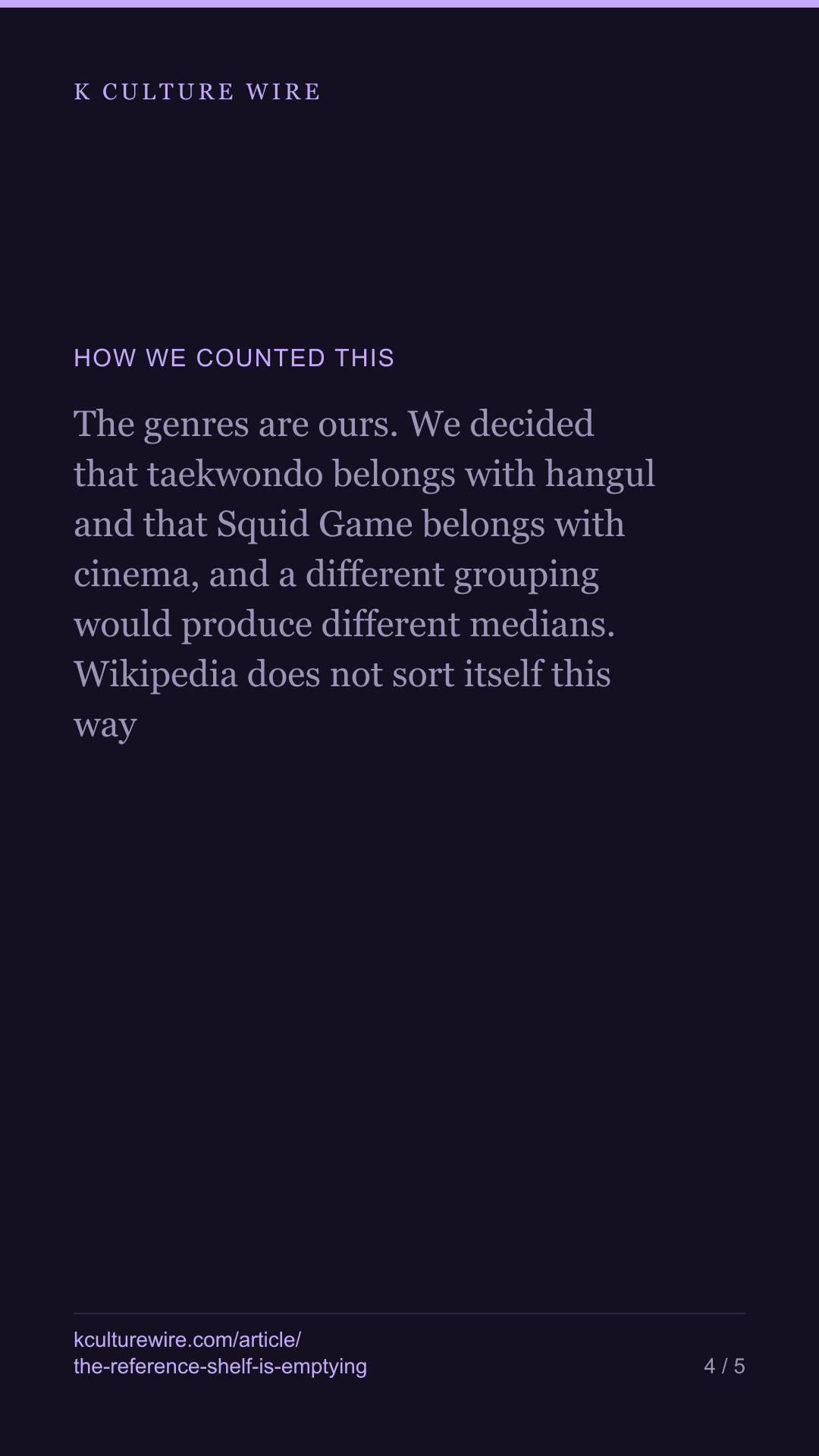
The genres are ours. We decided that taekwondo belongs with hangul and that Squid Game belongs with cinema, and a different grouping would produce different medians. Wikipedia does not sort itself this way.
An encyclopaedia article is not the thing itself. Reads of Korean language are not people learning Korean, and a fall in reads of Taekwondo is not a fall in people practising it. What we can see is how often someone opened a page to find out what something was.
And a control removes an explanation without supplying one. We know this is not a fall that singles Korea out. We do not know what it is.
The table behind this is at kculturewire.com/what-kind-fell.
Where these numbers come from
Sources
- Wikimedia — Pageviews API, human traffic only, monthly, per edition · https://wikimedia.org/api/rest_v1/
What we checked
- The genres are ours. We decided that taekwondo belongs with hangul and that Squid Game belongs with cinema, and a different grouping would produce different medians. Wikipedia does not sort itself this way
- An encyclopaedia article is not the thing itself. Reads of Korean language are not people learning Korean, and a fall in reads of Taekwondo is not a fall in people practising it
- What this can see is how often someone opened a page to find out what something was
- A control removes an explanation without supplying one. We know this is not a fall that singles Korea out. We do not know what it is
The data behind this
Written from the same data
Take this away — 10 cards
The figures in this article, as images. Free to repost with the address on them.
If you work in this business
Everything on this page is measured from the same weekly Netflix lists, per market and per title. We publish the pages free; what we sell is the same measurement cut to one company's catalogue — including the figures behind /what-kind-fell.
What a company sheet contains, and what it cannot tell you →