Southeast Asia is reading less about Korean language and craft — and less about Japan's too
Southeast Asia reads less about Korea than it did a year ago. Is that true of everything Korea makes, or does it depend on what?
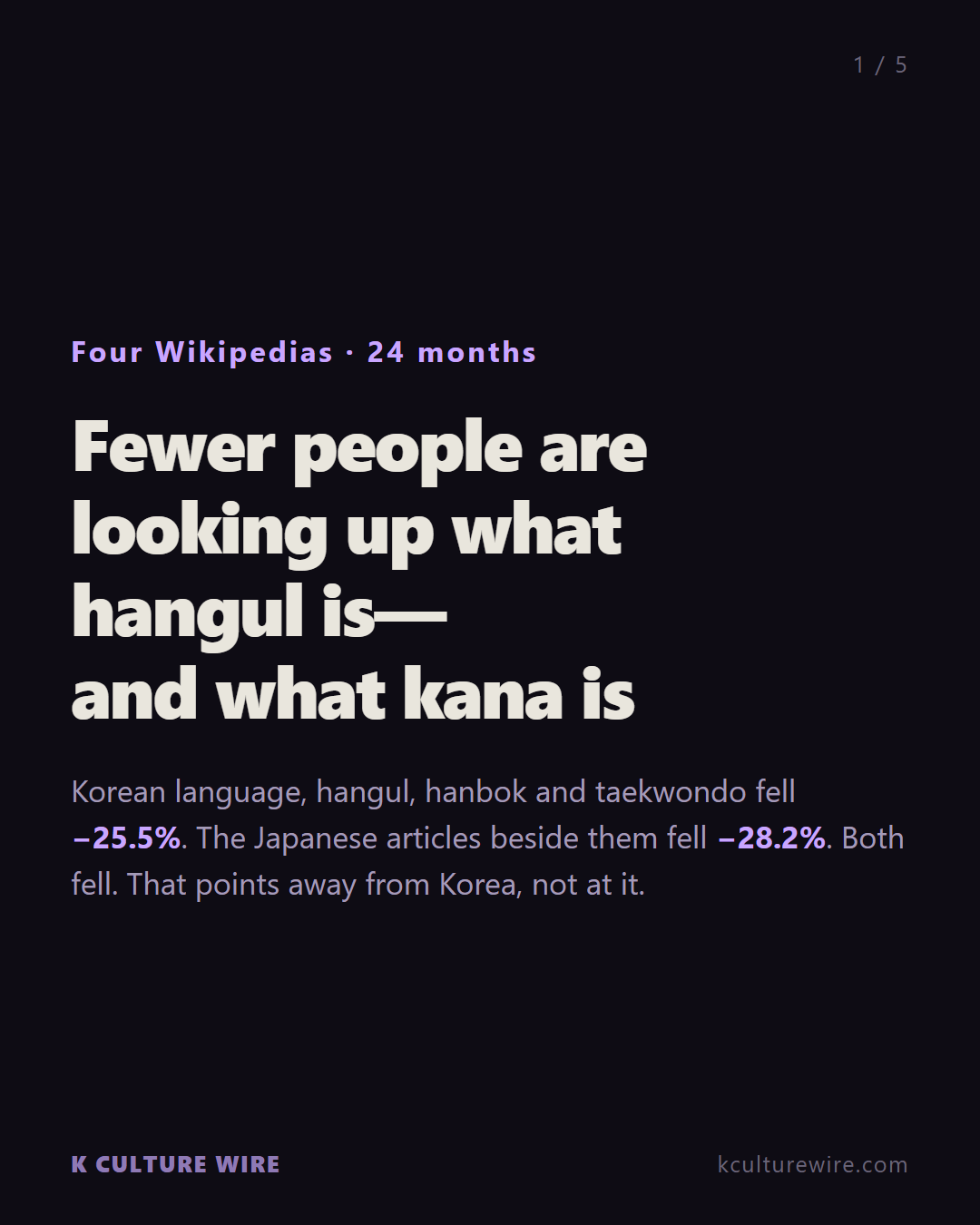
Of the three genres we measured, only one survived the check we run before publishing a median. In that one — language, writing, dress and martial art — Korean articles fell 25.5% and the Japanese articles beside them fell 28.2%. Both fell. That points away from Korea, not at it.
The genre we can report
Reads per million reads of each Wikipedia, summed across Indonesia, Vietnam, Thailand, Malaysia. The window is 2024-07 through 2026-06, 24 months, split 12 against 12 — the first twelve months against the last twelve.
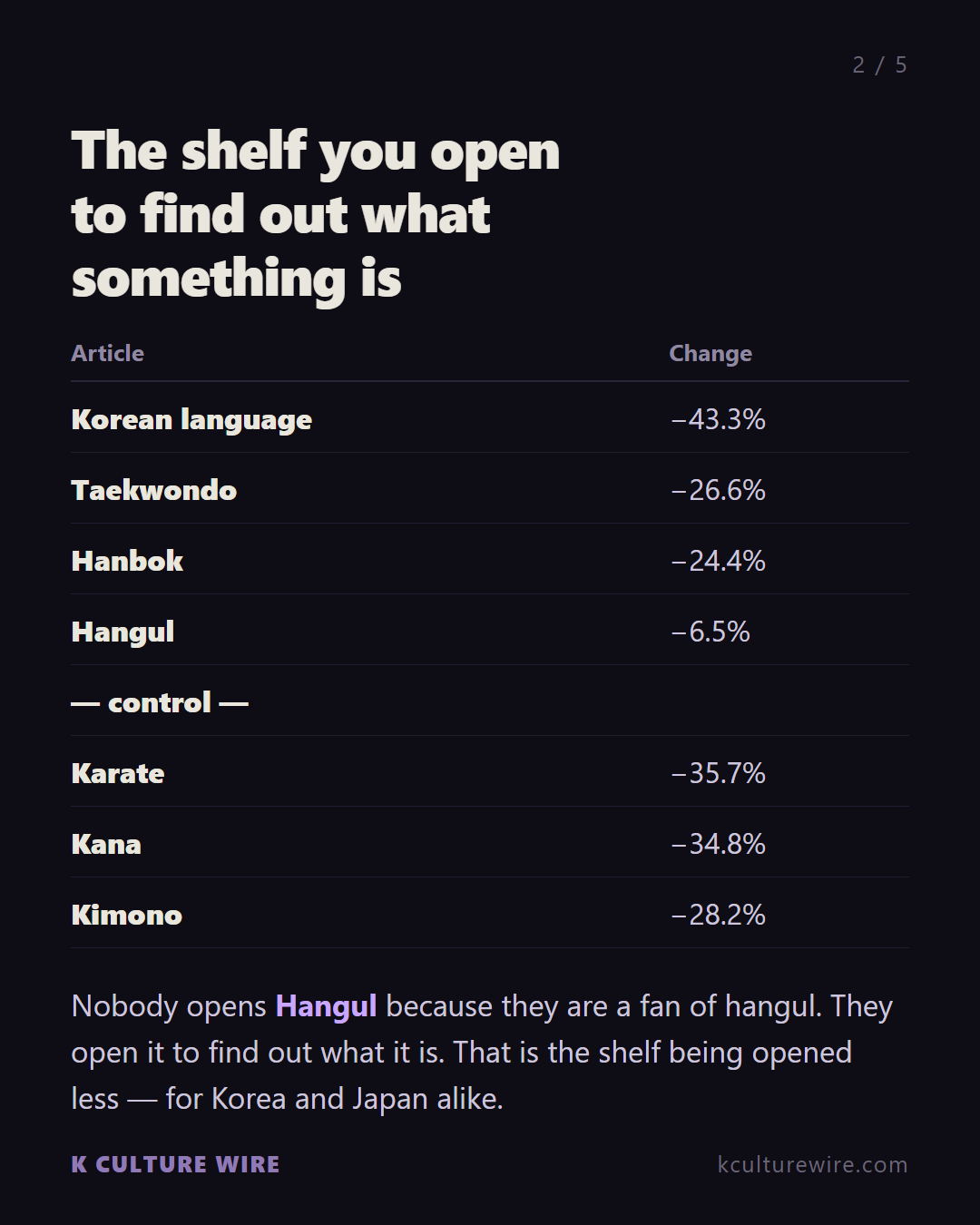
| Article | First 12 months | Last 12 months | Change |
|---|---|---|---|
| Korean language | 168.3 | 95.4 | −43.3% |
| Hangul | 67.1 | 62.7 | −6.5% |
| Hanbok | 40.7 | 30.8 | −24.4% |
| Taekwondo | 165.9 | 121.8 | −26.6% |
| Control — the same kind of article about Japan | |||
| Japanese language | 296 | 236.5 | −20.1% |
| Kana | 19.9 | 13 | −34.8% |
| Manga | 113.9 | 112.7 | −1.1% |
| Kimono | 49.7 | 35.7 | −28.2% |
| Karate | 87.3 | 56.1 | −35.7% |
The Japanese articles are here as a control, not as a competitor. If they had held steady while the Korean ones fell, the fall would be about Korea. They did not. Both sides of the table are down by roughly the same amount, which means what moved is the appetite for this kind of article — the reference kind, the kind you open to learn what something is.
The two we could not use
We measured three genres. Two of them produced numbers that look like a finding and are not one. Here they are anyway, because leaving them out would turn this page into a claim it cannot support.
| Genre | Korea | Japan (control) | Why we cannot use it |
|---|---|---|---|
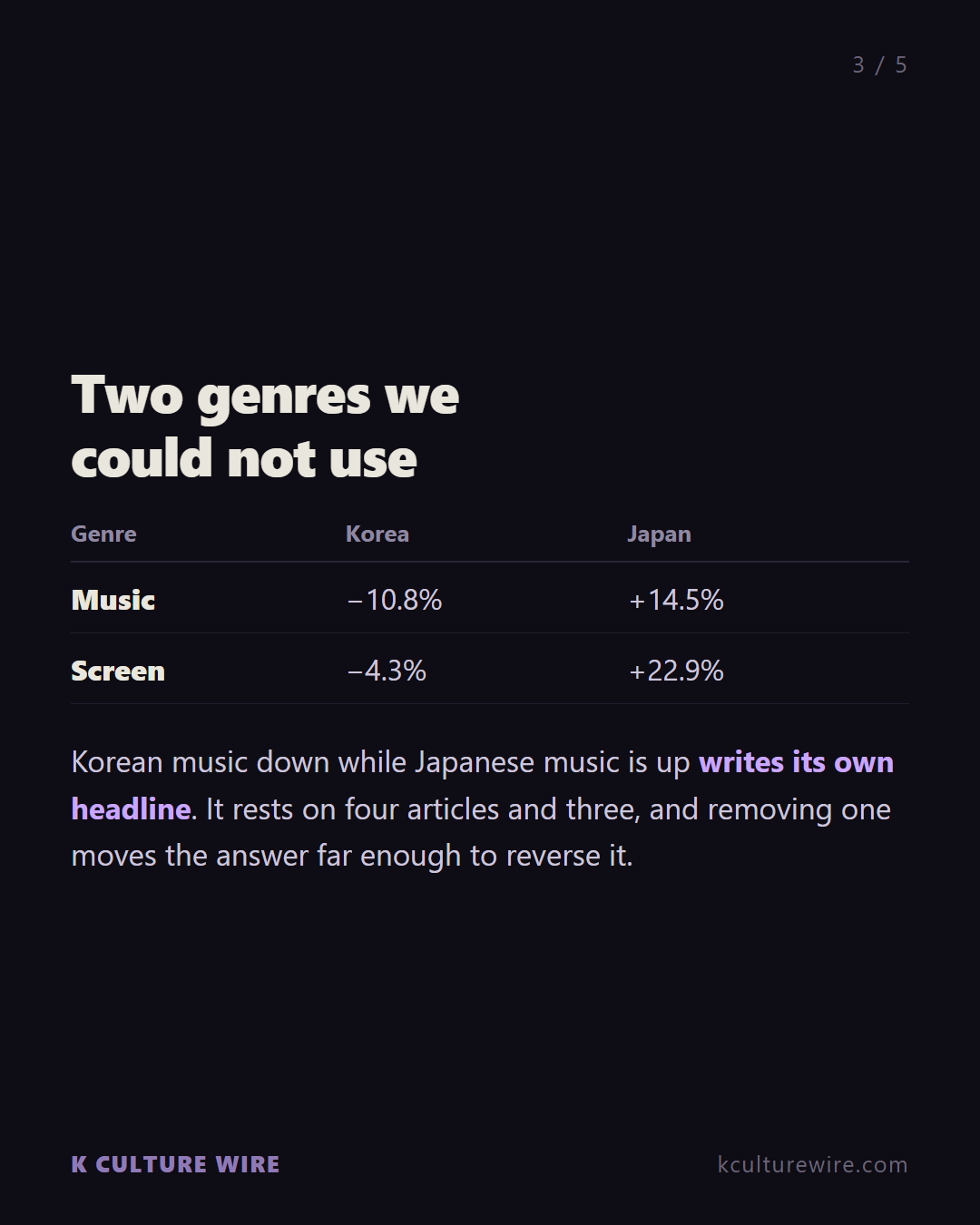
| Music | −10.8% (4 articles) | +14.5% (3 articles) | Removing one article moves the Korea and Japan figure by more than half its own size |
| Screen | −4.3% (4 articles) | +22.9% (4 articles) | Removing one article moves the Korea and Japan figure by more than half its own size |
⚠ Read those two rows as unmeasured, not as a result. Korean music at −10.8% against Japanese music at +14.5% is the kind of gap that would make a headline. It rests on four articles and three, and taking one out of either moves the answer far enough to reverse it. We are not going to print it as though it held.
How we decided what we could use
Each genre here holds three to five articles, so every figure on this page is the median of a handful. Before publishing any median we remove one observation, recompute, and repeat for each — a jackknife. If that moves the answer by more than half its own size, we do not report it.
⚠ The check runs in one direction only. A jackknife understates how much a median varies and is not consistent for the median, so a swing it finds is real while a swing it misses may simply be one it cannot see. Language and craft passing the check is not proof that its figure is solid — it is the absence of one specific way of being fragile. The method and its limits are here.
What this page cannot tell you
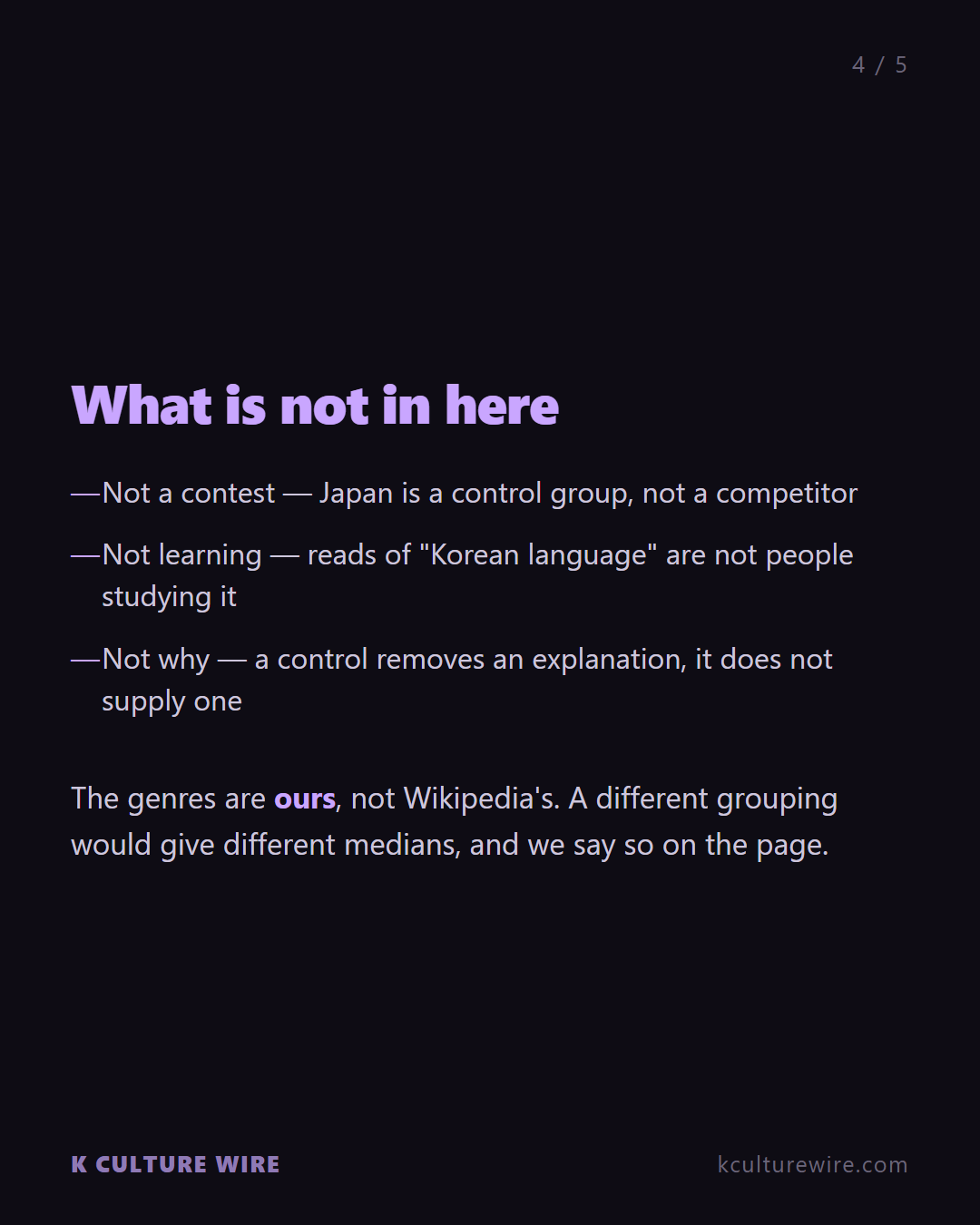
Not why. A control can remove an explanation — if Japanese articles of the same kind fell too, the fall is not about Korea — but it does not supply the one that replaces it.
Not two of the three genres. Music and Screen have too few articles for their medians to survive removing one, so this page reports that it cannot use them rather than quietly leaving them out.
Not interest, and not learning. This counts people opening an encyclopaedia article.
⚠ The three genres are our own grouping, not the encyclopaedia's. The article lists are published here so the same reads can be grouped a different way. Company articles sit with music because someone looking up HYBE is closer to someone looking up a song than to someone looking up a film.
Reads — Wikimedia Pageviews API, human traffic only, monthly. The most recent month is dropped because Wikimedia's monthly totals can still be filling when we fetch.
Card set — free to share
Five cards, 1080×1350. Every figure on them is in the table on this page. Take them.

14 seconds, with sound
A man and a woman read out the two medians side by side — the Korean articles and the Japanese ones beside them — and say plainly that both fell. Narrated. Free to repost with the address on it.
All our short films — each one built from a table on this site
A short, with sound
A man and a woman read out the two medians side by side — the Korean articles and the Japanese ones beside them — and say plainly that both fell. Free to repost with the address on it.
All our short films — each one built from a table on this site
What we wrote from this data
- Hangul reads fell 25.5% in a year. Kana fell 28.2%
Reads of Korean language, hangul, hanbok and taekwondo fell 25.5% across four Southeast Asian Wikipedias in a year. The Japanese equivalents fell 28.2%. Two other genres we measured could not be used at all, and we say why.
16 August 2026
How this was measured
We report the median rather than the mean. A handful of very large values would pull a mean away from where most of the sample actually sits, and in reads-per-title data those large values are the norm, not an error. Reads are expressed per million reads of that Wikipedia in that month, so that a large edition and a small one can be compared without the larger one winning by size alone. Stability of a median is checked with a jackknife — remove one observation, recompute, repeat for each (Quenouille 1949, Tukey 1958). The Korean figure is read against a control drawn the same way, because a movement that appears in the control as well is not a fact about Korea. Each genre is summarised by the median change across its articles, and each Korean genre is read against Japanese articles of the same kind measured the same way.
What this cannot tell you
A median tells you where the middle sits and nothing about the shape around it, so it should be read next to the range or the full distribution, not alone. Dividing by an edition's own total means a month when that edition was unusually busy lowers every article in it. The ratio measures share of attention inside an edition, not how many people read something. The jackknife understates how much a median varies, because removing one observation barely moves a median, and it is not consistent for the median (Miller 1974). A swing it finds is therefore real; a swing it misses is not evidence of stability. Establishing stability would need a delete-d jackknife or a bootstrap (Efron 1979), which we have not built. A control rules an explanation out; it does not identify the one that replaces it. We say what the control removes and stop there. The genres are ours, not Wikipedia's — we chose which article belongs to which, and a different grouping would give different medians. Each genre holds only three to five articles, which is why two of the three could not be used at all. An encyclopaedia article is not the thing itself: reads of "Korean language" are not people learning it.
Two things to know before reading the table
The last month is not in it. 2026-07 came back at 2,299 against a running mean of 120,531 — a month that had not finished filling when we read it. We dropped it rather than publishing a collapse that was an artefact of when we asked.
Japan is a control. The Japanese articles are a control, not a competitor. They are here to show whether a gap between genres is something happening to Korea or something happening to that kind of article.