Actors who also played in Korea are read 1.7x abroad
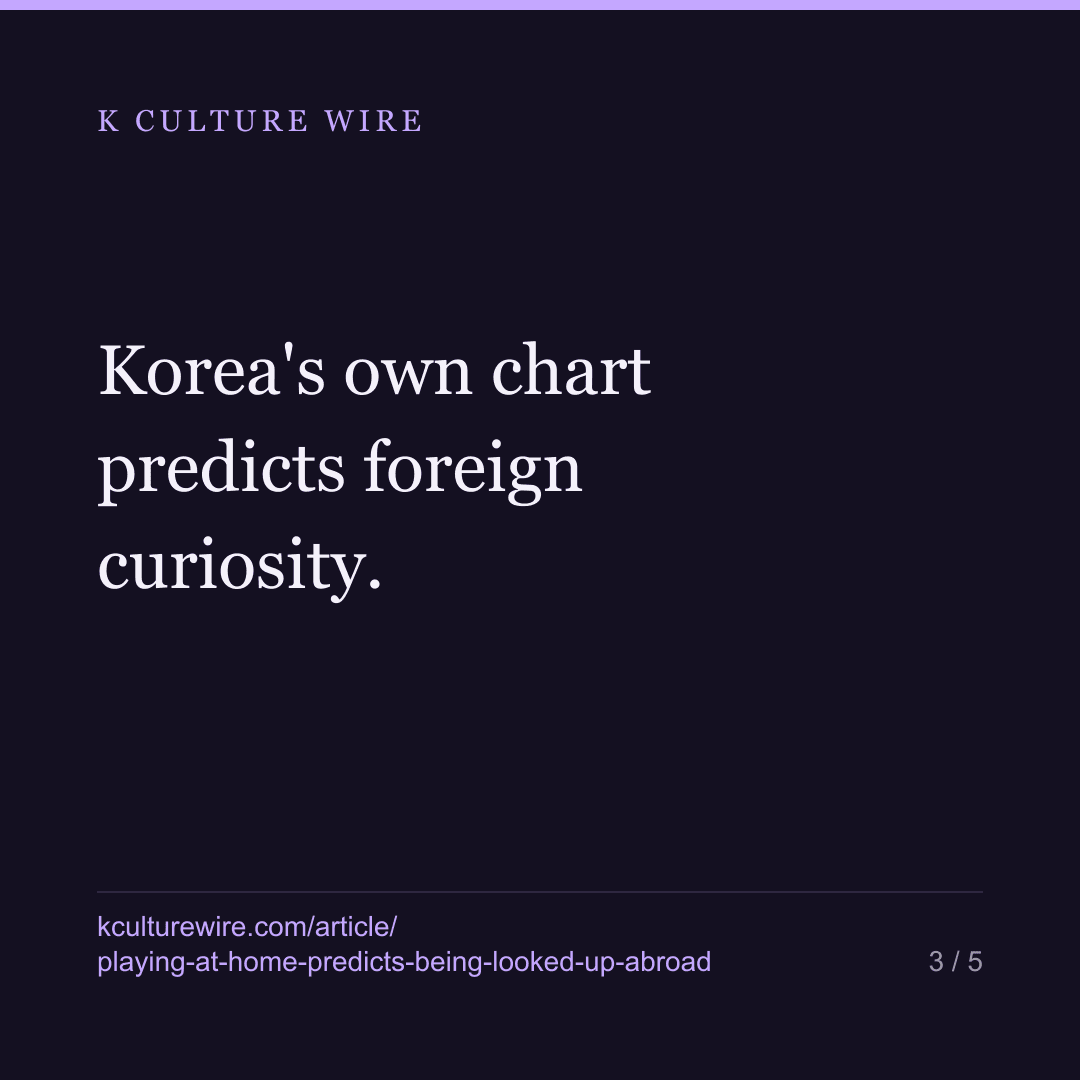
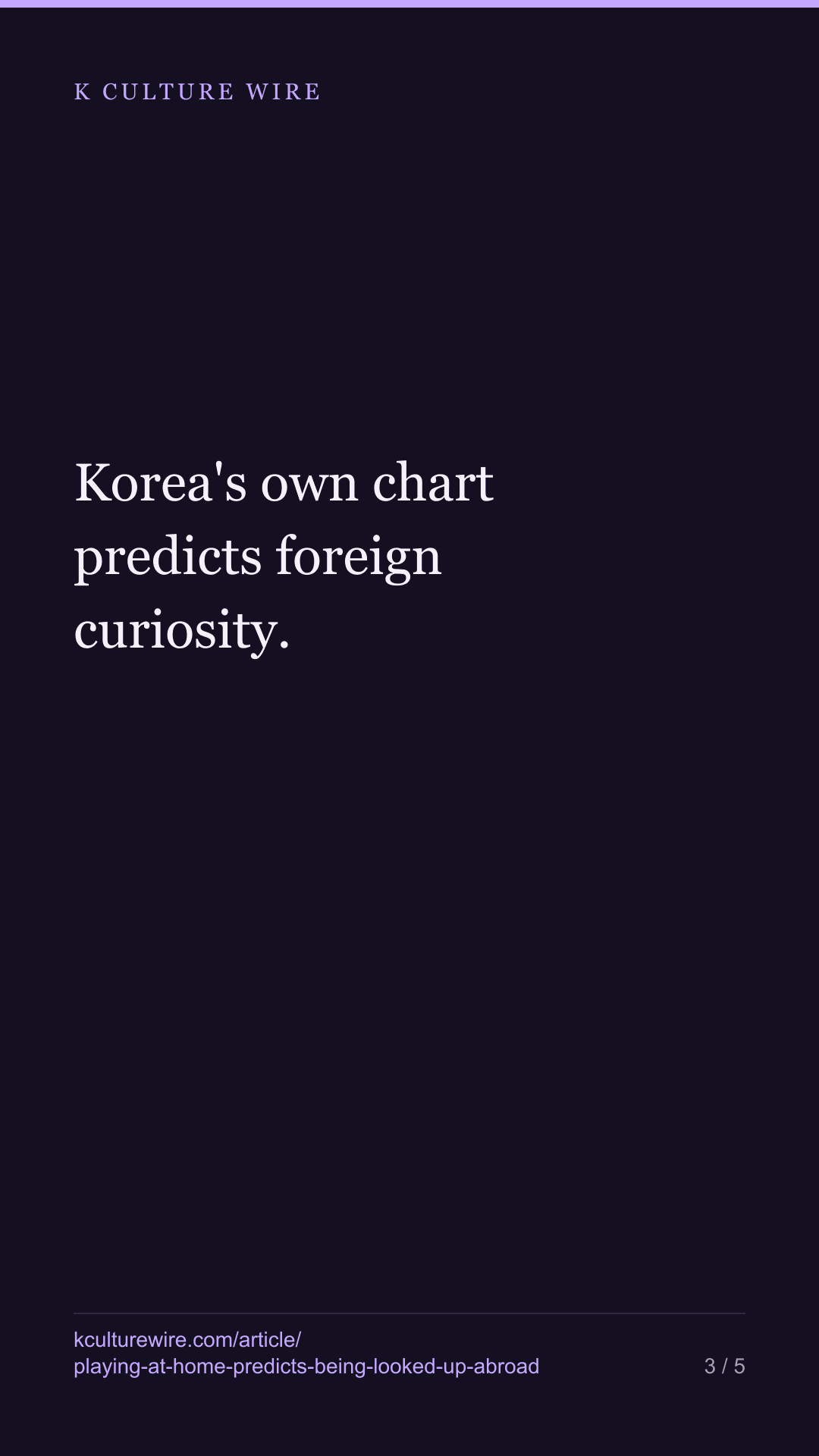
Hold the number of titles fixed and the gap is still there: 1,926 English Wikipedia lookups against 1,111. Hold how far the title travelled fixed and it survives that too. Korea's own chart predicts foreign curiosity.
The table this is written from: /actors
Two facts we published earlier this week sit next to each other, and putting them together says something neither says alone.
The first: 140 of the 397 Korean titles that charted in Southeast Asia never appeared on Netflix’s chart in Korea. The second: we track English Wikipedia lookups for every Korean actor in those titles who has an article — 808 of 1,391 people.
Join them, and the actors attached to titles that played at home are looked up more.
The obvious objection first
Actors with more titles get looked up more, and actors in Korea-charting titles have more titles. So the comparison only means something inside groups of equal size.
| Actors with… | Every title also charted in Korea | None did | Ratio |
|---|---|---|---|
| 1 title in our panel | 3,118 (201 people) | 1,776 (103) | 1.76 |
| 2 titles in our panel | 5,863 (64) | 2,524 (20) | 2.32 |
Median 30-day lookups. The gap is there at both sizes, and it is roughly the same size at both, which is what you want before taking it seriously.
The second objection, which is better
Perhaps titles that chart in Korea are simply bigger titles — they reach more markets, so of course their casts get looked up more. That would make this a story about title size wearing a Korean hat.
So we ran it again inside bands of equal reach, using only the 304 actors with exactly one panel title.
| That one title reached | Also charted in Korea | Did not | Ratio |
|---|---|---|---|
| 1 market | 1,841 (31) | 1,412 (65) | 1.30 |
| 2–4 markets | 3,687 (31) | 2,348 (26) | 1.57 |
| 5–6 markets | 3,046 (139) | 2,897 (12) | 1.05 |
It survives. Two actors whose single credit reached the same number of Southeast Asian markets still differ by a quarter to two-fifths in lookups, depending on whether that credit also played on Korea’s own chart.
⚠ The bottom-right cell rests on 12 people. Take that row as suggestive and the middle row, where the two groups are 29 and 25, as the solid one.
What we think this is, and what we will not claim
We will not say charting in Korea makes an actor famous abroad. Nothing here can establish that, and the arrow could easily point the other way or come from a third thing entirely.
The likeliest third thing is the one we found earlier: the titles that skip Korea’s Netflix chart are mostly broadcast dramas — they aired on KBS or SBS and Koreans watched them there. Broadcast drama and Netflix-commissioned drama are different production systems with different budgets, different casts and different promotion, and that difference could produce this gap on its own without the Korean chart doing any work at all.
What we can say is narrower and still useful: whether a title appears on Korea’s own chart is a usable signal about the international attention its cast receives, it holds after removing the two confounders anyone would raise first, and it is available in advance from a public source.
The hole in this that we cannot fill
583 of the 1,391 people in our cast join have no English Wikipedia article at all. They produce no lookup figure, so they are absent from every number above.
That is not a random 28%. An actor without an English article is almost certainly less known to the English-speaking audience this measures — so the people missing are the people at the bottom of the distribution, and they are probably missing unevenly between our two groups.
If broadcast-drama casts are less likely to have English articles, the true gap is larger than the one we printed. If Netflix-commissioned casts are, it is smaller. We cannot tell which, because the absent rows are absent by exactly the mechanism we would need to measure them.
We print the ratio and we print this paragraph, and we would rather you read both.
This rests on which titles played at home, which is itself a finding. Read the 140 titles that never charted in Korea →
What changed on 3 September 2026
We re-collected the cast data on 25 August 2026 and recounted every figure here. The join moved from 1,395 people to 1,391 and the number with an English Wikipedia article from 812 to 808. Median lookups moved with them: actors with one panel title went from 3,500 against 2,152 to 3,118 against 1,776, and the reach bands shifted too.
The finding held in direction and got slightly stronger for the one-title group — the ratio went from 1.63 to 1.76. It got weaker in the widest reach band, from 1.38 to 1.05, which is close to no difference at all. That band already carried our warning that its smaller cell rests on twelve people; this recount is a reason to lean on it less, not more.
Where these numbers come from
Sources
- Wikimedia — Pageviews API, en.wikipedia, all-access, user agents only, 30 days to 2026-08-03, for every Korean actor in our cast join with an English article · https://wikimedia.org/api/rest_v1/
- Netflix — Top 10 weekly country lists (Tudum). The Southeast Asia panel is six markets; the home comparison is Netflix's South Korea list over the same weeks · https://www.netflix.com/tudum/top10
- Wikidata — Cast member (P161) joined to titles on Q-numbers, restricted to Korean citizenship (P27 = Q884) · https://query.wikidata.org
What we checked
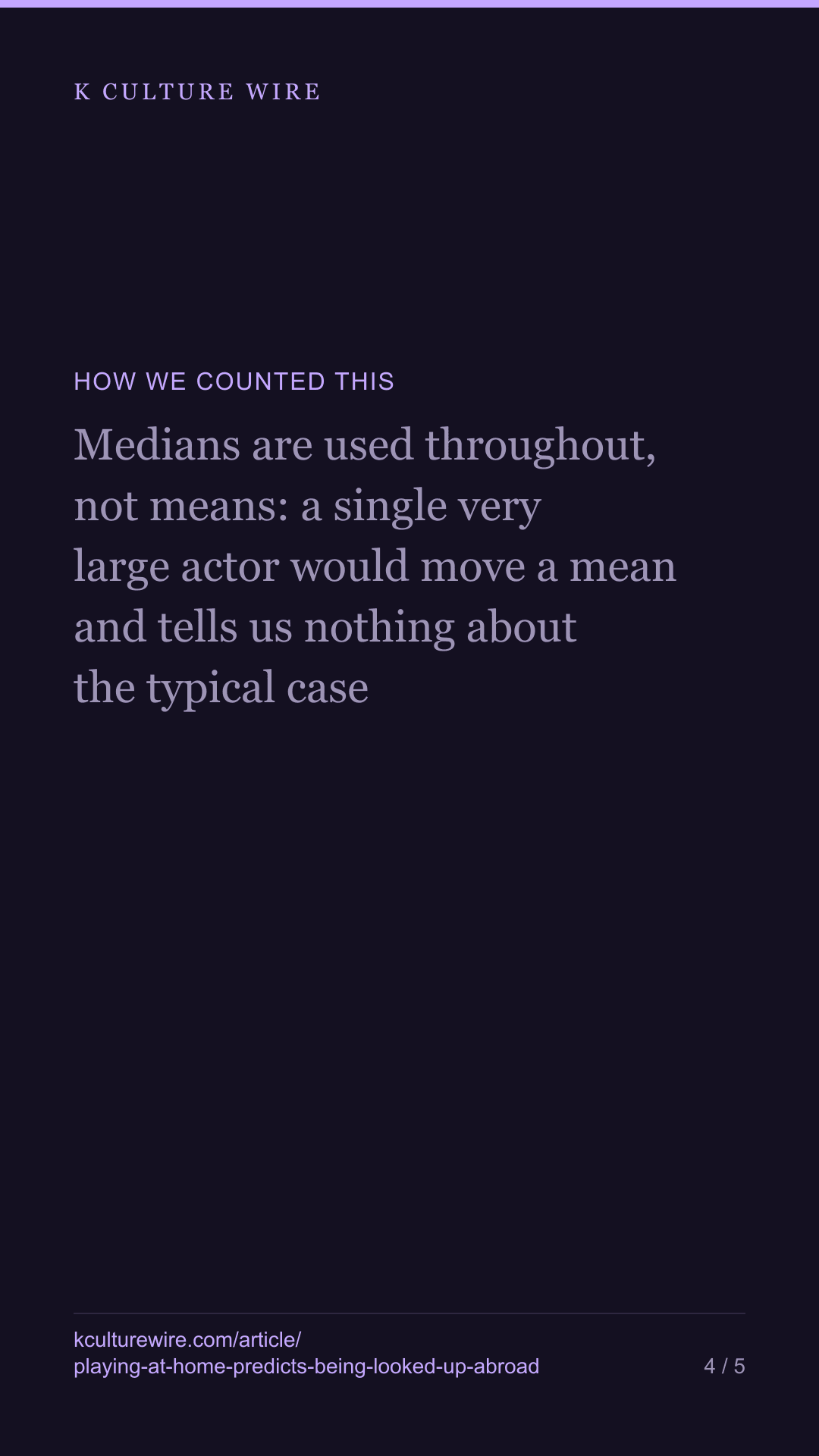
- Medians are used throughout, not means: a single very large actor would move a mean and tells us nothing about the typical case
- The comparison is run inside groups of equal title count, and then again inside groups of equal market reach, because both are obvious confounders and both had to be removed separately
- Every group size is printed beside its figure so a reader can see which comparisons rest on enough people
What we left out, and why
- Actors with no English Wikipedia article. 583 of the 1,391 people in the cast join produce no row here at all, and they are likely the less famous ones
- Any causal claim. Charting in Korea does not make anyone famous abroad; both are downstream of things we cannot see, and the piece says which
- Actors whose panel work is more than two titles, where the groups become too small to compare
The data behind this
Written from the same data
Take this away — 10 cards
The figures in this article, as images. Free to repost with the address on them.






If you work in this business
Everything on this page is measured from the same weekly Netflix lists, per market and per title. We publish the pages free; what we sell is the same measurement cut to one company's catalogue — including the figures behind /actors and /titles.
What a company sheet contains, and what it cannot tell you →