Titles · film
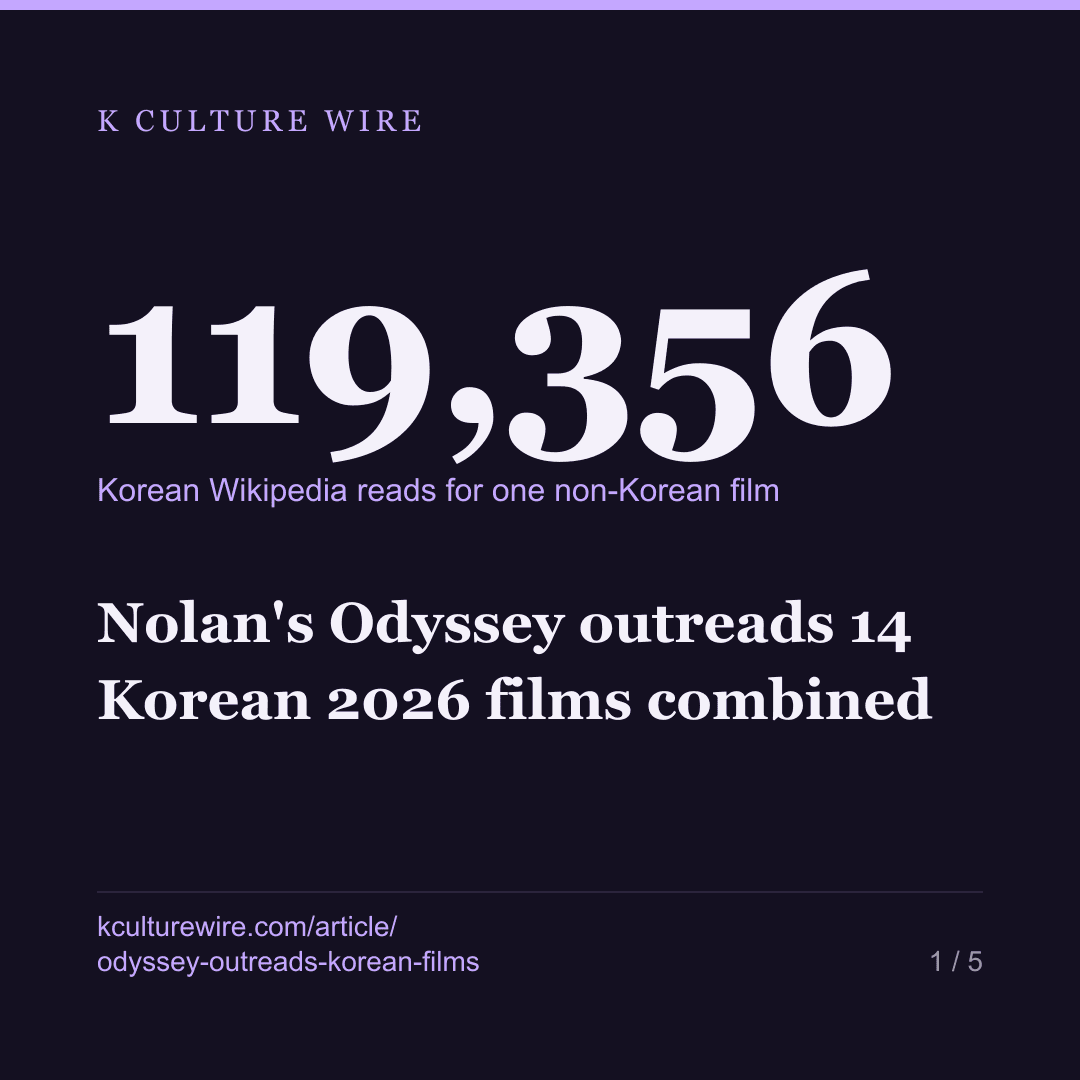
Nolan's Odyssey outreads 14 Korean 2026 films combined
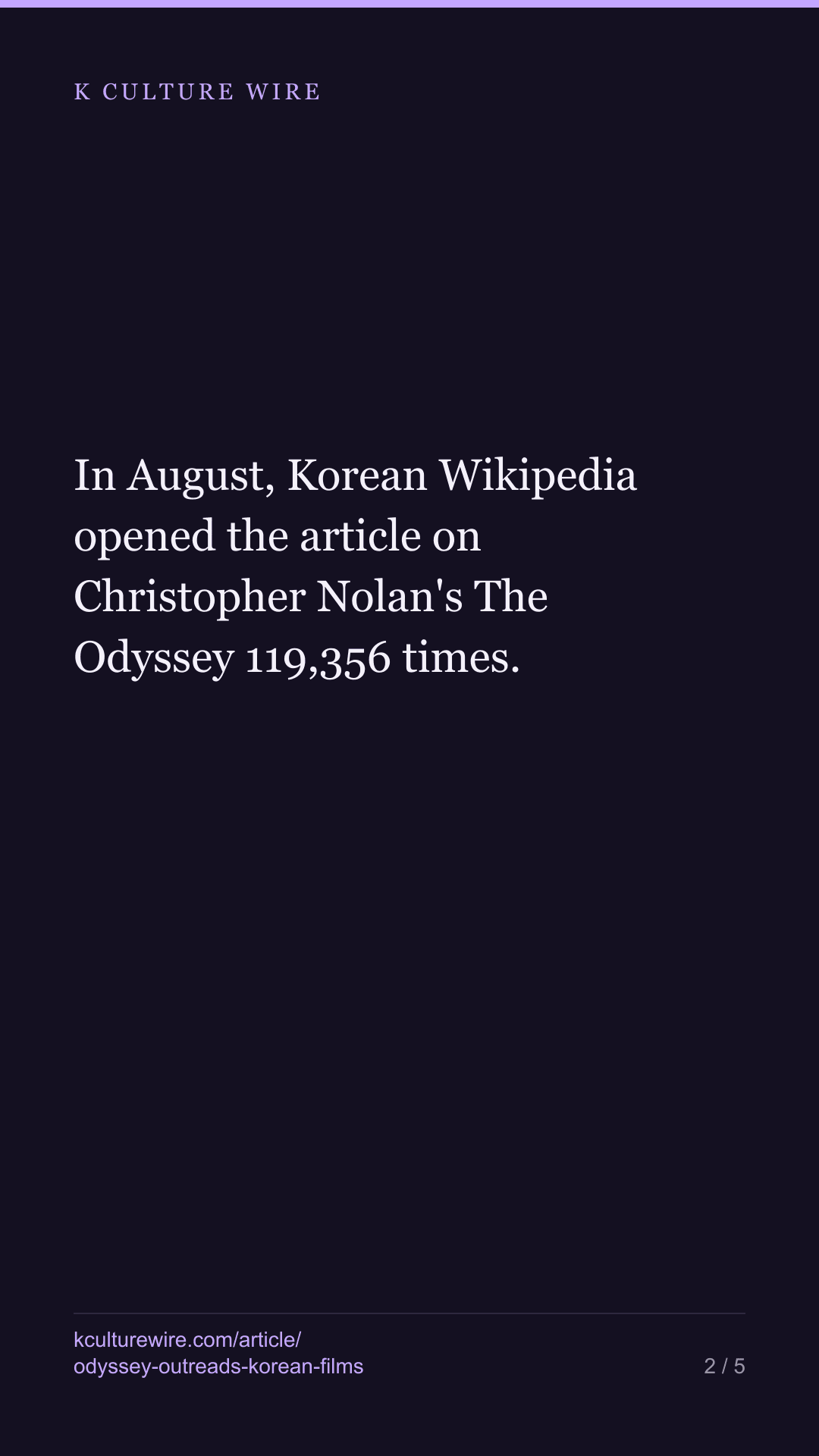
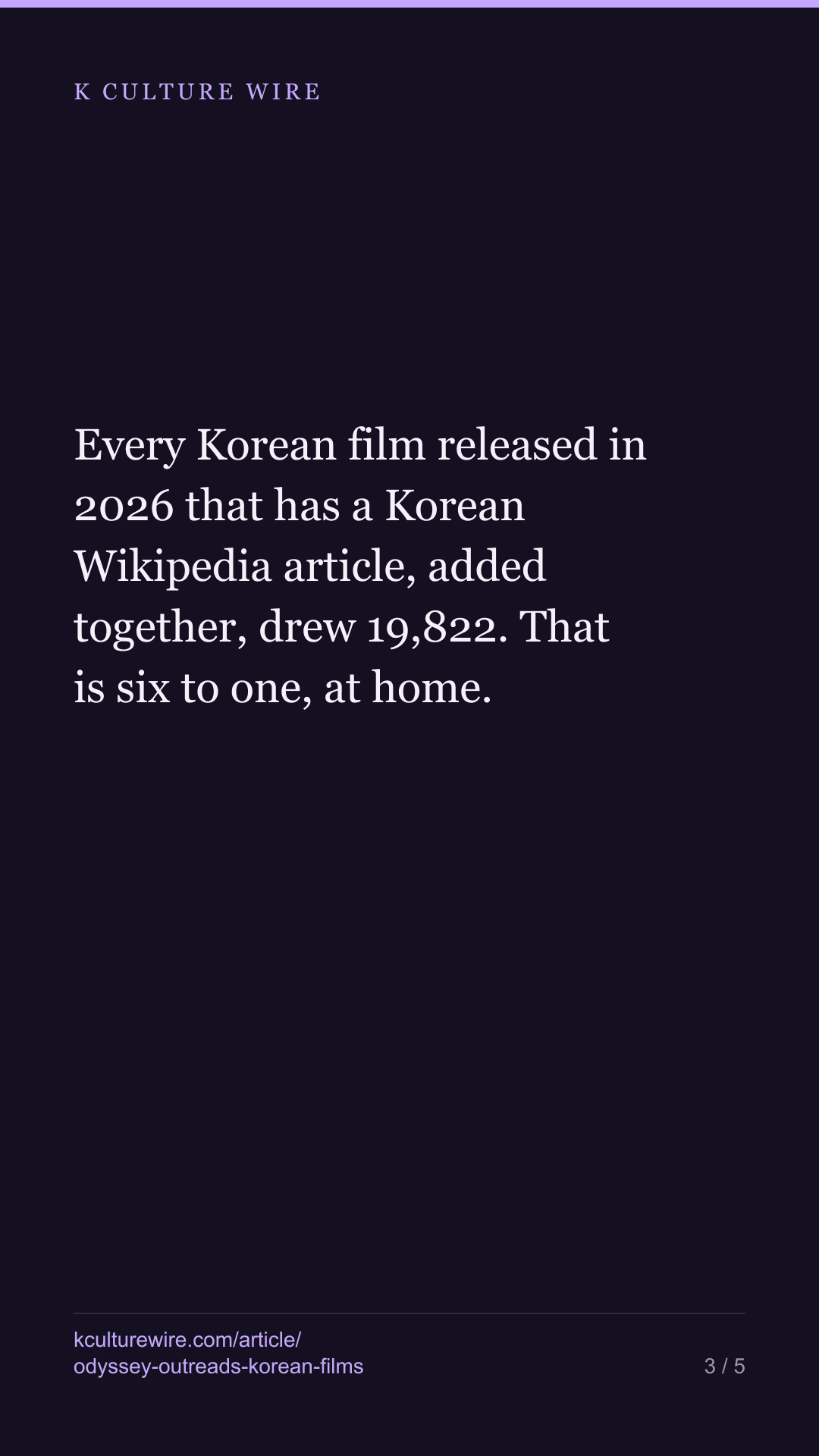
In August, Korean Wikipedia opened the article on Christopher Nolan's The Odyssey 119,356 times. Every Korean film released in 2026 that has a Korean Wikipedia article, added together, drew 19,822. That is six to one, at home.
The table this is written from: /titles
Korean Wikipedia opened the article on The Odyssey — Christopher Nolan’s 2026 film, with Matt Damon as Odysseus and Anne Hathaway as Penelope — 119,356 times during August.
Fourteen Korean films released in 2026 have a Korean Wikipedia article. Added together, over the same thirty days, they drew 19,822.
The ratio is 6.0 to 1, on the Korean-language encyclopedia, about films in a Korean release year.
One day against a month
The Odyssey’s biggest single day was 7,569 reads, on 8 August.
The best Korean film of 2026 on this measure is Hope (호프), with 5,633 reads across the entire month.
So one Tuesday of the Nolan film outdrew every Korean 2026 release’s whole August. Not the best of them — every one of them.
The fourteen
| Film | Title on Korean Wikipedia | August reads |
|---|---|---|
| The Odyssey (not Korean) | (오디세이) | 119,356 |
| Hope | (호프) | 5,633 |
| The King’s Warden | (왕과 사는 남자) | 4,937 |
| Wild Sing | (와일드 씽) | 1,600 |
| No Other Choice | (어쩔수가없다) | 1,493 |
| Salmokji: Whispering Water | (살목지) | 1,461 |
| Colony | (군체) | 1,390 |
| Humint | (휴민트) | 985 |
| Possible Love | (가능한 사랑) | 801 |
| Pavane: For A Dead Princess | (파반느) | 716 |
| Husbands in Action | (남편들) | 220 |
| Devils | (악마들) | 219 |
| Heartman: Rock and Love | (하트맨) | 181 |
| Judge Girl | (소녀심판) | 97 |
| Project Silence | (탈출: 프로젝트 사일런스) | 89 |
Eight of the fourteen drew under a thousand reads in a month. Five drew under 250 — about eight people a day, across a country of fifty-one million.
What we could not measure, and are not going to pretend we did
The number attached to The Odyssey in Korean coverage is nine million admissions. We did not measure that and we are not reporting it as ours. Korea’s admissions data lives in KOBIS, the Korean Film Council’s service, and reading it requires a key we do not hold. We asked for one; until it arrives, ticket sales are a hole in this page and we are marking it as a hole rather than filling it with someone else’s arithmetic.
What we can measure is what people looked up. That is a different thing, and it is worth being precise about which one you are reading.
The honest caveat about timing
These fourteen films were released at different points in 2026, and we compared them over one shared window in August. A film that opened in February has spent six months decaying; a film that opened in August is at its peak. That works in the Korean films’ disfavour for the older ones and in their favour for the newer ones, and we cannot separate the two effects with this data.
It does not close a gap of six to one.
Why this is a K-culture story
Korean film’s export decade is well documented — Parasite, Squid Game, the festival circuit. This is the same measurement pointed the other way: what the domestic audience was reading about in the month the year’s biggest picture was a Hollywood one.
A single foreign release taking six times the encyclopedia attention of an entire domestic release year is a fact about the home market, and it is measurable without any box-office data at all.
What Korean film does outside Korea is a different measurement, and it is on the screen-split page: films travel to far fewer countries than series, and most Korean titles never leave home at all.
Where these numbers come from
Sources
- Wikimedia — Pageviews per-article, ko.wikipedia, all-access, user agents only, 2026-08-01 to 2026-08-30 · https://wikimedia.org/api/rest_v1/
- Wikidata — Films with country of origin South Korea and a 2026 publication date that have a Korean Wikipedia article · https://query.wikidata.org/
What we checked
- Reading is not watching. A Wikipedia article being opened says someone looked the film up, not that they bought a ticket. We measured attention on one encyclopedia, and nothing else.
- The panel is 14 Korean films — those released in 2026 that Wikidata records and that carry a Korean Wikipedia article. A 2026 Korean film with no article cannot appear here, and its absence is a fact about the encyclopedia, not about the film.
- The window is the 30 days from 2026-08-01 to 2026-08-30. Wikimedia does not finalise the two most recent days, so they are excluded rather than counted low.
- Films released at different points in 2026 are compared over the same 30 days. A film released in February and one released in August are not at the same point in their own life, and that difference is inside every figure here.
What we left out, and why
- Admissions. Korea's box office numbers come from KOBIS, which requires an issued key we do not hold. We could not measure ticket sales, so we do not report any — including the widely repeated nine-million figure for The Odyssey.
- Every language other than Korean. This is what readers on the Korean Wikipedia did. The English, Japanese and Chinese editions were not counted.
- Why the gap exists. Screen counts, marketing spend and release strategy are not published anywhere we can read.
The data behind this
Written from the same data
Take this away — 10 cards
The figures in this article, as images. Free to repost with the address on them.


If you work in this business
Everything on this page is measured from the same weekly Netflix lists, per market and per title. We publish the pages free; what we sell is the same measurement cut to one company's catalogue — including the figures behind /titles and /most-read.
What a company sheet contains, and what it cannot tell you →