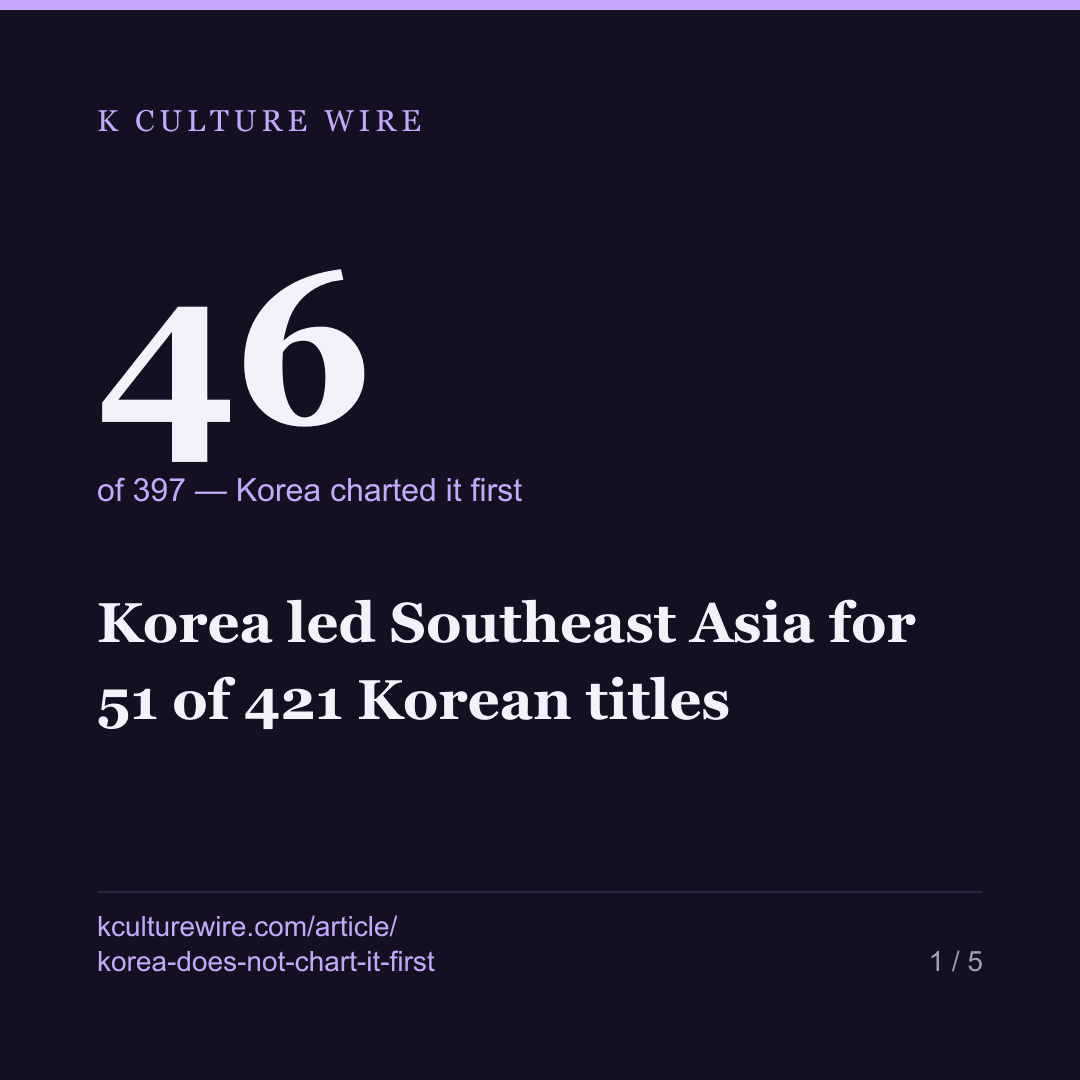
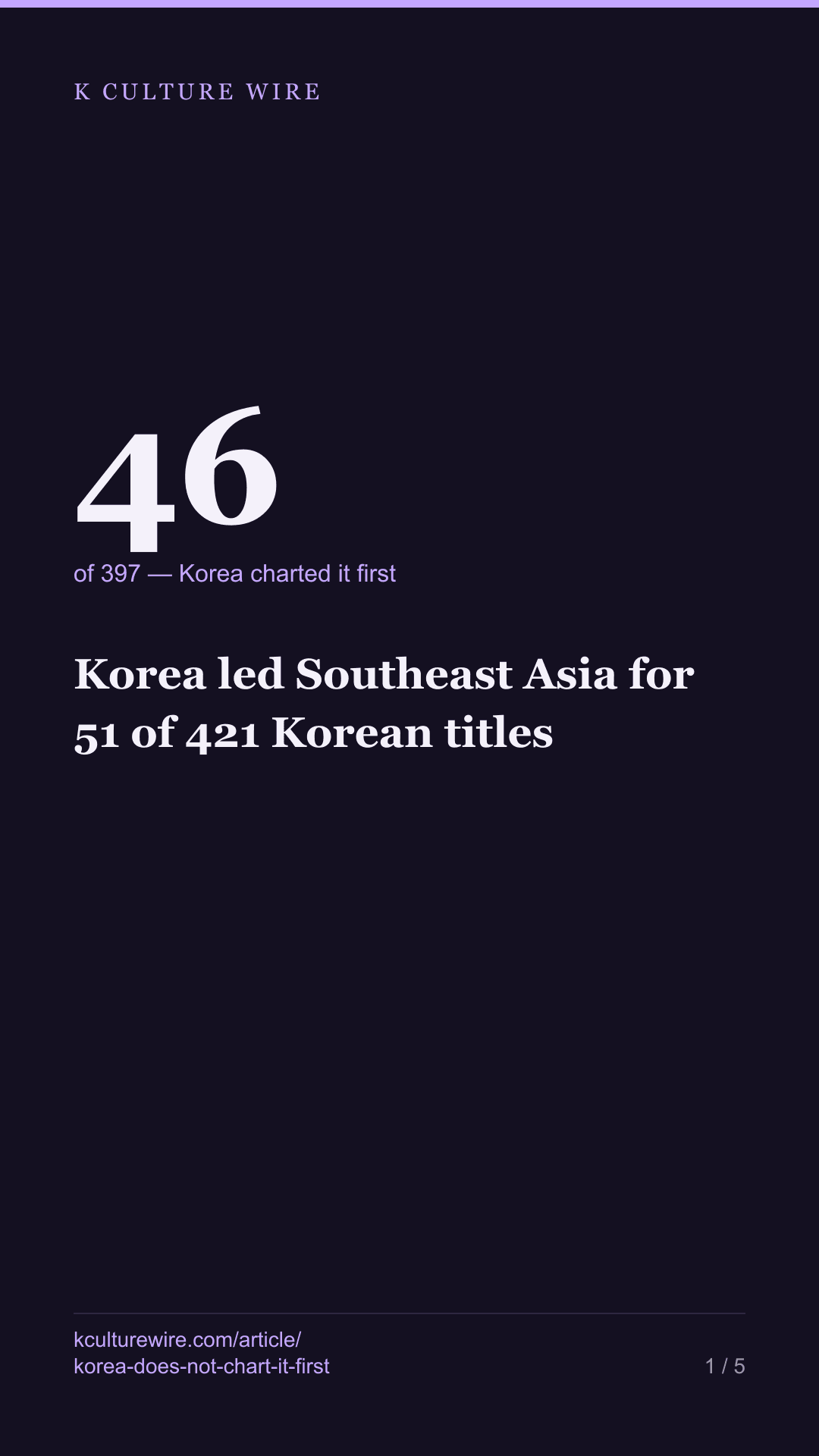
Korea led Southeast Asia for 51 of 421 Korean titles
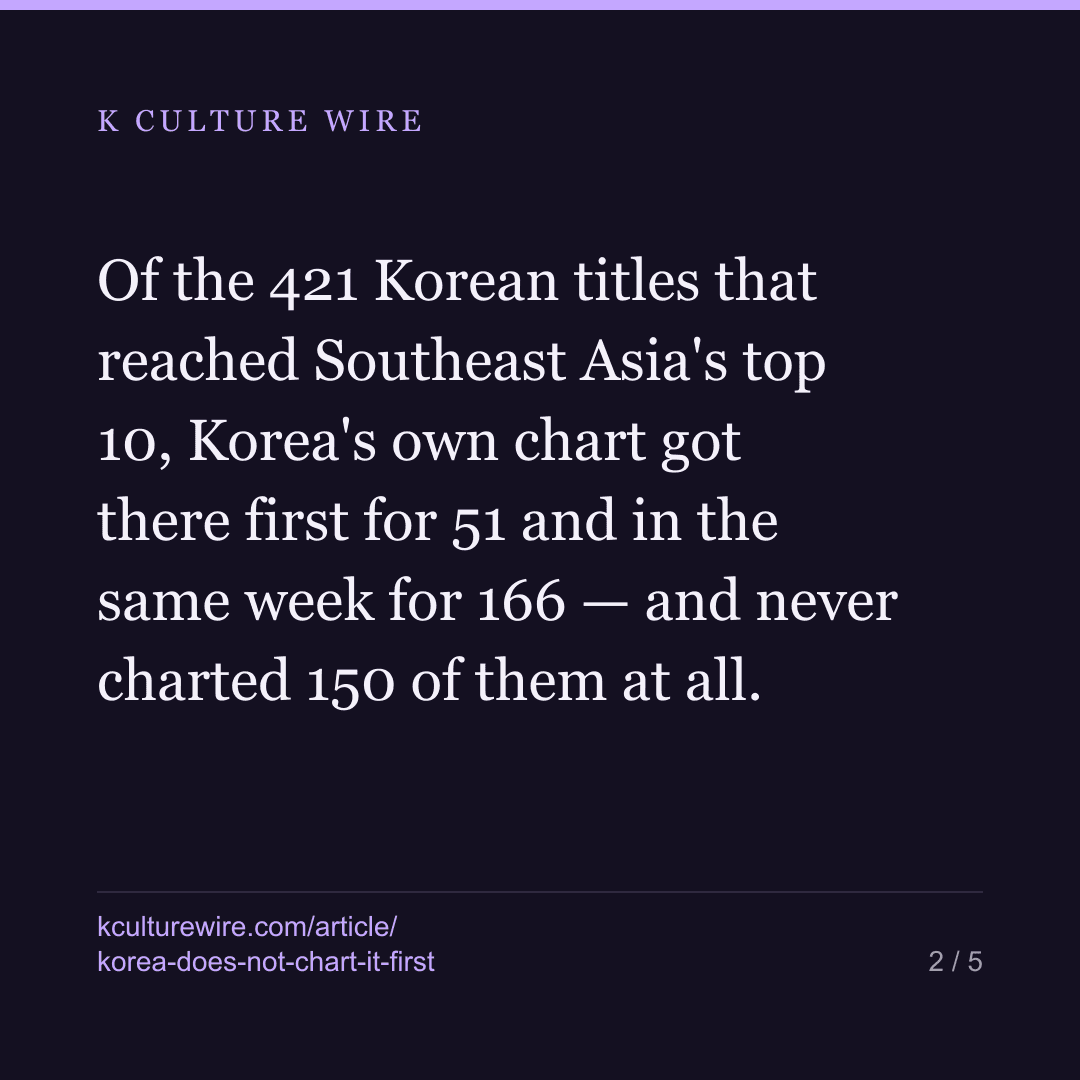
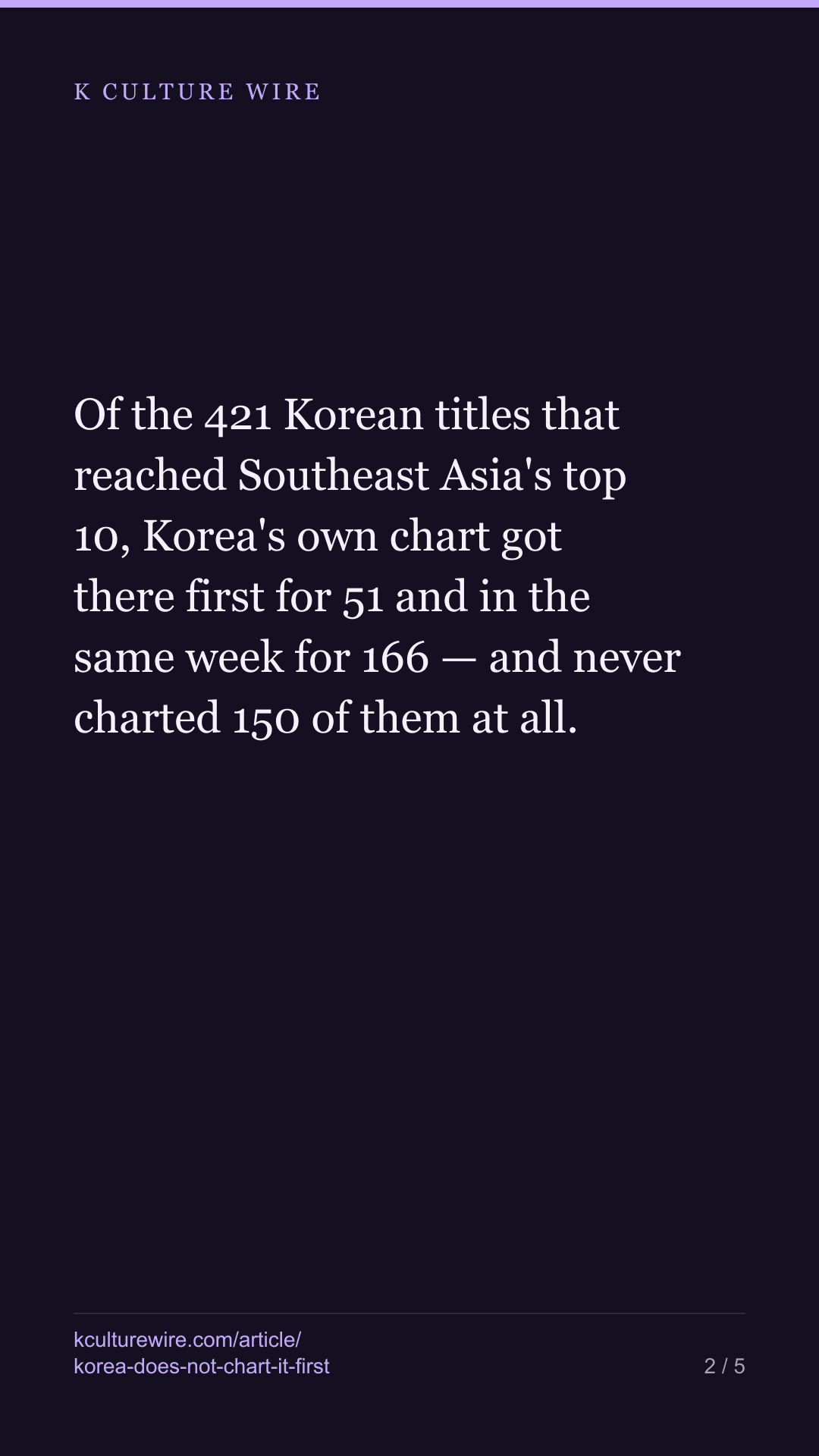
Of the 421 Korean titles that reached Southeast Asia's top 10, Korea's own chart got there first for 51 and in the same week for 166 — and never charted 150 of them at all. Series enter together; films scatter.
The table this is written from: /home-first
The question we are asked most often by readers outside Korea is some version of this: if I watch Korea’s Netflix top 10, will I see it before my country does?
That is a question about the future, and we do not sell those. But the backward-looking version is measurable, and the answer is clear enough that the forward-looking one mostly answers itself.
Korea got there first for 46 titles out of 397
397 Korean titles have entered the Netflix top 10 in Singapore, Malaysia, the Philippines, Thailand, Indonesia or Vietnam. For each one we took the first week it charted anywhere in those six, and the first week it charted in Korea.
| Titles | Korea first | Same week | Korea later | |
|---|---|---|---|---|
| Charted in both | 271 | 51 (18.8%) | 166 (61.3%) | 54 (19.9%) |
| Panel’s first week removed | 260 | 50 | 160 | 50 |
| Shared names also removed | 255 | 48 (18.8%) | 160 (62.7%) | 47 (18.4%) |
The three rows are the same measurement under progressively stricter conditions, and the answer does not move: around five titles in eight enter Korea and Southeast Asia in the same week.
The remaining 150 titles never charted in Korea at all — 35.6% of everything that reached Southeast Asia. Set against the whole panel, Korea’s chart led for 51 titles in 421. About one in nine.
“Same week” is not “same day”, and we cannot tell the difference
Netflix publishes one list per week. A title that entered Korea’s chart on a Monday and Jakarta’s on the following Friday appears here as a single simultaneous entry.
So the 62% is not evidence that these titles arrived at the same moment. It is evidence that any lead they had was shorter than the smallest unit our source publishes. That is a limit of the data, not a finding, and a reader deciding whether to watch Korea’s chart should treat it as one.
What we can say is the size of the leads we can see. When Korea led, the median lead was 10 weeks, and 15 of the 48 led by exactly one week. When Southeast Asia led, the median was 86 weeks — those are catalogue titles finding a second audience abroad a year or two later, not releases running ahead of Korea.
Series enter together. Films do not.
| Titles | Korea first | Same week | Korea later | |
|---|---|---|---|---|
| Series | 180 | 27 (15.0%) | 128 (71.1%) | 25 (13.9%) |
| Films | 80 | 23 (28.8%) | 32 (40.0%) | 25 (31.3%) |
Nearly three-quarters of Korean series enter both charts in the same week. Korean films do so 40% of the time, and the rest split almost evenly between arriving in Korea first and arriving later.
The mechanism for series is not mysterious — a Netflix series is released to every country at once, so the only thing that could separate the two charts is how hard each is to enter. For films it is different: many Korean films run in Korean cinemas long before they reach Netflix anywhere, and the order in which they then appear on two charts carries no single story.
Fifteen titles charted in all six countries and never once in Korea
Not “charted lower in Korea”. Never appeared.
| Title | Format | First week in Southeast Asia |
|---|---|---|
| The Penthouse: War in Life | TV | 2022-01-09 |
| The Cursed | TV | 2022-03-20 |
| Bad And Crazy | TV | 2022-04-03 |
| Secret Royal Inspector & Joy | TV | 2022-05-08 |
| Sell Your Haunted House | TV | 2022-07-24 |
| Police University | TV | 2022-07-31 |
| Young Lady and Gentleman | TV | 2022-08-28 |
| Sh**ting Stars | TV | 2022-10-16 |
| Jirisan | TV | 2022-10-30 |
| Unlock My Boss | TV | 2023-03-12 |
| Dr. Romantic | TV | 2023-05-07 |
| Murderer | Films | 2023-11-12 |
| Safe | Films | 2024-03-17 |
| Mama | Films | 2024-06-02 |
| The Stone | Films | 2025-08-03 |
It is worth being precise about what this is not. Korea’s list has exactly the same number of places as Singapore’s — 5,380 rows each, ten titles times two lists times 269 weeks. These titles did not miss Korea’s chart because Korea’s chart is smaller.
The explanation we had, and why we dropped it
Our first guess was the obvious one: these are television dramas. Koreans watched them when they aired on KBS, SBS, tvN or JTBC, so they never needed Netflix for them, while outside Korea Netflix was the only route. If that were right, the never-charted group should be full of titles with a Korean broadcaster and the charted group should not.
We tested it with Wikidata’s original-broadcaster field, and among series it goes the wrong way.
| Series | With a recorded Korean broadcaster |
|---|---|
| Never charted in Korea (60) | 47 — 78.3% |
| Charted in Korea (182) | 170 — 93.4% |
The titles that did chart in Korea are the ones more likely to have aired on Korean television. The explanation does not hold, and we do not have a replacement for it.
One detail is worth keeping, because it nearly fooled us. Ignoring format, the same comparison reads 37.2% against 66.7% — a gap three times larger, pointing the way we expected. That gap is format mix: the never-charted group is 83 films and 57 series, films rarely carry a broadcaster field at all, and the number was measuring how many films were in each group. Had we not split by format we would have published a confirmation of a hypothesis that is false.
What this can and cannot be used for
It answers a question about the past: how often, so far, has Korea’s chart been the earlier one. Forty-six times in 397.
It cannot tell you whether the next Korean title will follow that pattern, and we are not going to dress it up as though it can. If you want the underlying counts, they are in the tables behind the Southeast Asia panel and the country-reach page; what those tables cannot answer is listed on each of them, in the same place as what they can.
What changed on 3 September 2026
We added the chart week of 23 August 2026. One series entered the panel with it, and it charted in Korea in the same week, which is why the same-week column moves and Korea’s lead count does not.
| Was | Now | |
|---|---|---|
| Titles in the panel | 420 | 421 |
| Charted in both Korea and Southeast Asia | 270 | 271 |
| Korea first | 51 | 51 (unchanged) |
| Same week | 165 | 166 |
| Southeast Asia first | 54 | 54 (unchanged) |
| Never charted in Korea | 150 | 150 (unchanged) |
| Never charted in Korea, as a share | 35.7% | 35.6% |
| Series in the comparison | 179 | 180 |
| Series, same week | 127 | 128 |
| Chart rows per country | 5,360 | 5,380 |
| Weeks read | 268 | 269 |
The finding did not change, and the headline number did not move at all: Korea led for 51 titles either way. What grew is the denominator and the same-week column — a new Korean series appeared on both charts in the same week, which is the pattern this piece is about.
Where these numbers come from
Sources
- Netflix — Tudum weekly Top 10 country lists for Korea and the six Southeast Asian markets, 265 weeks from 2021-07-04 to 2026-07-26 · https://www.netflix.com/tudum/top10
- Wikidata — Country of origin (P495 = Q884) to identify Korean titles, and original broadcaster (P449) for the explanation tested below · https://query.wikidata.org
What we checked
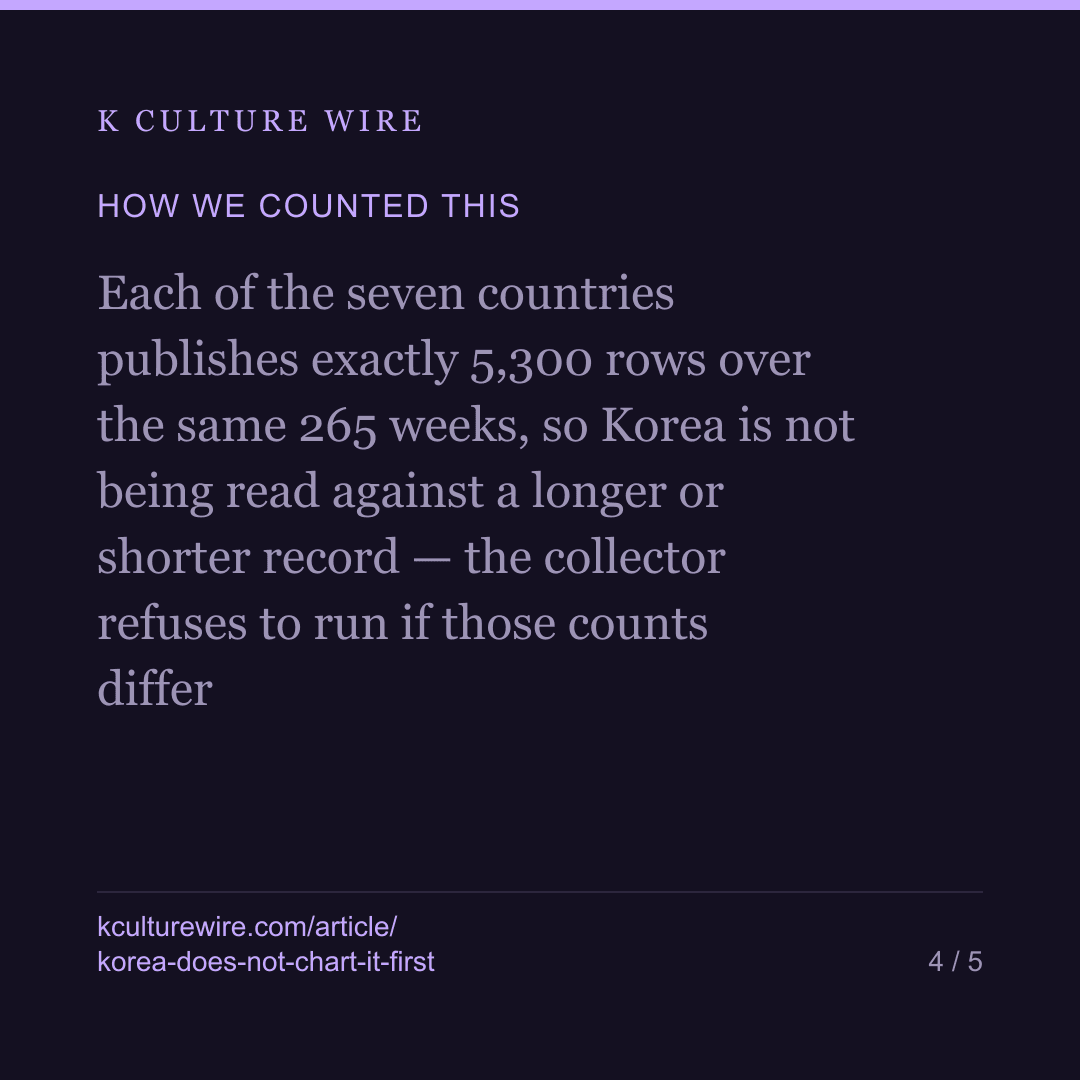
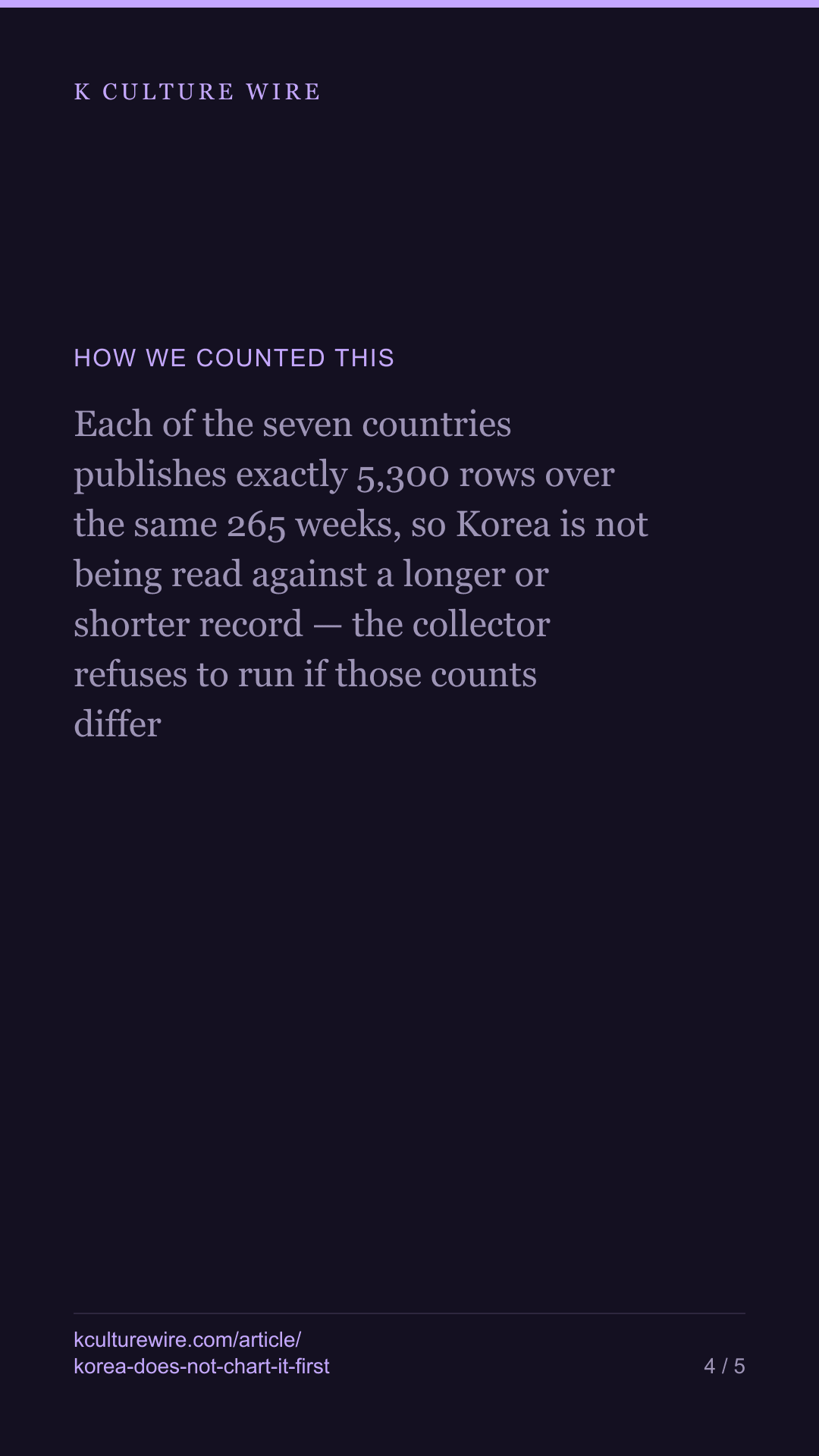
- Each of the seven countries publishes exactly 5,300 rows over the same 265 weeks, so Korea is not being read against a longer or shorter record — the collector refuses to run if those counts differ
- The 397 titles are the same panel that /titles and /reach read, and the collector refuses to run if its count disagrees with theirs
- Every split is reported three ways — all titles, the panel's first week removed, and shared names also removed — and the same-week share moves by 1.6 points across all three
What we left out, and why
- Any statement about what will chart next. This is a record of what has already happened, and the figures below are the reason we do not sell the other kind
- Leads shorter than seven days. Netflix publishes weeks, so a title that opened in Korea on Monday and in Jakarta on Friday looks simultaneous to us. We cannot see that lead and do not claim it is absent
- Release dates. A chart entry is not a release, and Korean films reach Netflix after a cinema run that has no equivalent abroad
- Lead times for nine titles whose name is shared by a film and a series. They stay in the counts, where only the first week matters, and are removed from every figure measured in weeks
The data behind this
Written from the same data
Take this away — 10 cards
The figures in this article, as images. Free to repost with the address on them.


If you work in this business
Everything on this page is measured from the same weekly Netflix lists, per market and per title. We publish the pages free; what we sell is the same measurement cut to one company's catalogue — including the figures behind /home-first and /titles and /reach.
What a company sheet contains, and what it cannot tell you →