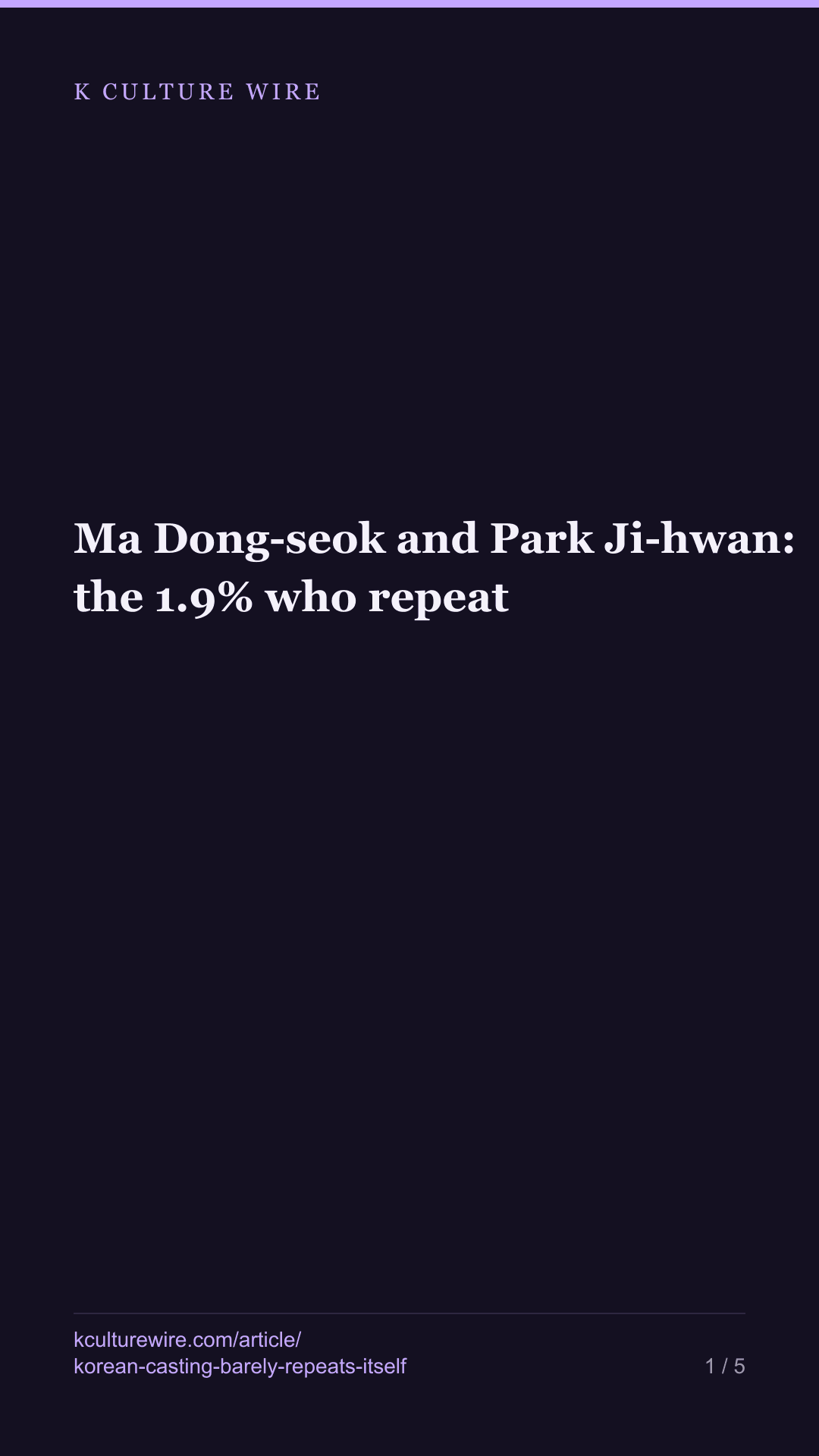
Ma Dong-seok and Park Ji-hwan: the 1.9% who repeat
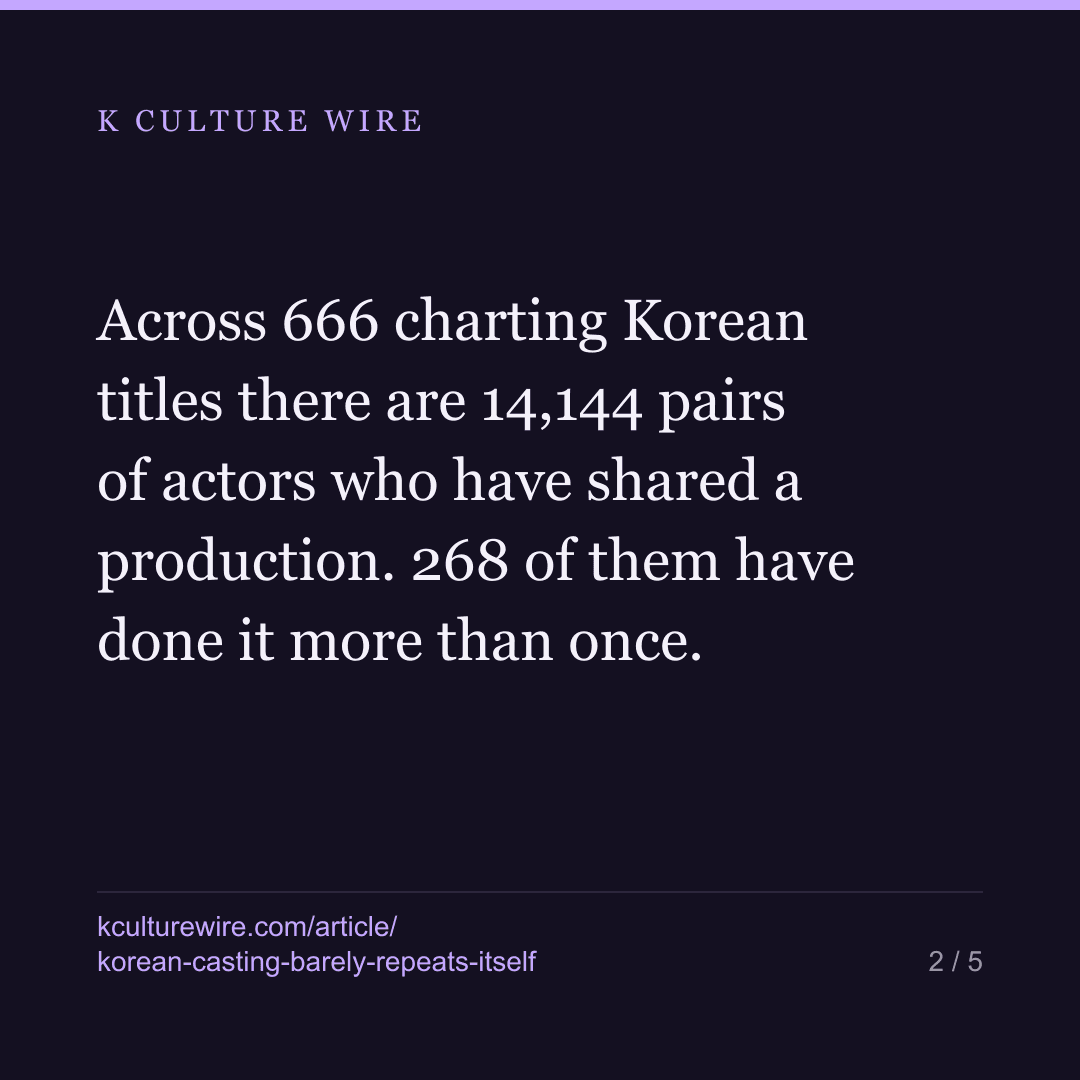
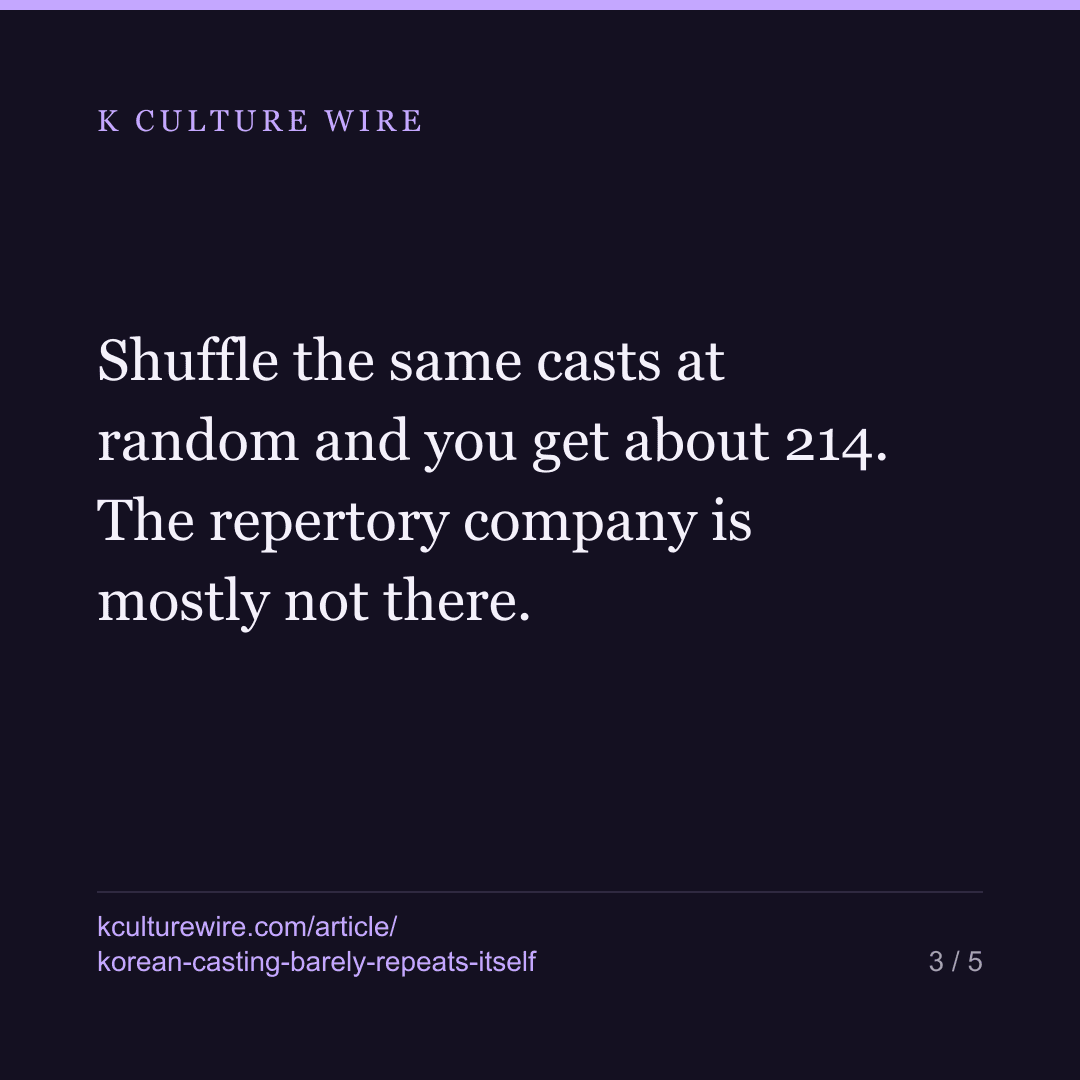
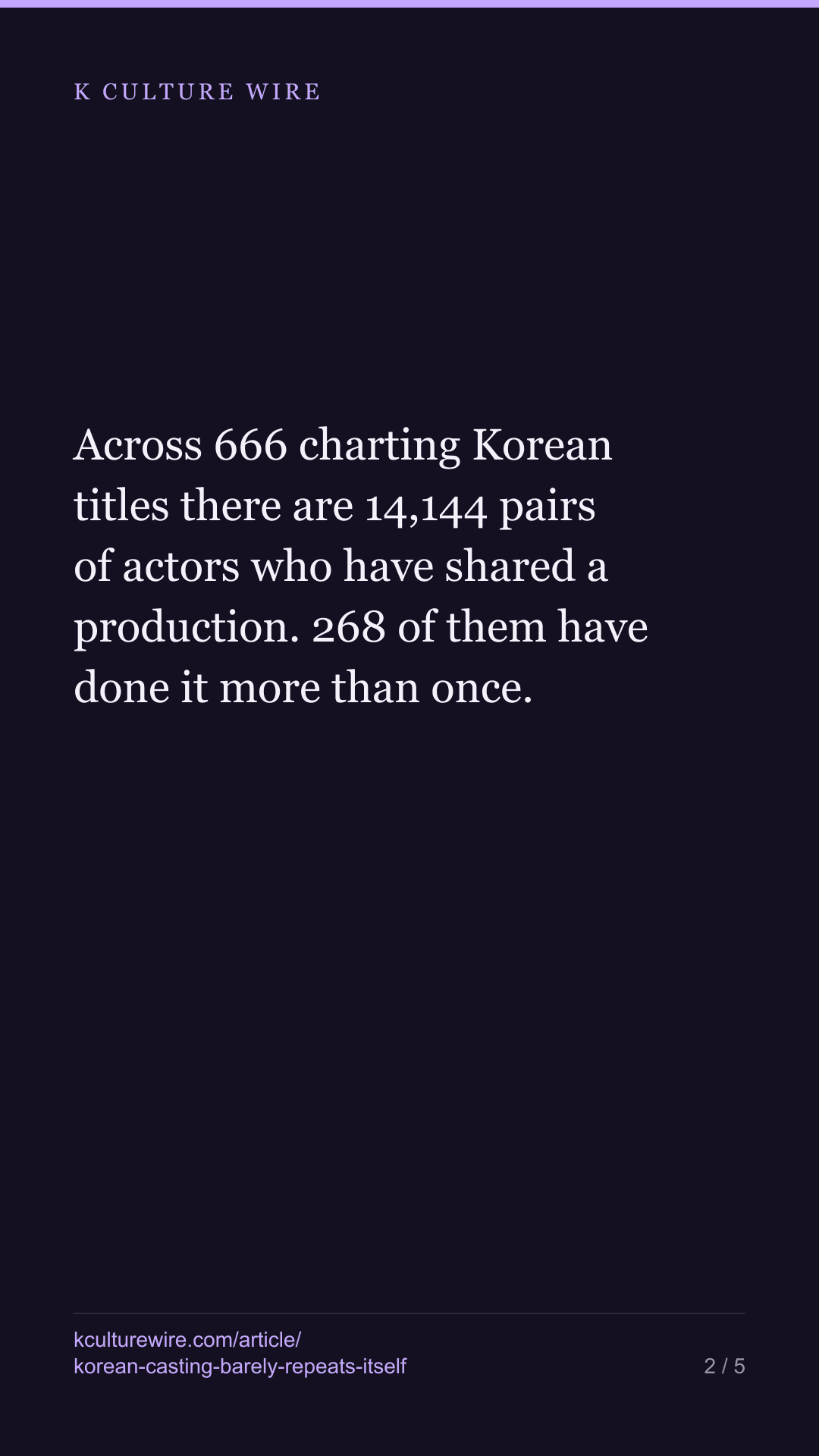
Across 666 charting Korean titles there are 14,144 pairs of actors who have shared a production. 268 of them have done it more than once. Shuffle the same casts at random and you get about 214. The repertory company is mostly not there.
The table this is written from: /actors
Ma Dong-seok and Park Ji-hwan have appeared in four of the same Netflix Top 10 titles. Jo Woo-jin and Kim Eui-sung have too. In this data they are the only two pairs who have done it four times — and they are the exception, not the rule.
Take every Korean film and series that has reached a Netflix Top 10 and has a cast recorded in Wikidata — 666 titles, 1,391 people, 3,579 credited roles. Draw a line between two people every time they appear in the same production.
You get 14,144 distinct pairs. Of those, 268 have worked together more than once. That is 1.9%.
| Times a pair has shared a title | Pairs |
|---|---|
| Once | 13,876 |
| Twice | 253 |
| Three times | 13 |
| Four times | 2 |
The two pairs at four are Jo Woo-jin with Kim Eui-sung, and Ma Dong-seok with Park Ji-hwan. Across 635 productions, nobody in this data has shared a credit with the same person five times.
Chance would give you almost the same number
1.9% sounds low, but low compared to what? So we built the comparison: keep every title’s cast size exactly as it is, pour all 3,579 roles into one pile, and deal them back out at random.
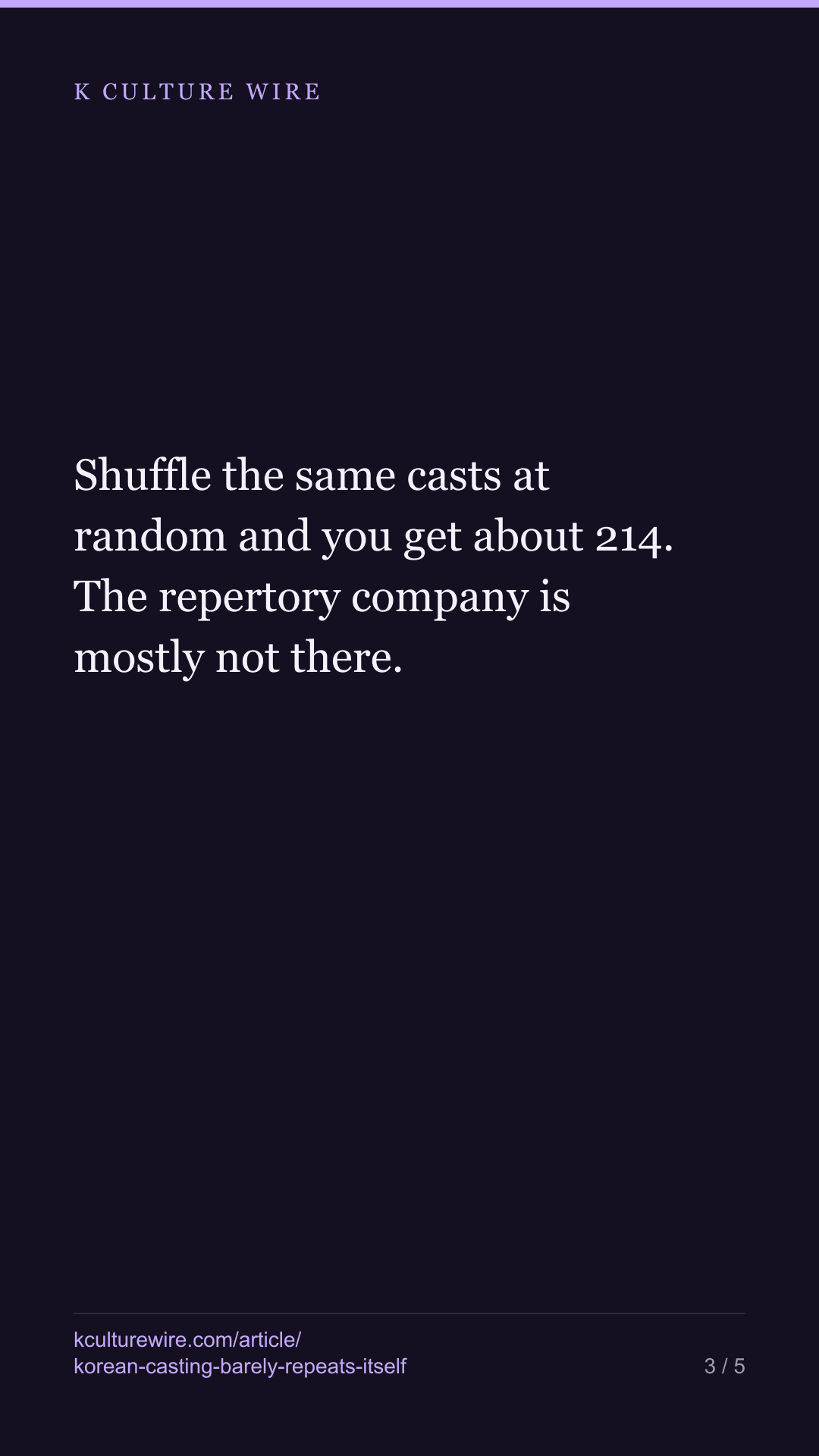
A random Korean film industry produces about 214 repeat pairs. The real one produces 268.
Thirty shuffles gave a median of 214 and a range of 194 to 253 — so the observed 268 sits above the middle of the random distribution but inside its range, and one shuffle in thirty beat it outright. Observed is 1.3 times chance. That is a real effect and a small one.
What that rules out
It rules out the repertory company as a description of the whole industry. If Korean production ran on a few tight circles who cast each other repeatedly, this ratio would not be 1.2. It would be several times chance, and the four-time pairs would be commonplace rather than two of them.
It does not rule out that such circles exist. Ma Dong-seok and Park Ji-hwan have made four of these titles together, which is not chance for those two people. The finding is about the aggregate: the circles are too few and too small to bend the whole distribution.
What could hide a repertory habit from us
Three things, and all of them push in the same direction — they make the real figure higher than 1.8%, not lower.
Wikidata’s cast lists are short. The median title here lists four people. A real production has dozens of credited actors, and the ones Wikidata records are the well-known ones. Two character actors who work together constantly can share ten films and never produce a single pair in our data because neither is listed.
We only see titles that charted. A director who casts the same four people in everything will show up here only for the productions that reached a Netflix Top 10. The rest of that body of work is outside the panel.
And we cannot see behind the camera. P161 is cast. If Korean production has a repertory habit, the most likely place for it is a director returning to the same crew, and none of that is in this data.
So read 1.8% as a floor on repetition and a ceiling on how confidently we can talk about it. What we can say is narrower: in the part of the industry that is visible in charting titles and recorded casts, actors pair up close to randomly.
Why we ran the shuffle at all
Because “only 1.8% repeat” is the kind of number that reads as a finding and is not one on its own. A sparse network of 1,355 people spread over 635 small casts will produce very few repeats no matter how it is organised. Without the null model we would have published a fact about arithmetic and called it a fact about Korean casting.
The shuffle is what turns it into a claim: not “repeats are rare” but “repeats are barely more common than they would be if nobody chose anybody.”
If pairings are close to random, what holds the network of Korean productions together at all? Read how it stays one connected body →
What changed on 3 September 2026
Two things moved, and one of them was our own mistake.
We re-collected the cast data on 25 August 2026, which took the set from 635 titles to 666 and from 1,355 people to 1,391. And we found that this piece had joined people by name rather than by Wikidata Q-number, so two different people who share a name were counted as one. The rest of this site joins on Q-numbers precisely because Korean names repeat; this article was the exception. It is now joined the same way as everything else.
Recounted, the pairs went from 13,558 to 14,144 and the repeats from 250 to 268 — 1.9% rather than
1.8%. We also wrote the shuffle as a script this time
(scripts/measure-kcw-casting-shuffle.mjs, seed 20260903) rather than running it by hand, so the
null model can be re-run whenever the data moves. On the new data thirty shuffles give a median of
214 and a range of 194 to 253, and no shuffle out of thirty beat the observed 268.
The finding did not change. Repeat pairing is real, small, and close to chance — 1.3 times it rather than 1.2. There is still no repertory company here.
One limit we should have stated the first time: the shuffle keeps each title’s cast size but does not keep how many titles each person appears in. It removes the tendency for the same people to gather in the same productions, which is what we wanted to test, but it is not a null model that holds an actor’s workload fixed. A shuffle that did would be a harder test than this one.
Where these numbers come from
Sources
- Wikidata — Cast member (P161) for every Korean title matched to a Wikidata item, restricted to people with Korean citizenship (P27 = Q884), joined on Q-numbers rather than names · https://query.wikidata.org
- Netflix — Top 10 weekly lists (Tudum), global and per-country, used to decide which titles are in the panel at all · https://www.netflix.com/tudum/top10
What we checked
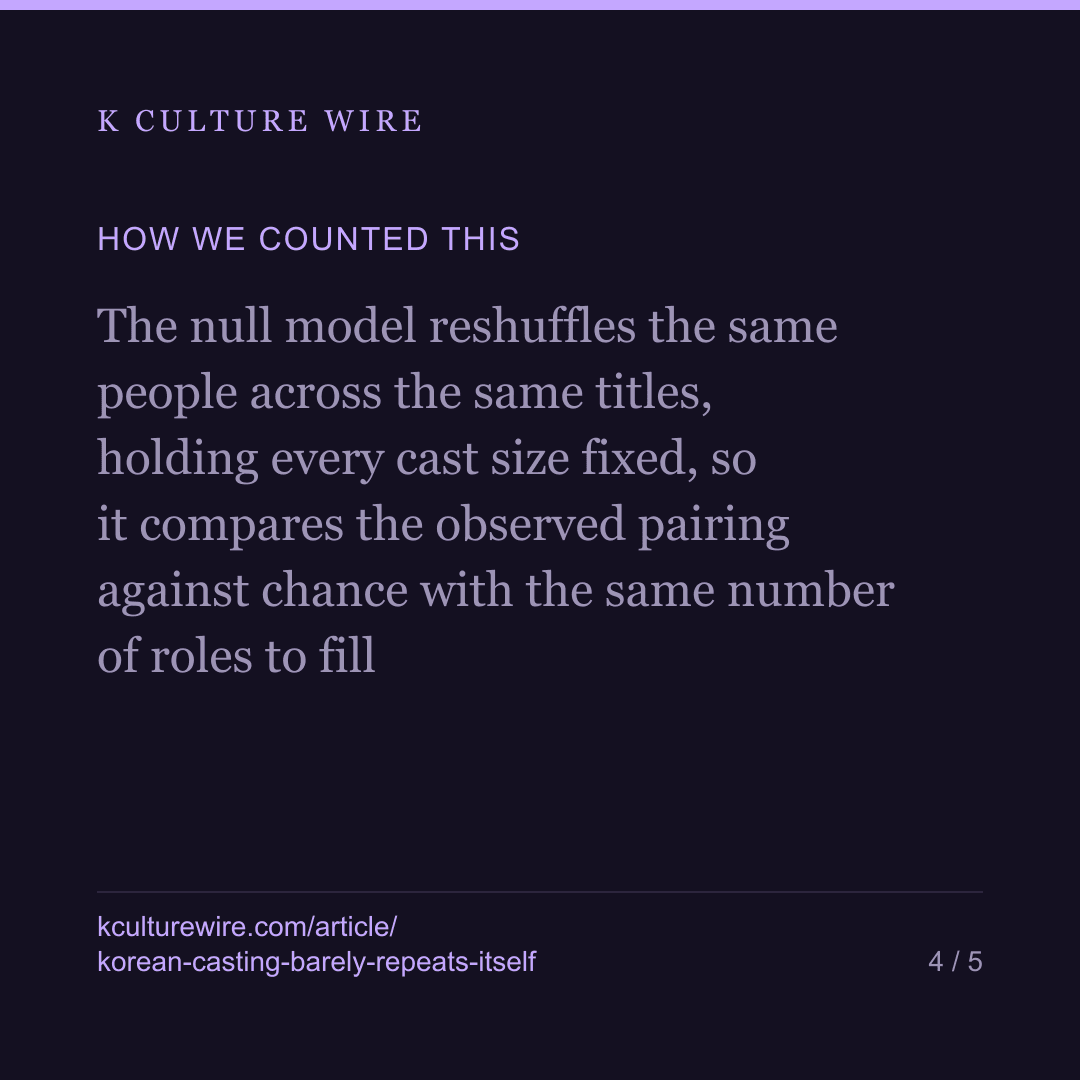
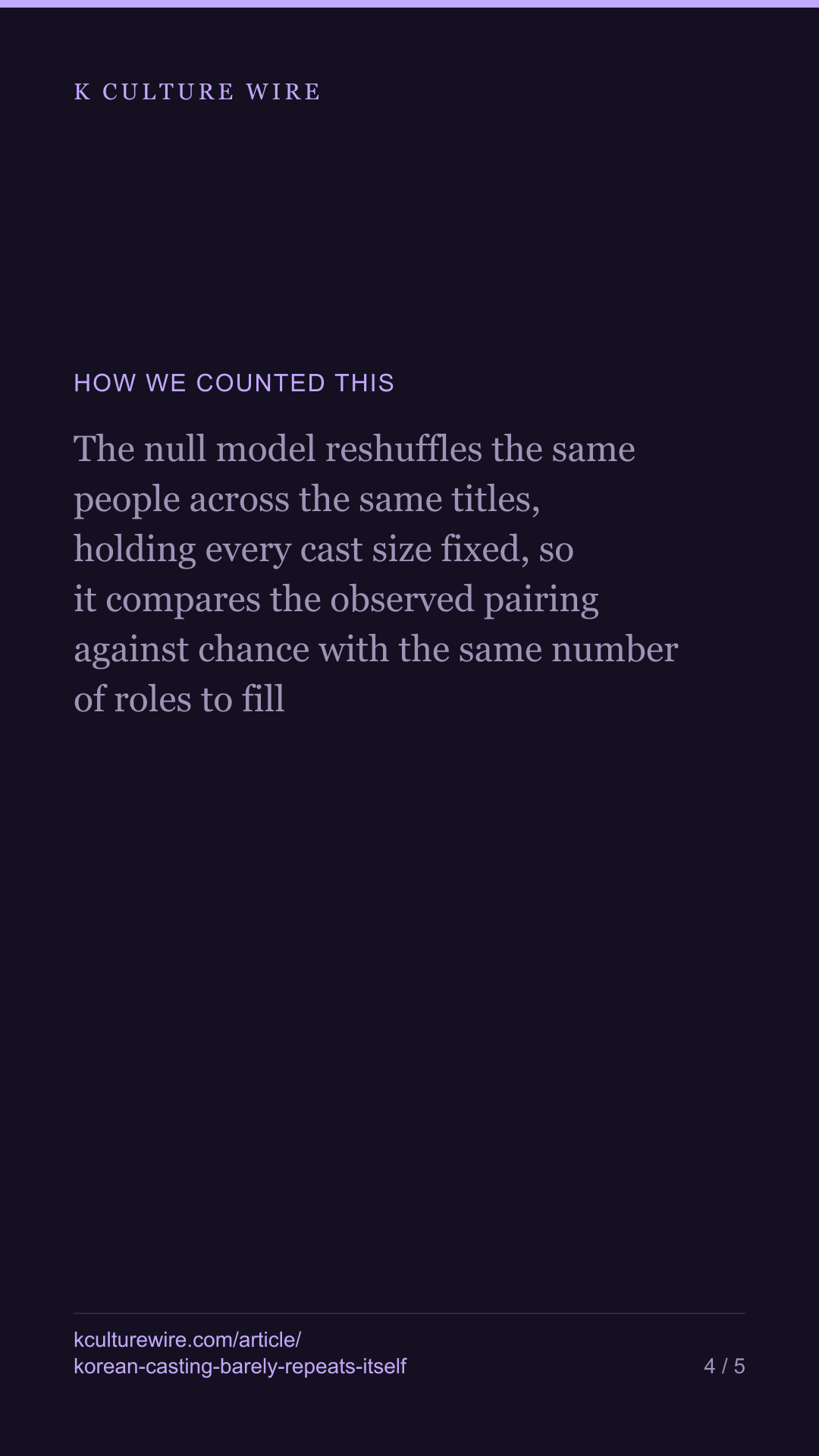
- The null model reshuffles the same people across the same titles, holding every cast size fixed, so it compares the observed pairing against chance with the same number of roles to fill
- The null was run 30 times; the median is quoted and the range is given rather than a single draw
- Pairs are counted once per title, so two people credited together in one production count once however many scenes they share
What we left out, and why
- Directors, writers and producers. Wikidata's P161 is cast, and a repertory habit could easily live behind the camera where we cannot see it
- Any claim that Wikidata's cast lists are complete. They are not, and the direction of that error is stated below
- Titles with no recorded cast. 266 of the 901 matched Korean titles carry no P161 statement and are absent from this entirely
The data behind this
Written from the same data
Take this away — 10 cards
The figures in this article, as images. Free to repost with the address on them.
If you work in this business
Everything on this page is measured from the same weekly Netflix lists, per market and per title. We publish the pages free; what we sell is the same measurement cut to one company's catalogue — including the figures behind /actors and /titles.
What a company sheet contains, and what it cannot tell you →