Ma Dong-seok has 21 titles. Steven Yeun is read 2x more
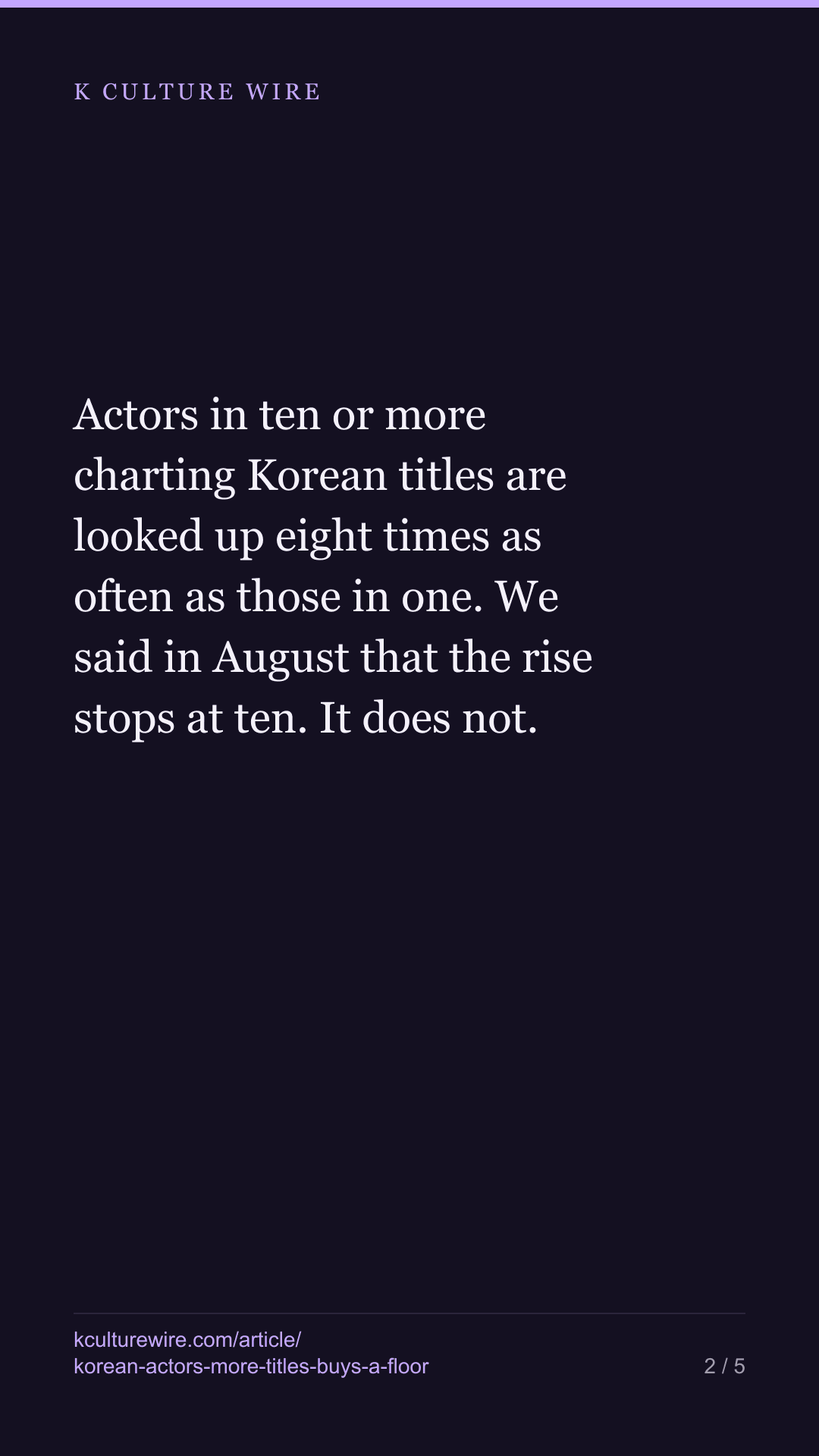
Actors in ten or more charting Korean titles are looked up eight times as often as those in one. We said in August that the rise stops at ten. It does not. The busiest are still not the most read: 21 titles against Steven Yeun's one.
The table this is written from: /actors
Take every Korean actor Wikidata places in the cast of a title that has reached a Netflix Top 10 — 1,113 of them have English Wikipedia articles — and ask a simple question: does appearing in more of those titles mean more people look you up?
Yes, and the effect is large. It does not stop where we said it did.
| Charting Korean titles | Actors | Median views in 30 days |
|---|---|---|
| 1 | 411 | 1,897 |
| 2 | 205 | 3,684 |
| 3 | 156 | 4,742 |
| 4–5 | 155 | 7,561 |
| 6–9 | 111 | 11,764 |
| 10 or more | 39 | 15,744 |
From one title to ten-or-more, the median rises more than eightfold, and it rises at every step.
In August we published this table with a turn at the end: the ten-or-more band sat below the six-to-nine band, and we wrote that the effect stops. That band held twenty-three people then. It holds thirty-nine now, after three more weeks of chart data and after we fixed a spelling fault that had been dropping forty-four Korean titles from the set. The turn was the thin band, not the world. The old reading is kept in the correction note rather than deleted.
Across all 1,077 actors the rank correlation is 0.319 — real, and much weaker than the table alone suggests. Volume explains part of this and nothing like all of it.
The busiest people are not the most looked-up
| Charting titles | Views | |
|---|---|---|
| Ma Dong-seok | 21 | 54,408 |
| Hwang Jung-min | 20 | 20,487 |
| Lee Byung-hun | 18 | 59,406 |
| Ha Jung-woo | 17 | 10,931 |
| Sul Kyung-gu | 17 | 11,478 |
| Kim Eui-sung | 15 | 5,098 |
Now the other end of the same panel:
| Charting titles | Views | |
|---|---|---|
| Steven Yeun | 1 | 111,016 |
| Jisoo | 2 | 88,091 |
| Nam Joo-hyuk | 2 | 68,657 |
Kim Eui-sung has fifteen charting titles and 5,098 views. Steven Yeun has one and 111,016 — more than twenty times as many. Both figures are correct and they are not in tension, because they measure different things: one is how much Korean screen work a person has done that travelled, the other is how many people typed their name into English Wikipedia in July.
The reading that survives is narrower than the headline table. Appearing in more hits raises the floor, not the ceiling. Working constantly moves an actor from 1,897 to 15,744 — from invisible to solidly present. It does not put anyone at the top. The top of this panel is held by people carrying something the panel cannot see: a career in English-language film, a place in a globally known group, a single show that broke out.
One title versus two
The cleanest cut in the data is not at ten. It is at two.
| Actors | Share of actors | Share of views | Median | |
|---|---|---|---|---|
| One charting title | 411 | 38.2% | 17.0% | 1,897 |
| Two or more | 666 | 61.8% | 83.0% | 6,087 |
Two in five of the panel have appeared in exactly one Korean title that reached a Netflix Top 10, and that group holds a sixth of the attention. The median actor with two or more charting titles is looked up 3.21 times as often as the median actor with one.
Whether that is a second title creating attention or attention creating a second booking, this data cannot say, and neither can any dataset we can reach.
Three things this does not measure, and one we broke ourselves
It is not a filmography. A charting title means a Korean film or series that reached a Netflix Top 10 somewhere. An actor with thirty years of work shows 1 if only one of those works ever charted. Kim Eui-sung’s fifteen is fifteen charting titles, not fifteen credits.
It is not billing. Wikidata’s P161 records a cast member. A lead and a one-scene part are the same row. Many of the ten-or-more group are character actors who appear in everything and are read about far less than the leads beside them — which is why the band moved so much when sixteen more people entered it, and why its shape at twenty-three should not have been called a finding.
It is not popularity. Every figure counts openings of an English Wikipedia article over thirty days. Not tickets, not streams, not attention inside Korea.
And one gap is our own doing. Our collector stored how many charting titles each actor appeared in, and not which ones. So we can tell you that Roh Yoon-seo drew 66,356 views across three charting titles, and we cannot tell you which three. Every question that begins did this show move its cast is unanswerable from what we saved. We are fixing the collector to keep the link. The pageview history can be re-fetched at any time; the join we discarded has to be re-queried from scratch, which is the more expensive of the two mistakes and the one we made.
We would rather print that than report the count as though it were the whole story.
More titles buys a floor. Does the kind of title matter as well as the count? Read what Korea’s own chart adds →
Where these numbers come from
Sources
- Wikimedia Foundation — Pageviews API, en.wikipedia, all-access, user agent class 'user', 30 days from 2026-07-24 to 2026-08-22 · https://wikimedia.org/api/rest_v1/
- Wikidata — Cast member (P161) on the Korean films and series that have appeared in a Netflix Top 10 · https://query.wikidata.org
- Netflix — Top 10 weekly lists (Tudum), used to decide which Korean titles the roster is drawn from · https://www.netflix.com/tudum/top10
What we checked
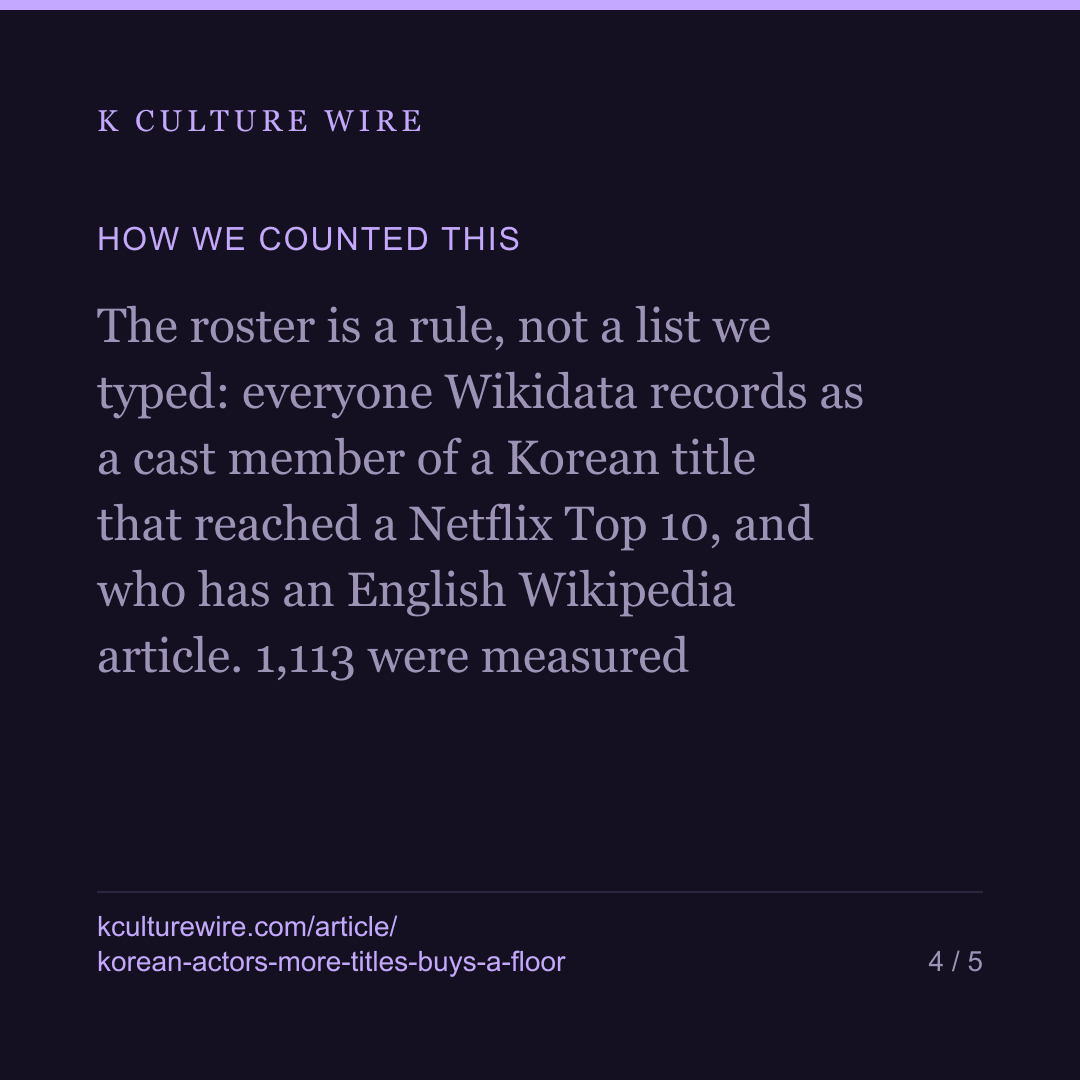
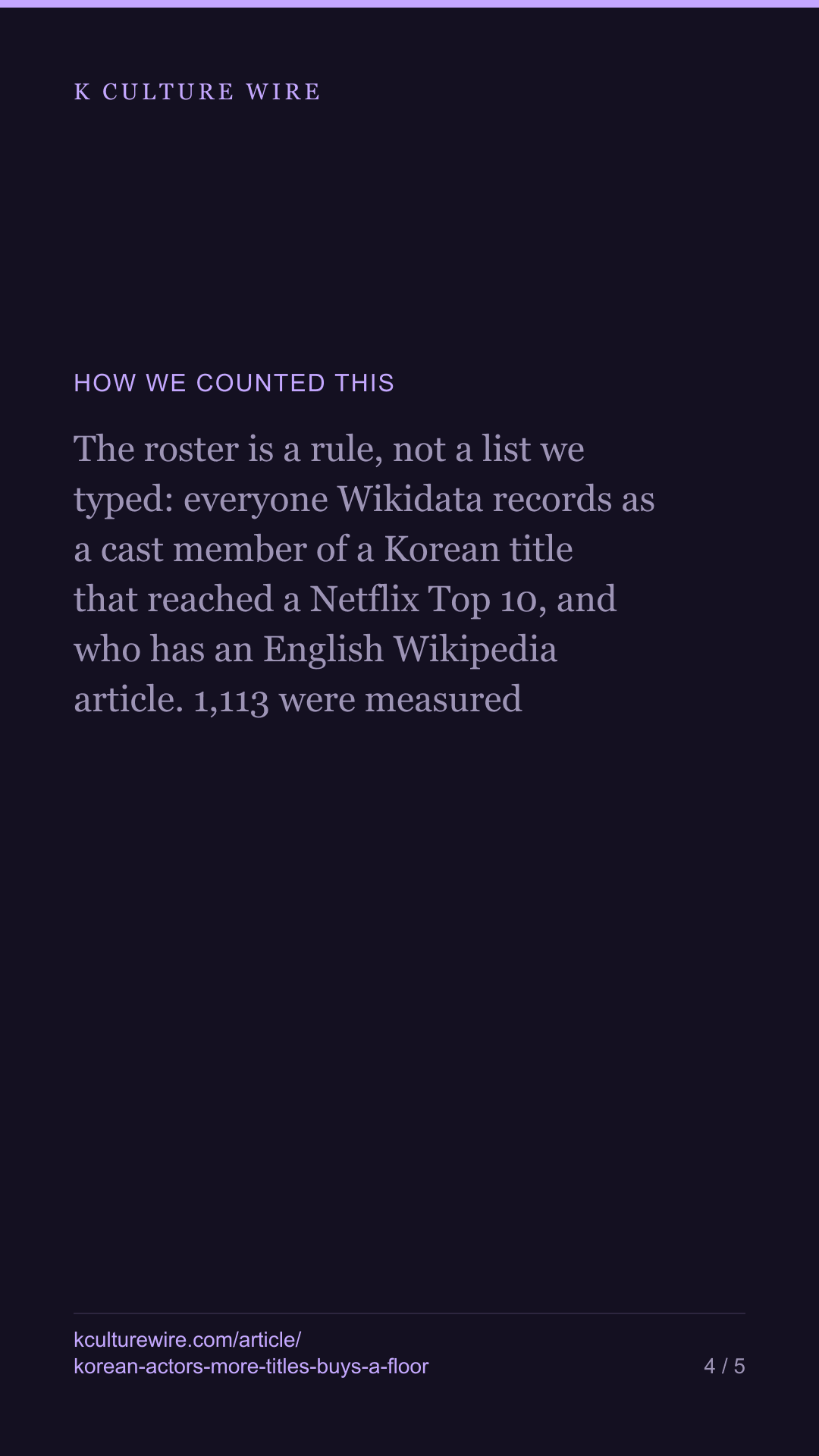
- The roster is a rule, not a list we typed: everyone Wikidata records as a cast member of a Korean title that reached a Netflix Top 10, and who has an English Wikipedia article. 1,113 were measured
- 1,077 of the 1,113 qualify for this piece. We require at least 300 views over the month and at least 25 days of data, because a name with 40 views produces a wild median from ordinary noise. The 36 excluded are small, not hidden
- Medians are used throughout, not means. Lee Byung-hun and Steven Yeun each distort a mean and neither tells you about the typical actor
- The relationship is also reported as a rank correlation over all 1,077, so the banded table cannot be accused of choosing its own cut points. Spearman is 0.319
- Every view figure comes from the actor panel's own window, 2026-07-05 to 2026-08-03. It is not the same window as our K-pop panel and the two are never mixed inside one number
What we left out, and why
- Filmography. The count here is Korean titles that reached a Netflix Top 10 — not a career. An actor with thirty years of work shows 1 if only one of those works ever charted
- Which titles. Our collector stored how many charting titles each actor appeared in and not which ones, so we cannot say what drove any individual's attention. We are fixing the collector; we are not going to guess in the meantime
- Any claim about causation in either direction. Being cast in hits and being looked up are both downstream of things this data does not contain
- Any claim about pay, billing or role size. A lead and a one-scene part are the same row in P161
The data behind this
Written from the same data
Take this away — 10 cards
The figures in this article, as images. Free to repost with the address on them.







If you work in this business
Everything on this page is measured from the same weekly Netflix lists, per market and per title. We publish the pages free; what we sell is the same measurement cut to one company's catalogue — including the figures behind /actors.
What a company sheet contains, and what it cannot tell you →