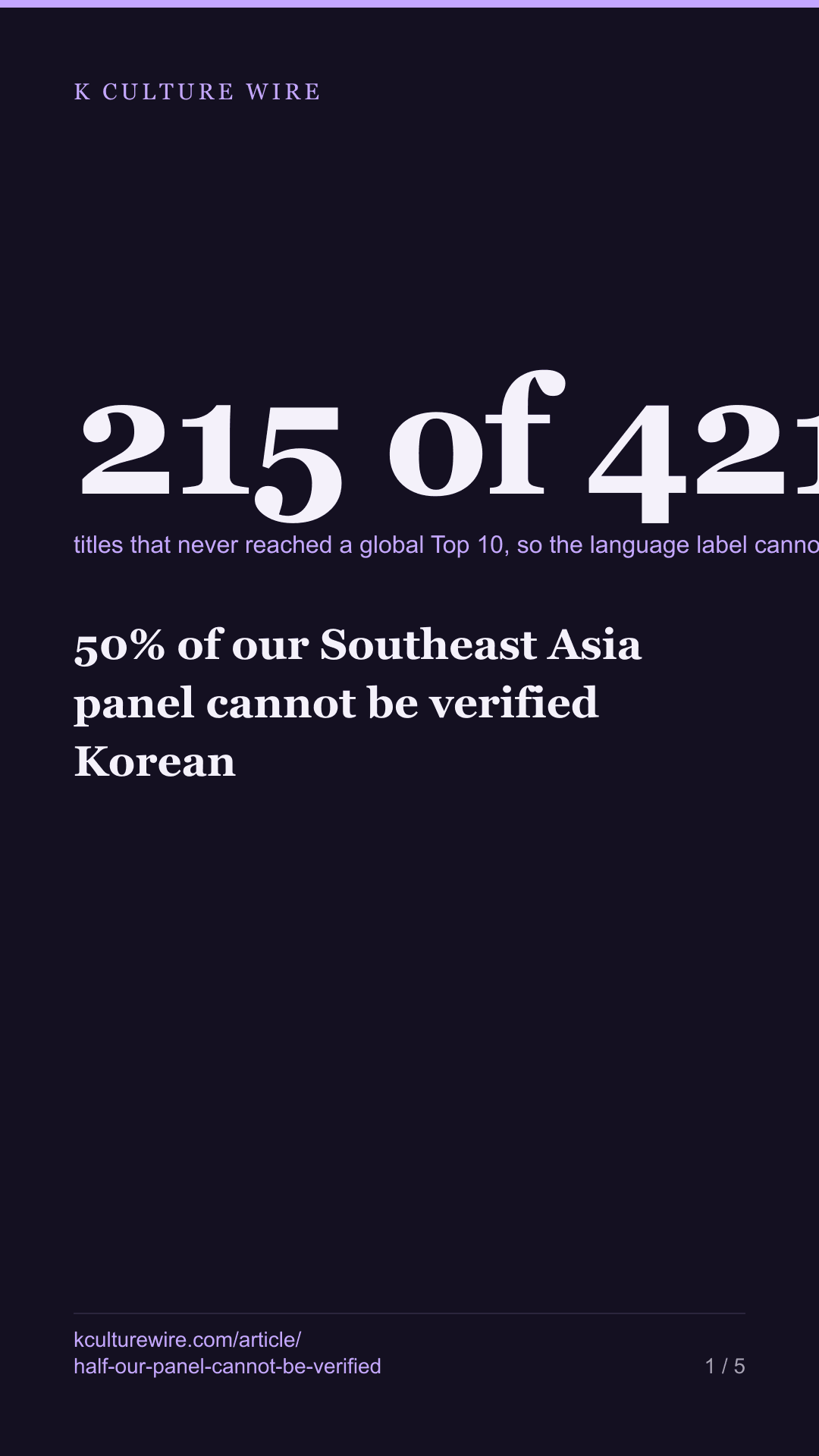
50% of our Southeast Asia panel cannot be verified Korean
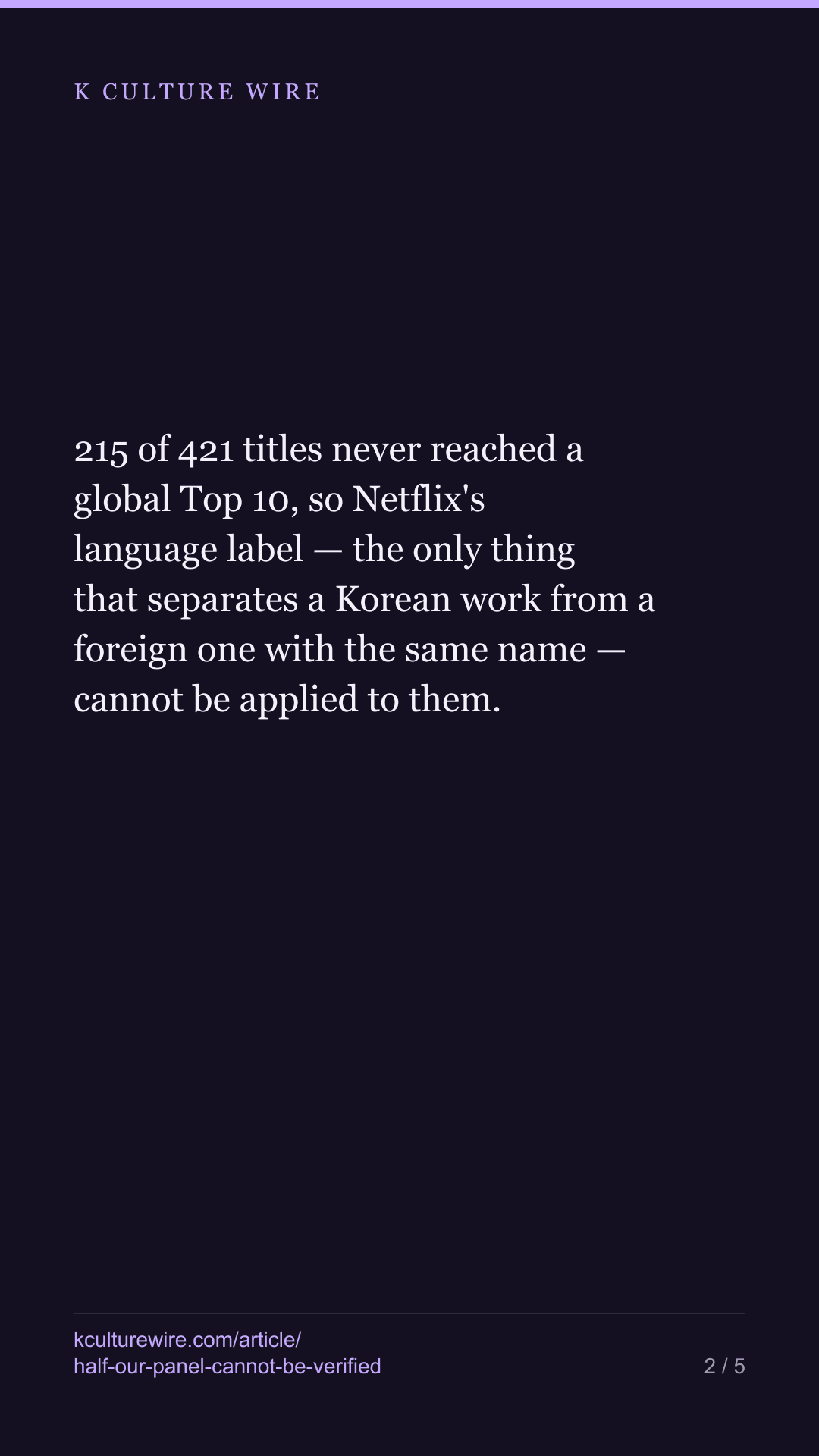
215 of 421 titles never reached a global Top 10, so Netflix's language label — the only thing that separates a Korean work from a foreign one with the same name — cannot be applied to them. They are also the small ones.
The table this is written from: /titles
Netflix does not say where a title was made. Anyone building a Korean panel has to decide that for themselves, and the usual method is to match a list of Korean works against the charts by name. That works until two countries make something with the same name, which they do constantly.
There is one thing in the published data that settles it. Netflix splits its global Top 10 by a title’s primary language, and a Korean work belongs on the Non-English side. If a title has reached the global chart, the label tells you which work charted.
Country charts carry no language field. And 215 of the 421 titles in our Southeast Asia panel have never reached a global Top 10. For those, the check cannot be run at all. They are in the panel on a name match and nothing else.
How much this actually costs you
Two numbers, and they point in different directions.
By title count it is half the panel. 215 of 421 — 51.1%.
By size it is small. The median title in that unverified group charted in one country for three weeks. The verified group’s median is 28 countries and 8 weeks. Whatever is wrong in the unverified half is concentrated in titles that barely moved.
Both numbers are true and neither is the answer on its own. If you are counting titles, half your rows are unconfirmed. If you are weighting by reach, the unconfirmed part is a tail.
What is actually in there
We looked. Among the unverified titles that did travel widely, foreign works with Korean-sounding company are plainly present — Tarot in 54 markets, Gossip Girl in 45, Mr. Robot in 43, Barbie in 37. None of those is a Korean work; each matched because Wikidata also records a Korean film or series with that exact name.
Others in the same group are real: Snowpiercer, Scent of a Woman, Watcher, Mine are Korean works that simply never broke into a global Top 10. We are not going to tell you what share is which, because we have not read all 197, and a guess presented as a figure would be worse than the gap it papers over.
Where the rule does work
On the titles that can be checked, it removes real errors rather than hypothetical ones.
38 titles matched a Korean work by name and turned out to sit on Netflix’s English charts — so they are the English-language work, not the Korean one. Seven more came out of this panel by hand after being read one at a time: Teach You a Lesson is Chinese, Hunger is Thai, The Empress is German.
The hand list is longer than seven — it is maintained once for every panel we build, and only the entries that actually appear in Southeast Asia’s charts show up in this count. The most recent addition, on 7 August 2026, was Friends: Wikidata carries a 2002 Korean drama of that name, but the title charting for 108 weeks across 36 markets is the American sitcom. It never charted in these six countries, so it is not among the seven above.
On 8 August 2026 10 more came out, and not by reading them. They came out because our own attribution query — the one that produces the shared/unambiguous split above — returned no Korean work at all for those exact titles. Waterworld, Re/Member, Into the Storm, Wildflower, Feng Shui, Glorious Days, Long Live Love! and You and Me were sitting in a Korean panel while the instrument we publish said nothing Korean carries those names.
That is a different kind of removal and we count it separately. Reading a title is a judgement; this was our own measurement contradicting our own list, which is not a judgement at all. A check now fails our build if any title in the panel is one the attribution query says no Korean work carries.
Why we print this at all
A panel that quietly includes what it cannot verify is more dangerous than one that says so, because
the first kind gets quoted. These counts are now on /titles, /reach and /staying-power, read
from the build rather than typed in, and a check fails our build if any limit the build measures
stops being shown.
That check was written on 7 August 2026 after we found that the figure had been computed for weeks and displayed nowhere. Counting a limit and showing it are different things, and until that day we had been treating them as the same.
Netflix has a second chart we had not used, and it settles some of these titles. Read what Korea’s own chart says about them →
What changed on 2 September 2026
We re-collected the source files on 25 August 2026. The panel moved from 421 titles to 420, so the unverified share is now 51.0% rather than 50.8%.
The finding did not change — it is still about half the panel. We are saying which numbers moved rather than swapping them quietly.
What changed on 3 September 2026
We added the chart week of 23 August 2026, which had been sitting in our archive while this panel still stopped at 16 August. One title entered the panel with it, so the denominator went from 420 to 421 and the unverified count from 214 to 215.
| Was | Now | |
|---|---|---|
| Titles in the panel | 420 | 421 |
| Never on a global Top 10 | 214 | 215 |
| Share unverified | 51.0% | 51.1% |
| Weeks named in our source line | 265 | 269 |
⚠ That last row is the one to read twice. This piece has always been counted over the whole archive, but its source line said 265 weeks to 26 July 2026 — the window as it stood when the piece was published, left there while the panel moved on underneath it. We do not know of a figure in the body that was wrong because of it, and we are not going to claim there was none: what we can say is that the line now names the window the numbers actually come from.
Two other figures were stale for a different reason and are corrected here rather than quietly. The summary line at the top of this piece said 421 while the body said 420 — it had been left behind when the panel moved on 25 August. And one exclusion note still referred to 197 unverified titles, a count from before that same rebuild. Both now read 215 of 421.
The finding did not change. It is still about half the panel, and it is still the small half.
Where these numbers come from
Sources
- Netflix — Top 10 weekly lists (Tudum), global and per-country, 269 weeks from 2021-07-04 to 2026-08-23. The global lists carry a language category; the country lists do not · https://www.netflix.com/tudum/top10
- Wikidata — Country of origin (P495 = Q884), used to match chart titles to Korean works by name · https://query.wikidata.org
What we checked
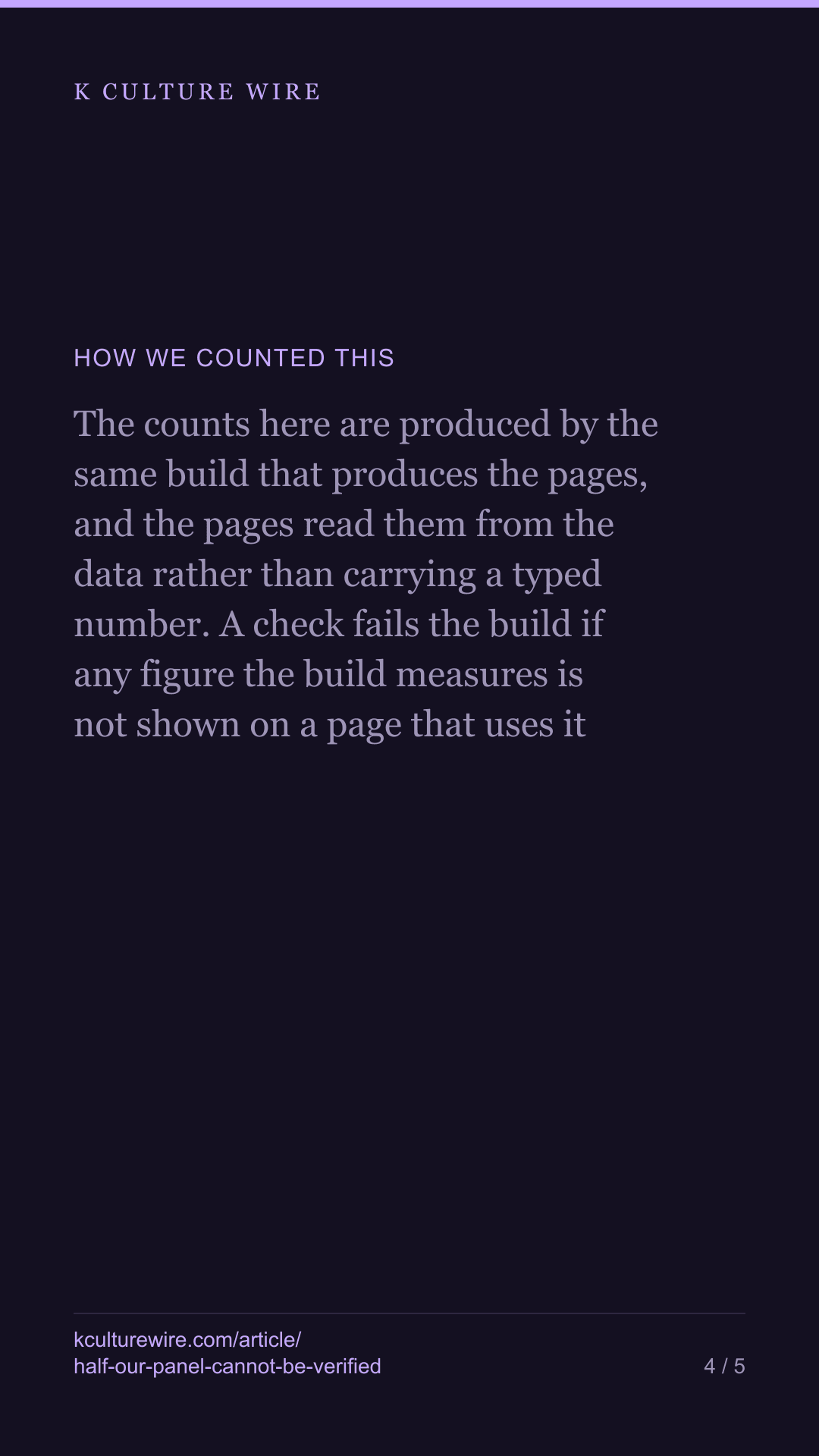
- The counts here are produced by the same build that produces the pages, and the pages read them from the data rather than carrying a typed number. A check fails the build if any figure the build measures is not shown on a page that uses it
- The language label comes from Netflix's own global chart categories, not from our judgement about a title
- The 'small' claim is a median over the unverified group itself: one country, three weeks. It is not an average, which a handful of large titles would distort
- Nine titles were removed by hand after being read one at a time; 36 were removed because Netflix files them on its English charts. Both counts are printed on the pages
What we left out, and why
- Any estimate of how many of the 215 are actually foreign. We can name examples but we have not audited the group, and a guess dressed as a figure is worse than the gap
- Any claim that the unverified titles are wrong. Most are probably Korean. The point is that we cannot show it from published data
- Hours viewed. Netflix publishes hours for its global chart only
The data behind this
Written from the same data
Take this away — 10 cards
The figures in this article, as images. Free to repost with the address on them.
If you work in this business
Everything on this page is measured from the same weekly Netflix lists, per market and per title. We publish the pages free; what we sell is the same measurement cut to one company's catalogue — including the figures behind /titles and /reach and /staying-power.
What a company sheet contains, and what it cannot tell you →