Korean film and TV share actors — but less than chance
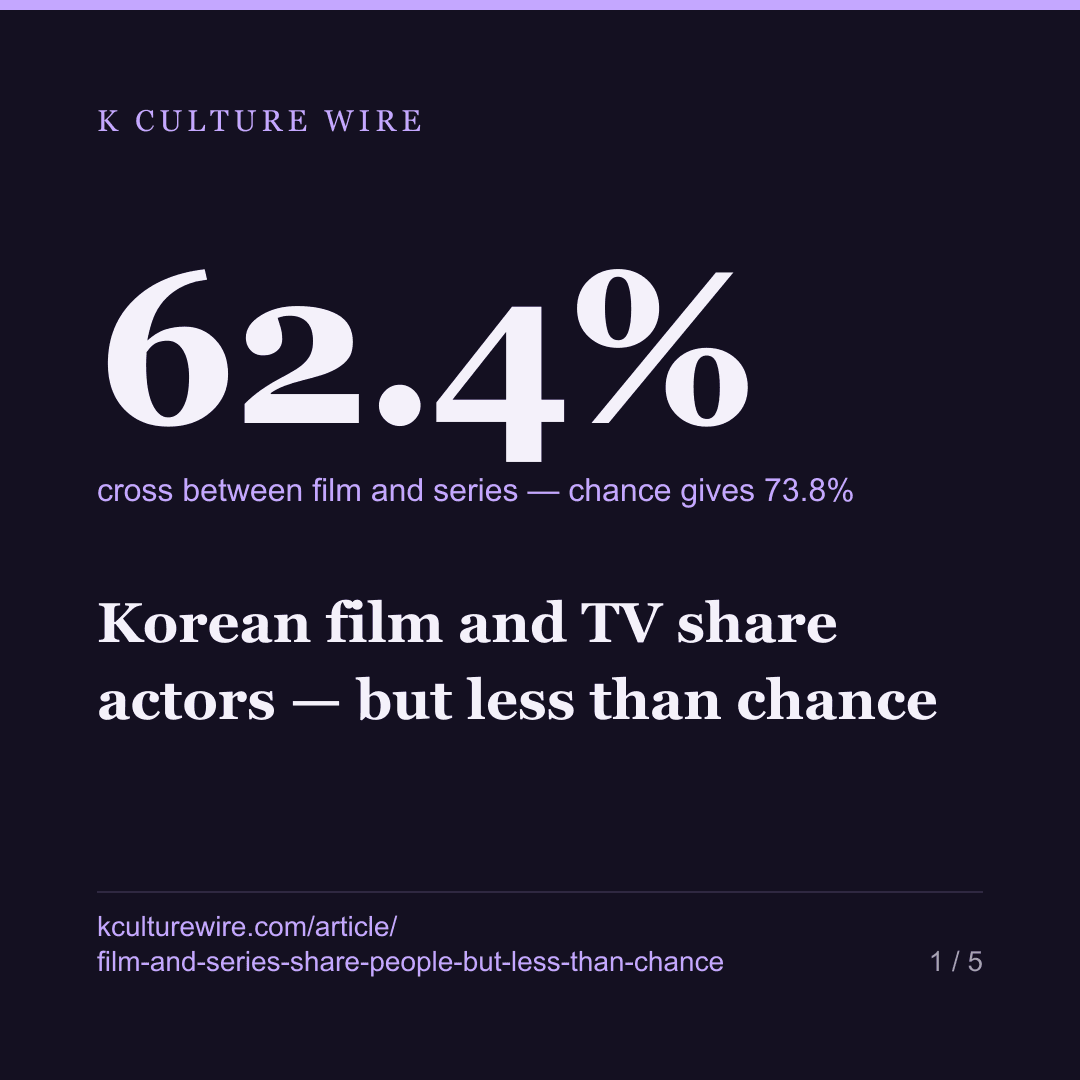
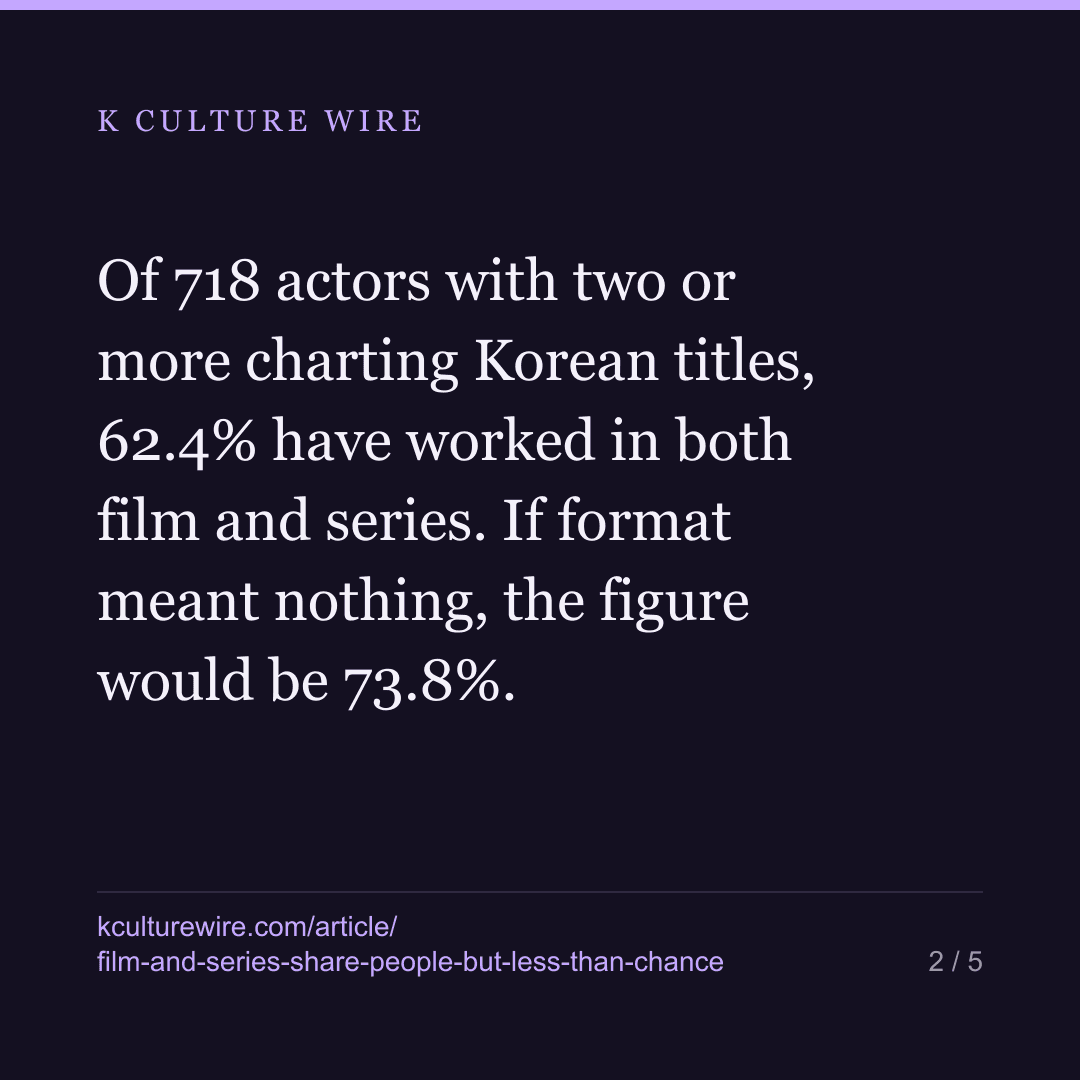
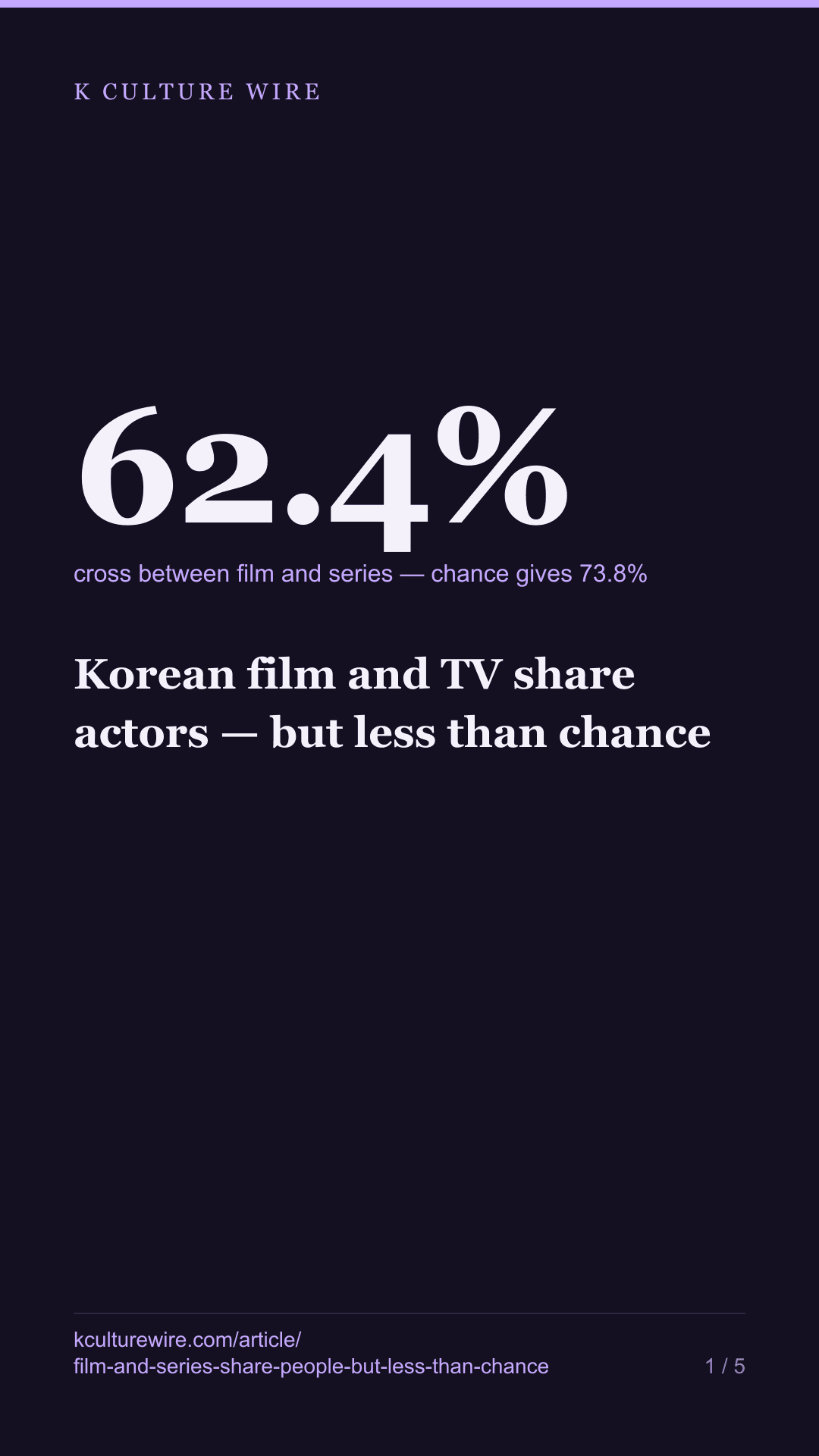
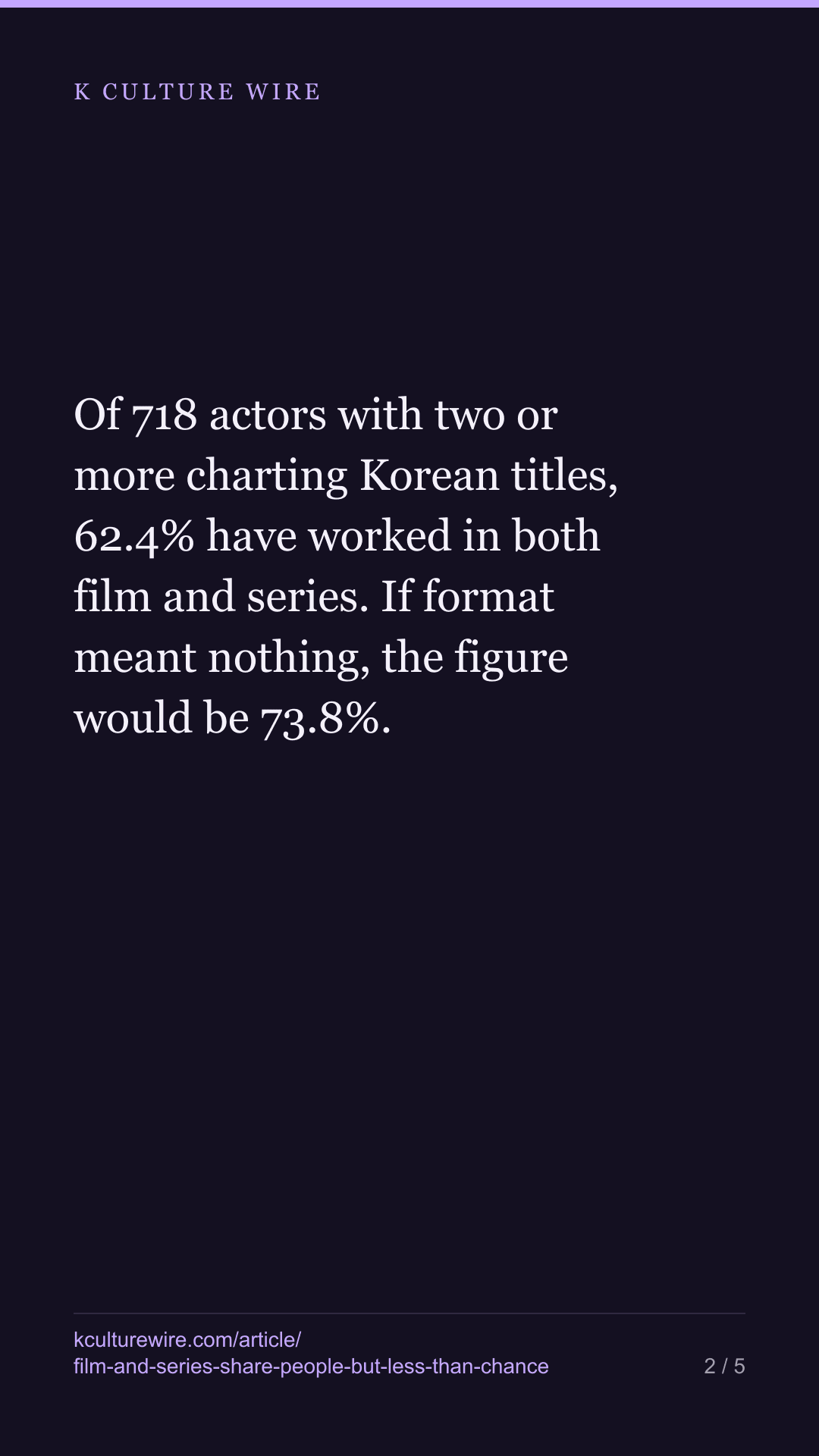
Of 718 actors with two or more charting Korean titles, 62.4% have worked in both film and series. If format meant nothing, the figure would be 73.8%. The gap is the size of the wall, and it is smaller than reputation suggests.
The table this is written from: /actors
Korean screen work is often described as two industries — film people and television people — with an occasional crossing that gets remarked on. The join between Netflix’s charts and Wikidata’s cast lists lets us put a number on it.
Of the 718 actors with two or more charting Korean titles, 448 have appeared in both a film and a series. That is 62.4%. Most people who work more than once work across the line.
The number that makes it interesting
62.4% sounds like a wall that barely exists. To know whether it is low or high you need something to compare it against, so we asked what the figure would be if format meant nothing at all — if each of a person’s titles were drawn without regard to whether it was a film or a series.
73.8%. Under that null, 530 of the 718 would have worked in both.
So the wall is real and it is thin: about 82 people who could have crossed, given how many titles they have, did not. Format is doing something. It is not doing very much.
Where the separation actually sits
| Of the 700 with two or more titles | People | Share |
|---|---|---|
| Both film and series | 448 | 62.4% |
| Series only | 182 | 25.3% |
| Film only | 88 | 12.3% |
Series-only outnumber film-only by more than two to one. That is the asymmetry: there is a population that works in television and does not appear in a charting Korean film, and it is twice the size of the population that does the reverse.
And it thins out fast with volume. Among the 204 people with five or more titles, 182 have done both — 14 are film-only and 8 series-only. Work enough and you cross almost regardless.
What would move these numbers
Incomplete cast lists push in one direction only. If a person did four series and two films and Wikidata records only the series, they appear here as a series specialist. Missing credits cannot turn a specialist into a crosser; they can only do the reverse. 62.4% is therefore a floor, and the true crossing rate is higher by an amount we cannot measure.
The null model is a comparison, not a prediction. It assumes a person’s titles are independent draws at film’s overall share of the set. Nobody’s career works that way. It is there to answer “compared to what”, which a bare 62.4% cannot.
And this is only what charted. A film actor whose work never reached a Netflix Top 10, or who works mainly in theatre or advertising, is either absent or looks like something they are not.
If the wall between formats is thin, is there a wall between people — do the same actors keep working together? Read how rarely a casting pair repeats →
What changed on 2 September 2026
We re-collected the cast data on 25 August 2026 and recounted every figure here. The set of actors with two or more charting titles moved from 719 to 718, and the film share of titles from 55.5% to 55.4%, because Wikidata’s cast statements changed underneath us in both directions.
The finding did not change. Crossing between film and series is still less common than chance would give — 62.4% against a null of 73.8%, where the earlier count said 62.3% against 73.7%.
Where these numbers come from
Sources
- Wikidata — Cast member (P161) with citizenship (P27 = Q884) on Korean titles that appeared in a Netflix Top 10, joined on Q-numbers; film or series from each title's instance-of statement · https://query.wikidata.org
- Netflix — Top 10 weekly lists (Tudum), used to decide which Korean titles enter the set · https://www.netflix.com/tudum/top10
What we checked
- Restricted to the 700 people with two or more titles here, because someone with one title cannot be shown to cross anything
- The chance figure is a null model, not an observation: for a person with n titles it is the probability that n independent draws are not all film and not all series, with the film probability set to film's share of the 666 titles (55.4%). It is stated as a comparison, not as what would really happen
- Film and series come from Wikidata's own instance-of statement, not our reading of a title
- No pageview data is used, so nothing here depends on whether a person has an English Wikipedia article
What we left out, and why
- Any claim about the whole industry. This is people credited in Korean titles that reached a Netflix Top 10 — a small, self-selected slice
- Any claim about billing or role size. P161 records a cast member; a lead and one scene are the same row
- Any claim that Wikidata's cast lists are complete. They are not. Missing credits push a person towards looking like a specialist, so the true crossing rate is probably higher than 62.4%
- Theatre, advertising, variety and anything that did not chart. A person who alternates between film and stage looks like a film specialist here
The data behind this
Written from the same data
Take this away — 10 cards
The figures in this article, as images. Free to repost with the address on them.





If you work in this business
Everything on this page is measured from the same weekly Netflix lists, per market and per title. We publish the pages free; what we sell is the same measurement cut to one company's catalogue — including the figures behind /actors and /titles.
What a company sheet contains, and what it cannot tell you →