Industry · esports
Faker's Wikipedia Page at Worlds 2026: German Reading Nearly Quadrupled, Korean Fell Below Usual
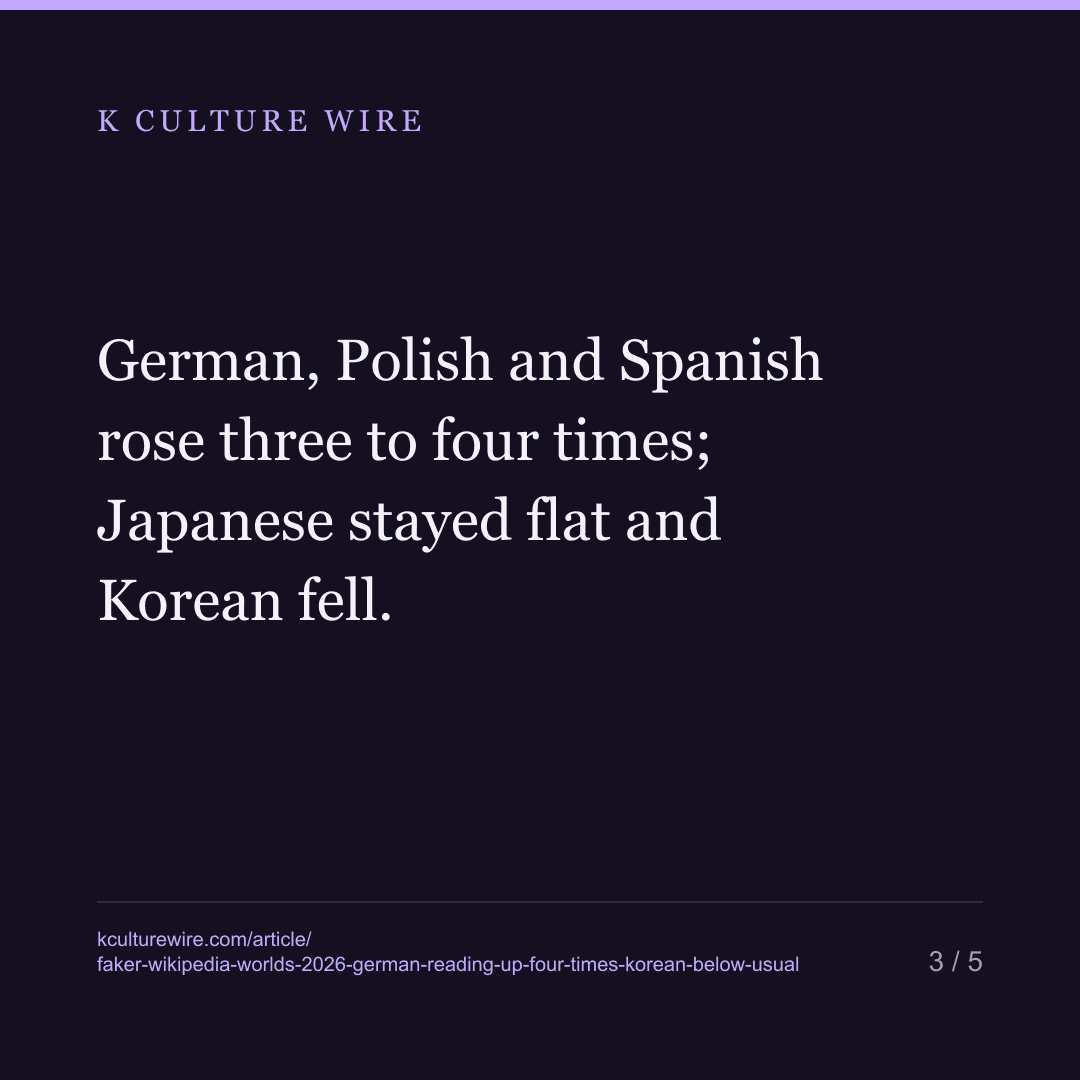
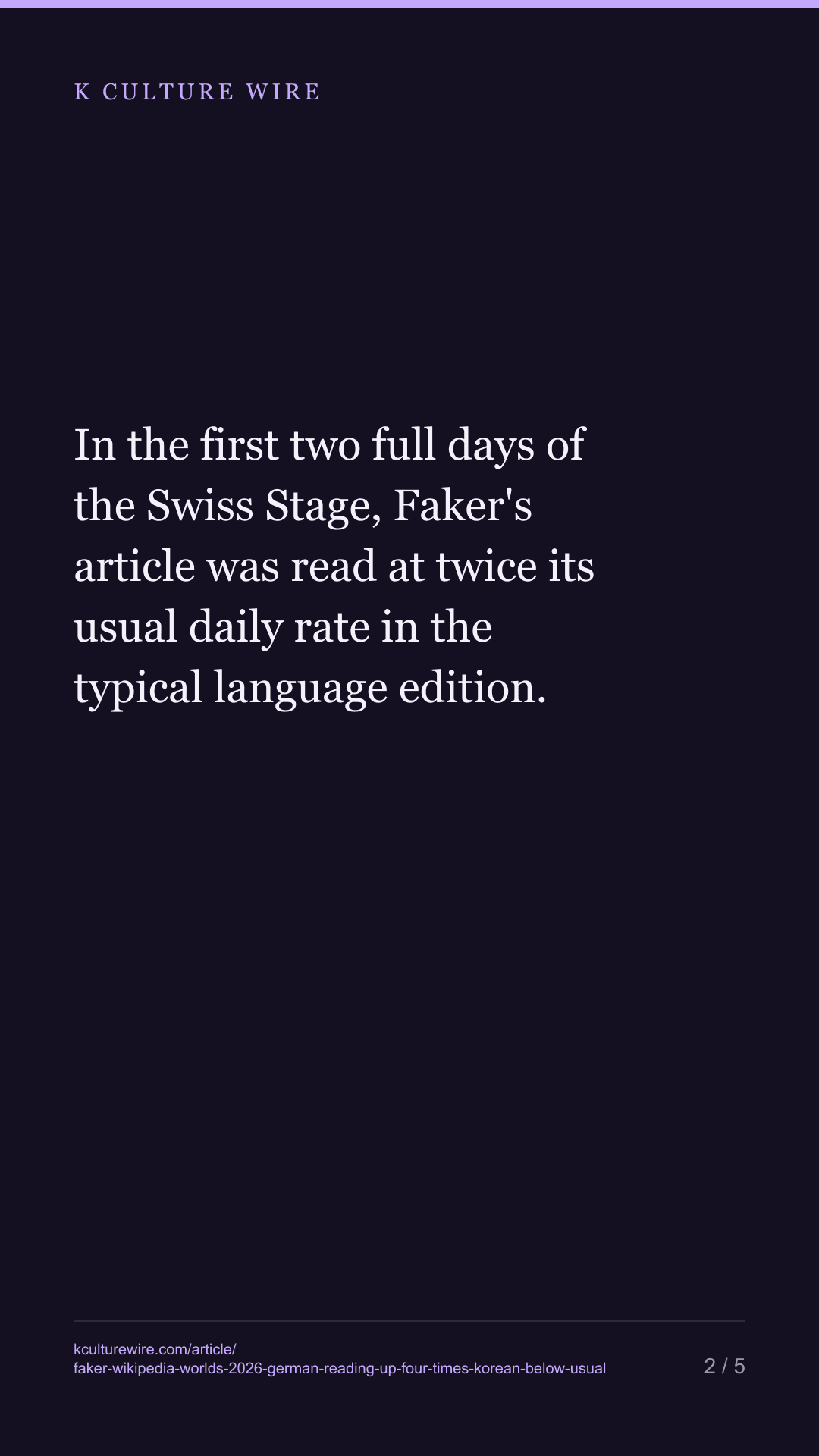
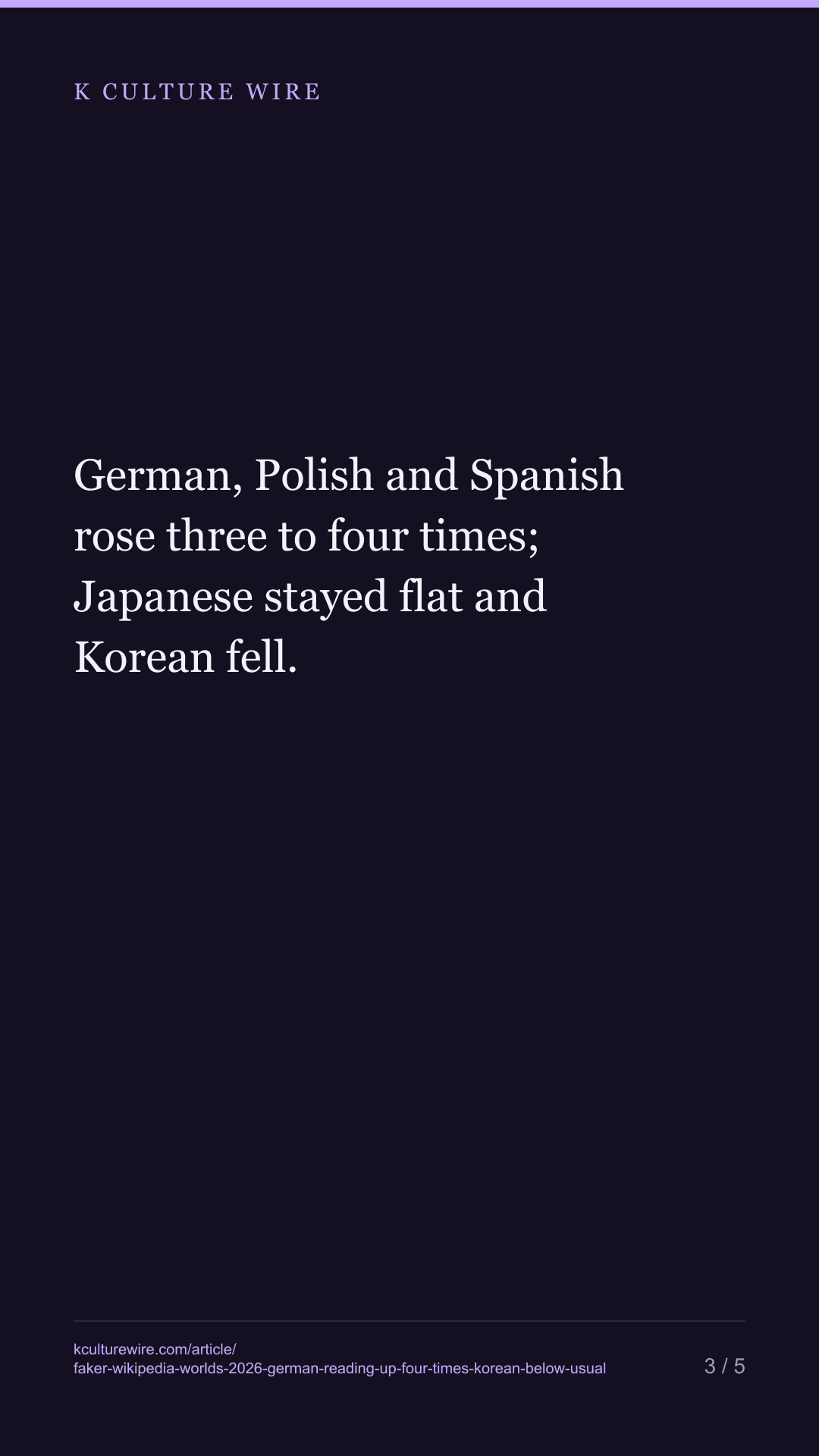
In the first two full days of the Swiss Stage, Faker's article was read at twice its usual daily rate in the typical language edition. German, Polish and Spanish rose three to four times; Japanese stayed flat and Korean fell.
The table this is written from: /worlds-2026
Faker and T1 are now 2-1 in the Swiss Stage (their win over CTBC Flying Oyster). Who is reading about him?
His Wikipedia article exists in 24 languages. We compared each edition’s reading on the first two full days of the Swiss Stage, 24 and 25 October, with its usual day in early October.
The rise, edition by edition
| Edition | Usual day | 24 Oct | 25 Oct | Times usual |
|---|---|---|---|---|
| German | 64 | 282 | 229 | 3.99 |
| Polish | 24 | 80 | 67 | 3.06 |
| Spanish | 111 | 381 | 296 | 3.05 |
| Italian | 22 | 67 | 55 | 2.77 |
| Portuguese | 32 | 109 | 67 | 2.75 |
| French | 142 | 444 | 256 | 2.46 |
| Turkish | 20 | 40 | 39 | 1.98 |
| Russian | 44 | 87 | 74 | 1.83 |
| English | 1,203 | 2,406 | 1,871 | 1.78 |
| Vietnamese | 93 | 115 | 105 | 1.18 |
| Chinese | 532 | 622 | 605 | 1.15 |
| Japanese | 164 | 171 | 149 | 0.98 |
| Korean | 314 | 270 | 225 | 0.79 |
The typical edition read him at about twice its usual rate (median 1.98 times). The spread runs from almost four times in German to below usual in Korean.
Two different kinds of reader
The editions that rose most are European ones with small usual audiences. On a usual day German Wikipedia reads Faker 64 times; on 24 October it read him 282 times. That pattern fits readers who look a player up when a tournament puts him in front of them.
The Asian editions barely moved. Chinese, Japanese and Vietnamese stayed within 18% of usual, and Korean dropped. These editions already read him every day: Chinese Wikipedia’s usual day is 532 reads, larger than every European edition’s peak.
English is in between: the largest edition by far, and up 1.78 times.
What this does not say
Wikipedia reads count look-ups, not fans or viewers. Most Korean readers use Namuwiki, which publishes no counts, so a falling Korean figure says nothing about interest in Korea. Two days is a short window, and the ratio for an edition with 20 or 30 usual reads moves a lot with a few readers. Team-by-team reading and the full language breakdown are on our Worlds 2026 page.
Wikipedia reading from the Wikimedia Pageviews API, user traffic only, UTC days. Match times from Riot Games’ official LoL Esports schedule, Korea Standard Time.
Where these numbers come from
Sources
- Wikimedia Pageviews API — Daily user reads (agent type user) of the Faker article in each of its 24 Wikipedia language editions, found through the English article's language links, 1 to 25 October 2026 (UTC days). Read 27 October 2026, 07:20 KST. · https://wikimedia.org/api/rest_v1/metrics/pageviews/per-article
- Riot Games (LoL Esports schedule) — T1's Swiss Stage matches: beat LOS 24 Oct 08:00 KST, lost to Dplus Kia 25 Oct 08:00 KST, beat CTBC Flying Oyster 27 Oct 02:00 KST (esports-api getSchedule, league 98767975604431411). · https://lolesports.com/en-US/schedule
What we checked
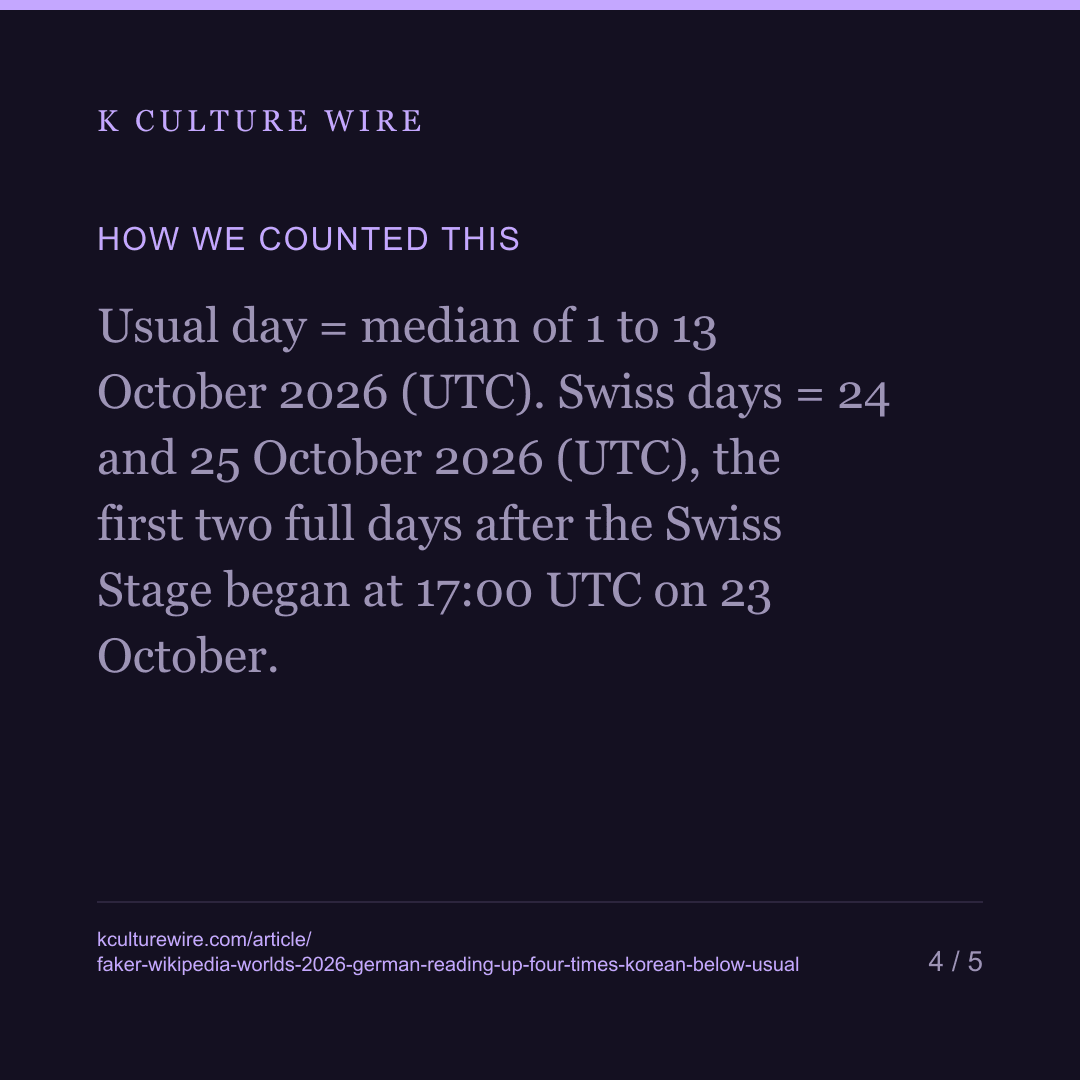
- Usual day = median of 1 to 13 October 2026 (UTC). Swiss days = 24 and 25 October 2026 (UTC), the first two full days after the Swiss Stage began at 17:00 UTC on 23 October.
- English: usual 1,203 a day; 2,406 and 1,871 on the Swiss days (1.78 times). Chinese: usual 532; 622 and 605 (1.15 times). Korean: usual 314; 270 and 225 (0.79 times).
- German (article title Lee Sang-hyeok): usual 64; 282 and 229 (3.99 times). Polish: usual 24; 80 and 67 (3.06 times). Spanish: usual 111; 381 and 296 (3.05 times). Japanese: usual 164; 171 and 149 (0.98 times).
- 13 editions had at least 20 reads on a usual day; their median rise was 1.98 times.
What we left out, and why
- The 11 editions with fewer than 20 reads on a usual day, where one extra reader moves the ratio a lot. Their figures are still on our Worlds 2026 page.
- 23 October (UTC), when the Swiss Stage began late in the day.
- 26 October onward: Wikimedia had not published those days when we wrote. Not measured, not zero.
- Namuwiki, where most Korean readers look players up; it publishes no reading counts.
The data behind this
Written from the same data
Take this away — 10 cards
The figures in this article, as images. Free to repost with the address on them.
If you work in this business
Everything on this page is measured from the same weekly Netflix lists, per market and per title. We publish the pages free; what we sell is the same measurement cut to one company's catalogue — including the figures behind /worlds-2026.
What a company sheet contains, and what it cannot tell you →
What do you make of this?
We counted it. What it means is yours to decide.