Cha Eun-woo, Kim Tae-hee and 383 stars share a quarter
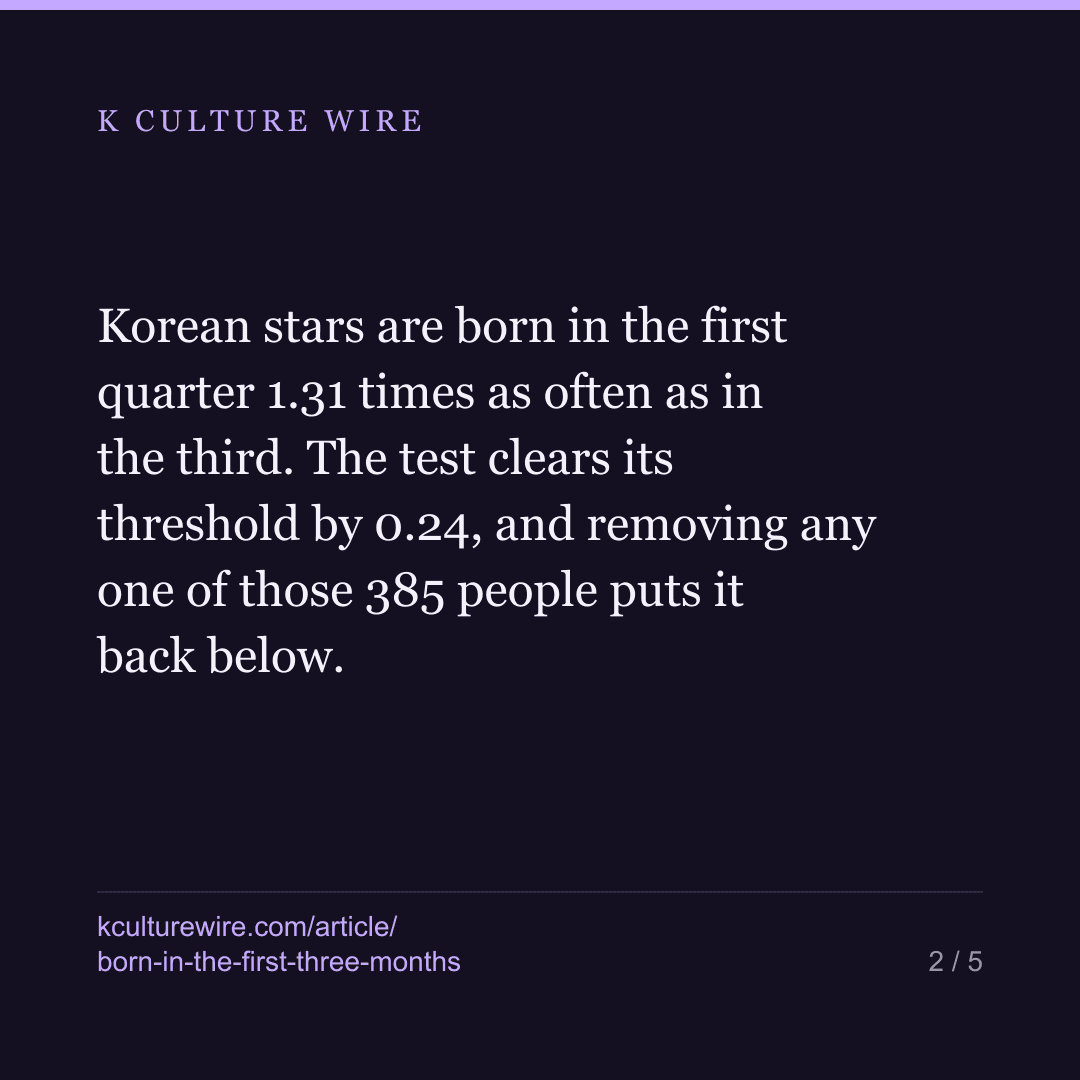
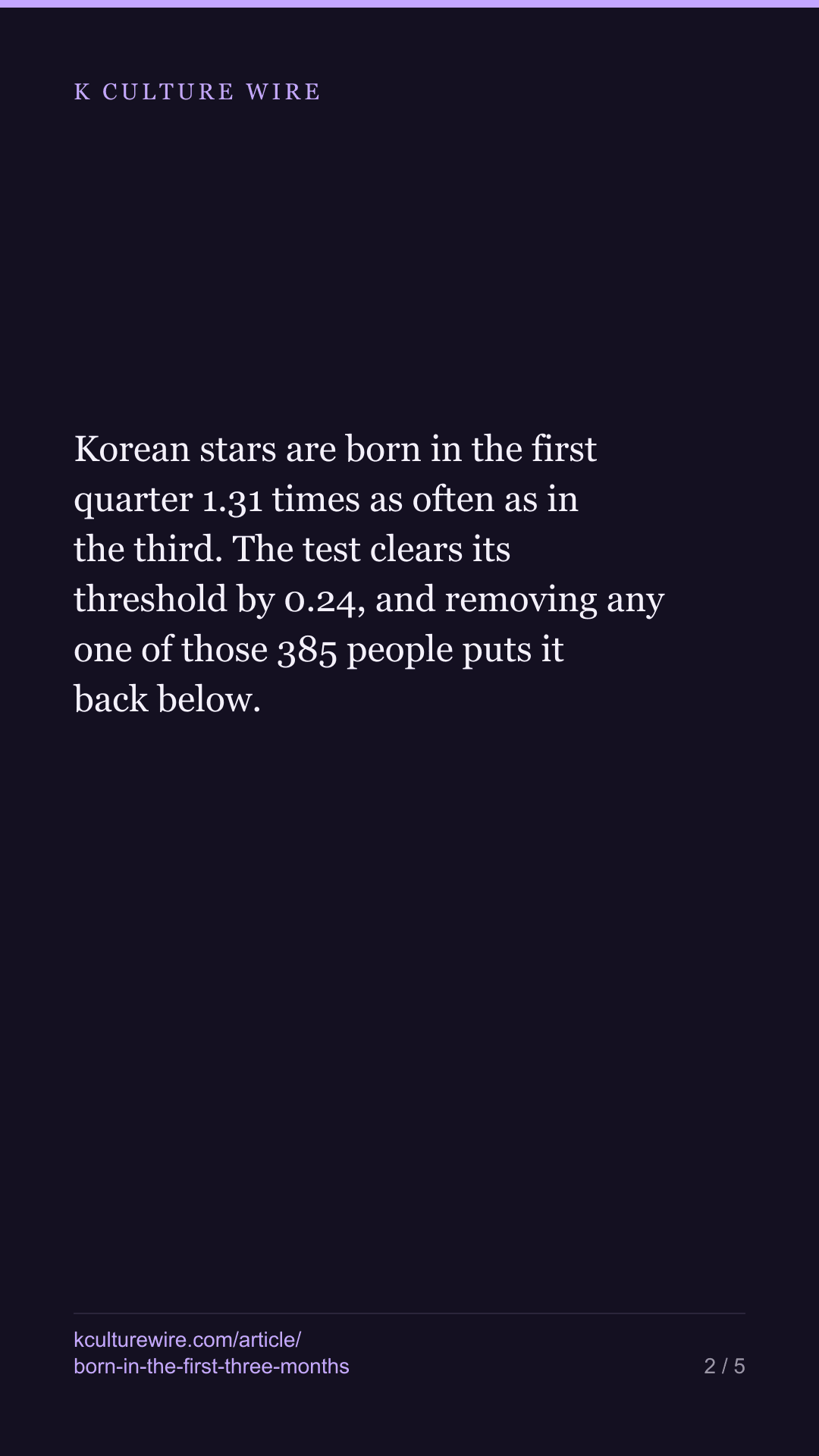
Korean stars are born in the first quarter 1.31 times as often as in the third. The test clears its threshold by 0.24, and removing any one of those 385 people puts it back below. Here is the finding we did not publish, and why.
The table this is written from: /star-signs
Here is a headline we could have written this morning.
Korean actors and singers are born in January, February and March far more often than in July, August and September — 385 against 293, a ratio of 1.31. Cha Eun-woo was born in March, Kim Tae-hee in March, Park Ji-hoon in February, Park Min-young in March, Choi Woo-shik in March, Ma Dong-seok in March.
We are not running it. This is the working.
What we counted
1,303 Korean actors and singers with a date of birth on Wikidata. We compared how many fall in each month against how many would fall there if birthdays were spread evenly — using the length of each month, so February is not marked down for being short.
| Month | Stars | Expected | Difference |
|---|---|---|---|
| January | 138 | 110.6 | +27.4 |
| February | 118 | 100.8 | +17.2 |
| March | 129 | 110.6 | +18.4 |
| April | 104 | 107.0 | −3.0 |
| May | 108 | 110.6 | −2.6 |
| June | 94 | 107.0 | −13.0 |
| July | 106 | 110.6 | −4.6 |
| August | 91 | 110.6 | −19.6 |
| September | 96 | 107.0 | −11.0 |
| October | 112 | 110.6 | +1.4 |
| November | 100 | 107.0 | −7.0 |
| December | 107 | 110.6 | −3.6 |
The chi-square figure is 19.92. The threshold for calling a twelve-way split uneven is 19.68.
It clears. By 0.24.
Then we did the thing we always do
We remove one observation and look again. If a finding rests on any single person, it is not a finding yet.
Of the 1,303 people, 385 can be removed one at a time to push the result back below the threshold. And those 385 are not scattered: they are exactly the January, February and March births. Take out Cha Eun-woo, or Kim Tae-hee, or any one of the other 383, and the result stops clearing.
That is not a robust effect. That is a coin landing on its edge.
The control we do not have
Even if it had cleared comfortably, it would not yet be a fact about stardom.
Births in the general Korean population are not spread evenly across the year either. To say anything about performers we would need the national monthly birth series to compare against, and without it a January bump among actors might be nothing more than a January bump among Koreans.
We do not hold that series. Not “it is unavailable” — we have not fetched it, and until we do, this measurement cannot separate the two explanations. We are saying so rather than leaving the gap where a reader would assume we had checked.
Why publish the non-story
There is an established name for the shape we were hoping to see. The relative age effect — described in Canadian junior hockey by Barnsley, Thompson and Barnsley in 1985, and reviewed across domains by Musch and Grondin in 2001 — is the finding that people born early in a selection year are over-represented among those who get selected. Korea’s school year begins in March, which is exactly the kind of cut-off that produces it.
That is a good hypothesis. It is not what we measured. What we measured is a distribution that squeaks past a threshold and falls back the moment one person leaves the room, in a panel with no control group attached.
The distance between those two sentences is the whole job.
The names, the twelve signs, and the other count that came out as chance are on which Korean stars share your zodiac sign and the year you were born.
The tables behind this are at kculturewire.com/star-signs and kculturewire.com/zodiac.
Where these numbers come from
Sources
- Wikidata — Names and dates of birth (P569), CC0 · https://www.wikidata.org/
What we checked
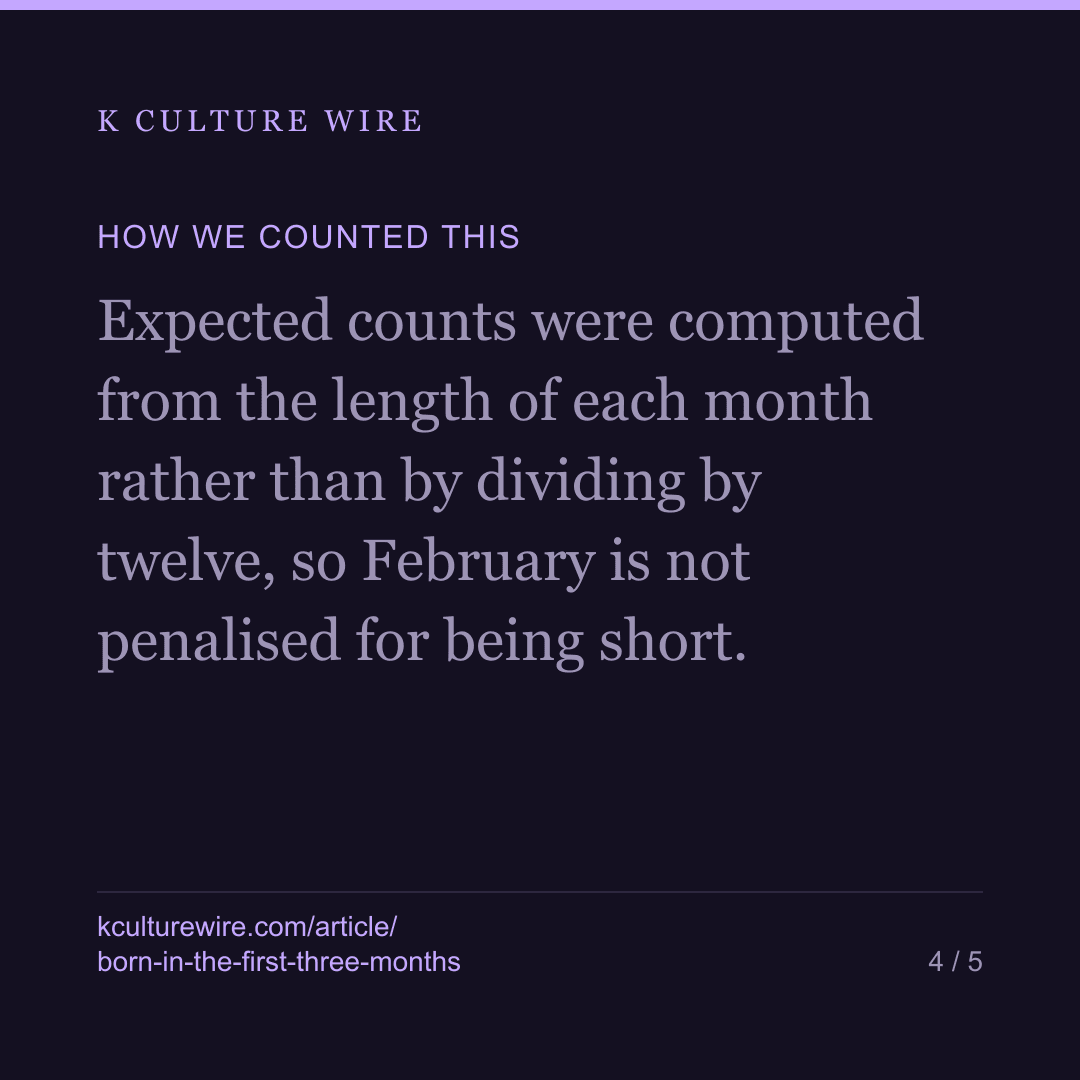
- Expected counts were computed from the length of each month rather than by dividing by twelve, so February is not penalised for being short.
- The leave-one-out test was run on all 1,303 people individually, not on a sample; the 385 removals that break the result are exactly the January-to-March births.
The data behind this
Written from the same data
Take this away — 10 cards
The figures in this article, as images. Free to repost with the address on them.







If you work in this business
Everything on this page is measured from the same weekly Netflix lists, per market and per title. We publish the pages free; what we sell is the same measurement cut to one company's catalogue — including the figures behind /star-signs and /zodiac and /born-on and /born-in/january.
What a company sheet contains, and what it cannot tell you →
What do you make of this?
We counted it. What it means is yours to decide.