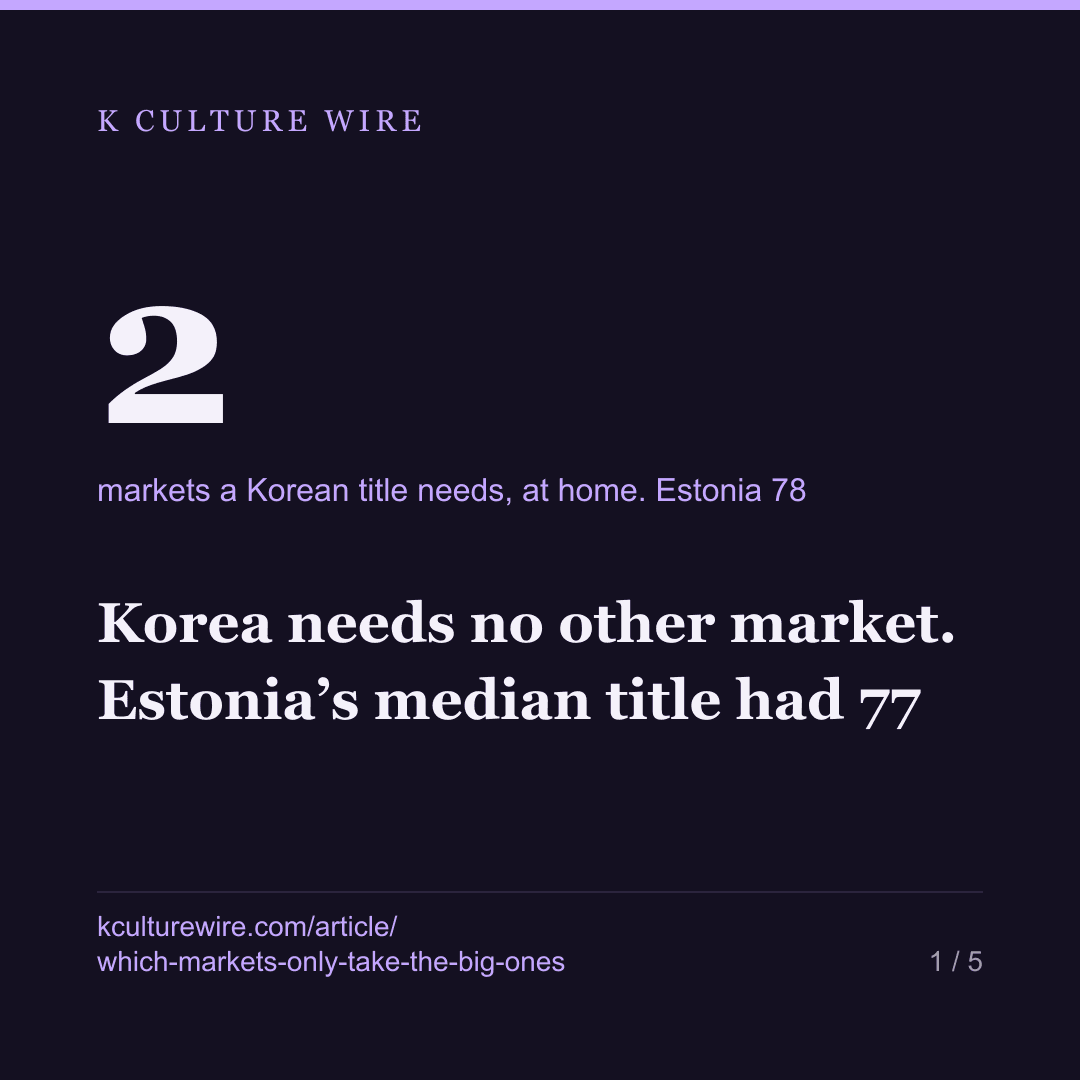
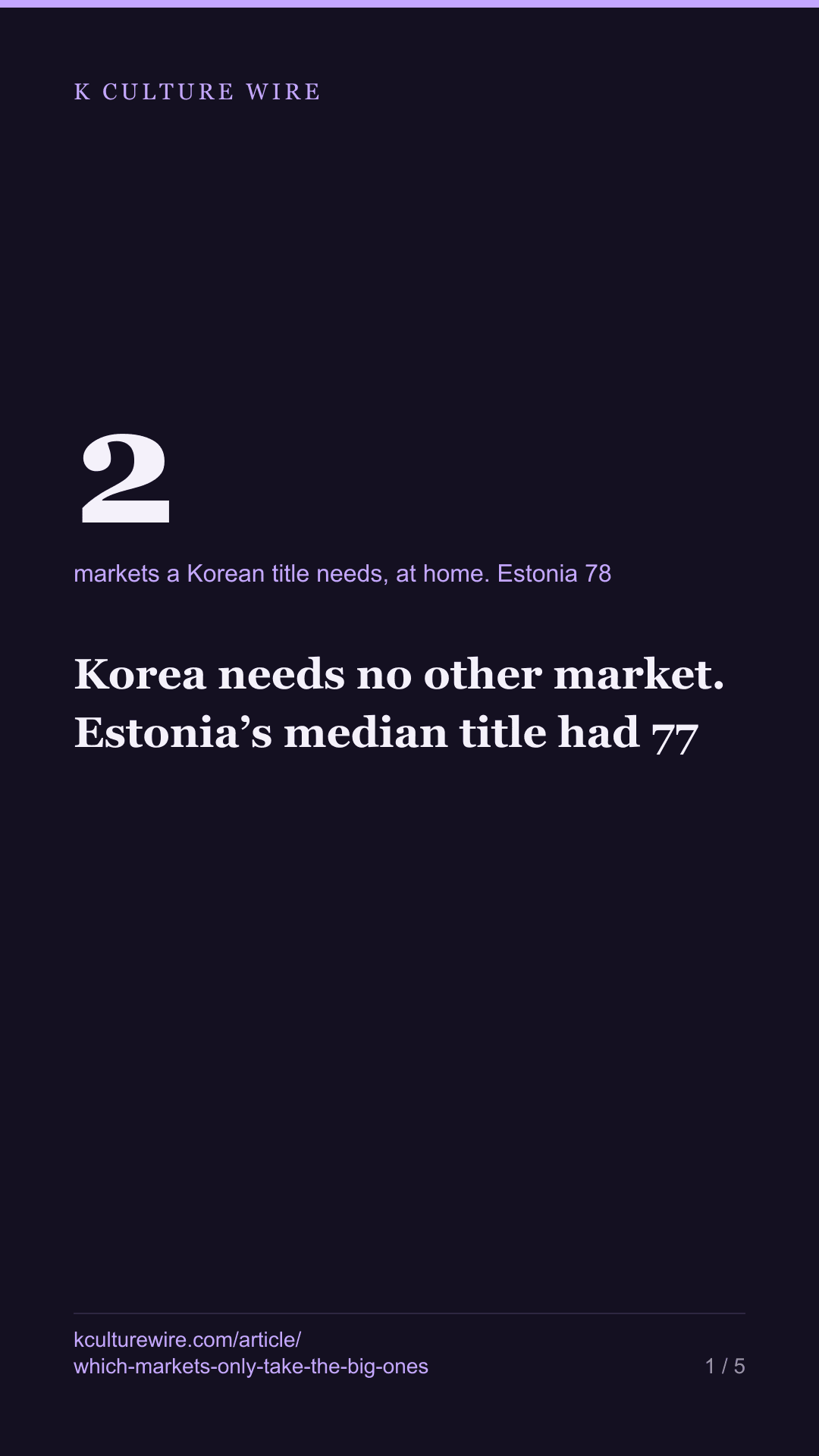
Korea needs no other market. Estonia’s median title had 77
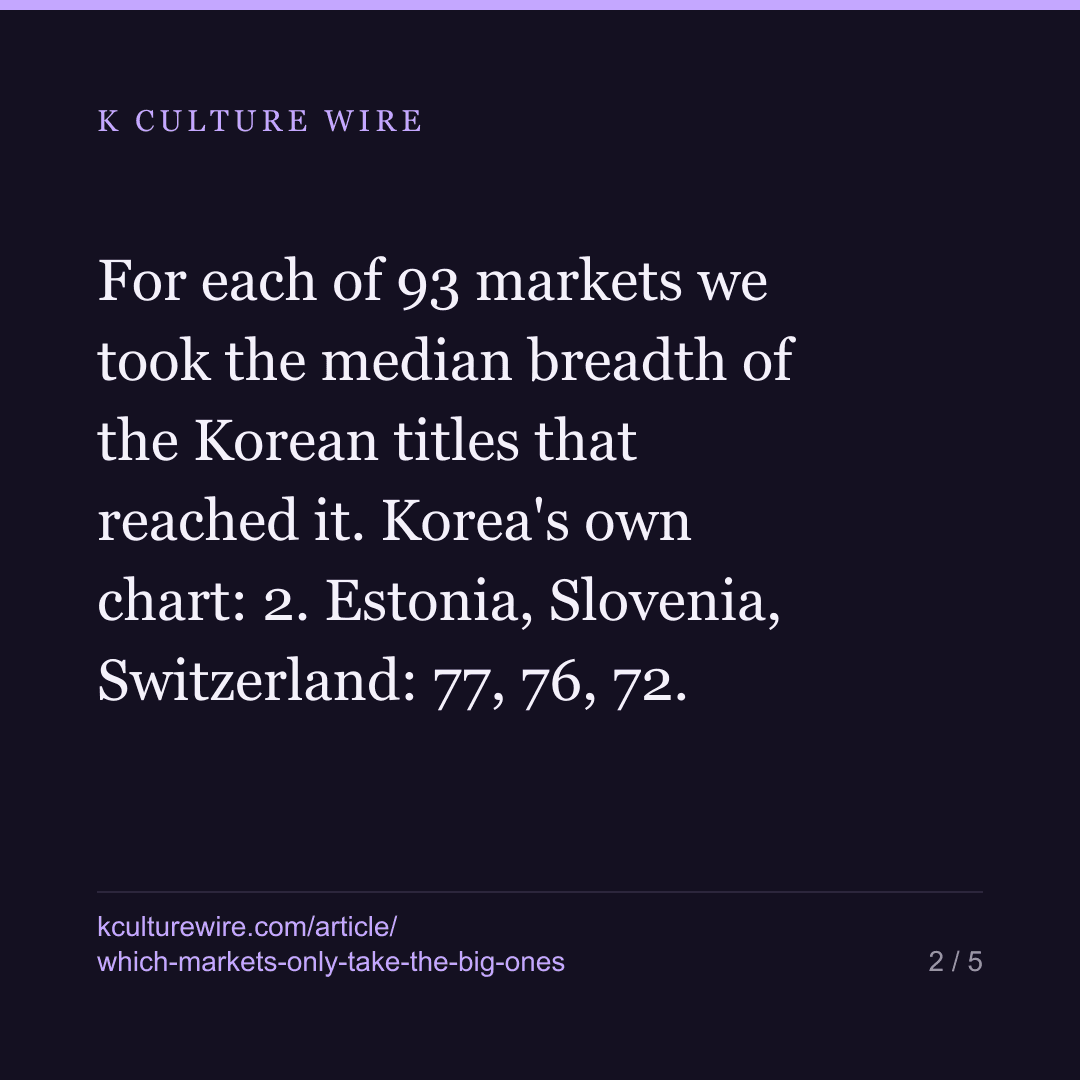
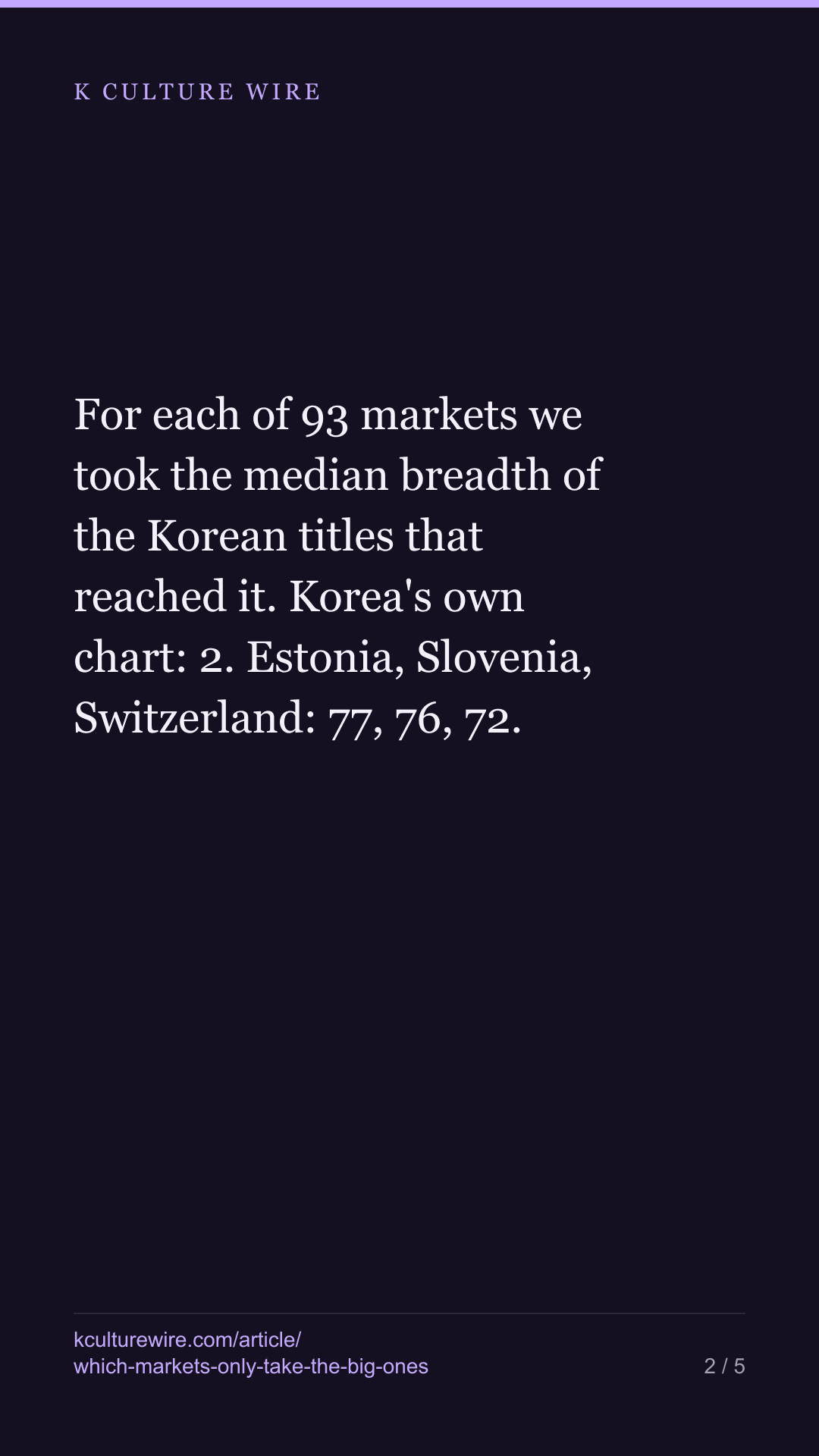
For each of 93 markets we took the median breadth of the Korean titles that reached it. Korea's own chart: 2. Estonia, Slovenia, Switzerland: 77, 76, 72. Most of that gap is how often a market plays Korean titles at all — but not all of it.
The table this is written from: /hard-markets
Every Korean title that charts anywhere has a breadth — the number of countries it reached at some point. Some markets carry titles that went almost nowhere else. Others only ever show the ones that went everywhere.
For a distributor that is the release-order question, and we had never measured it. So: for each market, the median breadth of the Korean titles that appeared there.
The two ends
| Only the widest titles get in | Median breadth | Korean share of that chart |
|---|---|---|
| Estonia | 77 | 1.9% |
| Croatia | 76 | 2% |
| Slovenia | 76 | 2.1% |
| Switzerland | 72.5 | 2.5% |
| Netherlands | 72 | 1.8% |
| Narrow titles get in too | Median breadth | Korean share of that chart |
|---|---|---|
| South Korea | 2 | 53.6% |
| Japan | 18 | 20.4% |
| Vietnam | 20 | 30.2% |
| Thailand | 20 | 24% |
| Taiwan | 21 | 24.2% |
On Korea’s own chart the median Korean title reached two countries in total — its own and one other. 64.1% of the Korean titles that chart in Korea reached five markets or fewer. Nowhere else comes close: in Estonia, exactly one of the 38 Korean titles that charted there had a breadth of five or under.
We are not publishing the other 83 markets in order. A league table of countries invites a reading this data cannot support, and the figure that explains most of the difference is in the second column of both tables.
The second column explains a lot of it
A market that rarely plays Korean titles at all will show only the biggest ones — not because it is hard to reach, but because there is one Korean slot and the biggest title takes it. That is a different statement, and the two are entangled.
So the same measurement, with markets grouped by how much of their chart is Korean:
| Korean share of the chart | Markets | Median breadth | Range within the band |
|---|---|---|---|
| Under 5% | 48 | 62.5 | 49 |
| 5–8% | 13 | 52 | 3 |
| 8–12% | 15 | 46 | 9 |
| 12% or more | 17 | 21 | 45.5 |
It falls straight down: 63, 52, 46, 21. The more of a chart is Korean, the narrower the titles that get onto it. Most of what looks like “hard to reach” is “rarely plays Korean titles”.
But it is not all of it. Inside the under-5% band — 49 markets that all play Korean titles about as rarely as each other — the breadth still ranges across 48.5 markets’ worth. Two countries with the same Korean share can want very different titles.
⚠ We cannot take that further. Separating “this market is hard” from “this market has one Korean slot” would need release and licensing data, and Netflix publishes none.
What this cannot tell you
It says which titles appeared, not why. Licensing windows, dubbing, local release dates and how crowded a chart already is would all produce this pattern, and none of them is in a rank table. A title may be unavailable in a market rather than unwanted by it, and those look identical here.
It is also not viewing. A title one place outside a top 10 is invisible at any level of viewing, so a market with a short Korean list may still be watching a great deal of it.
And breadth is a lifetime count, not a simultaneous one — a title that spread to 60 countries slowly counts the same as one that opened in 60 at once. We measure that difference separately, on when a Korean title is at its widest.
What changed on 3 September 2026
Our list of Korean titles had been frozen at 8 August. We rebuilt it, it went from 397 titles to 420, and one title we had been counting as Korean (Dangerous Liaisons, the 2022 French film) is not. 8 figures in this piece moved with it. None of them changed what the piece found. The ones a reader is most likely to have quoted:
| Was | Now | |
|---|---|---|
| Markets in the 5–8% band | 20 | 13 |
| Second-hardest market | Slovenia, median breadth 76 | Croatia, 76 |
Every table above is now generated from the counted file rather than typed out, and a check reads each figure back out of that file on every build. We print what moved rather than swapping it quietly: one wrong number makes the correct ones beside it worth doubting.
Where these numbers come from
Sources
- Netflix — Tudum weekly Top 10 country lists, 493,600 rows read, 2021-07-04 to 2026-07-26, 93 markets, Russia excluded · https://www.netflix.com/tudum/top10
- Wikidata — Korean titles identified by item number and country of origin, using the same single rule as the rest of this publication · https://query.wikidata.org
What we checked
- A market that rarely plays Korean titles will mechanically show only the biggest ones, so each market's Korean share is reported beside its breadth and the markets are also grouped into bands of similar Korean share
- Only markets with at least 10 charting Korean titles are measured, because below that a median moves on one title
- The full order of 93 markets is not published — a league table of countries invites a reading this data cannot support
- Breadth counts every country a title ever reached, not only the ones it held at once, so a title that spread slowly is not counted as narrow
What we left out, and why
- Russia, excluded across this publication because Netflix withdrew and the remaining weeks are not comparable
- Licensing windows, local release dates and dubbing schedules, none of which appear in a chart
The data behind this
Written from the same data
Take this away — 10 cards
The figures in this article, as images. Free to repost with the address on them.

If you work in this business
Everything on this page is measured from the same weekly Netflix lists, per market and per title. We publish the pages free; what we sell is the same measurement cut to one company's catalogue — including the figures behind /hard-markets.
What a company sheet contains, and what it cannot tell you →