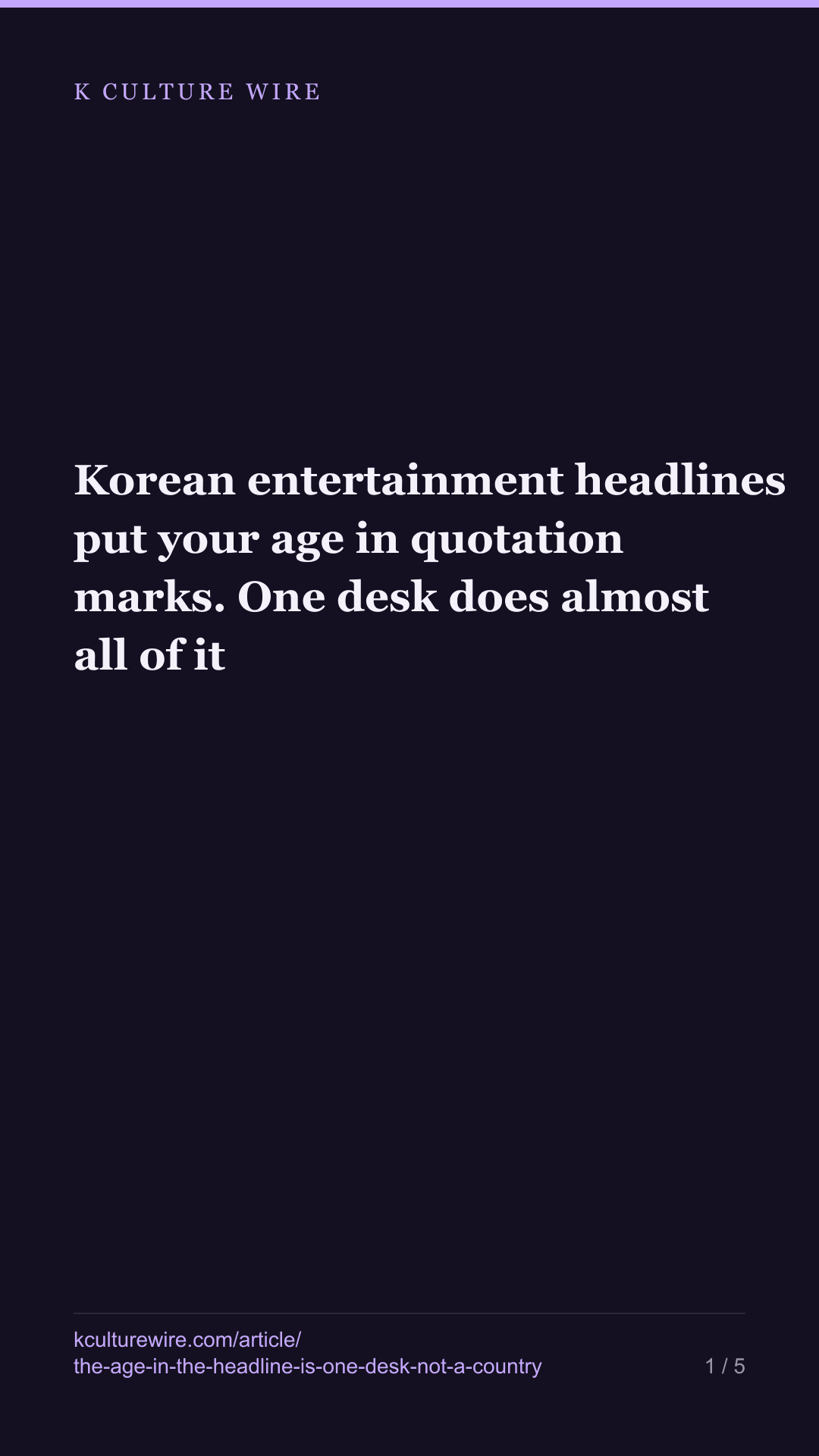
Korean entertainment headlines put your age in quotation marks. One desk does almost all of it
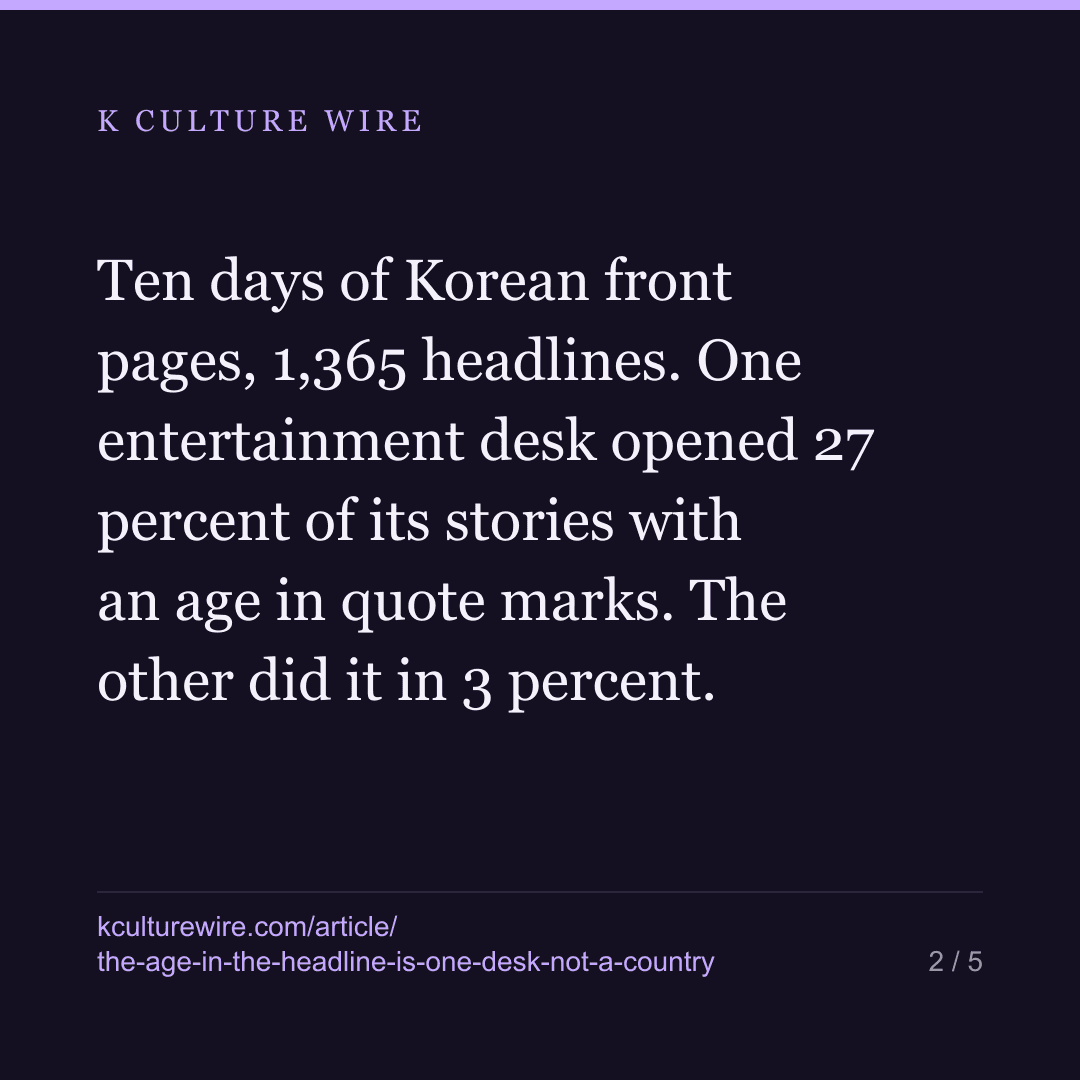
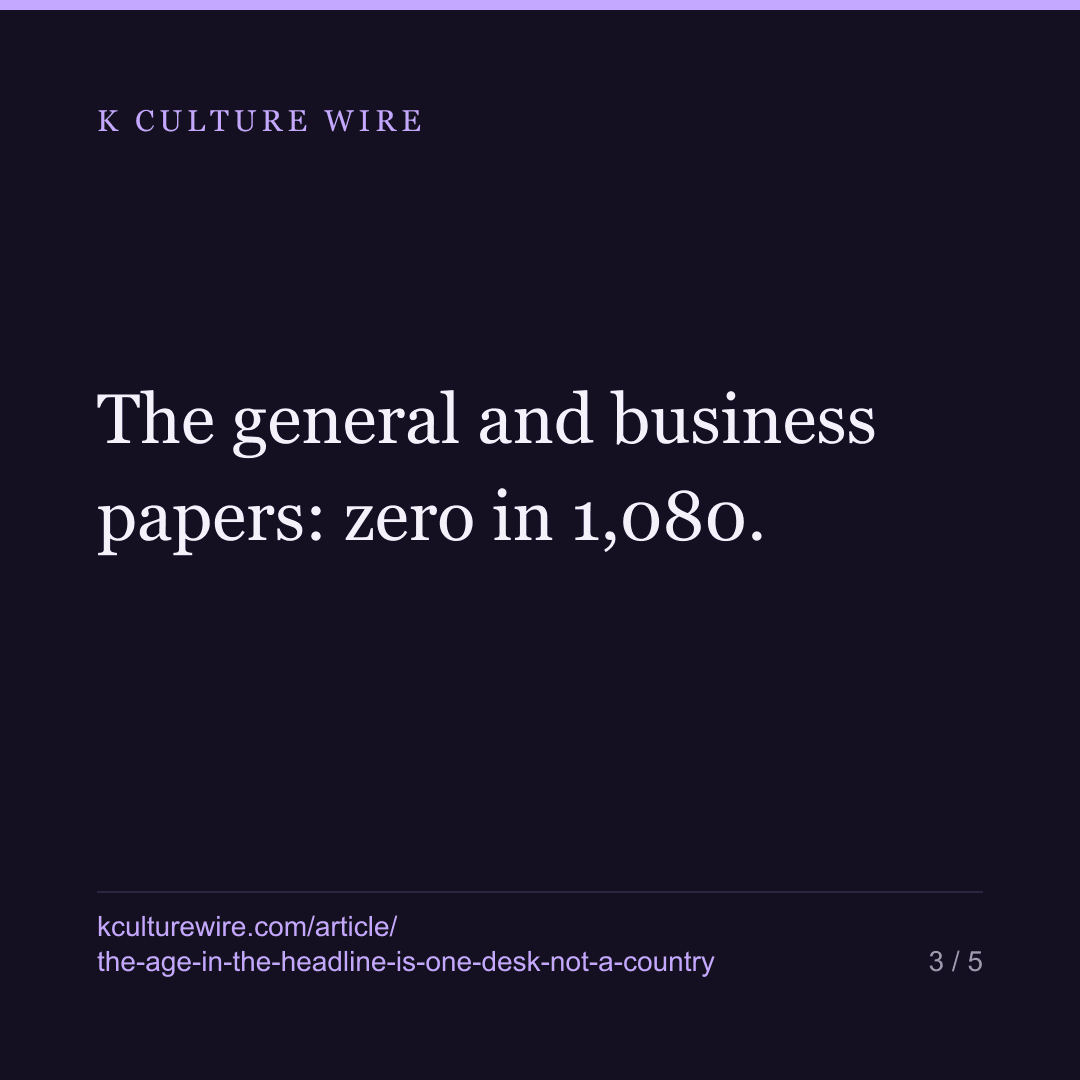
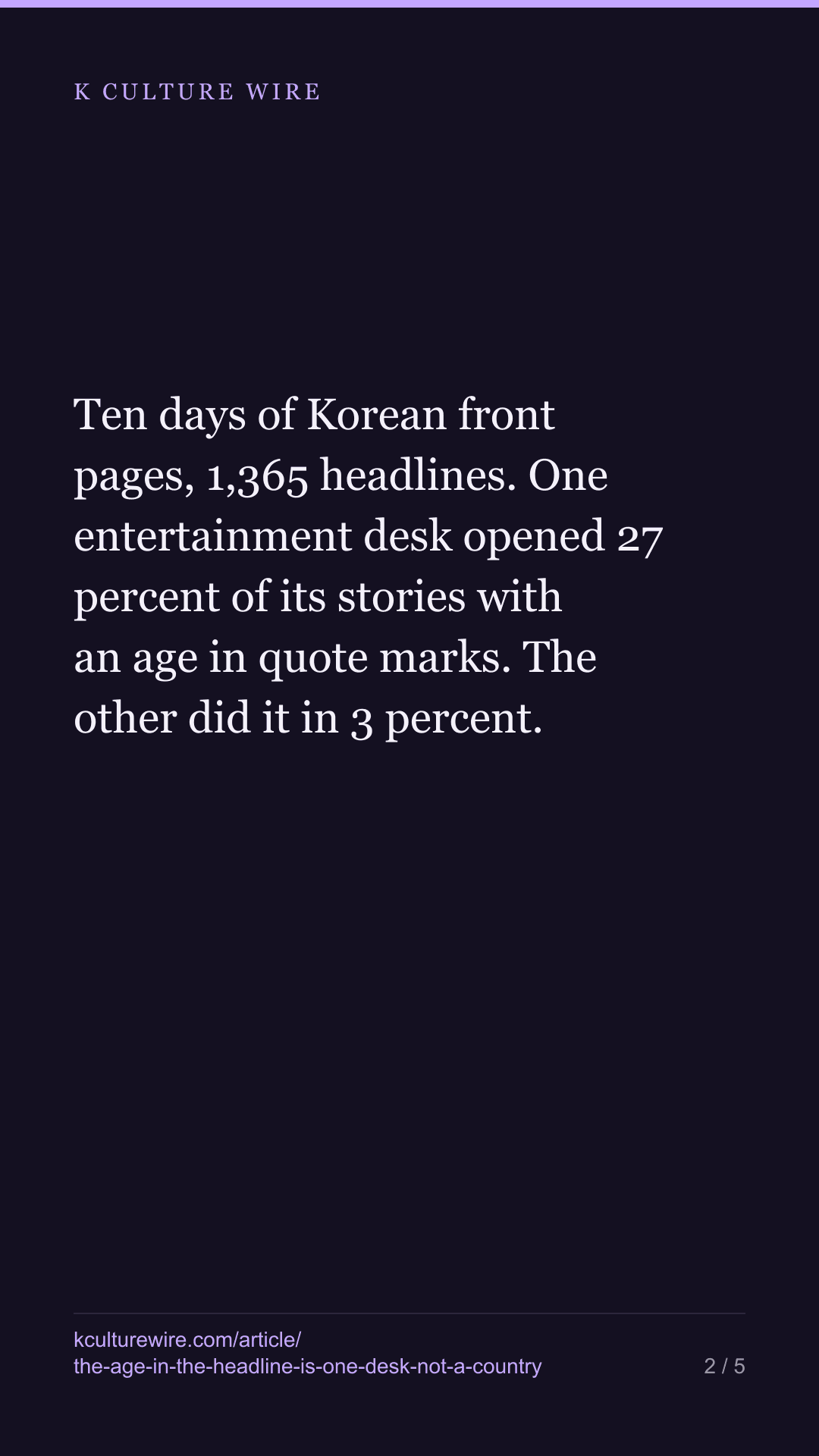
Ten days of Korean front pages, 1,365 headlines. One entertainment desk opened 27 percent of its stories with an age in quote marks. The other did it in 3 percent. The general and business papers: zero in 1,080.
The table this is written from: /age-in-headlines
Read a Korean entertainment headline and you will often be told how old the subject is, before you are told anything else, and the number will be in quotation marks.
“82-year-old” Kim Do-hyang, a fall three months ago
“32-year-old” Han So-hee went blonde and the mood changed completely
“39-year-old” Han Ji-eun, really? First dramatic short cut in 20 years
English-language desks do not write this way. The age, if it appears at all, goes in the body. So the obvious question is how common the Korean form actually is — and the answer turns out to be narrower than “Korean media.”
What we counted
We capture the front pages of four Korean outlets every day and keep the files. Ten days, four outlets, 1,365 headlines. For each one we looked for an age inside quotation marks or brackets, the form the desks actually use.
| Outlet | Beat | Headlines | With a quoted age | Rate | Age in first position |
|---|---|---|---|---|---|
| TenAsia | K-culture | 73 | 20 | 27.4% | 18 |
| Star News | K-culture | 212 | 6 | 2.8% | 4 |
| Maeil Business | business | 695 | 0 | 0.0% | 0 |
| Dong-A Ilbo | general | 385 | 0 | 0.0% | 0 |
It is one desk
TenAsia opened more than one headline in four with a quoted age, and 18 of its 20 put the number in the very first position, before the name.
Star News, covering the same beat on the same days, did it six times in 212 headlines.
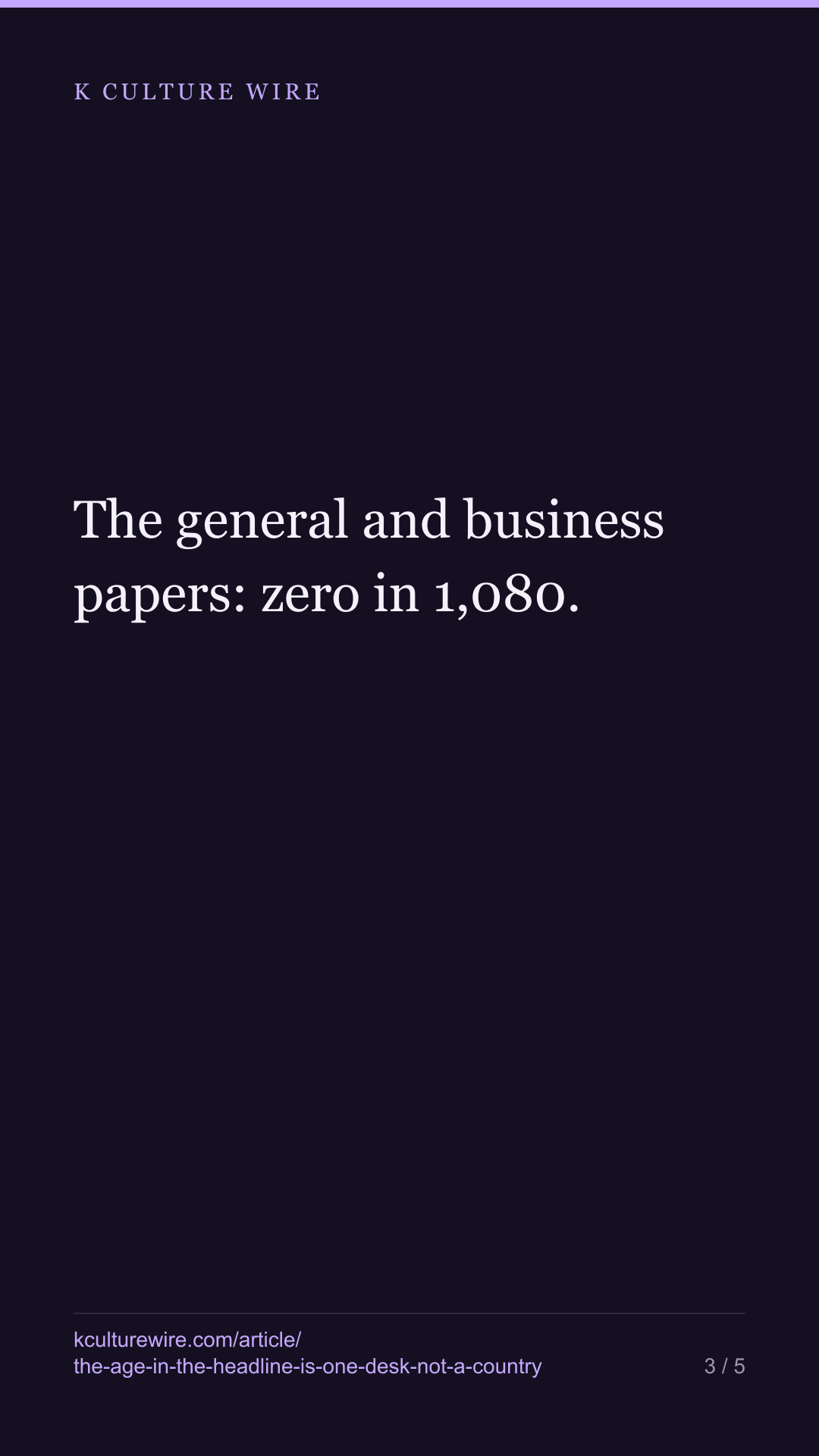
The business paper and the general paper did it zero times in 1,080 headlines.
That is the finding. This is not a Korean press convention, and it is not even an entertainment-press convention. It is one desk’s house style, and it is strong enough there that a reader who only ever saw TenAsia would reasonably conclude that Korean journalism always announces your age.
Which desk a story comes from turns out to matter for what reaches English readers at all. Our count of who the English-speaking world looks up when it looks up K-pop is built from the same kind of daily capture, and the names that travel are not evenly drawn from the desks that write about them.
Which ages get announced
Of the 26 quoted ages across the ten days:
| Age bracket | Times |
|---|---|
| 30s | 7 |
| 40s | 9 |
| 60s | 1 |
| 70s | 4 |
| 80s | 5 |
Nobody in their twenties or fifties had an age quoted in these ten days. With 26 cases that gap is not yet a pattern — it is one of the things worth watching as the archive gets longer. But the shape it hints at is a practice aimed at two moments: people in their thirties and forties, where the number carries an implication about looking younger than it, and people past seventy, where it carries an implication about still being active.
What we did not measure
We did not measure sex. A count that guessed it from names would be inventing a variable and printing it as a finding, and the practice may well fall unevenly by sex — which is a question this count cannot answer.
We did not check whether the printed ages are right. That needs recorded birth years, and reading them is a separate job from reading headlines.
And ten days is ten days. The rate at one desk is 27.4 percent across 73 headlines, which is a real count of a real ten days, and not a claim about the year.
One note on how this was built
The pattern that finds a quoted age broke twice while this was written. Korean desks use at least five quotation forms, and a character class holding all of them is easy to get wrong; the second time it silently matched nothing at all, which would have produced an article reporting that the practice does not exist.
Both times the tool refused to print a figure, because it runs its own tests before it will emit a number and a failing test stops it. That is why the count above is 26 and not 0. We mention it because a measurement that can return zero for the wrong reason is worth saying out loud.
Where these numbers come from
Sources
- K Culture Wire newsroom archive — Daily front-page headline capture from four Korean outlets, 2 to 11 September 2026, stored as dated files · https://www.kculturewire.com/
What we checked
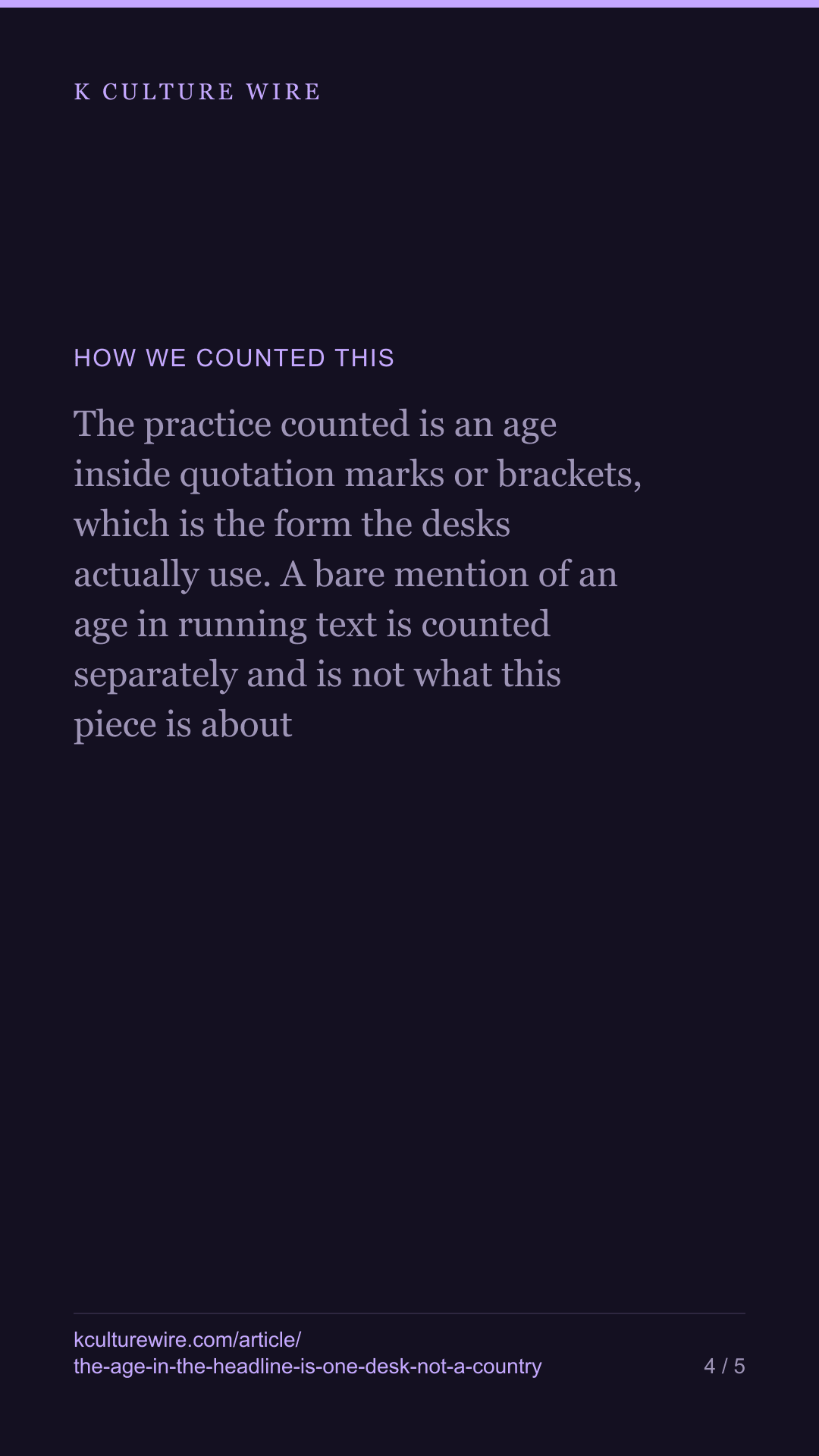
- The practice counted is an age inside quotation marks or brackets, which is the form the desks actually use. A bare mention of an age in running text is counted separately and is not what this piece is about
- Headline totals per outlet differ by a factor of nine, so every rate is printed beside the count it came from
- Sex is not measured. Guessing it from a name would be inventing a variable, and the practice may well fall unevenly by sex, which is a question this count cannot answer
- Whether the printed ages are correct is also not measured. That needs recorded birth years and we did not fetch them
- Ten days is ten days. 26 ages is a small sample, and the age brackets below should be read as a first look rather than a distribution
- The pattern-matching character class silently broke twice while this was built, once returning zero matches. Both times the tool's own tests refused to publish a figure, which is why the number here is 26 rather than 0
The data behind this
Written from the same data
Take this away — 10 cards
The figures in this article, as images. Free to repost with the address on them.
If you work in this business
Everything on this page is measured from the same weekly Netflix lists, per market and per title. We publish the pages free; what we sell is the same measurement cut to one company's catalogue — including the figures behind /age-in-headlines and /kpop-attention.
What a company sheet contains, and what it cannot tell you →