K Culture Wire · industry
What a Korean front page puts in a headline
10 days of front pages · 1,365 headline-days · four Korean outlets · 2026-09-02 to 2026-09-11
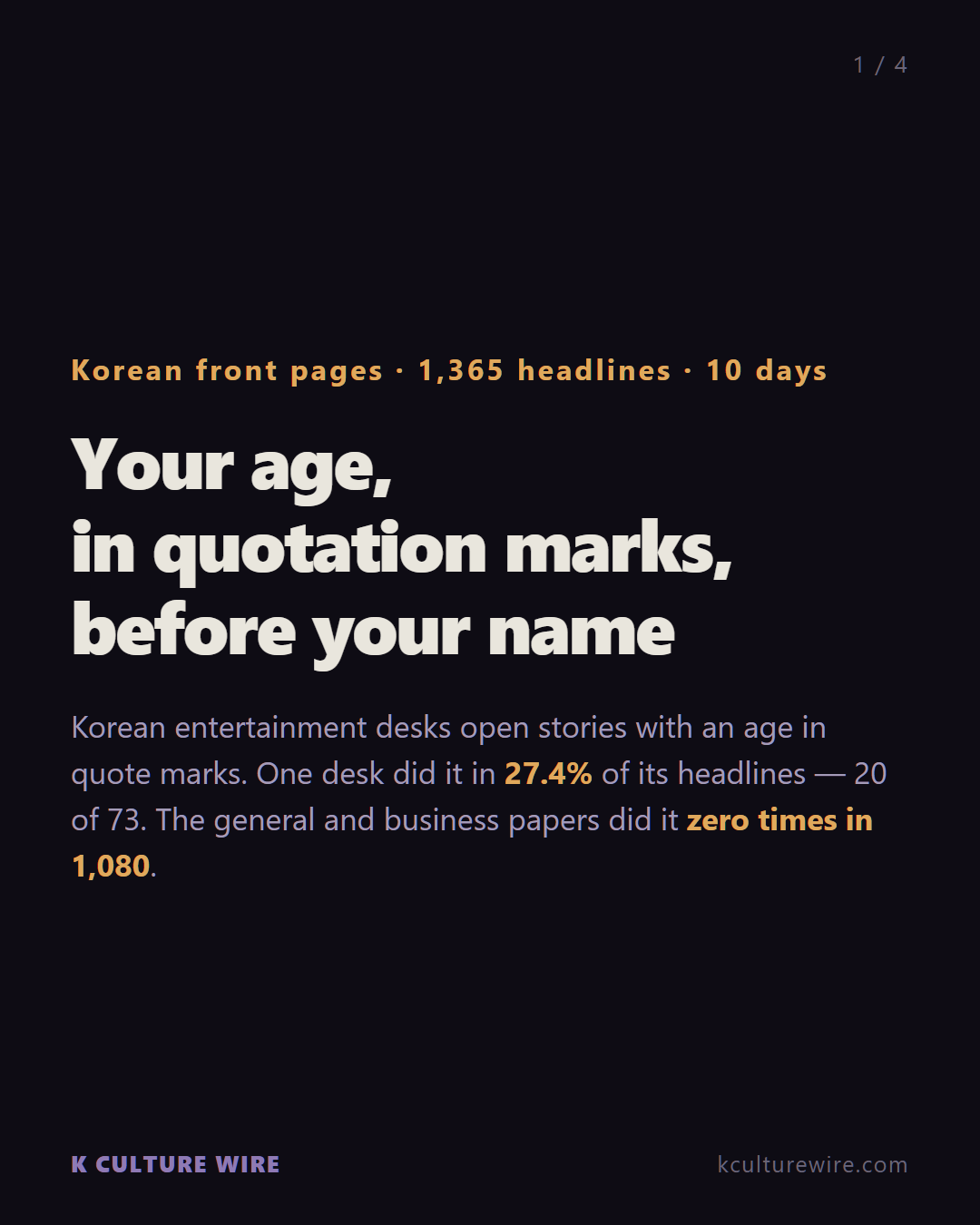
Korean entertainment desks tell you how old someone is before they tell you anything else, and they put the number in quote marks. English-language desks do not write this way. So we counted how common it actually is — and the answer is narrower than Korean media. One desk did it in 27.4% of its headlines. The general and business papers did it zero times in 1,080.
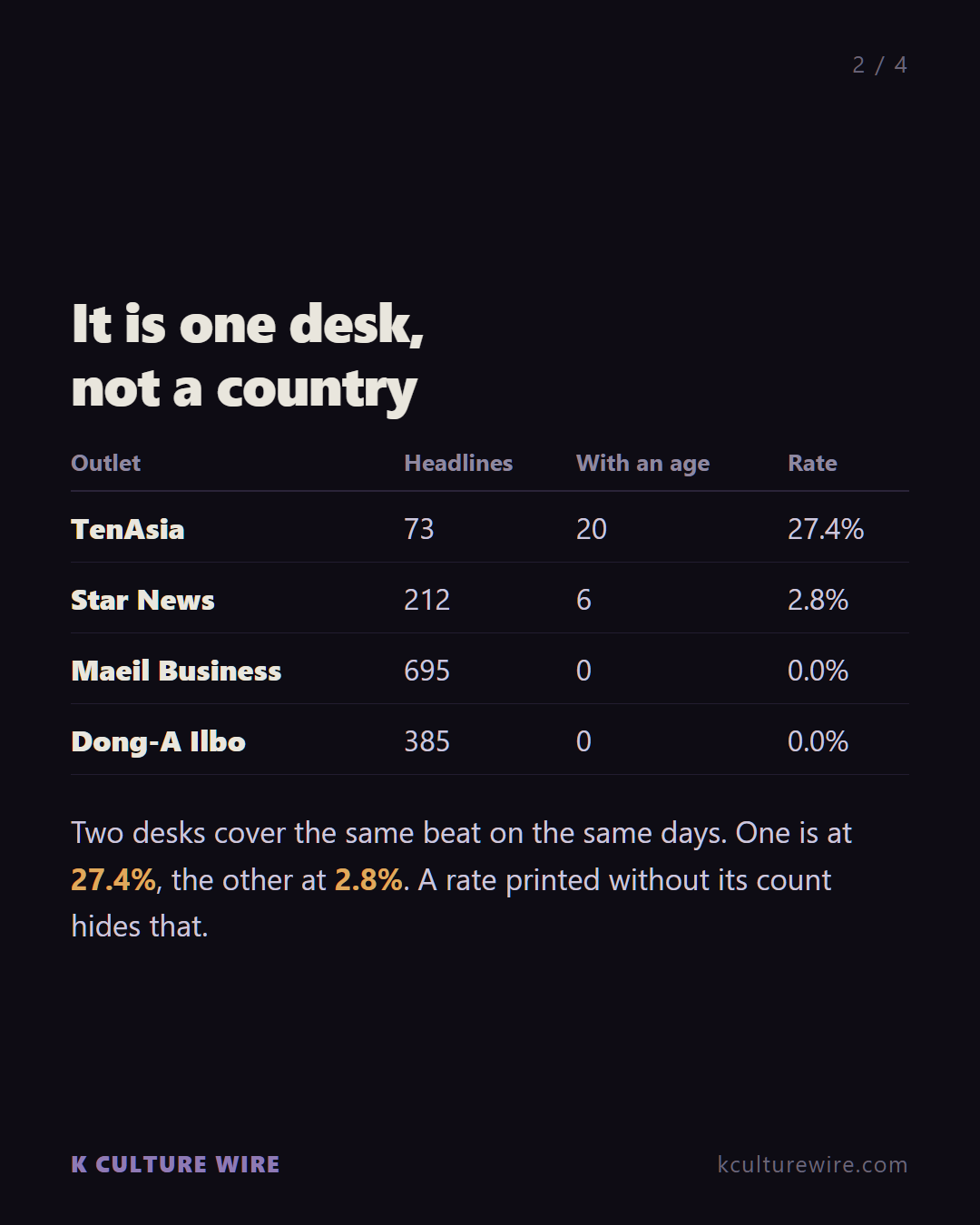
It is one desk, not a country
| Outlet | Beat | Headlines | With a quoted age | Rate | Age in first position |
|---|---|---|---|---|---|
| TenAsia | K-culture | 73 | 20 | 27.4% | 18 |
| Star News | K-culture | 212 | 6 | 2.8% | 4 |
| Maeil Business | business | 695 | 0 | 0.0% | 0 |
| Dong-A Ilbo | general | 385 | 0 | 0.0% | 0 |
Two of these desks cover the same beat on the same days. Every rate is printed beside the count it came from, because the headline totals differ by a factor of nine.
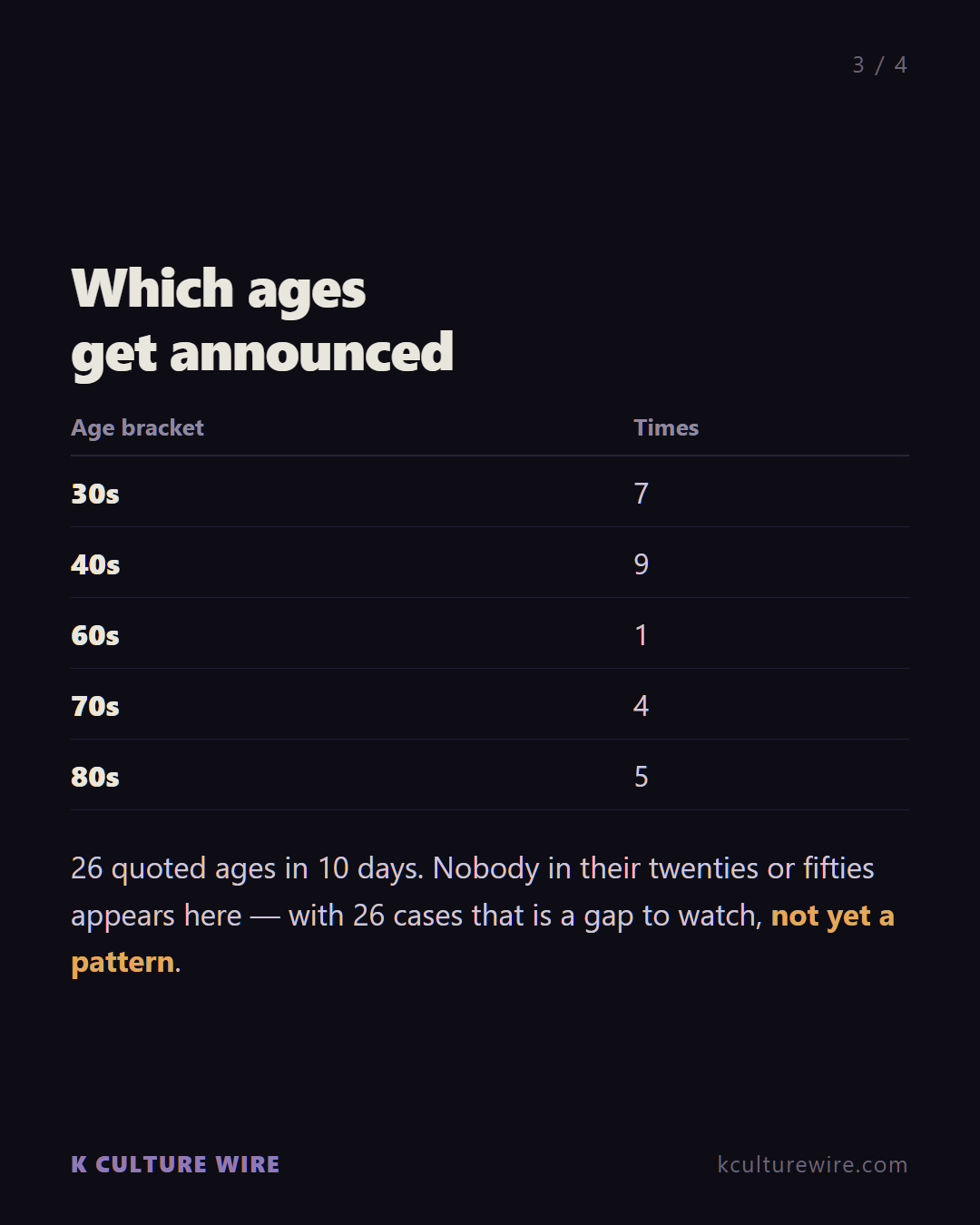
Which ages get announced
| Age bracket | Times | Share |
|---|---|---|
| 30s | 7 | |
| 40s | 9 | |
| 60s | 1 | |
| 70s | 4 | |
| 80s | 5 |
26 quoted ages across 10 days. The heaviest bracket is the 40s. Nobody in their 10s, 20s, 50s or 90s had an age quoted in these days — with 26 cases that is a gap to watch, not yet a pattern.
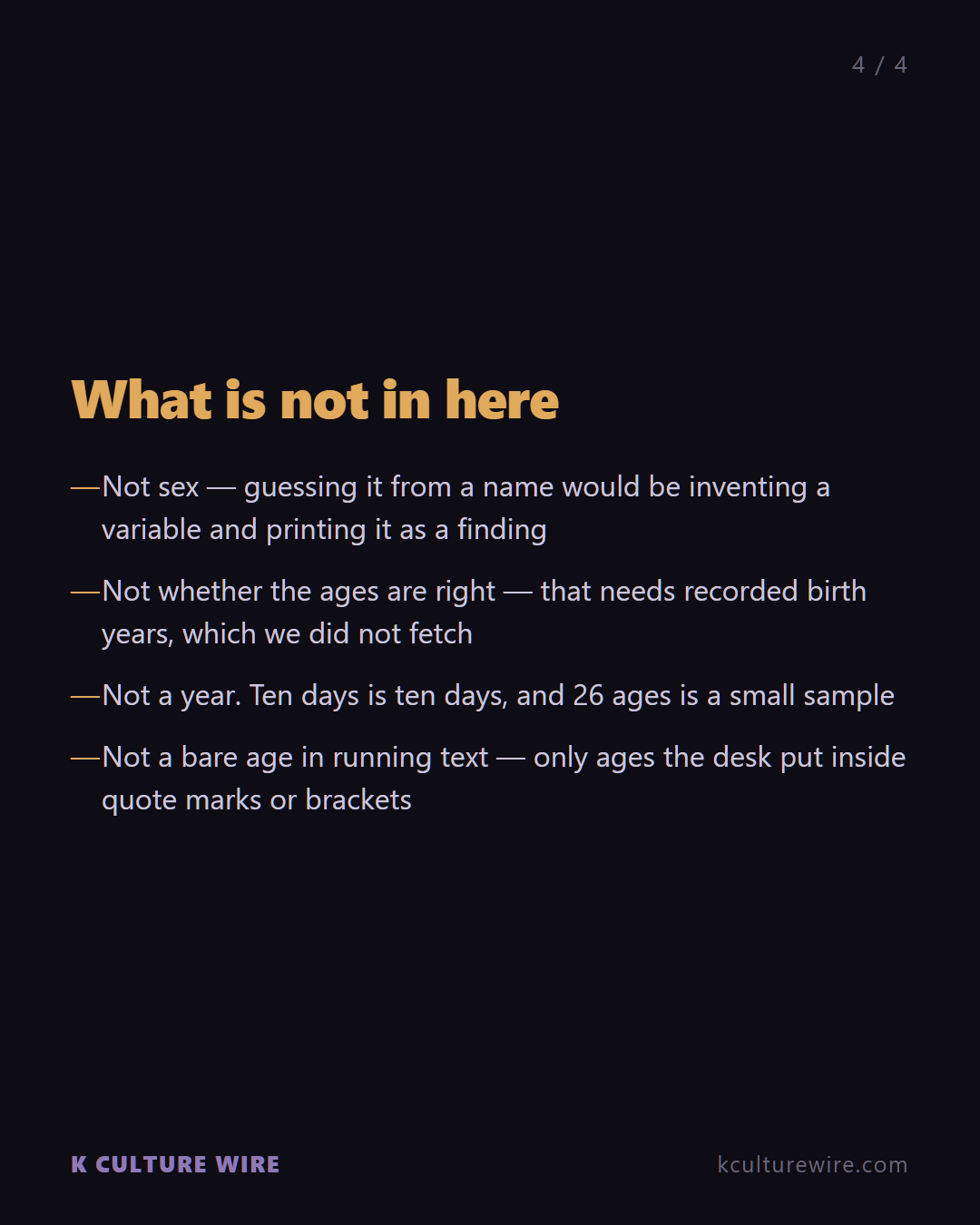
What this count does not do
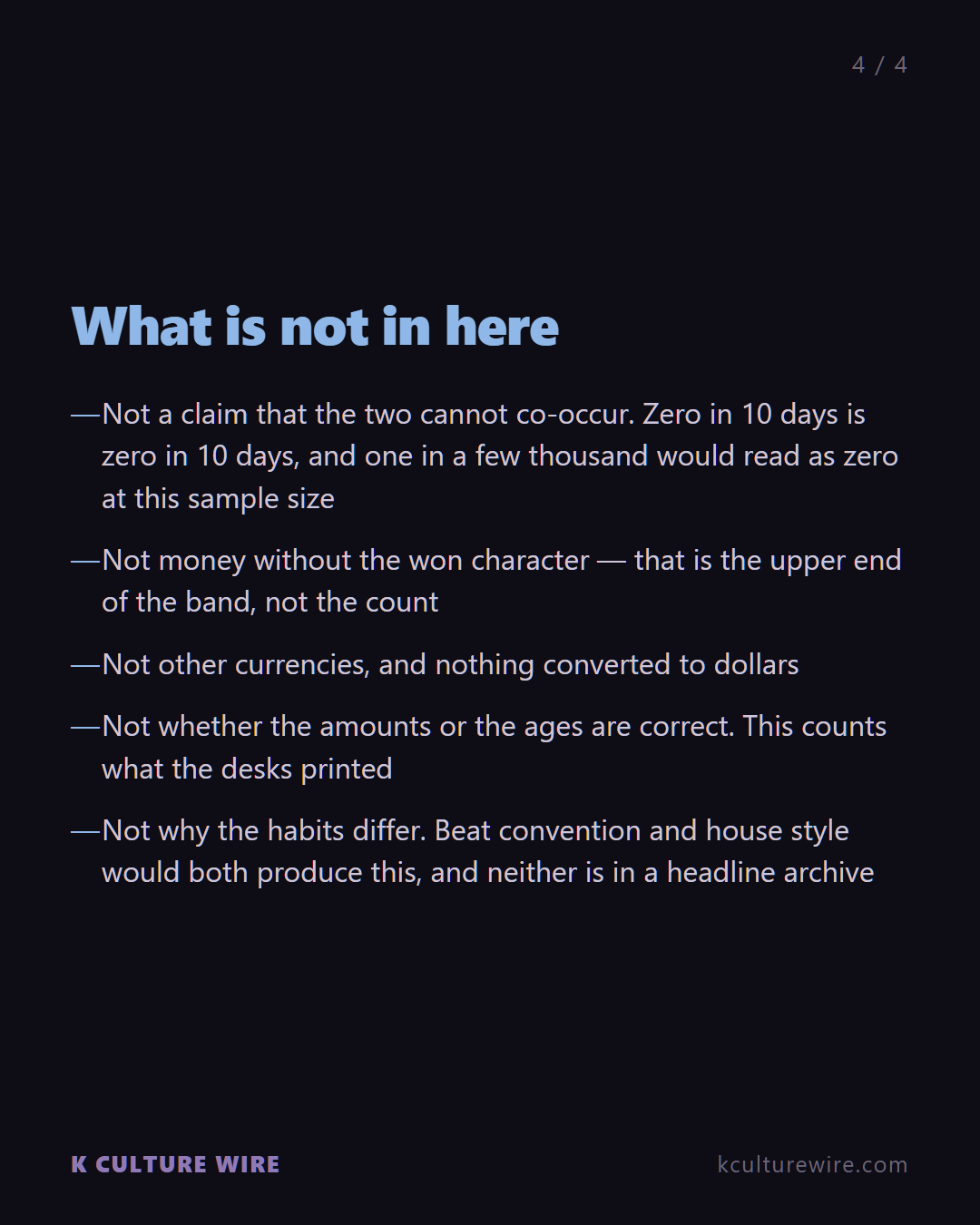
- It does not measure sex. Guessing it from a name would be inventing a variable and printing it as a finding. The practice may well fall unevenly by sex — this count cannot say.
- It does not check whether the printed ages are right. That needs recorded birth years, and reading those is a separate job from reading headlines.
- It counts only an age the desk put inside quote marks or brackets. A bare age in running text is a different thing and is counted separately.
- 10 days is 10 days. 26 quoted ages is a small sample, and the brackets above are a first look rather than a distribution.
The other number in the headline: money
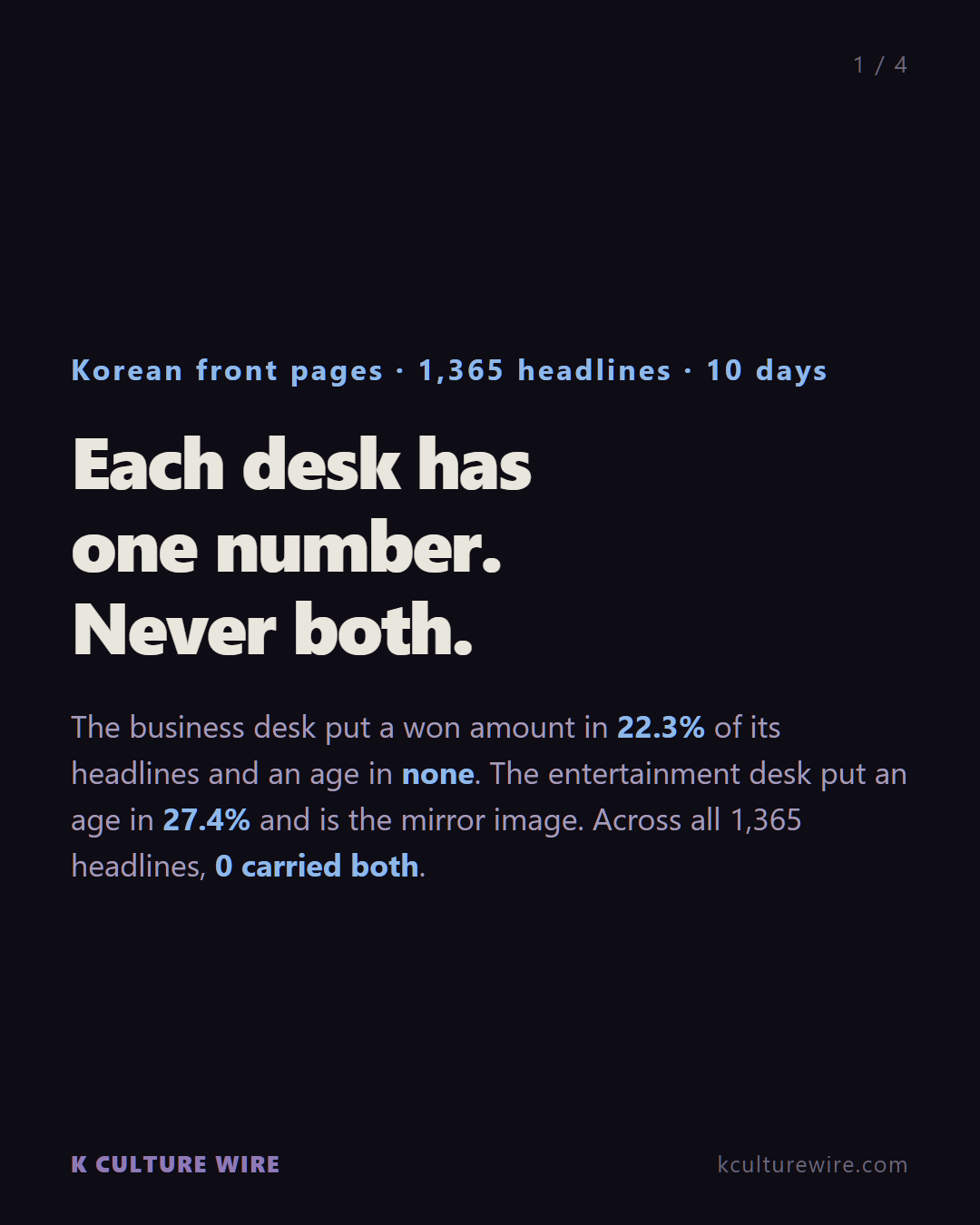
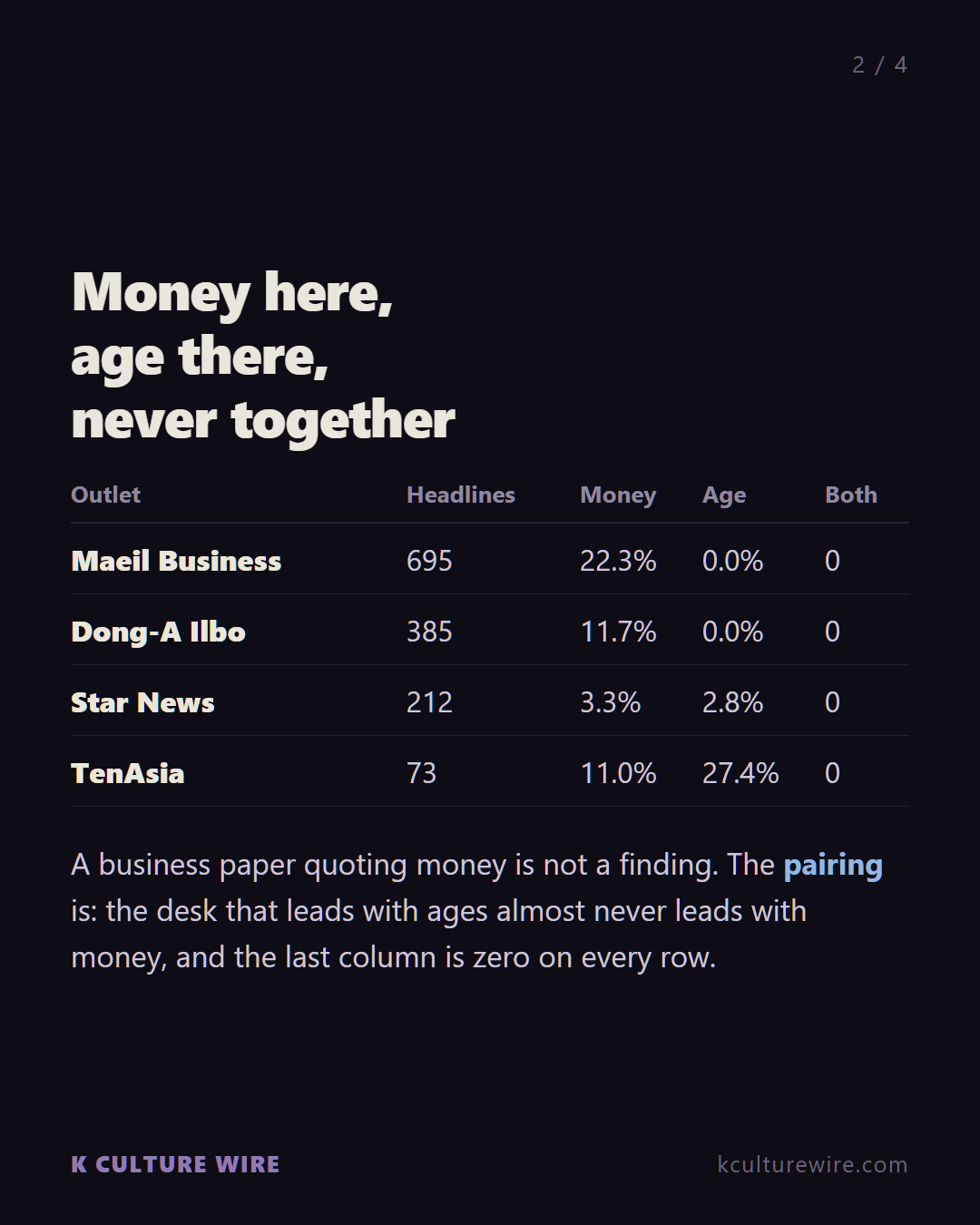
Reading the same file again, a second habit was hard to miss — the money. So we counted headlines carrying a number followed by the character for won, on exactly the same 1,365 headlines. The two habits turn out to be complementary rather than two versions of the same thing: the desk that leads with ages almost never leads with money, the desks that lead with money never lead with ages, and 0 headlines carried both.
| Outlet | Money | Age | Both | Headlines |
|---|---|---|---|---|
| Maeil Business · business | 22.3% | 0.0% | 0 | 695 |
| Dong-A Ilbo · general | 11.7% | 0.0% | 0 | 385 |
| Star News · K-culture | 3.3% | 2.8% | 0 | 212 |
| TenAsia · K-culture | 11.0% | 27.4% | 0 | 73 |
| All four desks | — | — | 0 | 1,365 |
A business paper quoting money is not a finding on its own. Maeil Business leads at 22.3% and prints no ages at all. What the pairing shows is that these are two different tools, held by different desks, and the Both column is zero on every row.
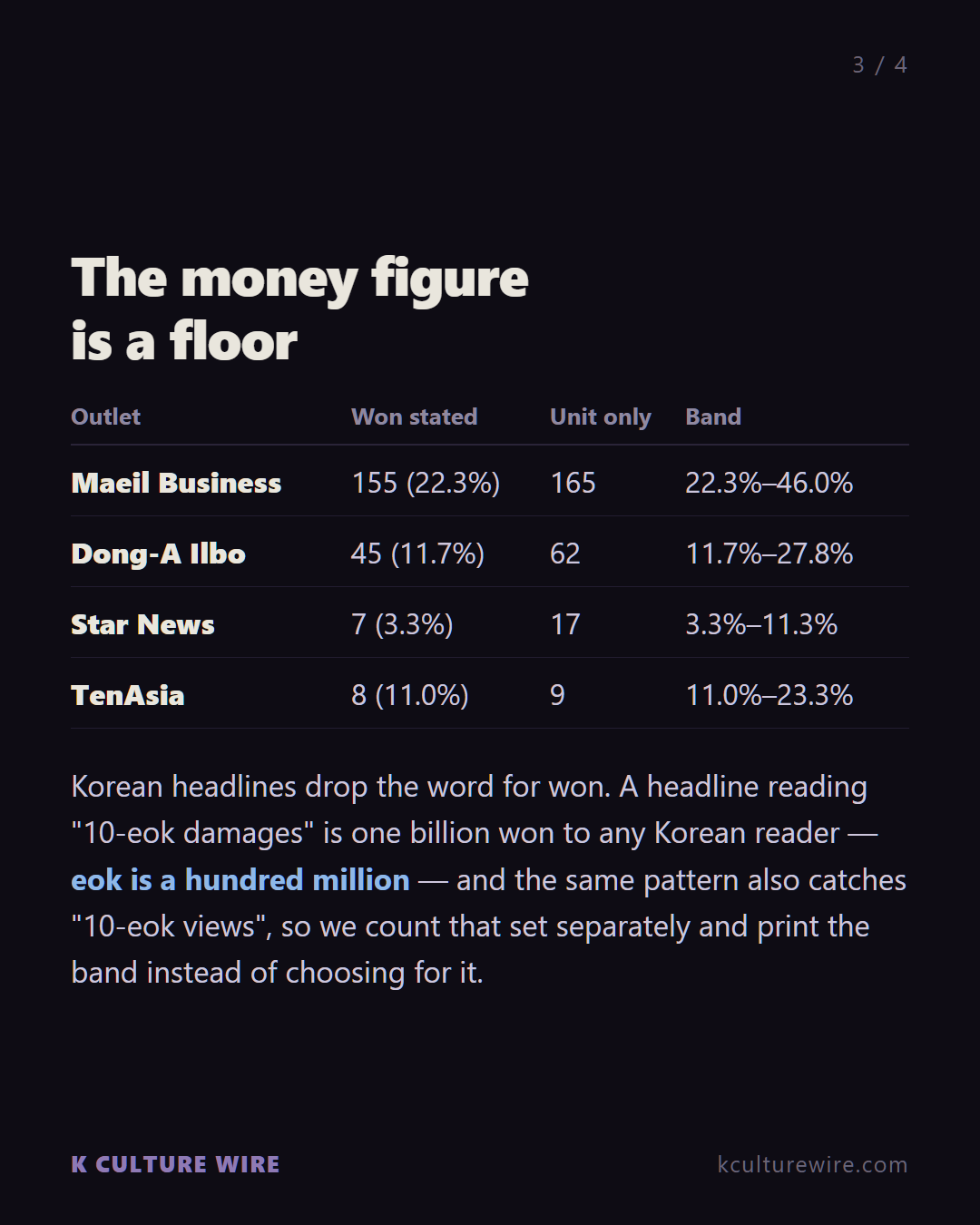
The money figure is a floor, and here is the band
| Outlet | Band | Won stated | Unit only |
|---|---|---|---|
| Maeil Business | 22.3%–46.0% | 155 (22.3%) | 165 |
| Dong-A Ilbo | 11.7%–27.8% | 45 (11.7%) | 62 |
| Star News | 3.3%–11.3% | 7 (3.3%) | 17 |
| TenAsia | 11.0%–23.3% | 8 (11.0%) | 9 |
Korean headlines drop the word for won constantly. A headline reading 10-eok damages is one billion won to any Korean reader — eok being the unit for a hundred million — and our pattern does not count it, because the same pattern also catches 10-eok views. Unit only counts headlines carrying a large-number unit with no won after it, so the low end of the band counts only what is unambiguously money and the high end assumes every bare unit is money — which it is not. The true figure sits between, and the ordering of the four desks is the same at both ends, which is the part the argument above rests on.
The third habit: the letters an English reader can actually read
A reader who cannot read Korean can still read the Latin script in a Korean headline — the brand, the acronym, the unit. Counted on the same file, 223 of 1,388 headline-days carry at least one Latin word of two or more letters, and the habit is again unevenly held.
| Outlet | With Latin | Minus its own initials | ALL CAPS | Headline-days |
|---|---|---|---|---|
| Star News · K-culture | 32.6% | 30.2% | 75 | 215 |
| TenAsia · K-culture | 20.5% | 19.2% | 7 | 73 |
| Maeil Business · business | 15.7% | 14.2% | 147 | 696 |
| Dong-A Ilbo · general | 7.2% | 7.2% | 24 | 404 |
| All four desks | — | — | — | 1,388 |
The second column exists because a paper prints its own name in its own headlines — MK is Maeil Business's abbreviation and is that desk's most frequent Latin word. Taking each outlet's initials out of its own count lowers every rate and changes no part of the order. The ALL CAPS column is a count of words, not headlines: the business desk's Latin is almost entirely capitals (the vocabulary of a market report), while the entertainment desks are the ones with lower-case and mixed-case words — and their frequent words are brands.
| Latin word | Times |
|---|---|
| MK | 31 |
| AI | 30 |
| kg | 19 |
| LG | 10 |
| ETF | 7 |
| GW | 7 |
| TV | 7 |
| AG | 6 |
The two totals on this page differ, and here is why. The money table sums to 1,365 and this one to 1,388. We photograph each front page more than once a day and merge the captures, because a page pushes headlines off during the day and overwriting would lose them. The money count was taken at 00:23 and this one at 05:30, so the later one holds 23 headline-days the earlier one had not seen yet. Neither number is wrong; each is stamped with the time it was taken.
Read the unit before the ranking: this whole page counts headline-days, so a headline still on the page tomorrow is counted again. The 1,388 headline-days contain 1,010 distinct headlines. We print both rather than pick one, and the word counts are the more repeat-sensitive of the two — one Star News headline carrying 'FACE OF GUCCI' held its place five days running and is 15 of that desk's 97 Latin words. The full write-up is at the letters an English reader can read.
20 seconds, with sound
Twenty seconds: the business desk put a won amount in 22.3% of its headlines and an age in none, the entertainment desk is the mirror image, and 0 of 1,365 headlines carried both. Free to repost with the address on it.
All our short films — each one built from a table on this site
Card set — free to share
Five cards, 1080×1350. Every figure on them is in the table on this page. Take them.
17 seconds, with sound
Seventeen seconds: one entertainment desk opened 27.4% of its headlines with an age in quote marks; the other desk on the same beat did it in 2.8%, and the business and general papers did it zero times in 1,080. Free to repost with the address on it.
All our short films — each one built from a table on this site
Card set — free to share
Five cards, 1080×1350. Every figure on them is in the table on this page. Take them.
What we wrote from this data
- Korean desks each have one number in the headline. In 1,365 of them, the two never appeared together
We counted quoted ages in Korean front pages last night, then won amounts in the same 1,365 headlines. The business desk uses money in 22 percent and ages in none. The entertainment desk is the mirror image. No headline carried both.
11 September 2026
- Korean entertainment headlines put your age in quotation marks. One desk does almost all of it
Ten days of Korean front pages, 1,365 headlines. One entertainment desk opened 27 percent of its stories with an age in quote marks. The other did it in 3 percent. The general and business papers: zero in 1,080.
11 September 2026
- A third of the K-culture desk's headlines carry Latin letters. At the general paper it is one in fourteen
If you cannot read Korean, the only legible part of a front page is its Latin script. We counted every Latin word in 1,388 headline-days. The K-culture desk prints them four times as often as the general paper, and prints a different kind.
11 September 2026