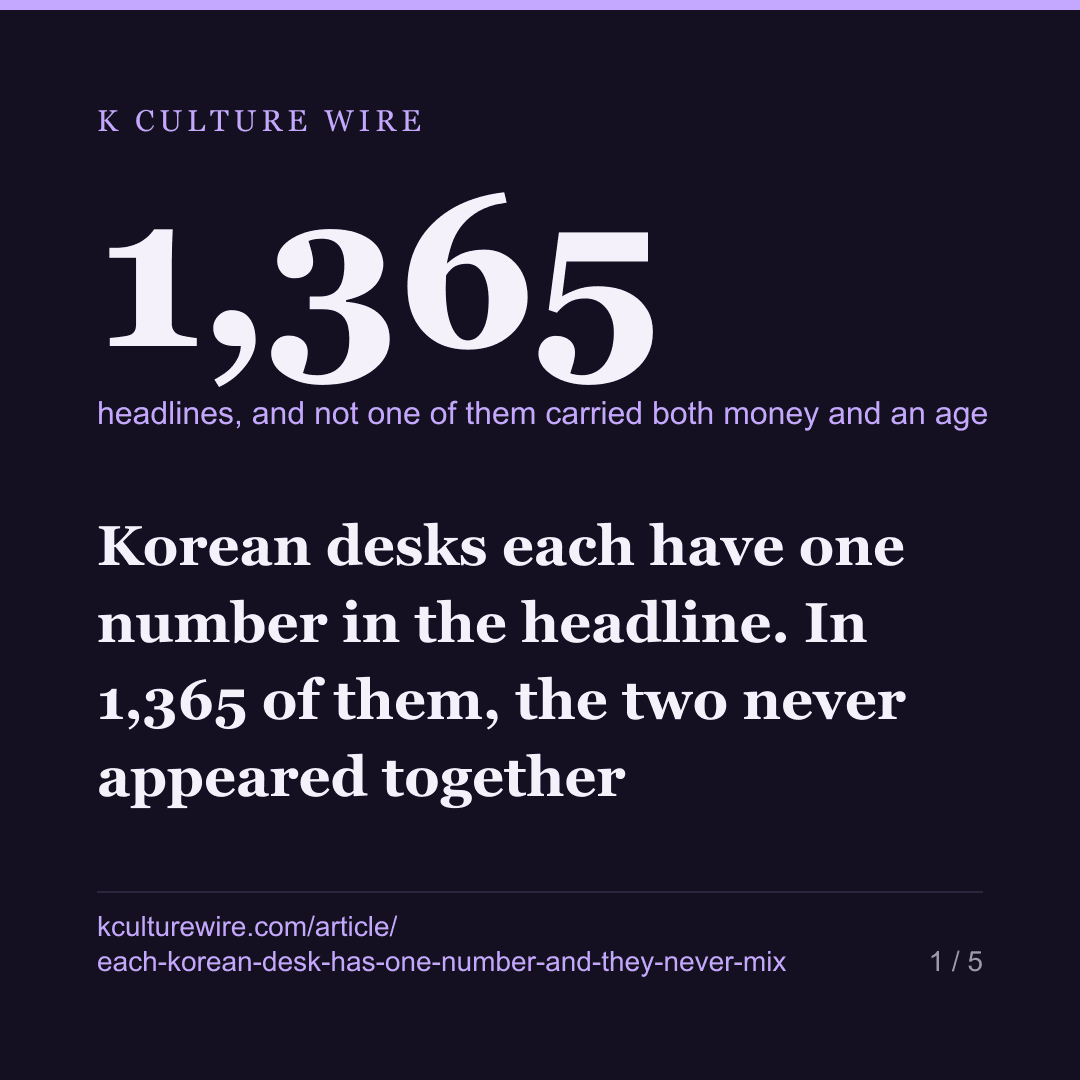
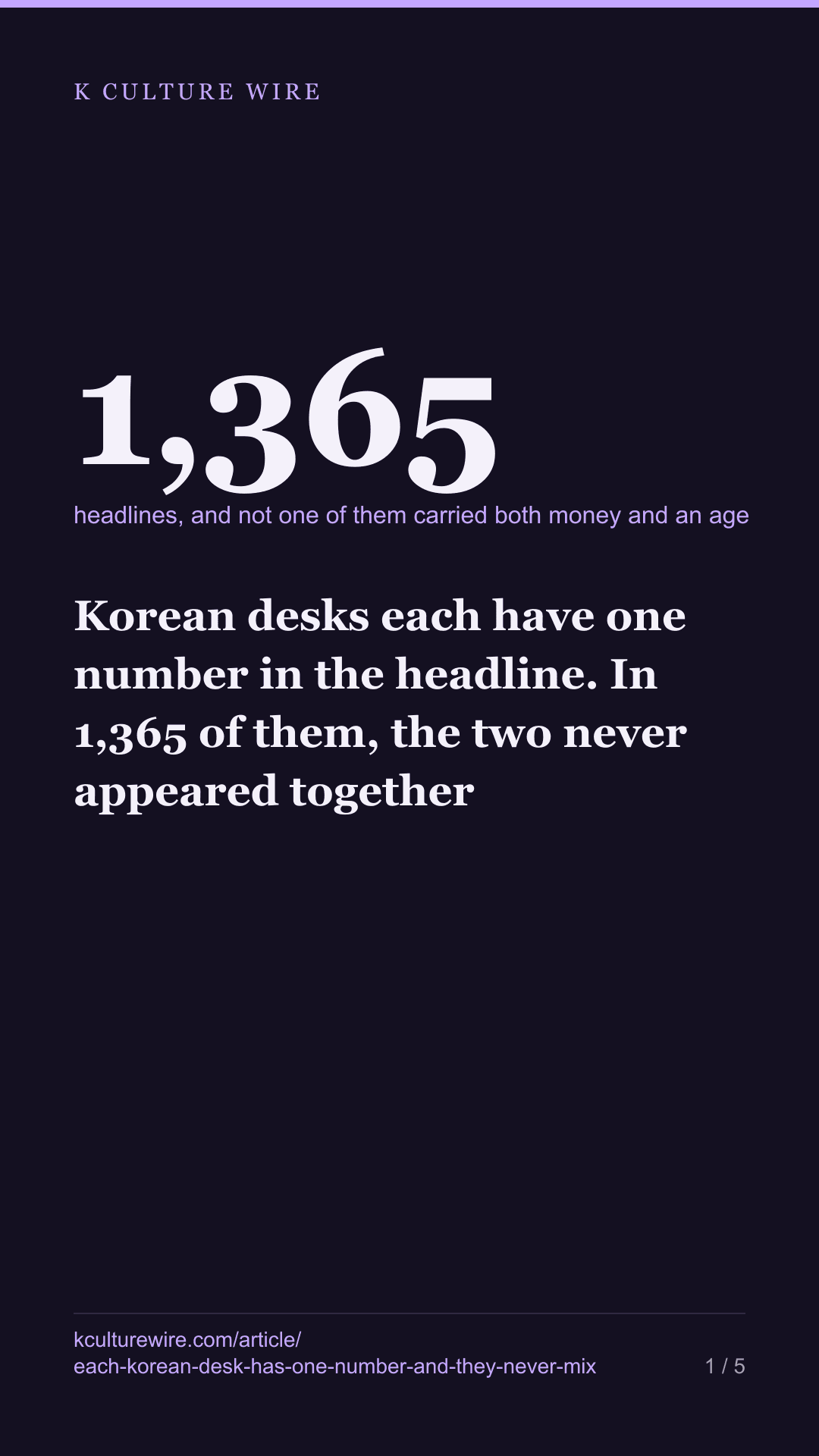
Korean desks each have one number in the headline. In 1,365 of them, the two never appeared together
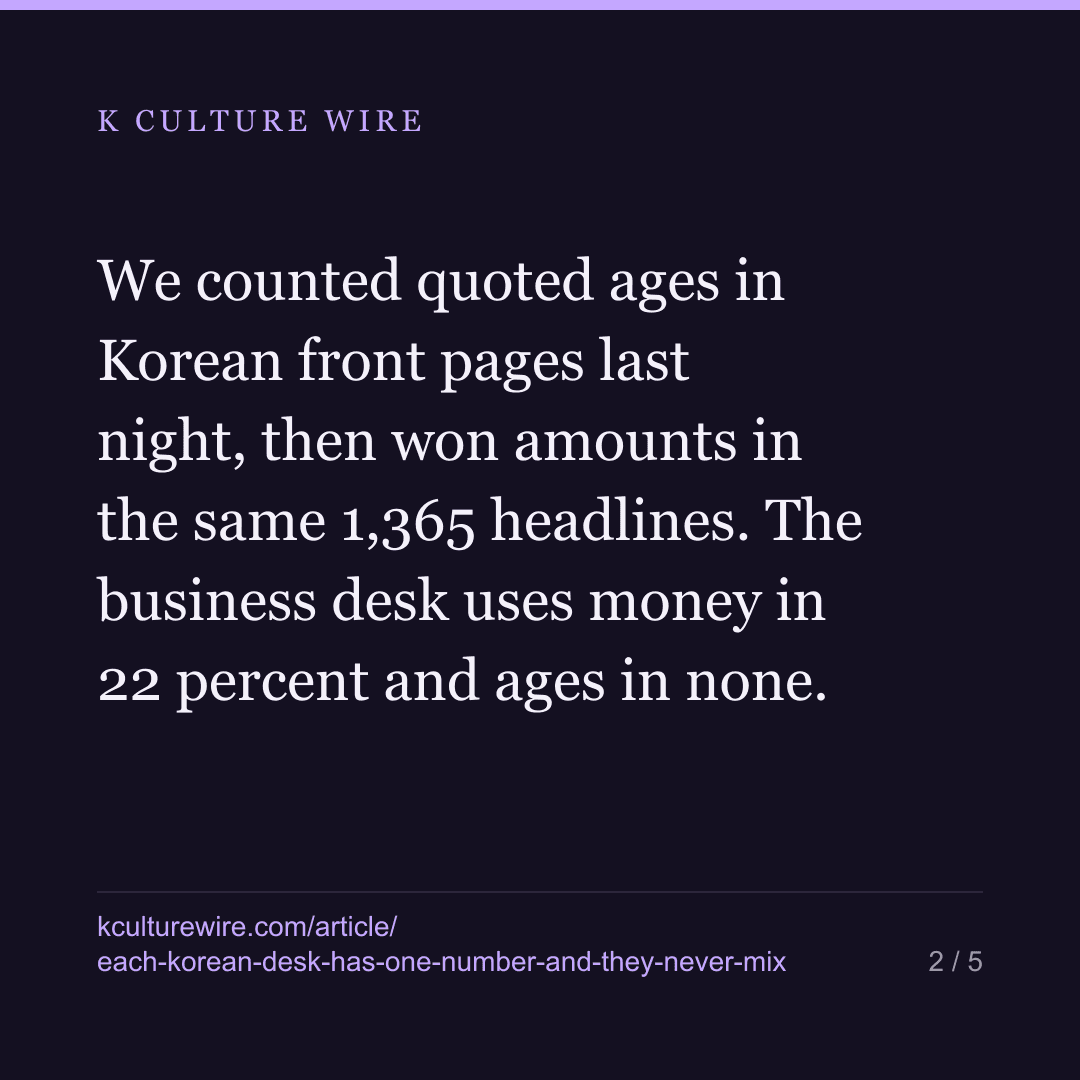
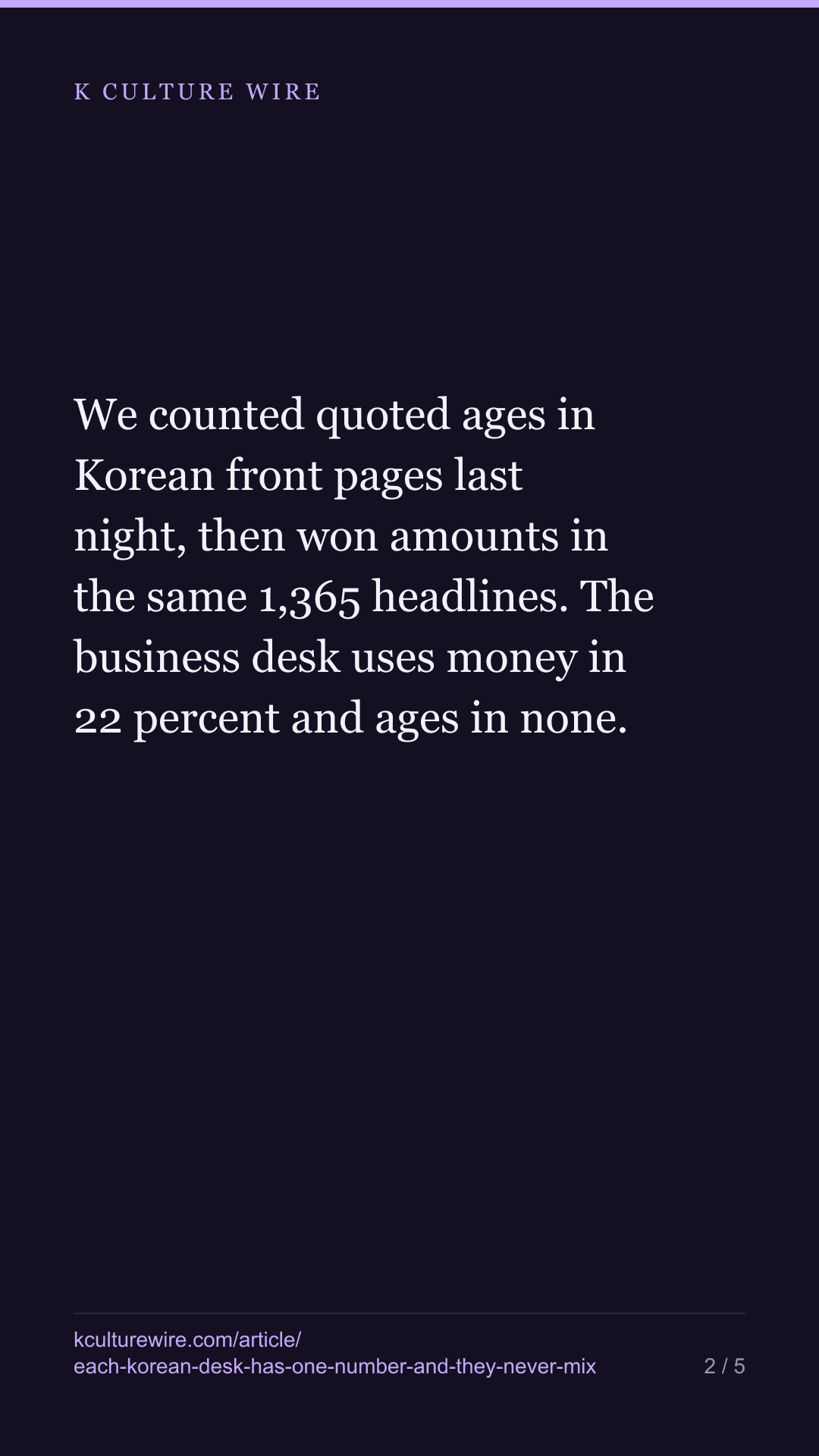
We counted quoted ages in Korean front pages last night, then won amounts in the same 1,365 headlines. The business desk uses money in 22 percent and ages in none. The entertainment desk is the mirror image. No headline carried both.
The table this is written from: /age-in-headlines
Last night we counted how often Korean front pages put a person’s age in the headline, in quote marks, before the name. The answer was one entertainment desk and almost nobody else: TenAsia did it in 27.4 percent of its headlines and the business and general papers did it zero times in 1,080.
Reading the same file again, a second habit was hard to miss — the money. “1 billion won in damages.” “A 100-million-won flex.” “A 4-million-won car rebuilt for 6 million.” So we counted that too, on exactly the same 1,365 headlines.
Each desk has one number
| Desk | Beat | Headlines | With a won amount | With a quoted age | With both |
|---|---|---|---|---|---|
| Maeil Business | business | 695 | 155 (22.3%) | 0 (0.0%) | 0 |
| Dong-A Ilbo | general | 385 | 45 (11.7%) | 0 (0.0%) | 0 |
| TenAsia | K-culture | 73 | 8 (11.0%) | 20 (27.4%) | 0 |
| Star News | K-culture | 212 | 7 (3.3%) | 6 (2.8%) | 0 |
A business paper quoting money is not a finding. What the pairing shows is that the two habits are complementary and non-overlapping: the desk that leads with ages almost never leads with money, the desks that lead with money never lead with ages, and across all 1,365 headlines not one carried both.
TenAsia is the interesting row. It is the only desk that does both at any real rate — a quoted age in more than one headline in four, a won amount in one in nine — and even there the two never landed in the same headline. Whatever selects for one appears to exclude the other within a single line of copy.
The money figure is a floor, and here is the band
Korean headlines drop the word for won constantly. A headline reading 10-eok damages is one billion won in damages to any Korean reader — eok being the unit for a hundred million — and our pattern does not count it, because the same pattern also catches 10-eok views.
So we counted that set separately rather than deciding for it:
| Desk | Money (won stated) | Unit only, won omitted | Band |
|---|---|---|---|
| Maeil Business | 155 (22.3%) | 165 | 22.3–46.0% |
| Dong-A Ilbo | 45 (11.7%) | 62 | 11.7–27.8% |
| TenAsia | 8 (11.0%) | 9 | 11.0–23.3% |
| Star News | 7 (3.3%) | 17 | 3.3–11.3% |
The low end counts only what is unambiguously money. The high end assumes every bare unit is money, which it is not. The true figure sits between, and the ordering of the four desks is the same at both ends — which is the part the argument above actually rests on.
What the zero is and is not
Zero co-occurrences in 1,365 headlines is not proof that a Korean desk cannot write “‘82-year-old’ Kim, 300 million won.” It is a statement about a small sample: a habit that showed up once in a few thousand headlines would read as zero here too.
What it does rule out is the casual assumption that these are both just “numbers in headlines.” They are two different tools, held by different desks, and one of the two — the age — is the one English-language readers find strangest about Korean coverage. It is also the one confined to a single desk.
One note on the unit above, because it changes the reading: eok is a hundred million, so a headline saying 10-eok is one billion won, not ten. English coverage of Korean figures gets this wrong often enough that we spell it out rather than convert silently.
The full table for the age side, day by day and by age bracket, is on the age-in-headlines page.
Where these numbers come from
Sources
- K Culture Wire newsroom archive — Daily front-page headline capture from four Korean outlets, 2 to 11 September 2026, stored as dated files · https://www.kculturewire.com/
What we checked
- The same 1,365 headlines and the same ten days as our earlier count of quoted ages, so the two measurements are directly comparable and the age column here reproduces that article exactly
- A headline counts as carrying money when a number is followed by the character for won, with or without a unit. Counted that way: Maeil Business 155 of 695, Dong-A Ilbo 45 of 385, TenAsia 8 of 73, Star News 7 of 212
- Headlines carrying a large-number unit (trillion, hundred-million, ten-thousand) with no won after it are counted separately, not as money: 165, 62, 9 and 17 respectively. That set includes both omitted-won money and non-money uses such as view counts, so it is reported as a band rather than folded in
- The age pattern is imported from the tool behind the earlier article rather than rewritten, because that pattern broke twice while it was being built and a second copy would repeat the fault
- Headlines carrying both a won amount and a quoted age: zero, at every one of the four desks
What we left out, and why
- Any claim that the two cannot appear together. Zero in ten days is zero in ten days, and this is a small enough sample that a co-occurrence rate of one in a few thousand would show up as zero here
- Money without the won character. 'Ten billion in damages' is money to a reader and is not counted as money here, because the same pattern also catches 'a billion views'. The band is stated instead of guessed at
- Amounts in other currencies, and any conversion. Nothing here is converted to dollars
- Whether the amounts or ages are accurate. This counts what the desks printed, not whether it was right
- Why the habits differ. Beat convention, house style guides and what each desk's readers respond to would all produce this, and none of them is in a headline archive
The data behind this
Written from the same data
Take this away — 10 cards
The figures in this article, as images. Free to repost with the address on them.
If you work in this business
Everything on this page is measured from the same weekly Netflix lists, per market and per title. We publish the pages free; what we sell is the same measurement cut to one company's catalogue — including the figures behind /age-in-headlines.
What a company sheet contains, and what it cannot tell you →