So Ji-sub outreads Jennie and V on our K-pop list
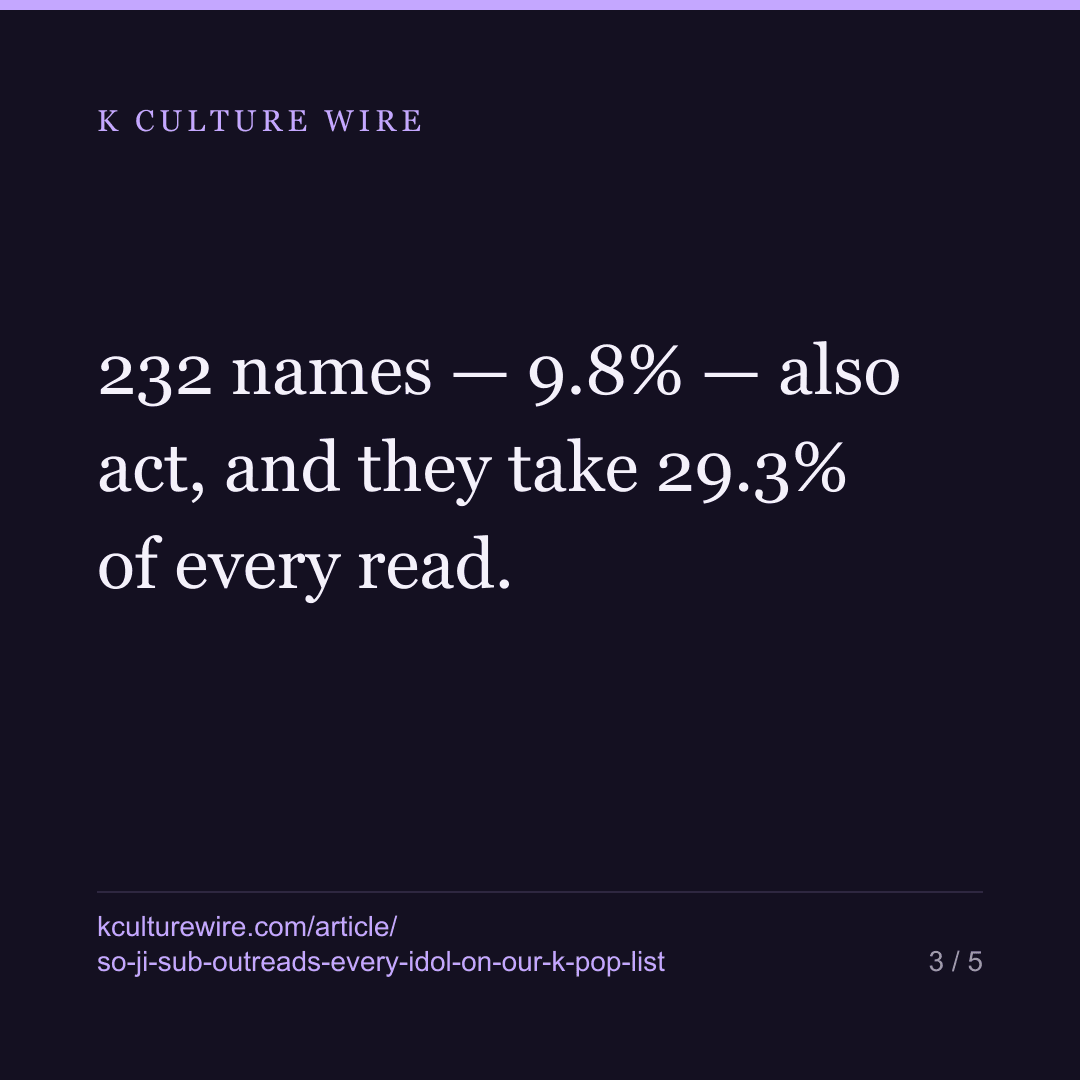
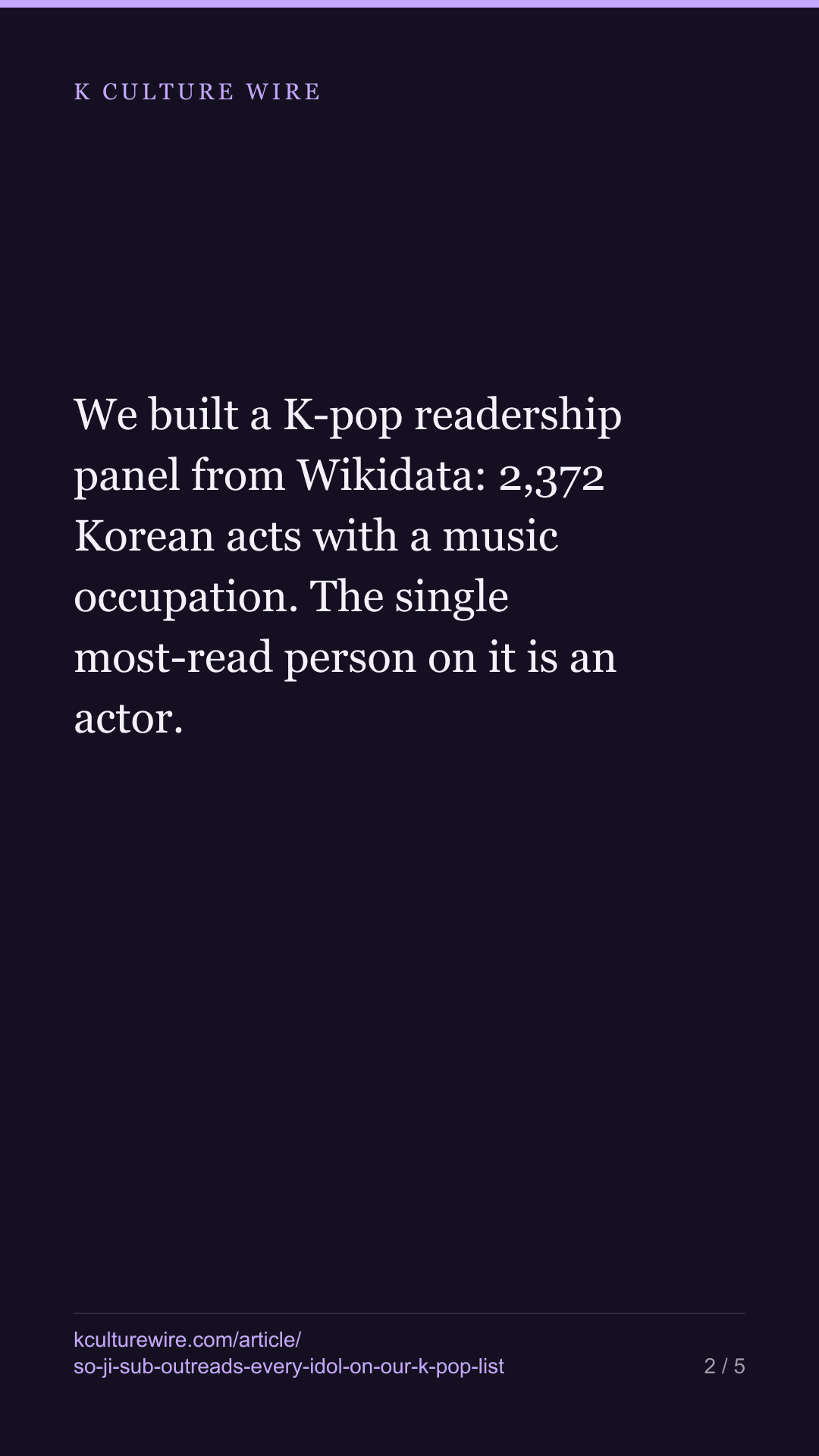
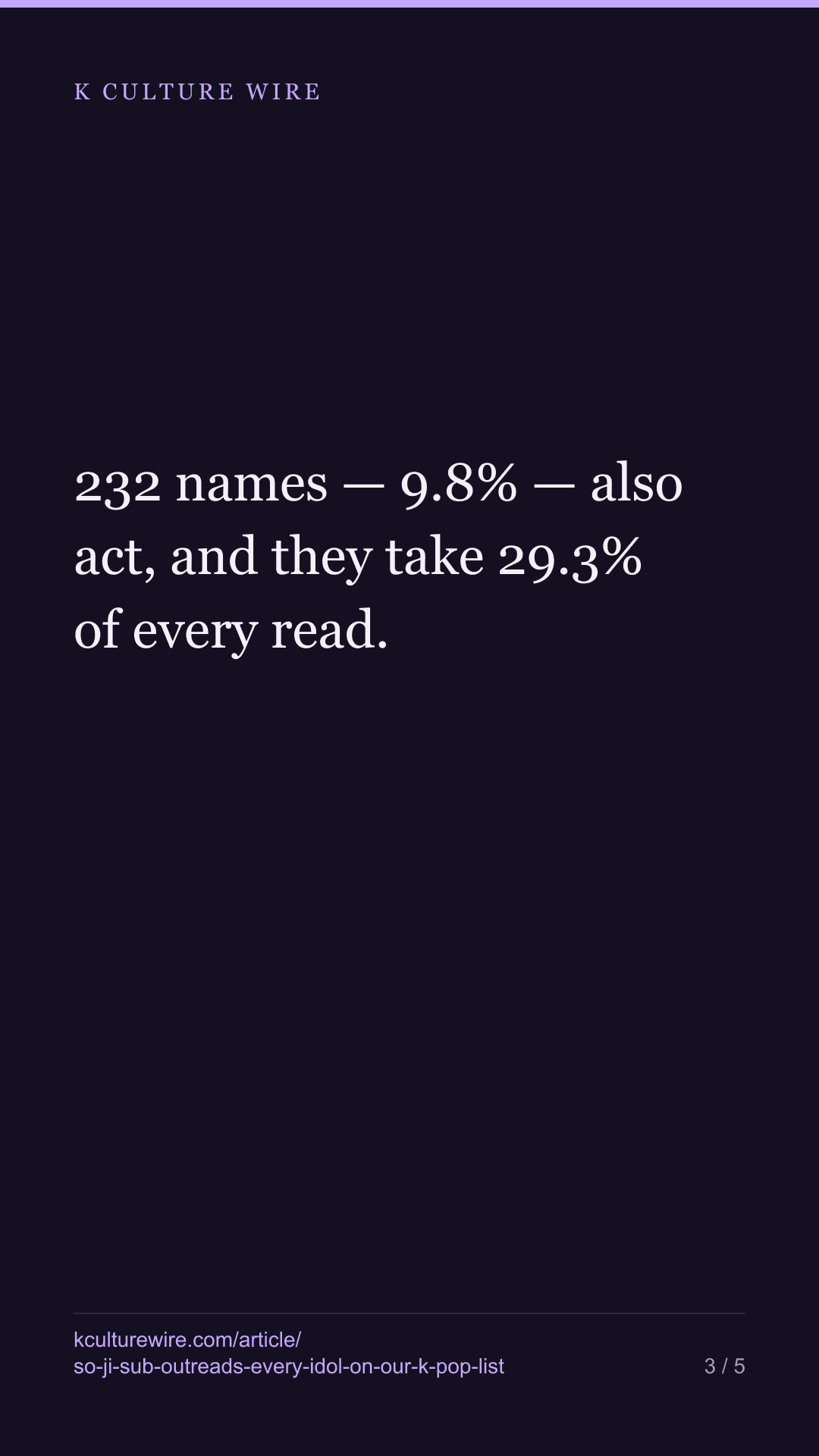
We built a K-pop readership panel from Wikidata: 2,372 Korean acts with a music occupation. The single most-read person on it is an actor. 232 names — 9.8% — also act, and they take 29.3% of every read.
The table this is written from: /kpop-attention
Ask who the most-read Korean music figure is and the honest answer, on our own numbers, is awkward: So Ji-sub, with 156,817 article opens in thirty days. That is more than Jennie (119,891), more than V (118,449), more than Jung Kook (103,735).
So Ji-sub is known to most people as an actor.
He is on the list for a reason, and the reason is the problem
Our K-pop panel is not hand-picked. It is everybody Wikidata records as a Korean citizen with an occupation of singer, rapper, composer or musician — 2,372 names in all. So Ji-sub is in it because that field records a music occupation for him. We did not add him, and we are not going to quietly remove him: the moment we start deciding by hand who counts as K-pop, the number stops being a measurement and starts being an opinion.
But leaving him in has a consequence worth putting a number on.
9.8% of the names, 29.3% of the attention
| Names | Share of names | Share of reads | |
|---|---|---|---|
| Also recorded as actors | 232 | 9.8% | 29.3% |
| Music occupations only | 2,140 | 90.2% | 70.7% |
Nearly a third of everything read on a K-pop list is being read about people who also act, and they are one name in ten. Four of the ten most-read individuals — So Ji-sub, Steven Yeun, Jisoo, Cha Eun-woo — carry an acting credit in the same record.
So what is a “most-read K-pop star” ranking measuring?
Three answers, and we are not choosing between them for you.
- It is measuring exactly what it says. These people are recorded as musicians. If a drama sends people to an idol’s page, the idol was still looked up.
- It is measuring drama, wearing a music label. A quarter of the attention arrives through work that is not music, and the ranking never says so.
- The question is broken. In Korean entertainment the categories genuinely overlap — the same person releases an album and carries a series — and any list that forces one label will misdescribe somebody.
Our own reading is the third, which is why this page exists at all. But the first two are defensible and we have no measurement that settles it.
What we did about it
We publish the overlap figure beside the ranking rather than hiding it, and we keep a music-occupation-only list next to the full one so both are visible. A ranking that cannot show you what it swept in is not a ranking you should trust — including ours.
The tables, both versions, are at which K-pop names are looked up most.
So: should a K-pop chart count So Ji-sub? Leave him in and the list is honest about the record but misleading about the genre. Take him out and somebody is deciding by hand who is really an idol. We would rather show you both lists than make that call in private.
Where these numbers come from
Sources
- Wikidata — P27=Q884 (Korean citizenship) with occupation singer/rapper/composer/musician; groups via P31/P279* from Q215380 with P495=Q884 — CC0 · https://www.wikidata.org/
- Wikimedia — Pageviews API — en.wikipedia, all-access, user traffic, 2026-07-24 to 2026-08-22 · https://wikimedia.org/api/rest_v1/
What we checked
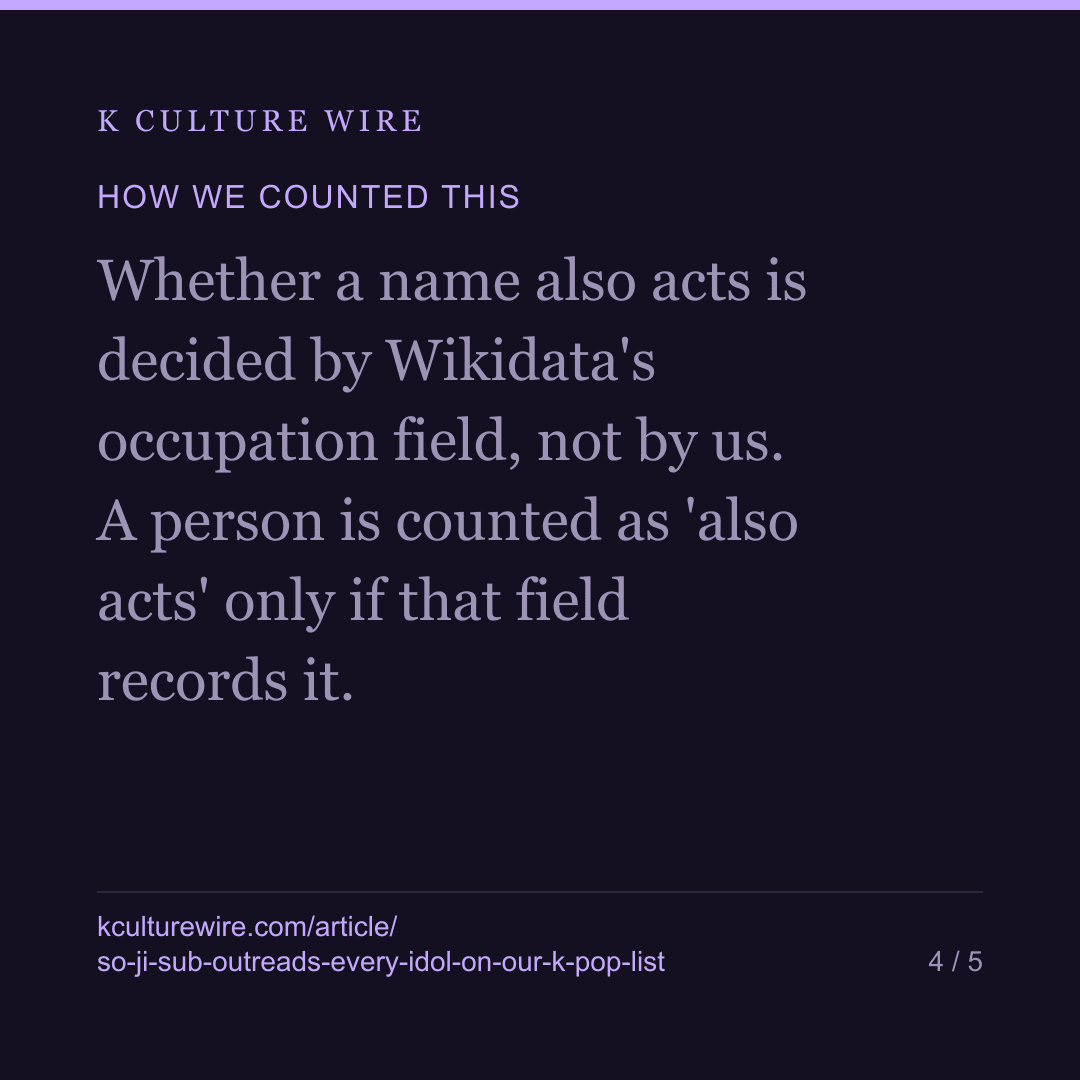
- Whether a name also acts is decided by Wikidata's occupation field, not by us. A person is counted as 'also acts' only if that field records it.
- Every name in the panel is there because Wikidata records a music occupation for them. So Ji-sub is in the panel for that reason and no other — we did not add or remove anybody by hand.
What we left out, and why
- Any judgement about who is or is not a K-pop artist. We report what the record says and what the reads were.
- Popularity. An article open is one person opening one encyclopaedia page, not a fan, a listener or a ticket.
- Korean-language reading. This counts the English Wikipedia only, so it is not a measure of interest inside Korea.
The data behind this
Written from the same data
Take this away — 10 cards
The figures in this article, as images. Free to repost with the address on them.





If you work in this business
Everything on this page is measured from the same weekly Netflix lists, per market and per title. We publish the pages free; what we sell is the same measurement cut to one company's catalogue — including the figures behind /kpop-attention.
What a company sheet contains, and what it cannot tell you →