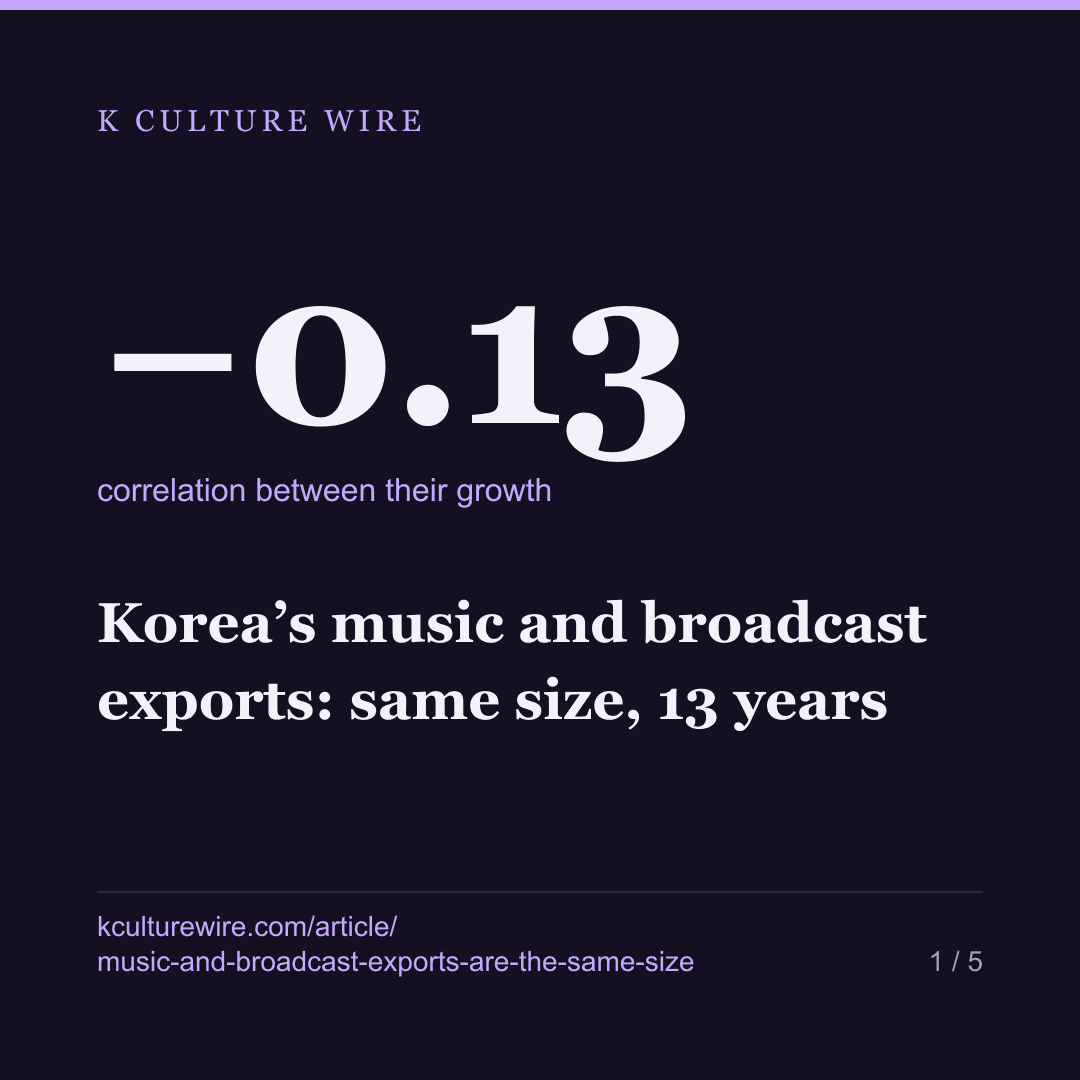
Korea’s music and broadcast exports: same size, 13 years
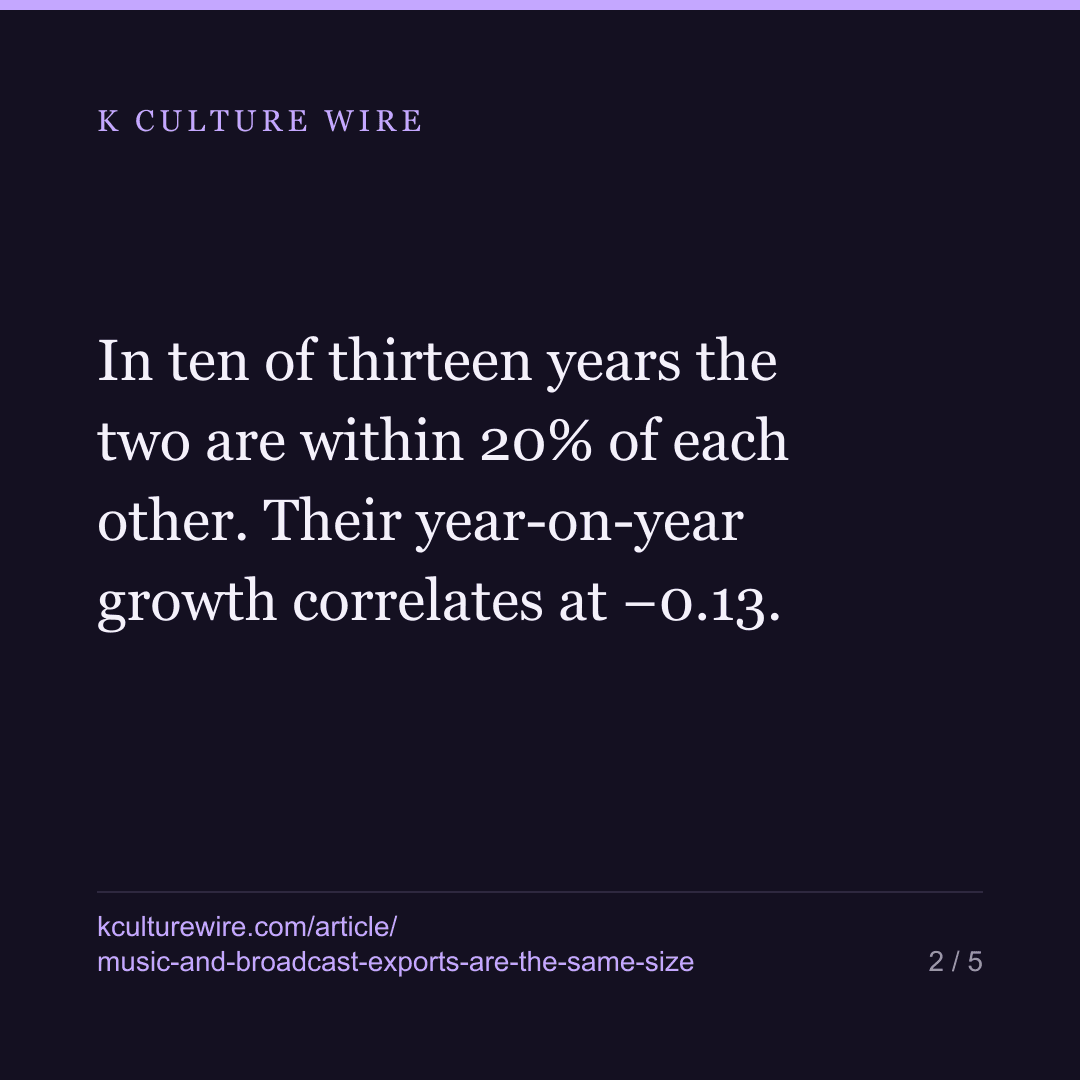
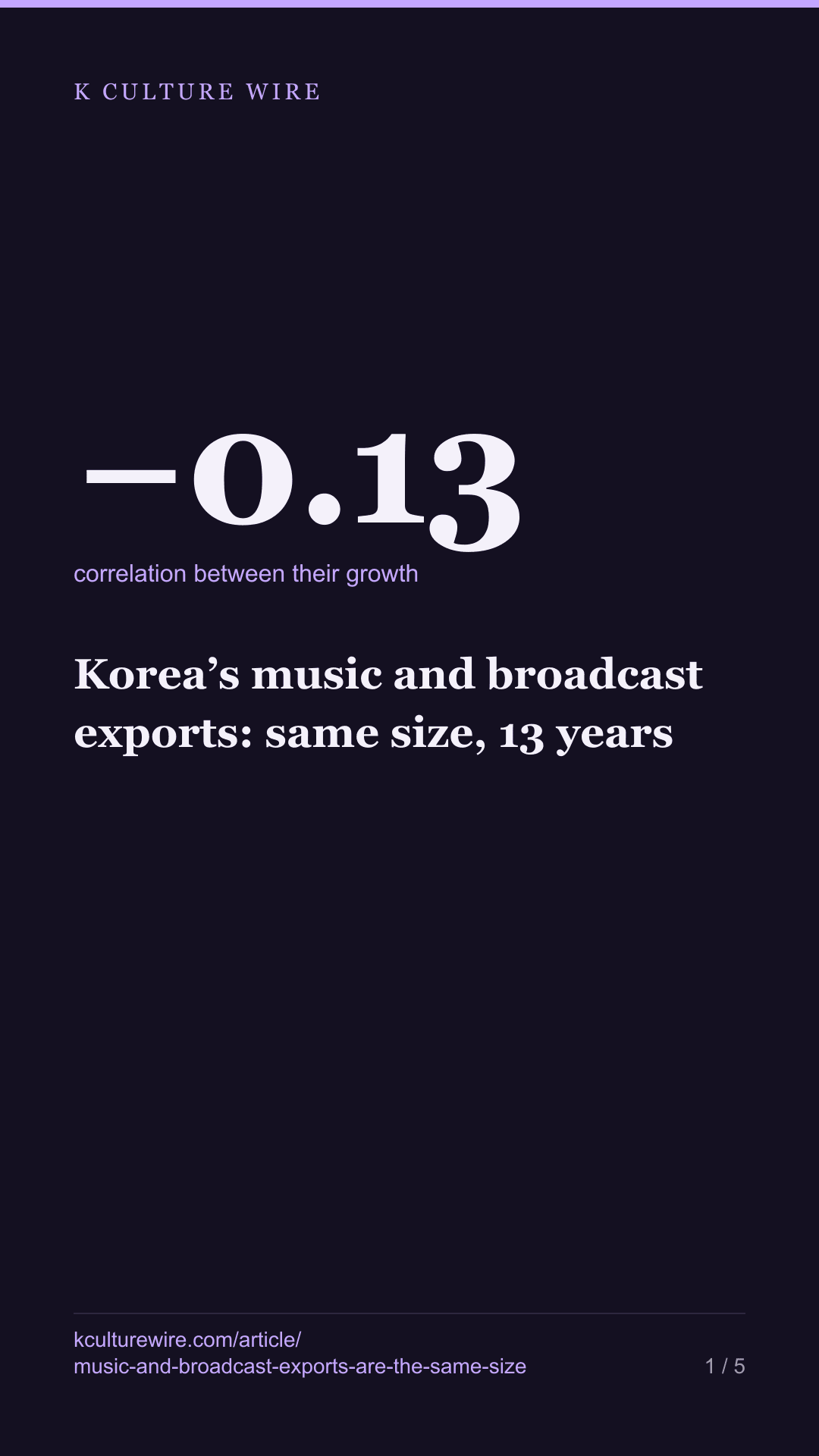
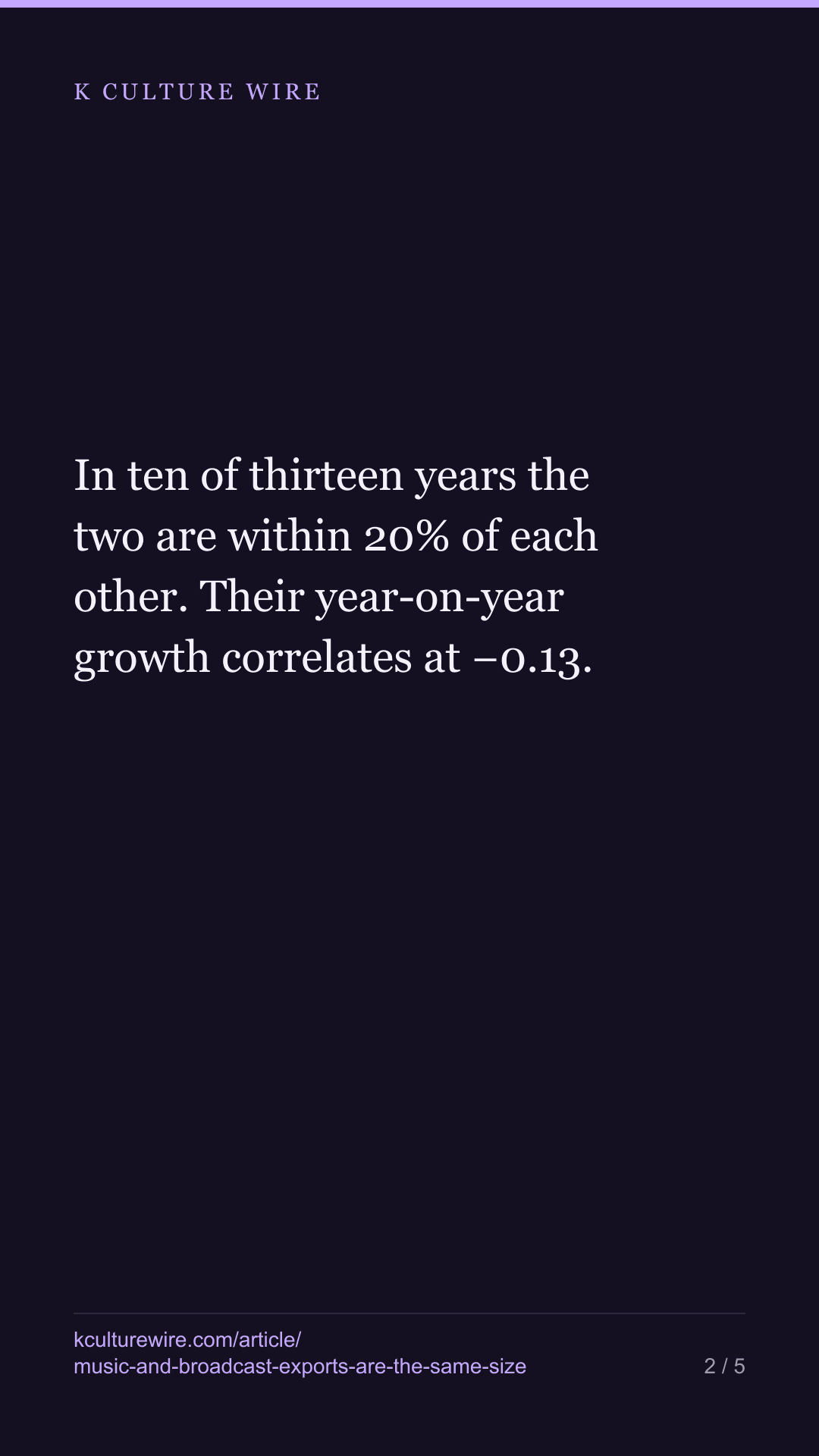
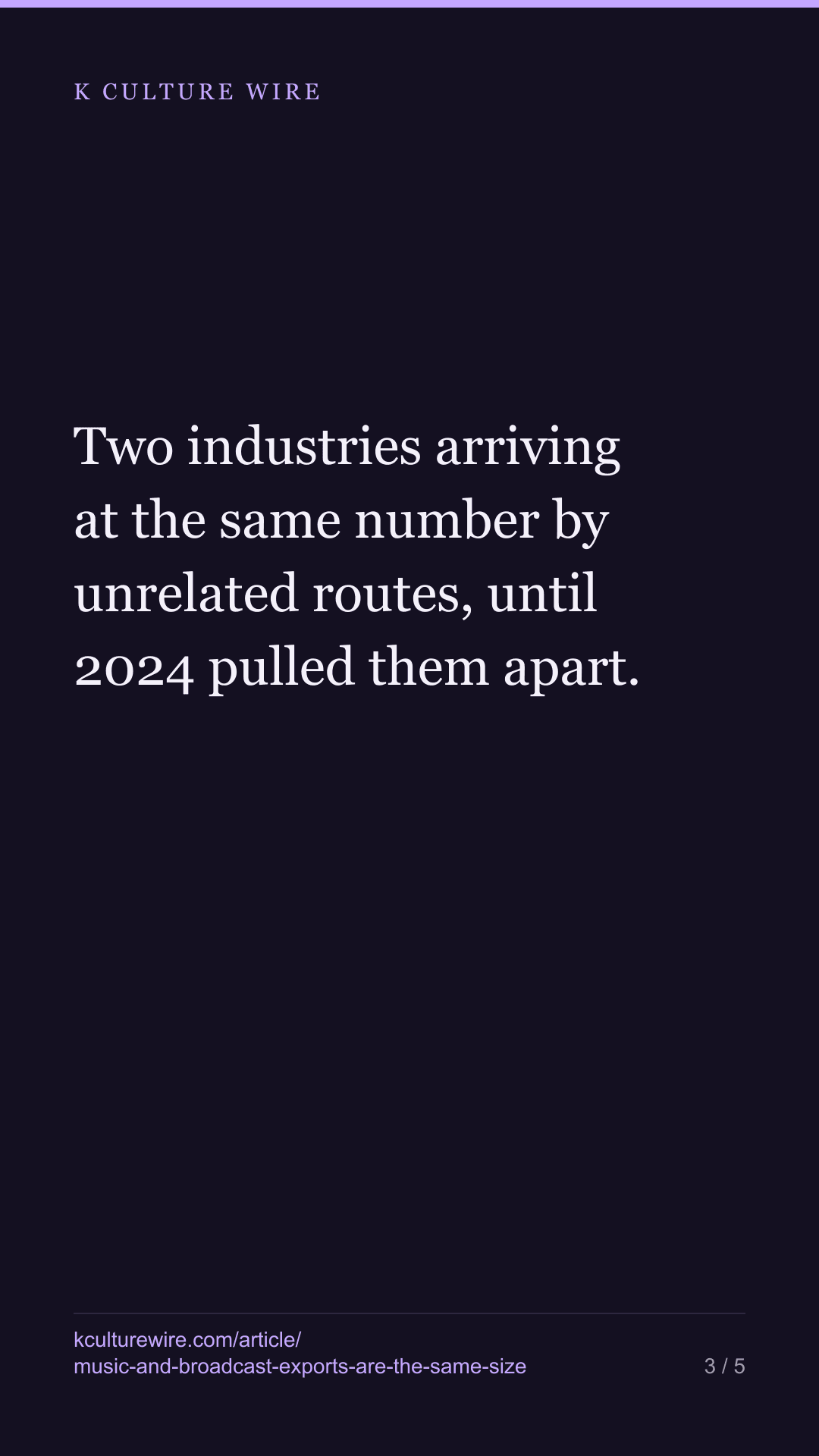
In ten of thirteen years the two are within 20% of each other. Their year-on-year growth correlates at −0.13. Two industries arriving at the same number by unrelated routes, until 2024 pulled them apart.
The table this is written from: /exports
Korea exports music and Korea exports television. They are usually discussed as one thing — the Korean wave, one export story with two faces. The survey that measures both has thirteen years where the series overlap, and it says something more specific.
They are almost exactly the same size, and they have been the whole time.
| Year | Broadcast | Music | Music ÷ Broadcast |
|---|---|---|---|
| 2012 | $233.8m | $235.1m | 1.01 |
| 2015 | $320.4m | $381.0m | 1.19 |
| 2018 | $478.4m | $564.2m | 1.18 |
| 2021 | $718.0m | $775.3m | 1.08 |
| 2024 | $1,257.2m | $1,801.4m | 1.43 |
In ten of the thirteen years the two are within 20% of each other. The ratio has been above 1 in nine years and below in four, and until recently it never left the band.
They arrive at the same number by different routes
That is the part that is easy to miss. Being the same size year after year looks like one force driving both. Their growth rates say the opposite.
Year-on-year growth in the two series correlates at r = −0.13. That is not a relationship. In three of twelve years they moved in opposite directions outright — most sharply in 2020, when broadcast exports grew 28.5% and music exports fell 10.1%.
| Year | Broadcast growth | Music growth |
|---|---|---|
| 2017 | −11.9% | +15.8% |
| 2019 | +12.7% | +34.0% |
| 2020 | +28.5% | −10.1% |
| 2023 | +10.5% | +31.8% |
| 2024 | +20.0% | +47.4% |
2020 is the clearest case. Touring stopped and music export growth went negative; broadcast content had its best year of the decade. Two industries, one shock, opposite signs — which is what you would expect from a business built on physical gatherings sitting beside one built on licensing files.
2024 is the first real divergence
The ratio reached 1.43 in 2024, the widest in the series, on music growing 47.4% against broadcast’s 20.0%. That is one year. The band held for twelve before it, and one year outside a band is not a break in it — it is one year outside a band.
We will know in eighteen months, which is how far behind this survey runs.
What this is useful for and what it is not
Useful: if you are sizing Korean content exports and you have one of these two numbers, the other one is close. That has been reliable for over a decade and it is a genuinely handy fact.
Not useful: predicting one from the other’s direction. They have been the same size and unrelated in motion at the same time, which is a strange combination and the reason we would rather print both series than a single “Korean wave export” figure.
And this is two categories, not the whole industry. Games are larger than both and games are not in this comparison. We picked these two because they are the pair most often treated as one story; the survey does not treat them as one, and neither should a forecast.
Same size, unrelated motion. The viewing figures tell a third story again. Read exports grew, viewing did not →
Where these numbers come from
Sources
- Korea Creative Content Agency — Content Industry Survey (콘텐츠산업조사), music export value by region and broadcast export value by type of exporter, reference years 2012–2024, via KOSIS · https://kosis.kr
What we checked
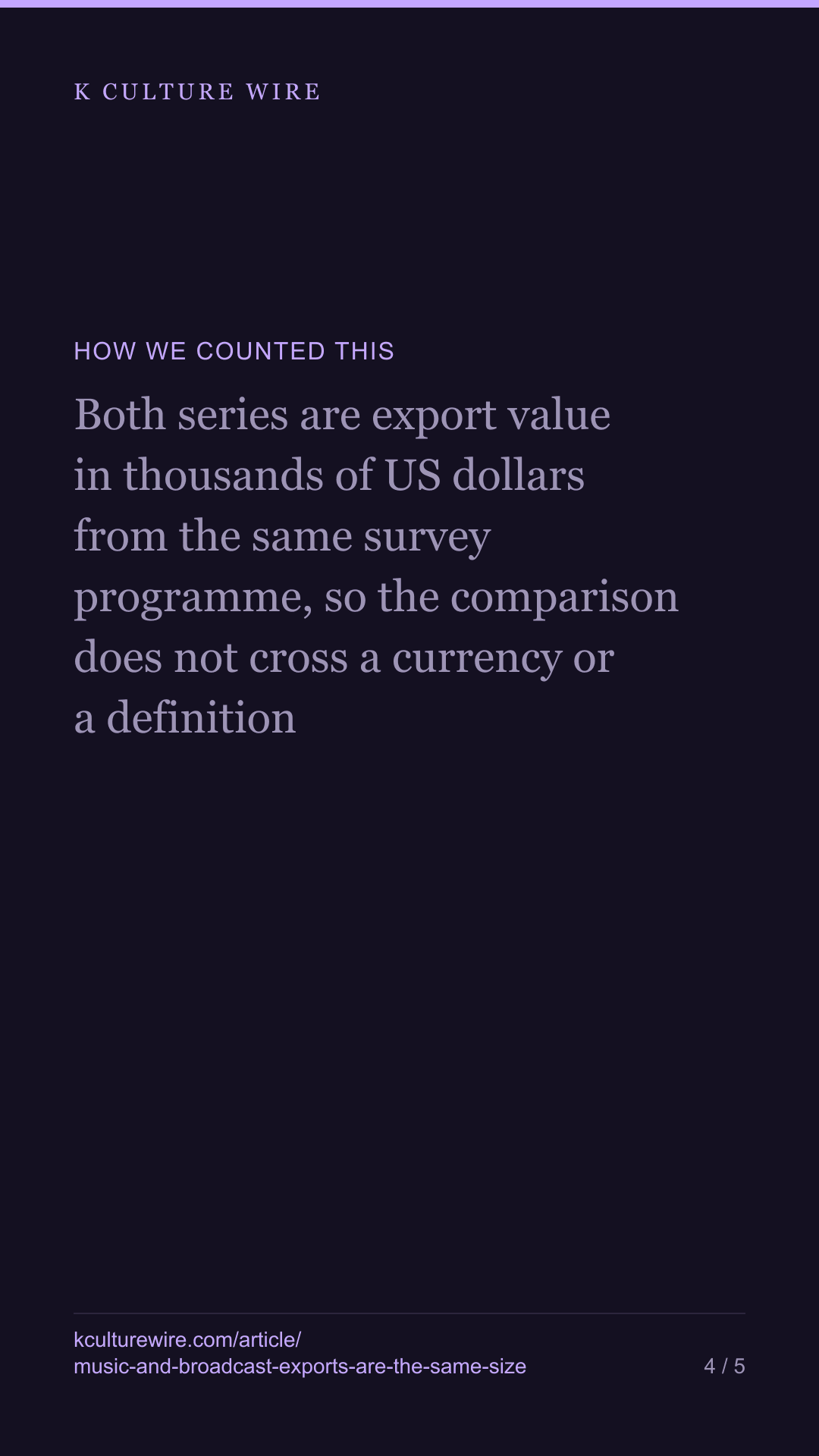
- Both series are export value in thousands of US dollars from the same survey programme, so the comparison does not cross a currency or a definition
- The overlap is thirteen years, 2012 to 2024. The music series runs longer but we compare only the years both cover
- Growth rates are computed from the published totals rather than from the regional or exporter breakdowns, so a revision inside one category cannot move them
What we left out, and why
- 2025 and 2026. The survey runs about eighteen months behind and those years are not published
- Any claim that one industry causes the other. Correlation is the whole point here and it is close to zero
- Film, games, webtoons and publishing. This is two of the survey's categories, chosen because they are the two most often described as the same phenomenon
The data behind this
Written from the same data
Take this away — 10 cards
The figures in this article, as images. Free to repost with the address on them.
If you work in this business
Everything on this page is measured from the same weekly Netflix lists, per market and per title. We publish the pages free; what we sell is the same measurement cut to one company's catalogue — including the figures behind /exports and /tv-exports.
What a company sheet contains, and what it cannot tell you →