Titles · drama
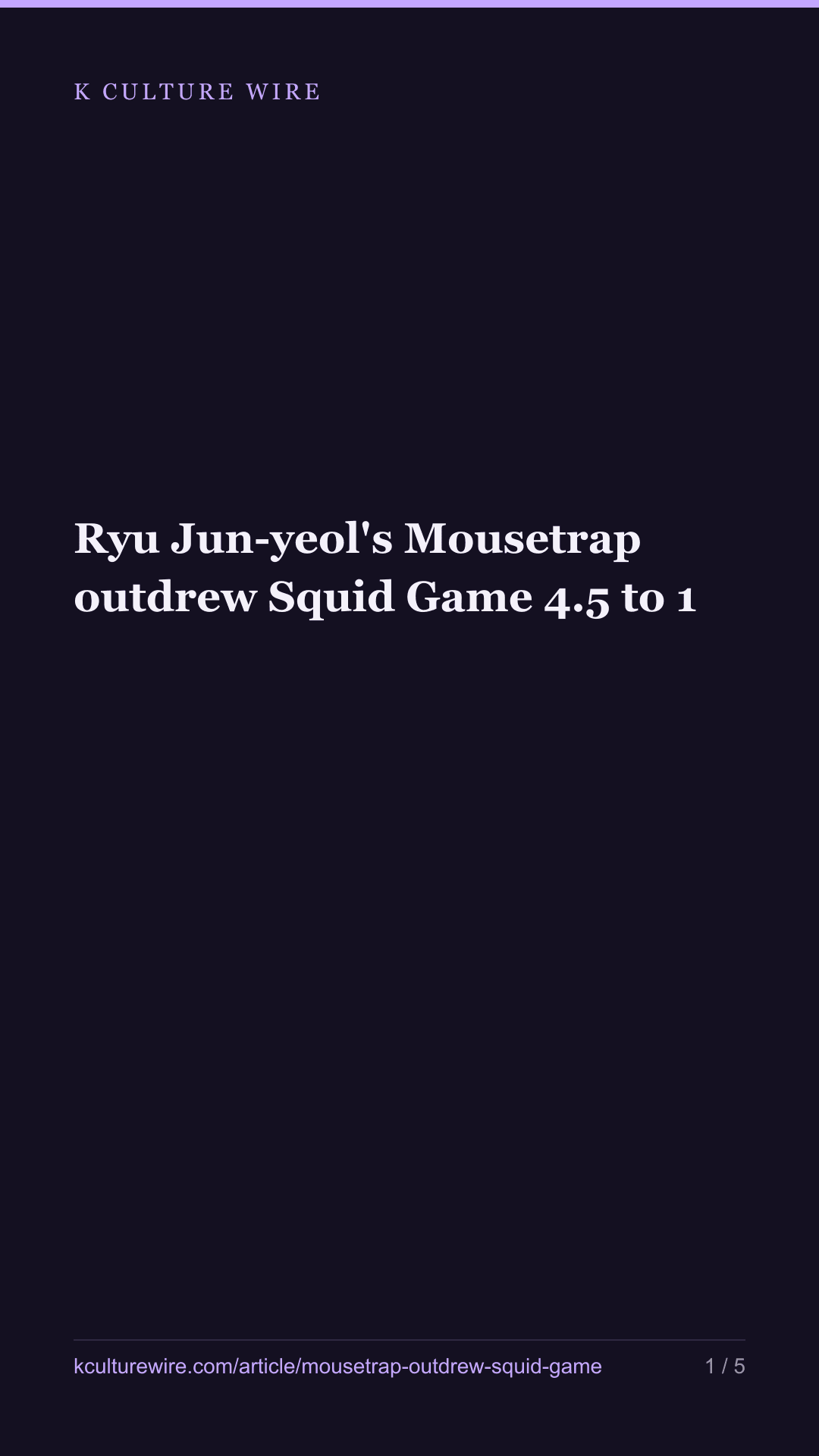
Ryu Jun-yeol's Mousetrap outdrew Squid Game 4.5 to 1
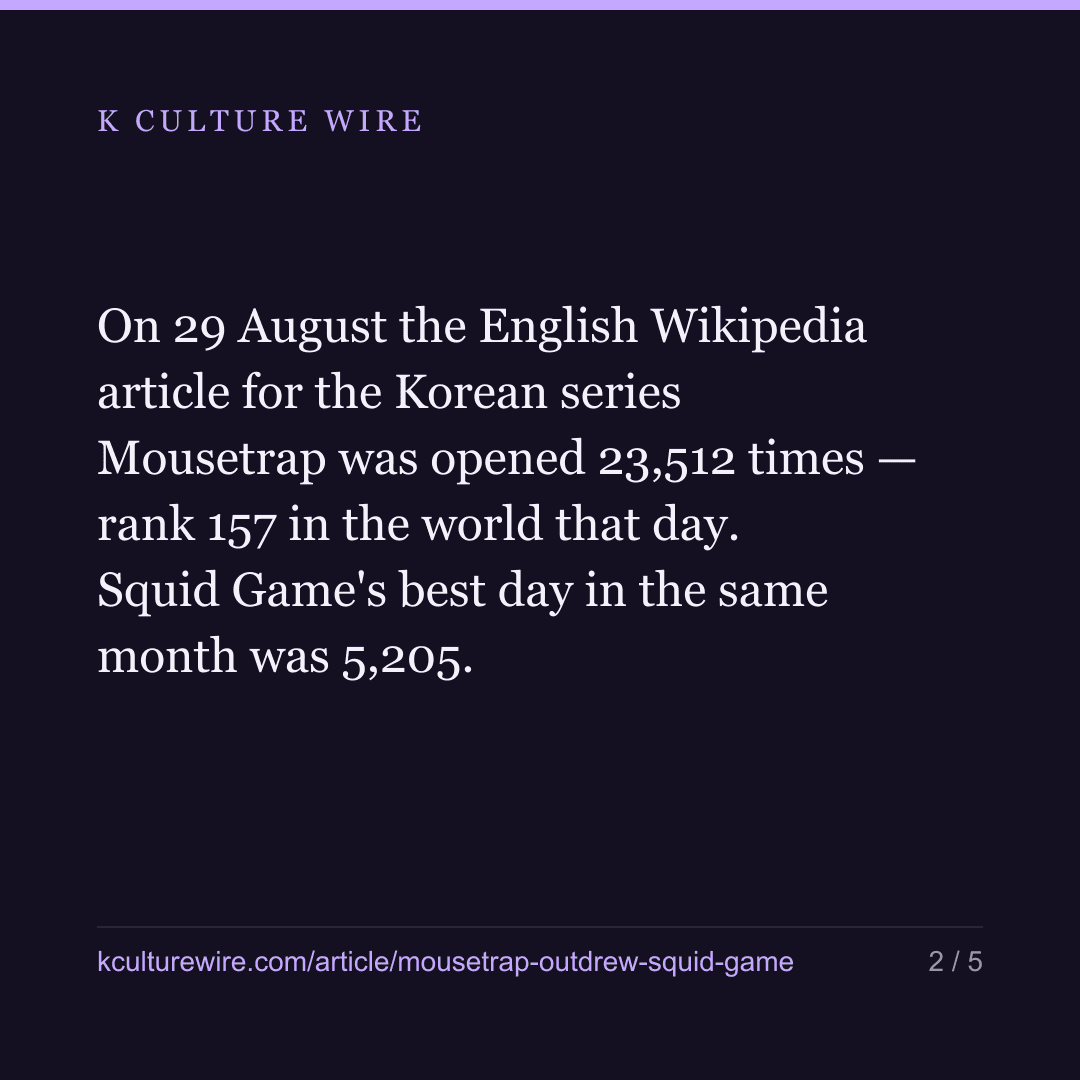
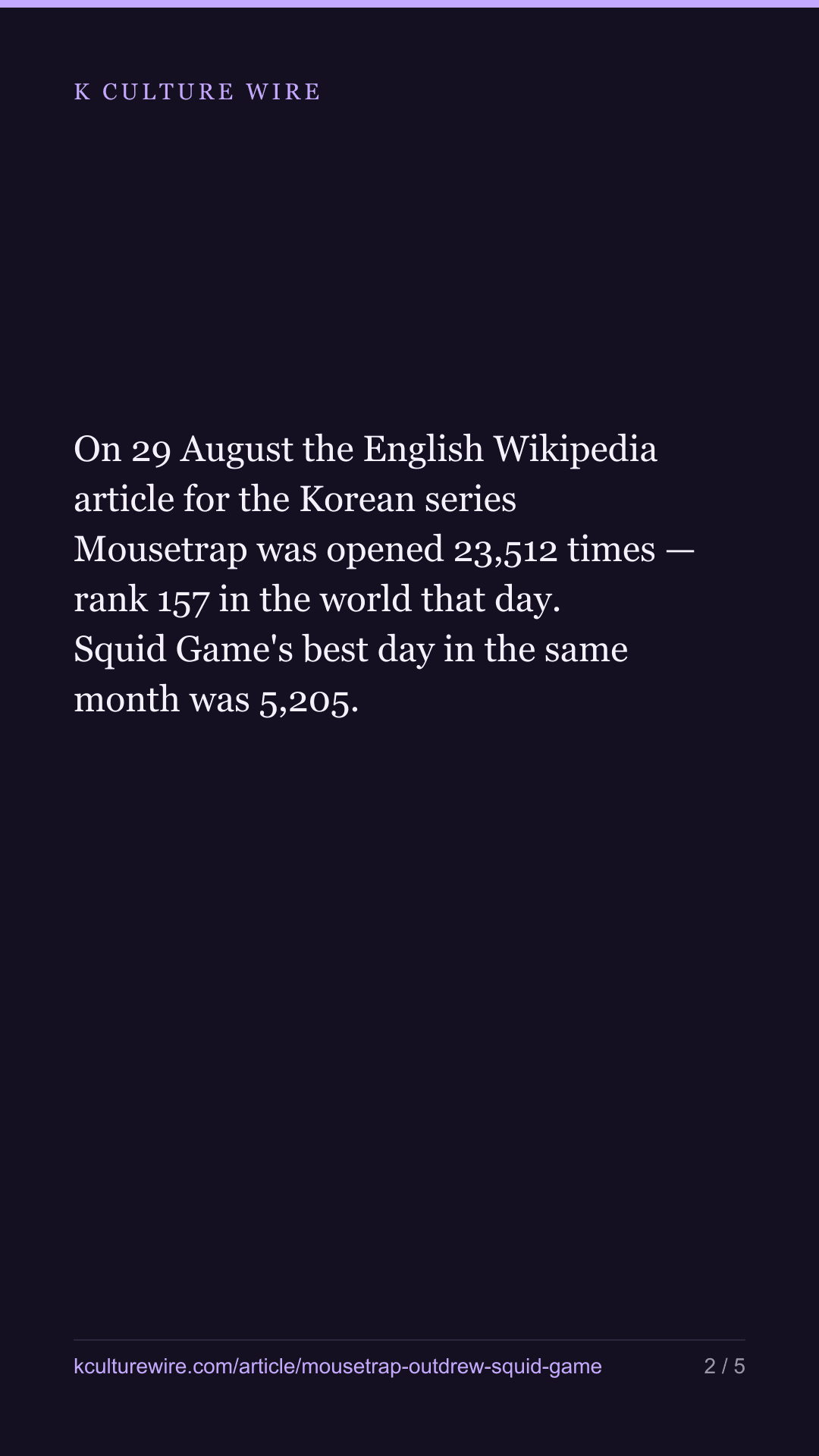
On 29 August the English Wikipedia article for the Korean series Mousetrap was opened 23,512 times — rank 157 in the world that day. Squid Game's best day in the same month was 5,205. Two days earlier Mousetrap drew 658.
The table this is written from: /most-read
On 29 August 2026, the English Wikipedia article for Mousetrap (들쥐) — the Korean series with Sul Kyung-gu, Ryu Jun-yeol and Lee Kyu-hyung — was opened 23,512 times.
That put it at rank 157 of every article on English Wikipedia that day, out of roughly six million.
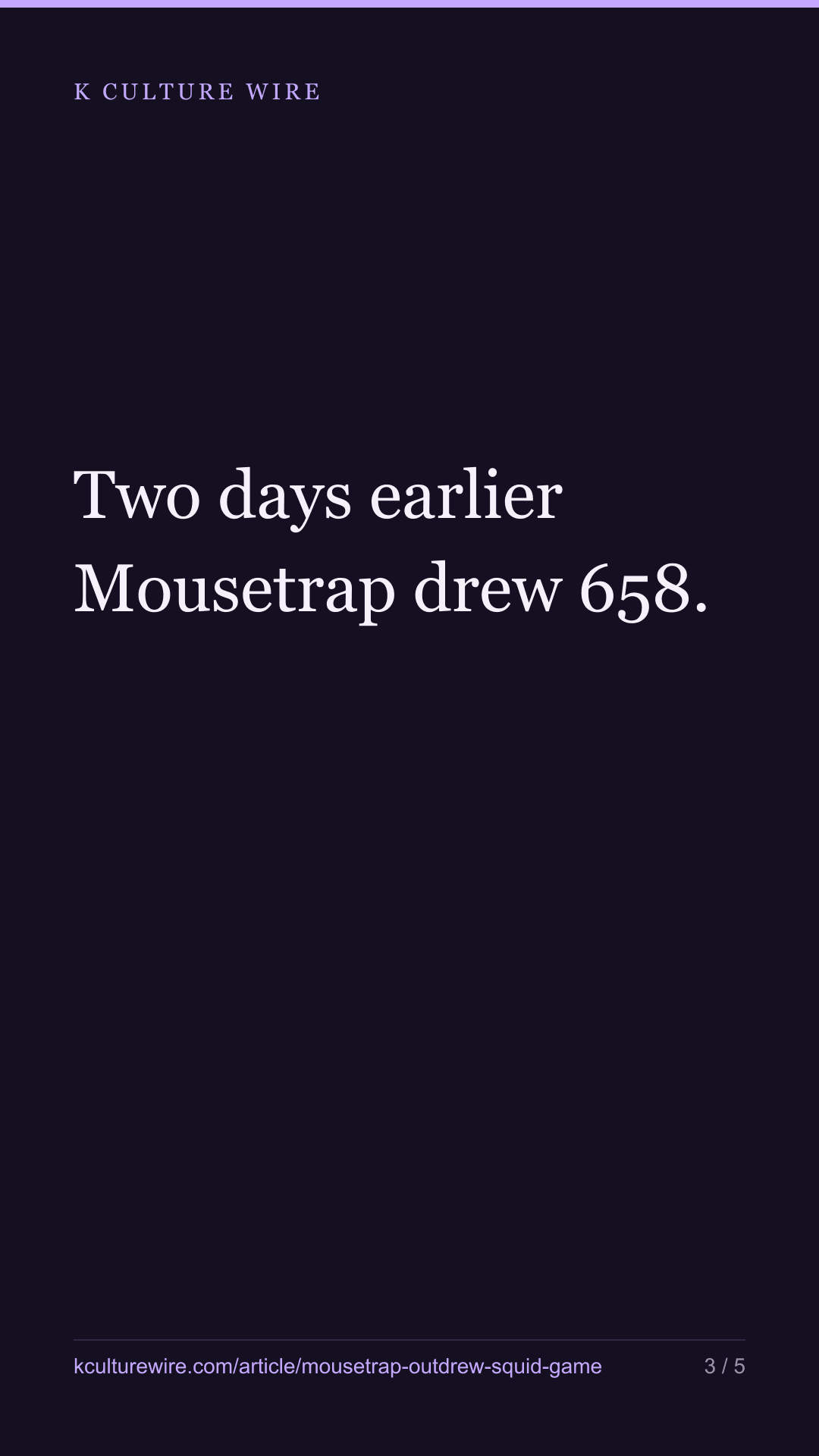
Two days earlier it had been opened 658 times.
The two days
| Date | Reads | Change |
|---|---|---|
| 26 Aug | 522 | — |
| 27 Aug | 658 | ×1.3 |
| 28 Aug | 13,190 | ×20.0 |
| 29 Aug | 23,512 | ×1.8 · world rank 157 |
| 30 Aug | 21,033 | ×0.9 · world rank 186 |
Thirty-six times its Wednesday, by Friday.
Against the benchmark everyone uses
Squid Game is still the reference point for how big a Korean title can get. Over the same thirty days, its English Wikipedia article was opened 82,425 times in total, and its single best day was 5,205.
One day of Mousetrap was 4.5 times Squid Game’s best day of the month.
That is not a claim that Mousetrap is bigger than Squid Game. A seven-year-old show sits at a settled baseline; a new one is at its opening peak, and the peak always wins that comparison. What it does show is the size of the spike: a Korean series can still move a global encyclopedia by an order of magnitude in forty-eight hours.
It was not alone
Mousetrap was one of two Korean articles in the world’s thousand most-read on each of those days.
- 29 August — Mousetrap at #157 (23,512) and Hope, the 2026 Korean film, at #895 (8,610)
- 30 August — Mousetrap at #186 (21,033) and Four Hands, Two Sonatas (포핸즈) at #340 (15,420)
Four Hands, Two Sonatas ran the same pattern one day behind: 1,425 on 27 August, 15,420 on 30 August — ten times over in three days.
Two out of a thousand. Korean culture’s share of the world’s daily reading attention, on the days two Korean series were breaking out, was 0.2%. Both figures are true at once, and the second one is the part that rarely gets written down.
How this was counted, and what broke while we counted it
We took Wikimedia’s top-1,000 list for each day, resolved every ranked article to its Wikidata item, and asked whether that item’s country of origin or its subject’s citizenship is South Korea.
Our first pass got it wrong in both directions, and it is worth saying how. We resolved article titles with redirects turned on, which silently swapped the title we asked about for the title we landed on — so Mousetrap (TV series) came back attached to the ordinary English word Mousetrap, and checking that word told us the article was about a device for catching mice. It is: they are two different pages. The Korean series is at Mousetrap_(TV_series), and that is the page holding rank 157.
The lesson is narrow and we are keeping it: check the exact identifier the data gave you, never the name you would have typed. A hand-retyped title dropped a parenthesis and nearly lost us the whole story.
Where this fits
If you follow K-drama, Mousetrap breaking out is news you already have. What this page adds is the denominator — where it sits among everything the English-reading world looked up that day, and what the previous benchmark actually measures when you put the two side by side in the same month.
Nobody publishes that number, so we counted it.
The standing version of this measurement — the hundred most-read Korean names of the month — is on the most-read page, and what a chart position does and does not tell you is on the rank page.
Where these numbers come from
Sources
- Wikimedia — Pageviews top-1000 per day, en.wikipedia, all-access; and per-article daily series, user agents only · https://wikimedia.org/api/rest_v1/
- Wikidata — Country of origin and citizenship for every article in the daily top 1,000, resolved by page identifier · https://query.wikidata.org/
What we checked
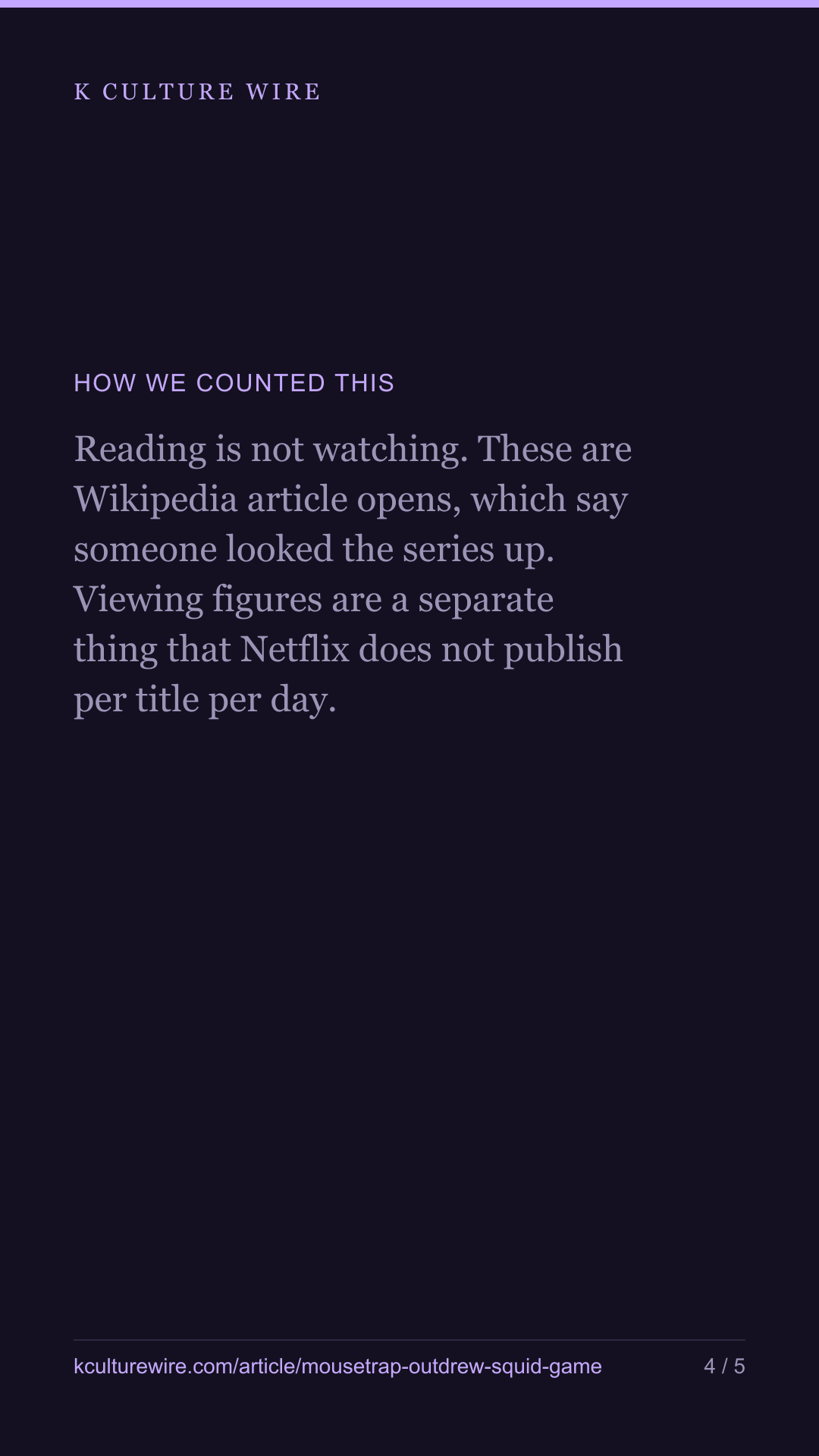
- Reading is not watching. These are Wikipedia article opens, which say someone looked the series up. Viewing figures are a separate thing that Netflix does not publish per title per day.
- We resolved every one of the ~990 ranked articles to a Wikidata item and asked whether its country of origin or its subject's citizenship is South Korea. On 29 August 15 articles could not be resolved and on 30 August 17 could not — those are unmeasured, not zero, and a Korean title could be hiding in them.
- The comparison with Squid Game is inside one 30-day window, 2026-08-01 to 2026-08-30. Squid Game is seven years old and its readership long ago settled; a new series is at its opening peak. This compares one day to one day in the same month, not two shows over their lifetimes.
- Two most recent days are excluded because Wikimedia does not finalise them.
What we left out, and why
- Why the spike happened. Release dates, platform promotion and press coverage are not in this data, and we did not substitute a guess for them.
- Every Wikipedia edition except English. The Korean, Japanese and Chinese editions were not part of this count.
- Whether the readers are Korean or foreign. Wikimedia publishes per-country figures only in aggregate, not per article per country per day.
The data behind this
Written from the same data
Take this away — 10 cards
The figures in this article, as images. Free to repost with the address on them.
If you work in this business
Everything on this page is measured from the same weekly Netflix lists, per market and per title. We publish the pages free; what we sell is the same measurement cut to one company's catalogue — including the figures behind /most-read and /titles.
What a company sheet contains, and what it cannot tell you →