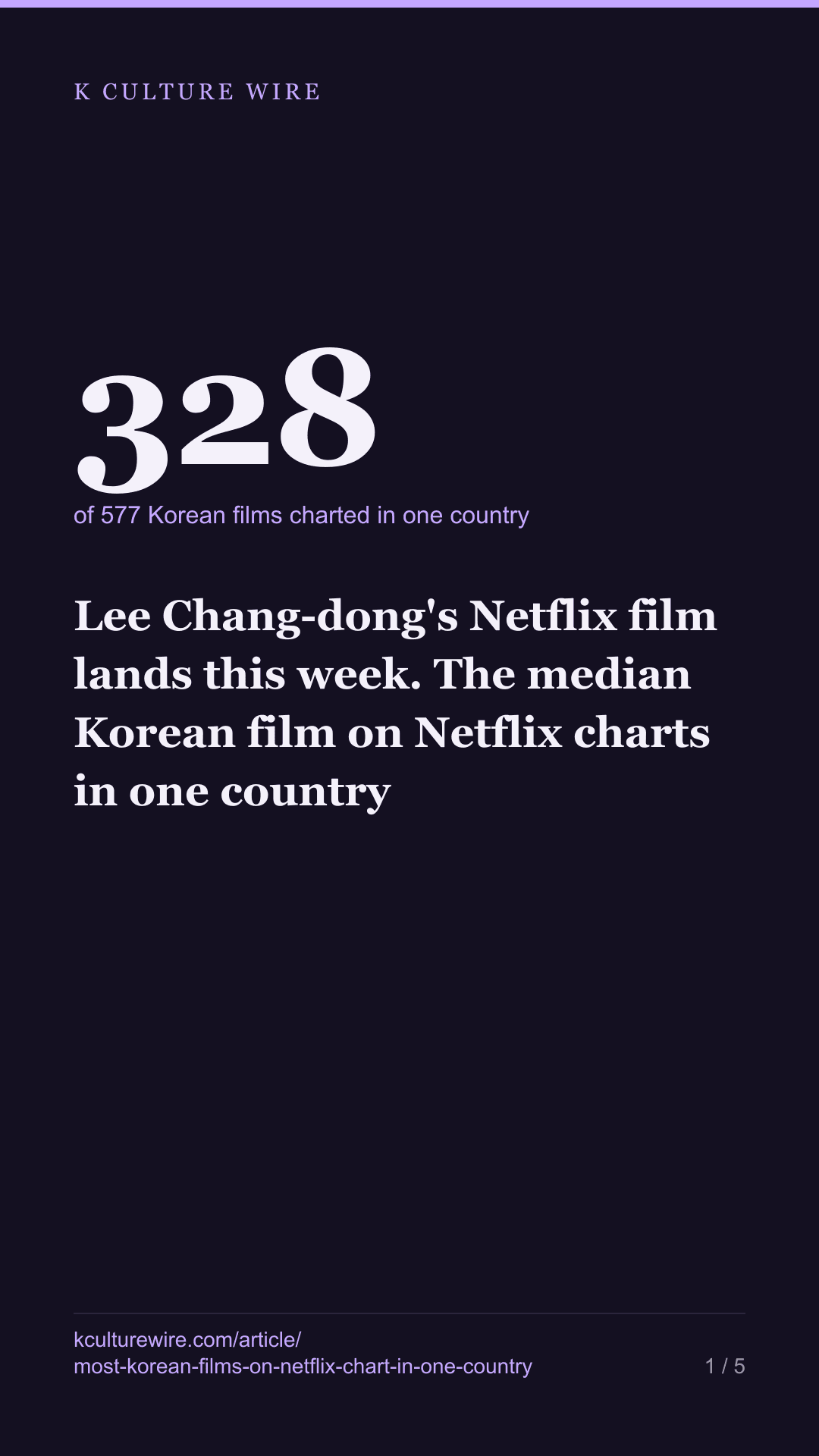
Lee Chang-dong's Netflix film lands this week. The median Korean film on Netflix charts in one country
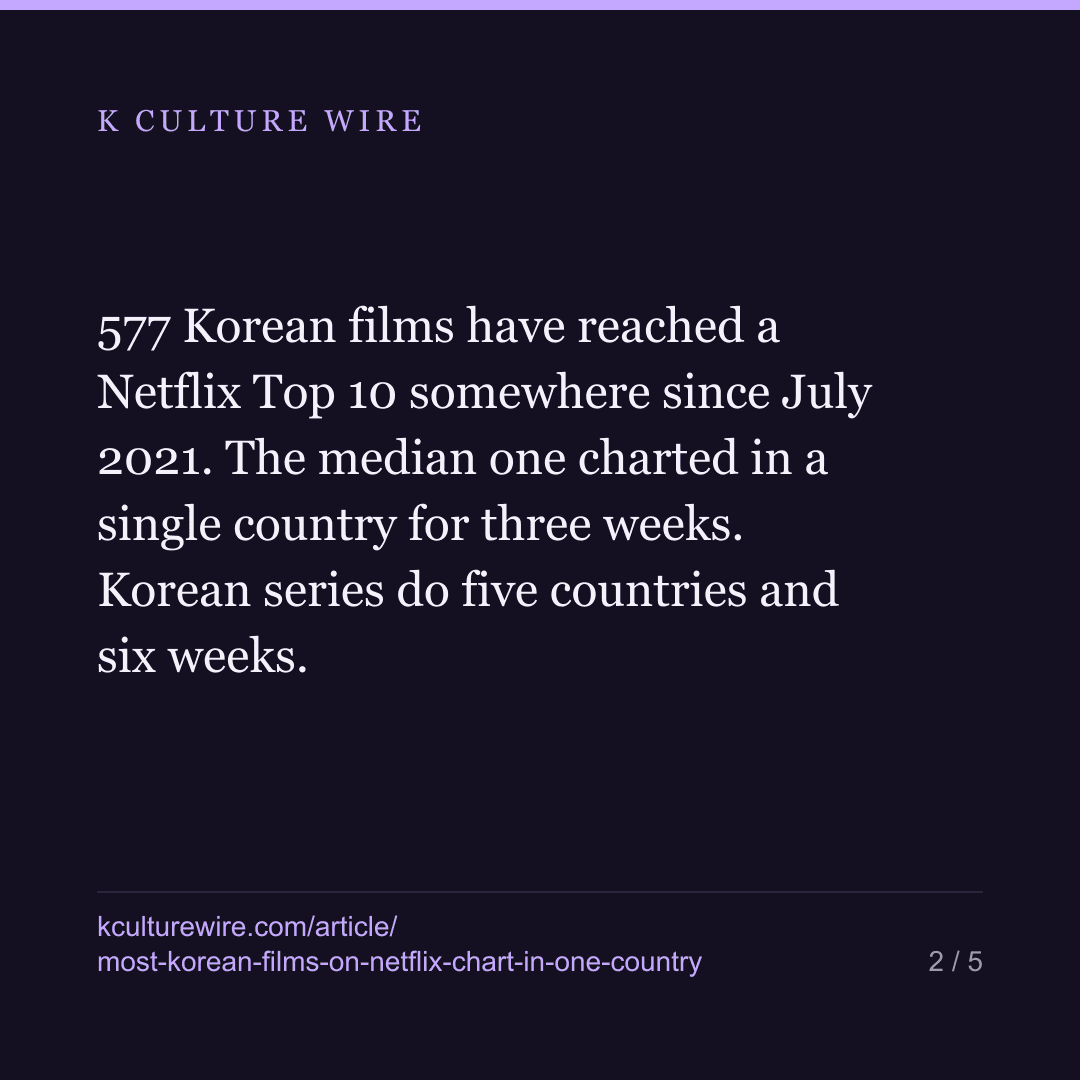
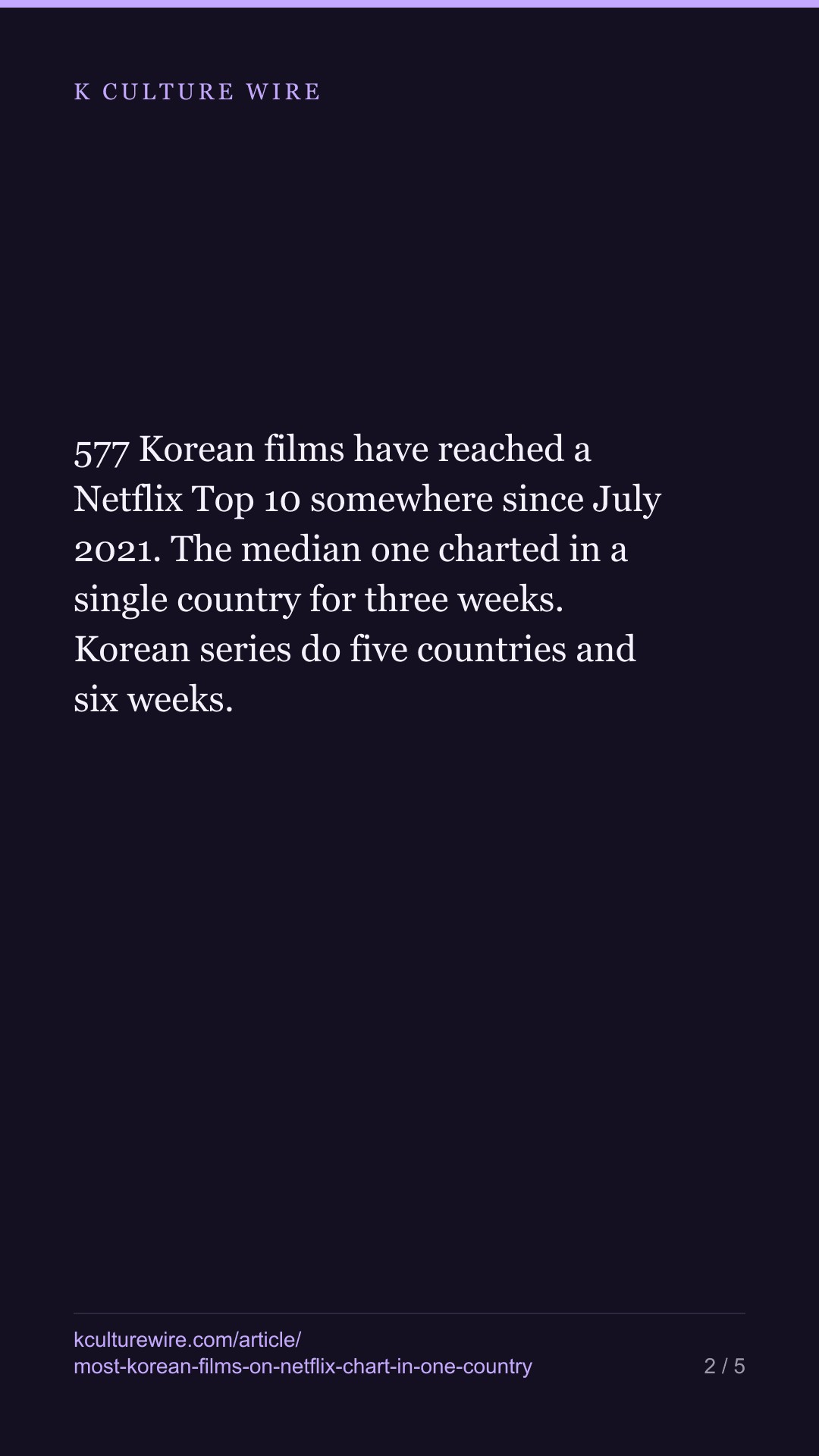
577 Korean films have reached a Netflix Top 10 somewhere since July 2021. The median one charted in a single country for three weeks. Korean series do five countries and six weeks. One film managed all 93 at once.
The table this is written from: /korean-movies-on-netflix
Reviews out of Venice this week put Lee Chang-dong’s Possible Love — his first feature in years, running close to three hours, made for Netflix — in front of an international audience before most people have had a chance to watch it. It is a good week to ask what usually happens to a Korean film on that service.
The answer is narrower than the headlines about Korean cinema suggest.
The median Korean film on Netflix charts in exactly one country
Between July 2021 and August 2026, across 93 national Top 10 charts:
| Korean films | Korean series | |
|---|---|---|
| Titles that charted anywhere | 577 | 396 |
| Median countries reached | 1 | 5 |
| Median weeks on a chart | 3 | 6 |
| Median chart places held | 3 | 15 |
| Charted in exactly one country | 328 | 119 |
| Charted for exactly one week | 118 | 37 |
| Reached number one somewhere | 155 | 149 |
328 of the 577 films — 57% — never appeared outside a single country’s chart. For series the same figure is 30%.
More Korean films chart than Korean series, and they travel far less far. That is not a contradiction: a film is a cheap thing to add to a catalogue in one market, and a great many Korean films are added that way.
Why these numbers are lower than the ones we published in August
We wrote in August that the median Korean series charted in 35 countries and the median film in 11. Those figures came from a deliberately narrow set: the 232 titles that had appeared in a Netflix global Top 10 at least once, because the global list carries a language label and the label is what proves a title is the Korean work rather than a foreign one with the same name.
That door only admits titles that already travelled. This piece uses the wider set — titles identified by Wikidata item number, whether or not they ever reached a global chart — and the medians fall accordingly. Both numbers are correct about their own set. The August piece answers how far do the Korean titles that travel get? This one answers what happens to a Korean film on Netflix, taken as a whole?
We are keeping both, with the doors named, rather than quietly replacing one with the other.
The ceiling, when a film hits it, is the whole map
| Film | Countries | At once | Weeks | Chart places | Run |
|---|---|---|---|---|---|
| The Great Flood | 93 | 93 | 11 | 351 | 2025-12-21 → 2026-03-15 |
| Carter | 92 | 92 | 5 | 201 | 2022-08-07 → 2022-09-04 |
| Desire | 90 | 90 | 5 | 247 | 2026-07-19 → 2026-08-16 |
The Great Flood charted in all 93 markets in the same week, and held 351 country-weeks in total. That is what the top of this distribution looks like — not a slow build across territories but everything, everywhere, immediately, and then eleven weeks.
Length is a separate thing from width. Tarot charted for 34 weeks, the longest run of any Korean film here, but reached only 54 countries and never more than 10 at once. It stayed on shelves rather than sweeping them.
What this says about a prestige release
A festival premiere buys the one thing the median Korean film on Netflix does not have: attention in several countries at the same time. Whether it converts into a wide chart run is a different question, and one we can only answer afterwards — so we will not guess it now.
What we can say is that attention of this kind is short. We measured 774 Korean musical acts and found the median one loses half of its peak Wikipedia readership within two months; for 26 Korean titles measured the same way, the answer was also two months. Comics are the exception — a Korean webtoon is read 14 times more once a drama exists — because an adaptation builds an audience rather than spending one.
Method
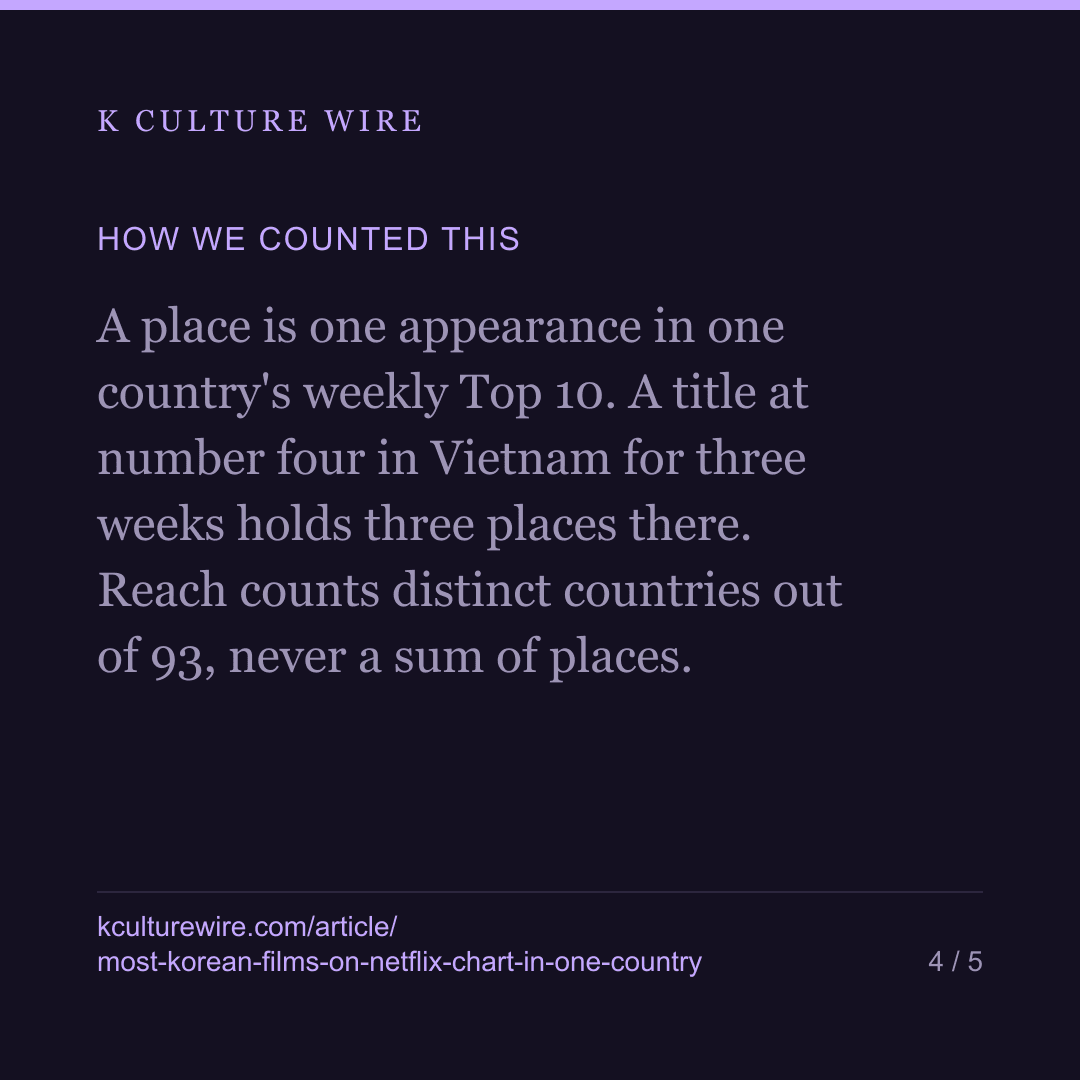
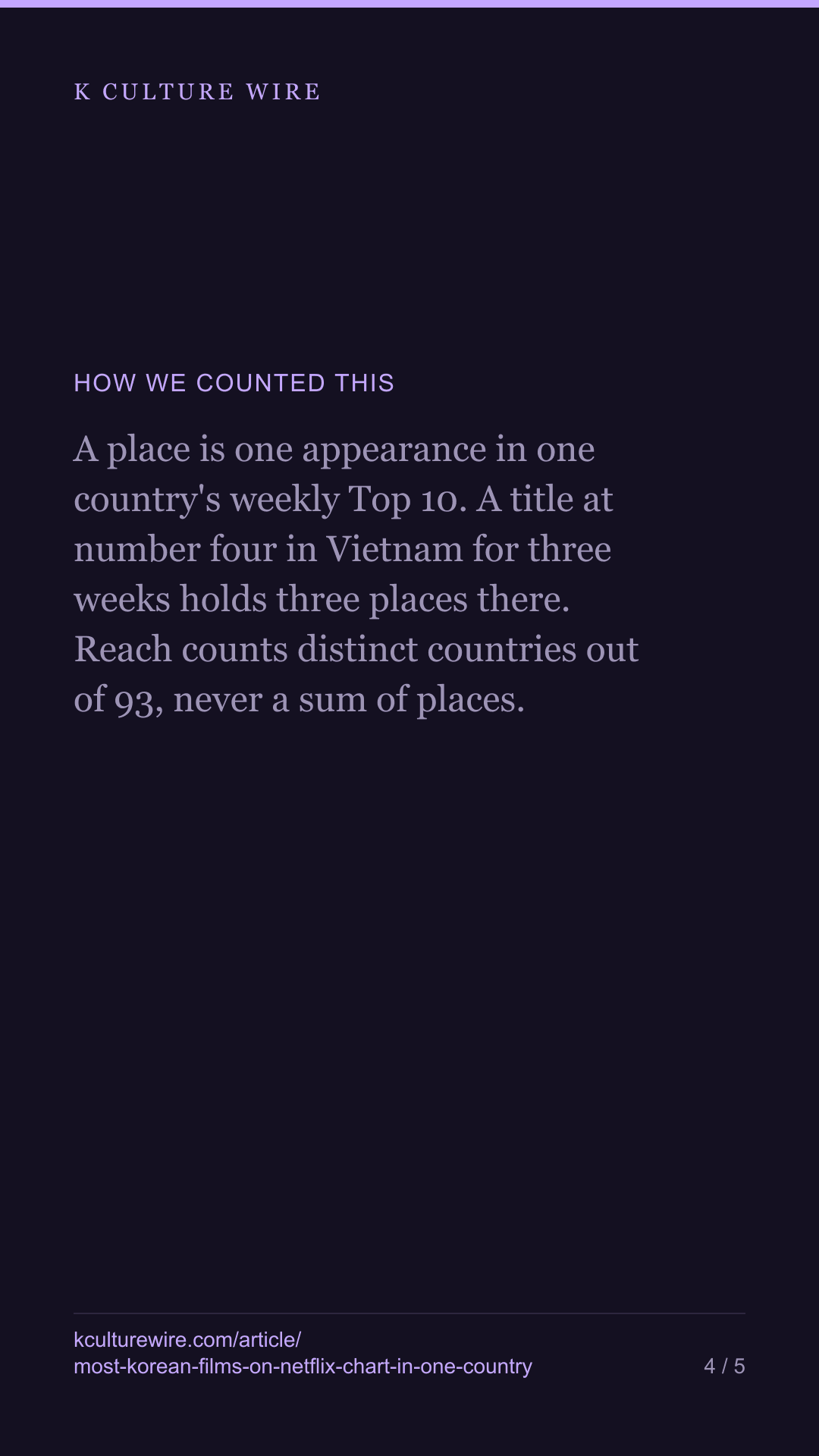
Every chart place here was read from Netflix’s published weekly Top 10 tables for individual countries, 93 markets, from the week of 2021-07-04 to the week of 2026-08-16. Korean titles were identified through Wikidata by item number — the companies credited on a title and cast members recorded as Korean citizens — never by matching names. A place is one appearance in one country’s weekly chart; reach is the count of distinct countries, and we never add places across countries and call the total a reach. Whether a film opened in cinemas first is not in these rows, so films of both kinds sit in the same table.
Where these numbers come from
Sources
- Netflix — Top 10 weekly country lists (Tudum), 93 markets, 2021-07-04 to 2026-08-16 · https://www.netflix.com/tudum/top10
- Wikidata — Companies credited on a title and cast members recorded as Korean citizens, retrieved by item number rather than by name · https://query.wikidata.org
What we checked
- A place is one appearance in one country's weekly Top 10. A title at number four in Vietnam for three weeks holds three places there. Reach counts distinct countries out of 93, never a sum of places.
- Korean titles were identified by item number in Wikidata — credited companies and cast recorded as Korean citizens — rather than by matching names, so a foreign title sharing a name with a Korean one cannot enter the set.
- These medians are lower than the ones in our earlier piece on series and films because the two pieces open a different door, and the difference is explained in the article rather than reconciled away.
The data behind this
Written from the same data
Take this away — 10 cards
The figures in this article, as images. Free to repost with the address on them.



If you work in this business
Everything on this page is measured from the same weekly Netflix lists, per market and per title. We publish the pages free; what we sell is the same measurement cut to one company's catalogue — including the figures behind /korean-movies-on-netflix.
What a company sheet contains, and what it cannot tell you →