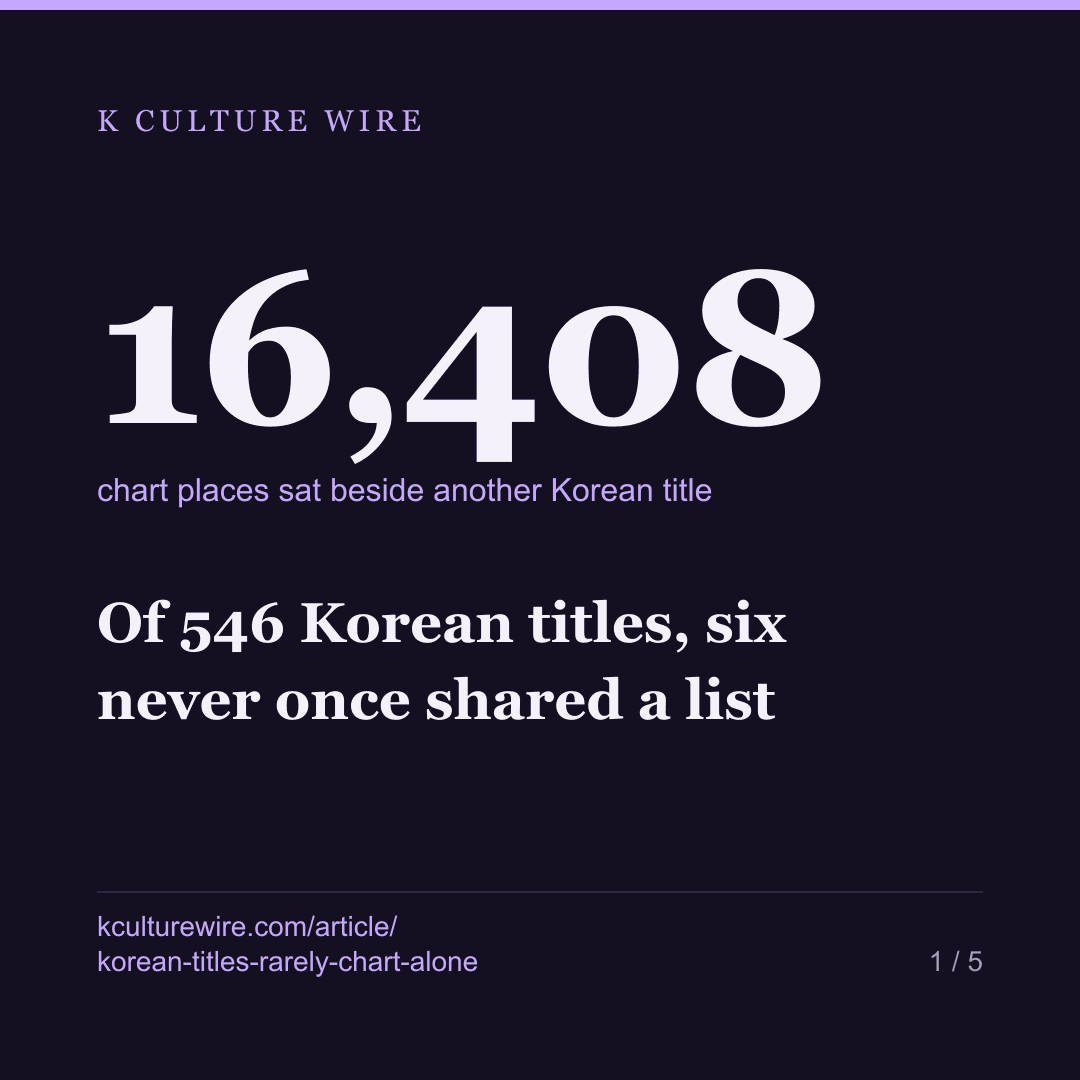
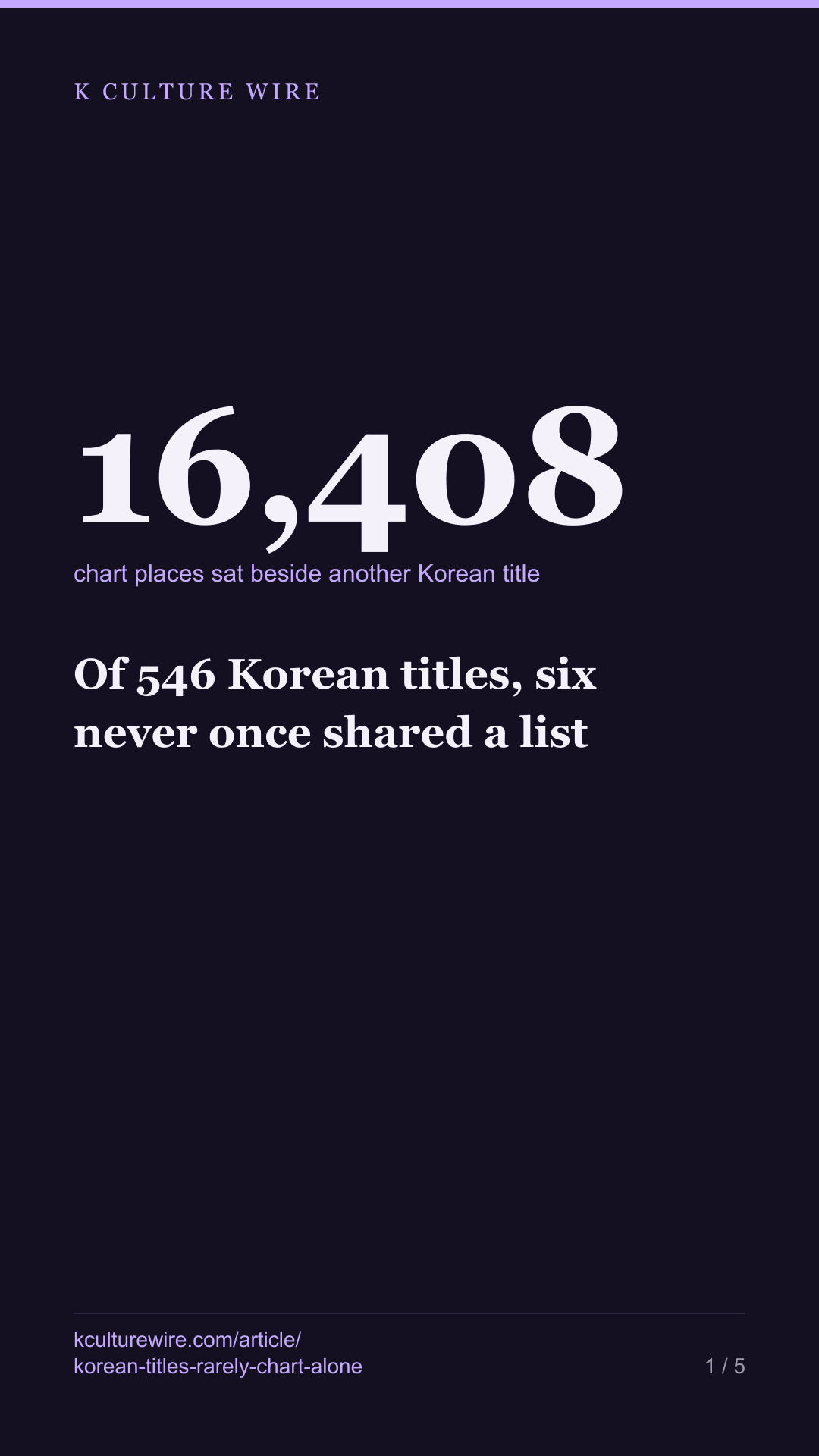
Of 546 Korean titles, six never once shared a list
We counted every country-week of the Netflix top 10 in which a Korean title appeared — 16,408 of them — and asked which other Korean titles were on that same list. Only six titles went their whole run without ever meeting another.
The table this is written from: /what-to-watch-after
If you have ever finished a Korean series and wondered what people watched next to it, the honest answer is that nobody can tell you. Netflix publishes no viewing figures by country, no hours and no overlap between titles. What it does publish is a top 10 list for each country, every week — and a list is a thing two titles can be on at the same time.
So we counted that instead. We took the 501,040 rows of Netflix’s weekly country top 10, found the 16,408 country-weeks in which at least one Korean title appeared, and asked, for every Korean title we hold a page for, which other Korean titles were on that same country’s list in that same week.
The first thing the count says is how rarely a Korean title is on its own.
Of the 546 titles we hold a page for, 540 shared a country’s weekly top 10 with another Korean title at least once. Six never did.
The six
| Title | Countries | Weeks | Best position |
|---|---|---|---|
| Way Home | 6 | 5 | 1 |
| Summertime | 3 | 3 | 1 |
| Grand Prix | 2 | 3 | 1 |
| Our Universe | 5 | 2 | 7 |
| The Three Musketeers | 1 | 2 | 7 |
| Rookie Cops | 1 | 1 | 7 |
Three of the six reached number one somewhere. That is worth sitting with, because it cuts against the reading that comes first. A title that never met another Korean title on a list is not a title that failed to get noticed. It is a title that turned up in a country, in a week, when it was the only Korean thing on that country’s list — and in three cases went straight to the top of it.
The other reading is simpler and probably closer: these are short runs. Five of the six charted for three weeks or fewer. A title on one country’s list for one week can meet at most nine other titles in its entire existence, and if none of them are Korean, it ends up here. Length, not quality, is doing most of the work.
What the count looks like at the other end
The same measure at the top produces numbers that are easy to misread in the opposite direction.
Squid Game and My Name were on the same country’s top 10, in the same week, 274 times. That is the largest pairing in the data. Squid Game shared a list with 232 different Korean titles, across 2,659 country-weeks in total — so even its closest neighbour accounts for only about a tenth of its co-appearances.
This is the number most likely to be mistaken for something it is not. It is not a count of people. Netflix publishes nothing that would let anyone say the same viewer watched both, and we are not saying it. It is not a claim that the two are alike. And it is not a recommendation — we do not know what you like, and any figure derived from a chart cannot know either.
What it mostly reflects is that Squid Game held a place on some country’s list for sixty weeks across ninety-three countries. A title that lasts will sit beside almost everything eventually. Read the sharing count next to the run length, or it will tell you something untrue.
Why we counted this at all
We had this data for a long time and were not using most of it. Our pages read a summary of the weekly rows — per title, per country, first week, last week, peak — and the summary throws away the one thing that makes this count possible: which titles were on a list together.
That is a general lesson we would rather state than keep. Having “used the data” usually means having used a summary of it. The rows underneath can still hold an axis the summary cannot express.
The full table, title by title, is on what to watch after a Korean show. Every title page now carries its own list of the titles it sat beside, with the country-week count next to each, and the same warnings attached — because the number is more useful than a recommendation, and more honest.
Where these numbers come from
Sources
- Netflix — Tudum weekly country top 10, all-weeks-countries.tsv, 501,040 rows retrieved 2026-08-29
What we checked
- The count is of published chart rows, not of people. Netflix releases no viewer data by country, so nothing here says the same person watched two titles
- Sharing a list is not similarity. A horror series and a family romance can share a country's top 10 for a year
- A large sharing count mostly measures how long a title lasted. A title that charted for one week in one country can meet at most nine others, ever
- We count a title as Korean only if it is in our own table of 974. A Korean title we do not hold would be invisible to this count even when it was on the same list
What we left out, and why
- Russia, which Netflix withdrew from; the remaining weeks are not comparable
- The 428 titles in our table that have no page here, because a reader following the count has nowhere to go
The data behind this
Written from the same data
Take this away — 10 cards
The figures in this article, as images. Free to repost with the address on them.


If you work in this business
Everything on this page is measured from the same weekly Netflix lists, per market and per title. We publish the pages free; what we sell is the same measurement cut to one company's catalogue — including the figures behind /what-to-watch-after and /clumping and /hit-or-flop.
What a company sheet contains, and what it cannot tell you →