Stars · music
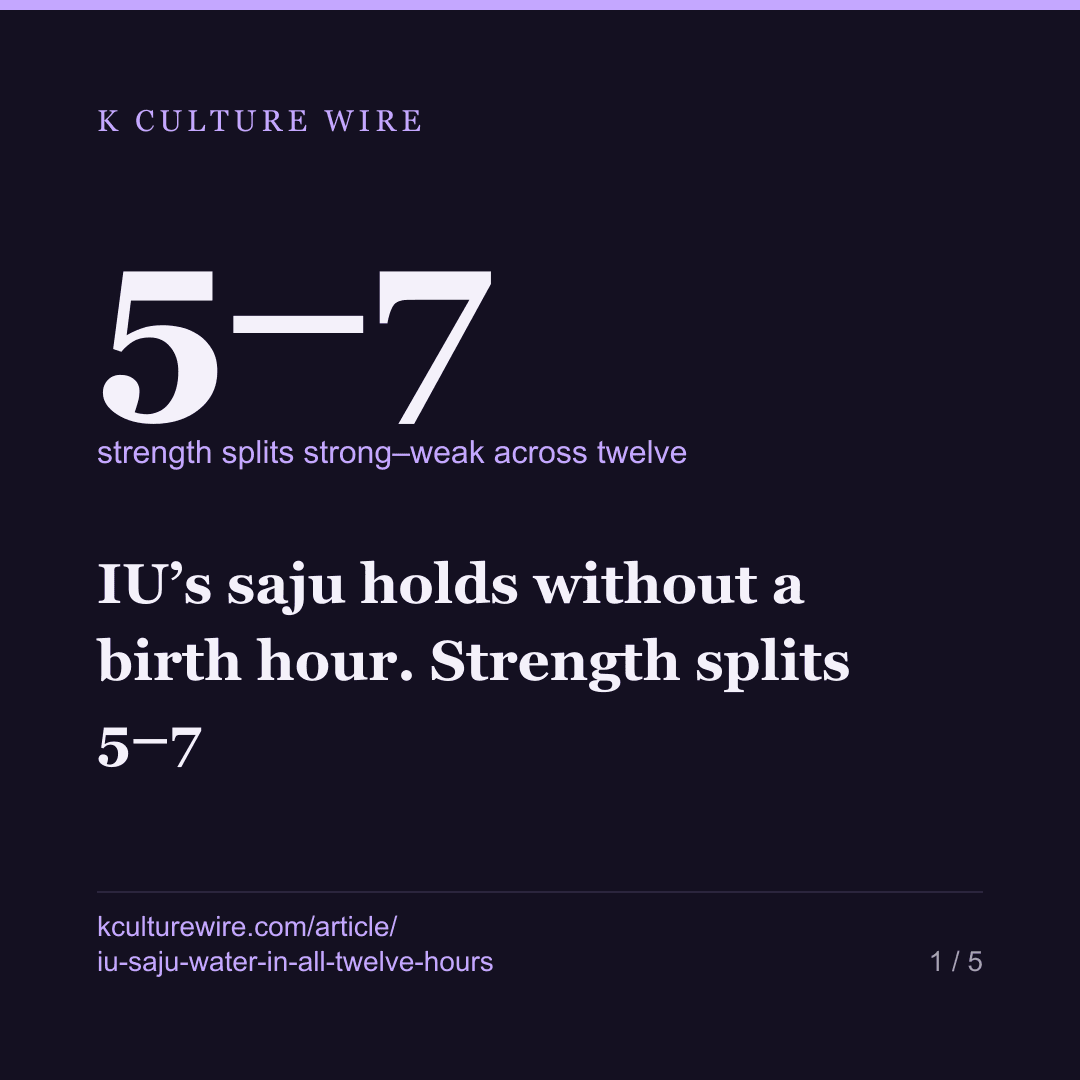
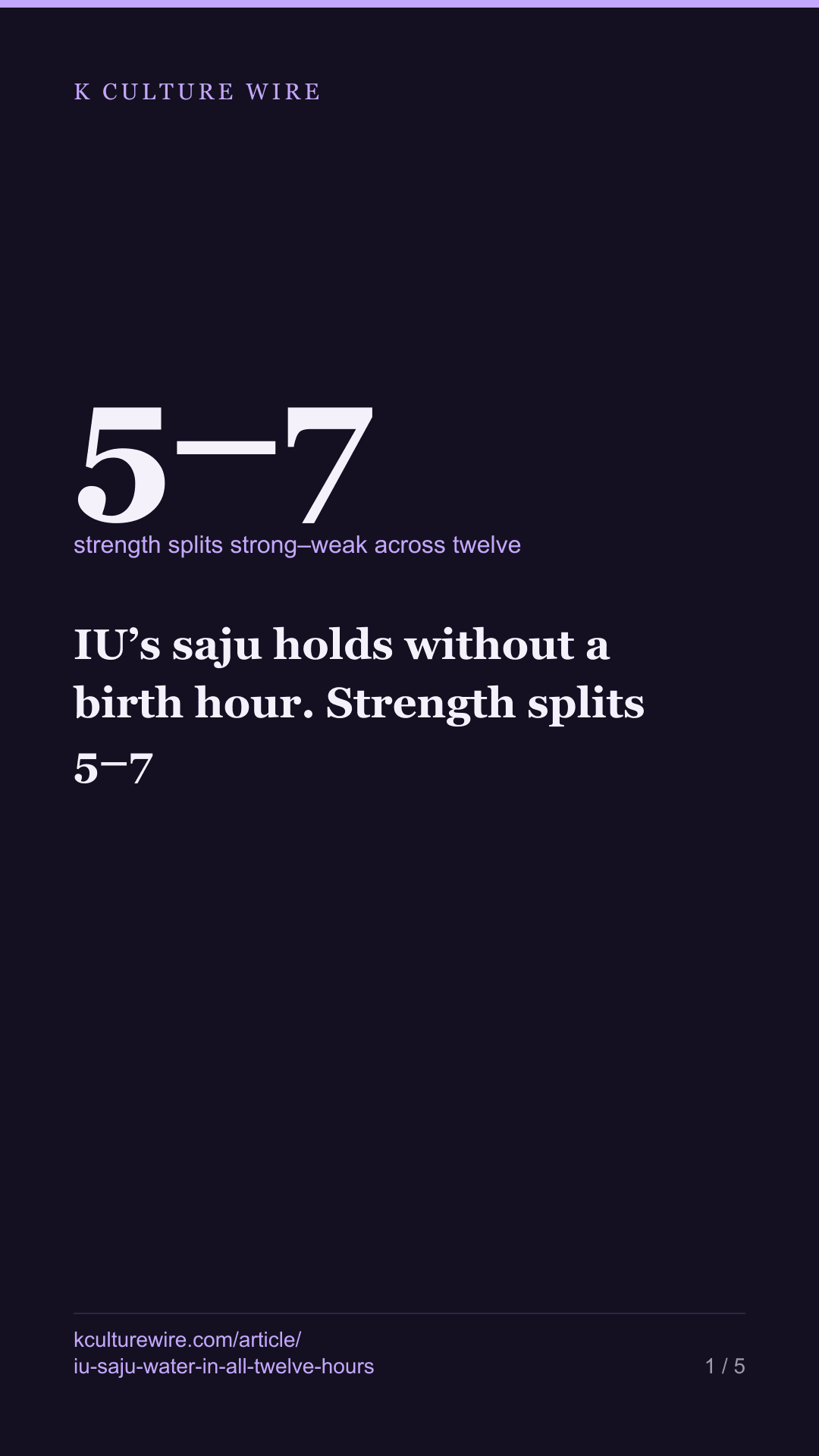
IU’s saju holds without a birth hour. Strength splits 5–7
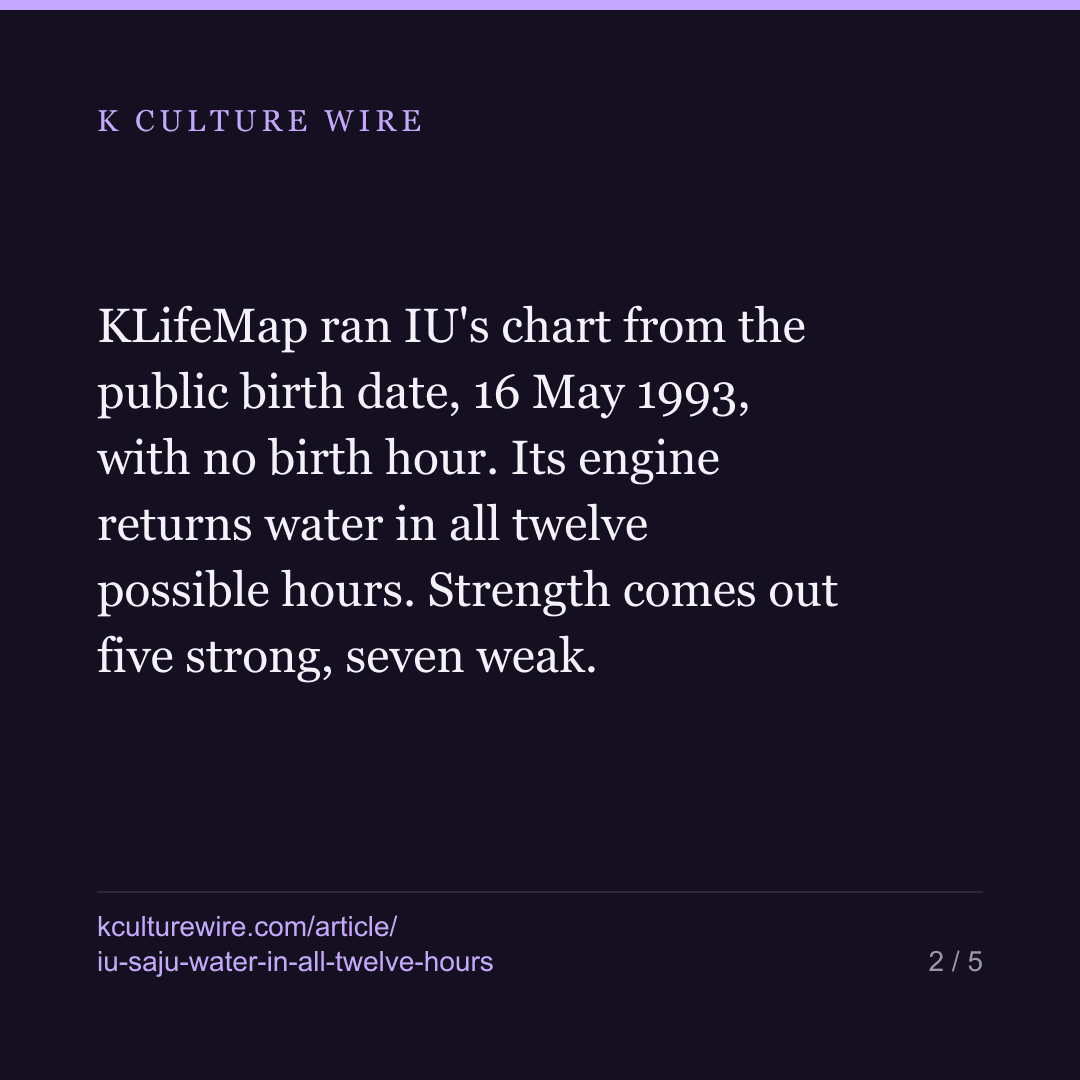
KLifeMap ran IU's chart from the public birth date, 16 May 1993, with no birth hour. Its engine returns water in all twelve possible hours. Strength comes out five strong, seven weak. We report the reading and what it cannot settle.
The table this is written from: /community
IU was born on 16 May 1993, and no source anywhere publishes the hour. Those two facts are the only things in this article that are not a reading.
Three pillars, not four
Saju sets a birth moment out as four pillars of two characters each — year, month, day, hour — so a complete chart is eight characters. The hour pillar needs a clock time. KLifeMap, which sells saju readings in Korean, therefore stopped at three for IU: year 癸酉, month 丁巳, day 丁酉. It did not fill the missing hour with noon, and it did not estimate one.
That leaves a question the reading has to answer honestly, and it is the interesting part: of the things a saju engine outputs, which ones survive not knowing the hour, and which ones move?
What holds: water, in all twelve hours
The day stem is 丁, and the birth month 巳 is a summer month. KLifeMap’s engine puts seasonal balance — jo-hu (調候), the principle set out in the Qiongtong Baojian (窮通寶鑑), also known as the Nangangmang (欄江網) — ahead of both strength and structure for anyone born in summer or winter. On that rule it returns water as IU’s governing element.
Then it substituted all twelve possible hour branches, one at a time, holding the calendar date fixed, and re-ran the reading. Water came back twelve times out of twelve. The rule that decides the answer does not depend on the hour, so the answer does not either. That is one judgement the engine will make about IU without knowing something nobody knows.
What moves: five hours strong, seven weak
The strength reading does not hold. Across the same twelve hours the chart comes out sin-gang (身强), strong, in five of them and sin-yak (身弱), weak, in the other seven. Strength is what an engine leans on to weigh the ten gods and to read the luck cycles, so knowing IU’s birth hour would change that part of the reading — and the reading itself says so rather than picking the larger side and calling it settled.
Seven out of twelve is not a finding about IU. It is a measurement of how much of a saju an unknown hour takes away.
The day pillar was wrong once, and the cause was a clock
The first edition of this reading gave IU’s day pillar as 丙申, one place back in the sixty-cycle from 丁酉 — a difference of exactly one day. The engine shifts a Korean clock time back by 32 minutes to approximate true solar time at the longitude of Seoul, and a chart cast at midnight minus 32 minutes lands on the day before. The midnight branch was being represented by 00:30, which crossed that line. We found it while checking the numbers before setting any of them in type; KLifeMap fixed the boundary and republished. The full account, with the twenty-four-hour table for all three charts, is in our earlier piece on the missing birth hour.
What none of this can tell you
This is a three-pillar reading, not a four-pillar one. Knowing the hour can change it. Public profiles carry dates and almost never hours, which is why no complete chart for any Korean public figure can be built from the public record — ours included.
And a count we published ourselves, on our own data: across 1,047 Korean actors who reached a Netflix chart, the spread across the twelve zodiac years is indistinguishable from chance, chi-square 7.77 against a threshold of 19.68. A birth year does not pick out who reaches a chart, and this article does not say otherwise.
Who else is in the room
IU was born in a Rooster year, and so were 91 other Korean actors and singers we hold a birth date for. Of the 69 in that room whose Wikipedia reads we can measure across Indonesian, Vietnamese, Thai and Malay, IU is read most — 208.57 per million, ahead of Song Hye-kyo at 154.46 and Jun Ji-hyun at 114.48. Han So-hee shares the year as well, born in November 1993. Every one of those names, with the birth years beside them, is at kculturewire.com/star-signs.
The reading is KLifeMap’s, and it is published in Korean: the full text is here. Readers who want to put their own date through the same engine in English can do that at klifemap.ai. What we can count — who shares a birth year with whom, and how flat that spread turns out to be — is at kculturewire.com/star-signs.
Where these numbers come from
Sources
- KLifeMap — Saju engine (sajuEngine.js), three-pillar reading, published in Korean 2026-08-21 and corrected 2026-08-22 · https://klifemap.ai/content/star-iu-samju-saju
- KLifeMap — BaZi (Four Pillars) reading, English edition — the same engine, run on a date the reader supplies · https://klifemap.ai/saju.html?lang=en
- Wikidata — Date of birth (P569), CC0 — IU is item Q20145 · https://www.wikidata.org/wiki/Q20145
- K Culture Wire — Zodiac-year spread of 1,047 Korean actors who reached a Netflix chart; reads 2025-08 through 2026-07
What we checked
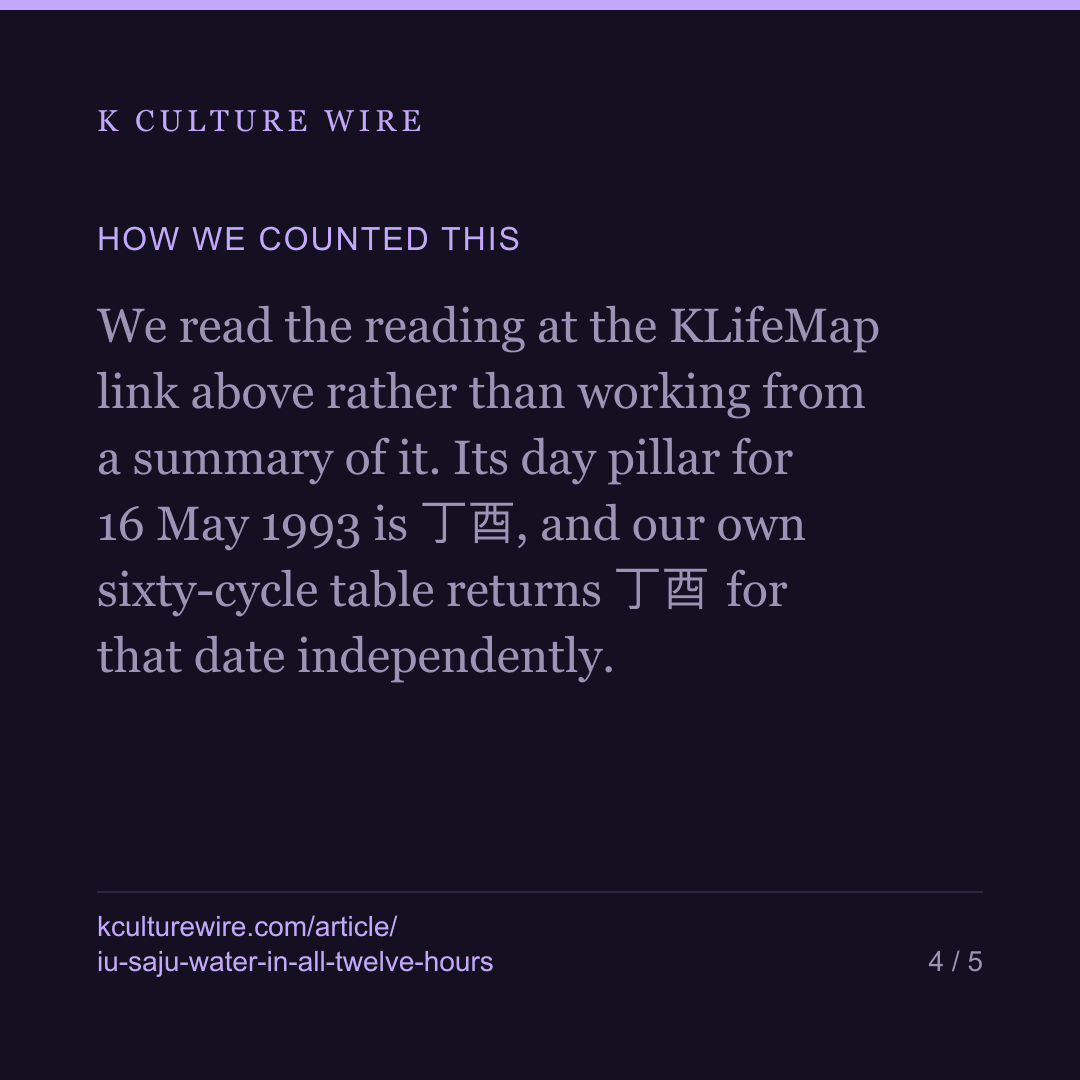
- We read the reading at the KLifeMap link above rather than working from a summary of it. Its day pillar for 16 May 1993 is 丁酉, and our own sixty-cycle table returns 丁酉 for that date independently.
- The twelve-hour sweep is KLifeMap's own, run against its engine with the calendar date held fixed. We asked for the count of hours falling in each outcome rather than for a verdict, and the counts sum to twelve: five strong, seven weak.
- Read counts for the Rooster room come from the Wikimedia Pageviews API across the Indonesian, Vietnamese, Thai and Malay Wikipedias, twelve months to July 2026, human traffic only.
What we left out, and why
- The hour pillar. Public profiles carry birth dates and almost never birth hours, so a four-pillar chart cannot be built for IU or for anyone else from the public record.
- Anything the engine did not output. We quote its judgements and add nothing to them — no character reading, no fortune, no advice.
- Twenty-three of the 92 people in the Rooster room have a birth date on record but no read count, because their article is not in the four-language panel we measure. They are named on that page with an empty figure rather than a zero.
The data behind this
Written from the same data
Take this away — 10 cards
The figures in this article, as images. Free to repost with the address on them.

If you work in this business
Everything on this page is measured from the same weekly Netflix lists, per market and per title. We publish the pages free; what we sell is the same measurement cut to one company's catalogue — including the figures behind /community and /star-signs.
What a company sheet contains, and what it cannot tell you →
What do you make of this?
We counted it. What it means is yours to decide.