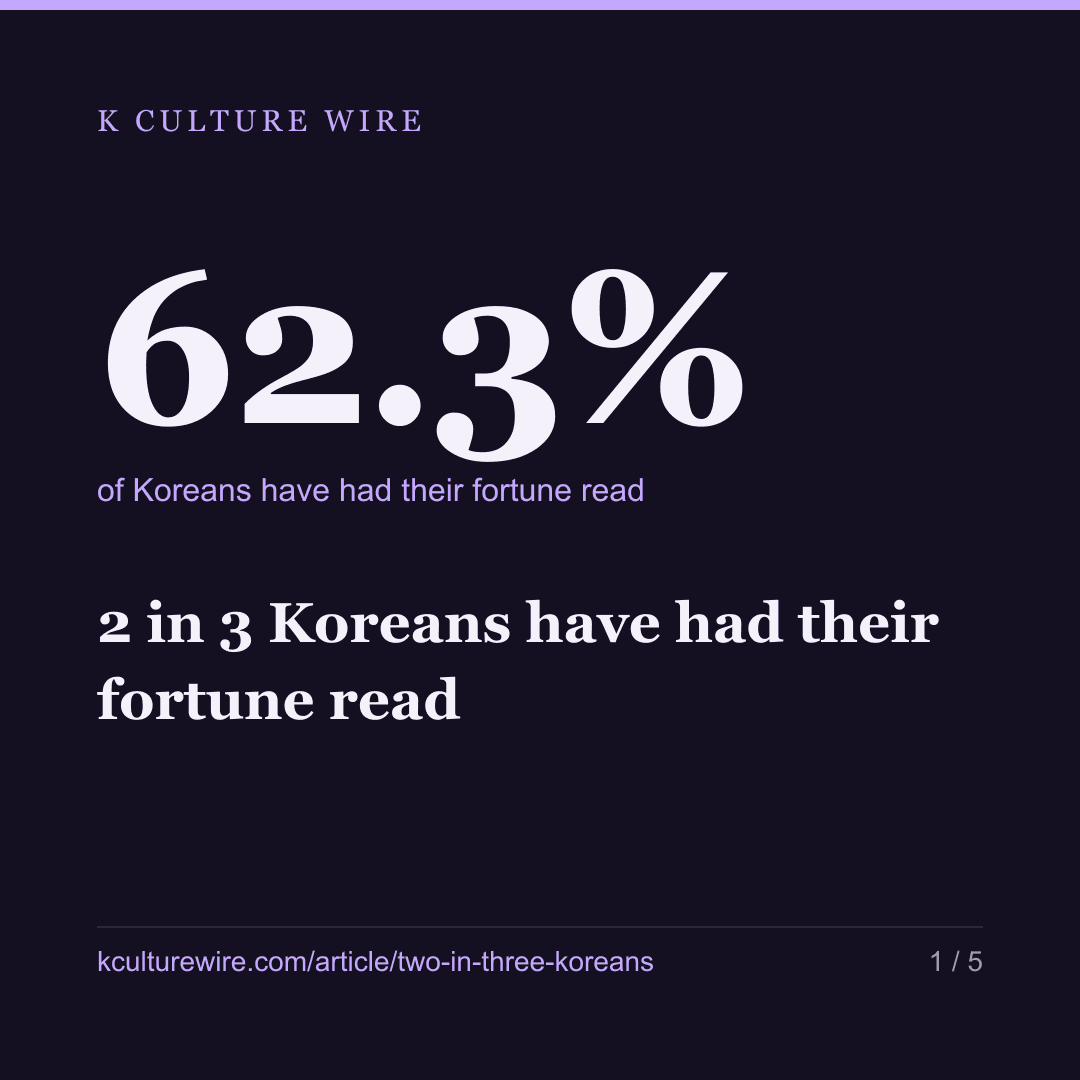
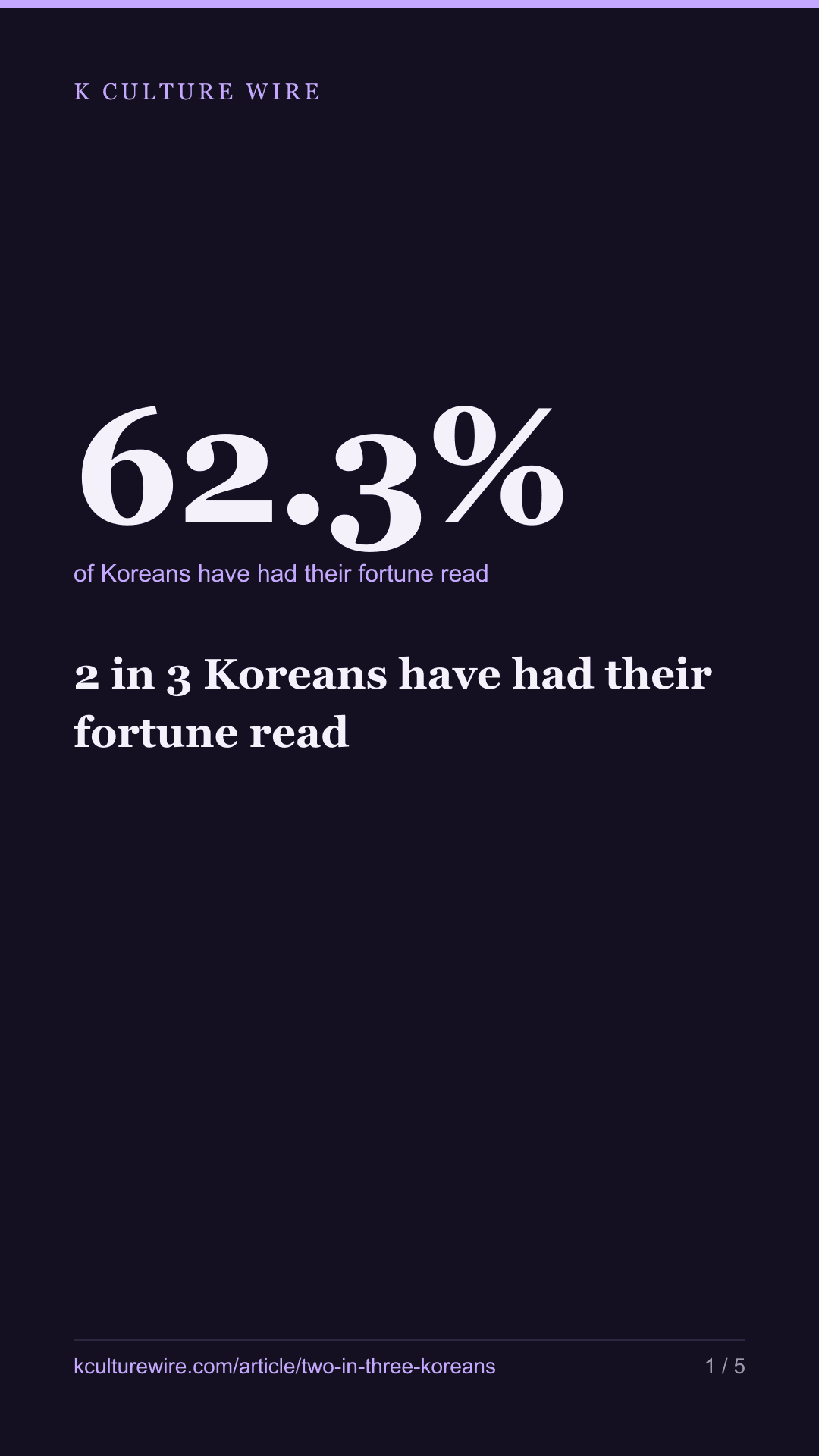
2 in 3 Koreans have had their fortune read
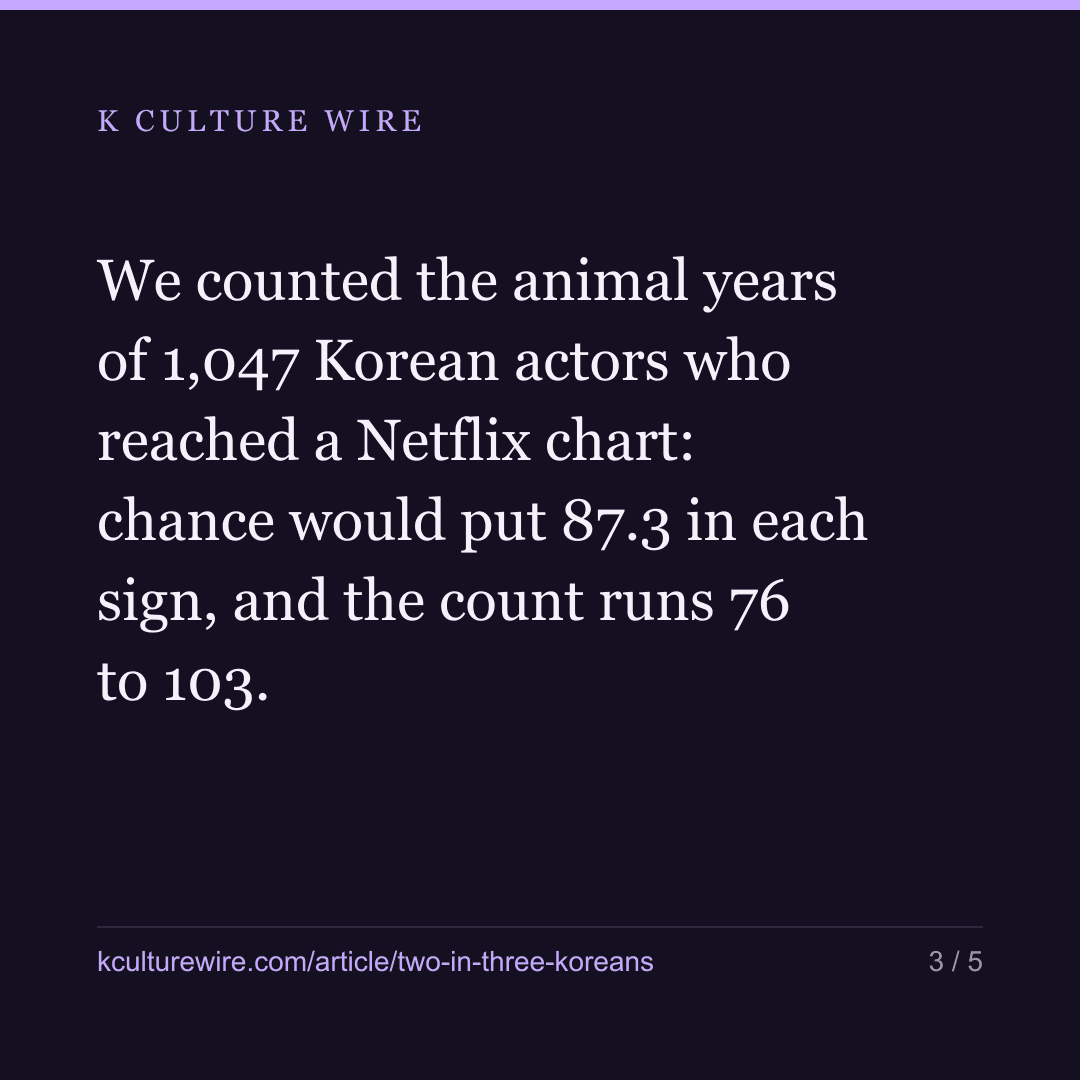
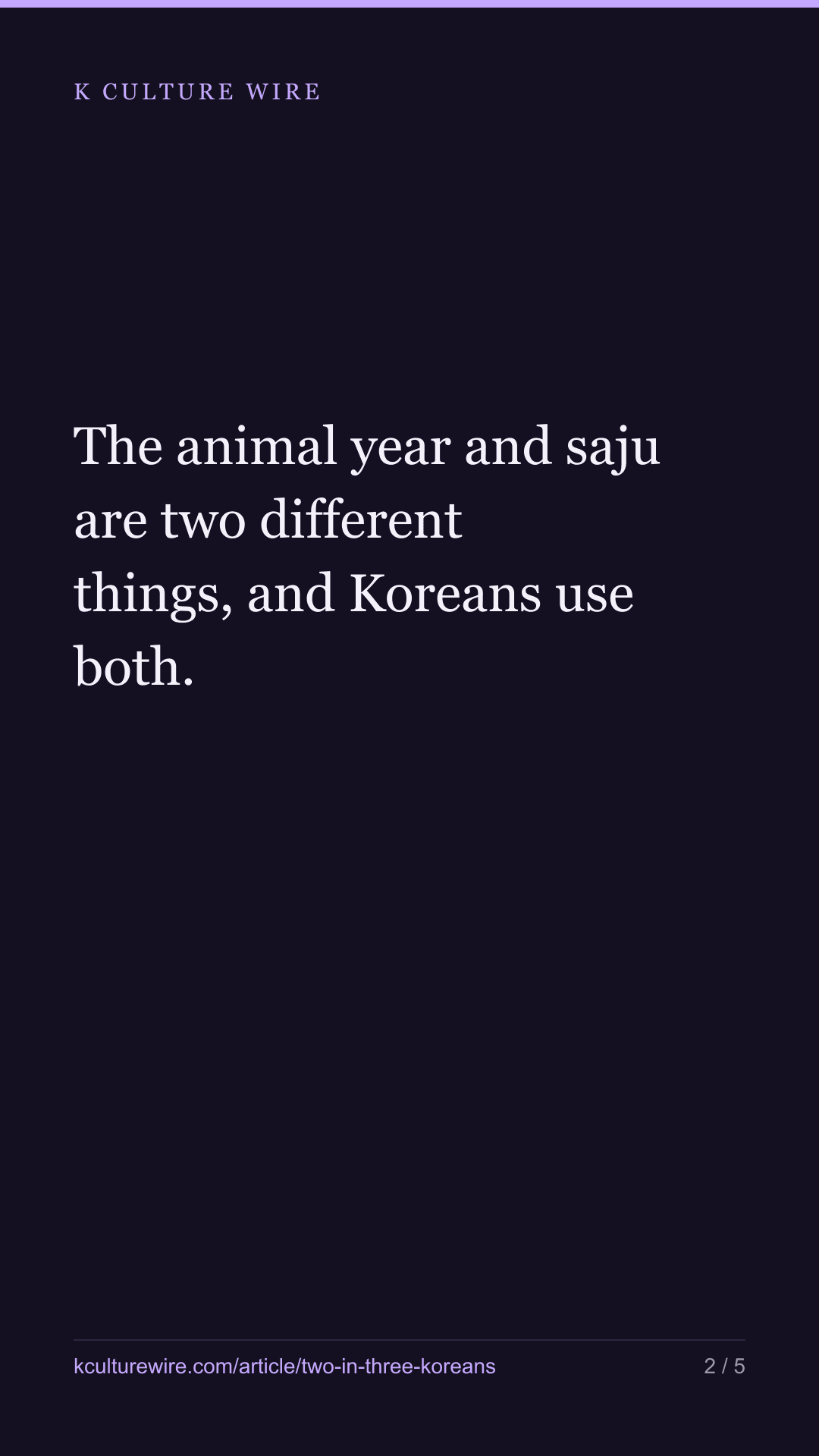
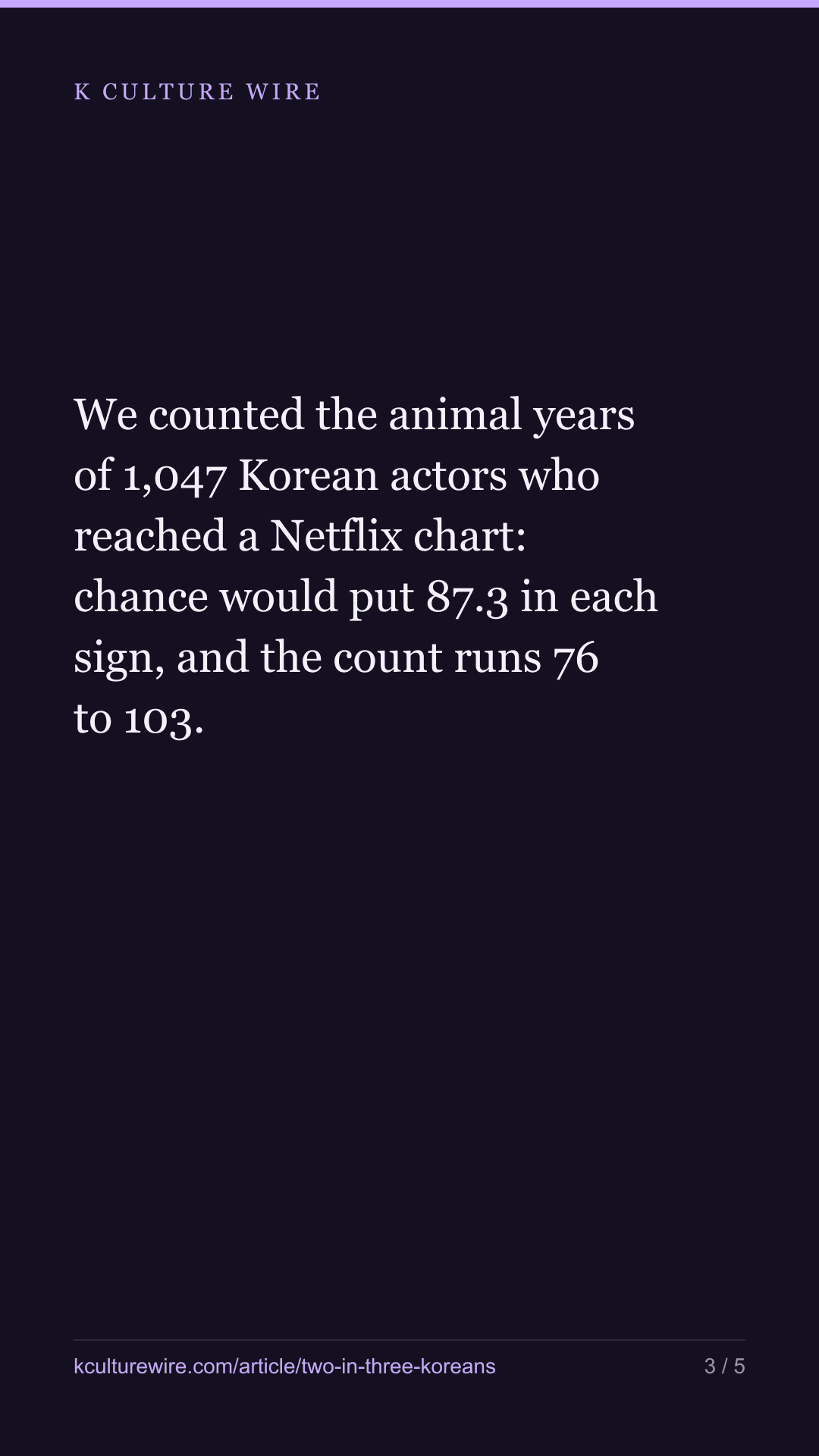
The animal year and saju are two different things, and Koreans use both. We counted the animal years of 1,047 Korean actors who reached a Netflix chart: chance would put 87.3 in each sign, and the count runs 76 to 103.
The table this is written from: /community
Ask a Korean friend what their animal year is and you will get an answer instantly. Ask what their saju is and you may get a pause — because that is the bigger thing, and most people know it is bigger than they can explain over coffee.
Here is the part outsiders usually miss: these are two different things, and Koreans use both.
The number first
In a 2026 national survey of 1,200 people aged 13 to 69, 62.3% said they had had their fortune read at least once. There are 15,853 registered fortune-telling businesses in the country. That is not a fringe habit. It is closer to a normal errand — something done before a wedding, before signing a lease, before naming a baby.
The animal year is the one you already know
Twelve animals, one per year, on a repeating cycle. Born in 2000 you are a dragon; born in 2001, a snake. It works roughly the way a Western star sign does — one label, shared with everyone born in the same window, easy to say out loud. Which is why it travels. English-language threads about Korean astrology are full of people calling out to each other: “Where my dragons at?” “Anyone else a rooster?” Nobody is asking a question. They are finding each other.
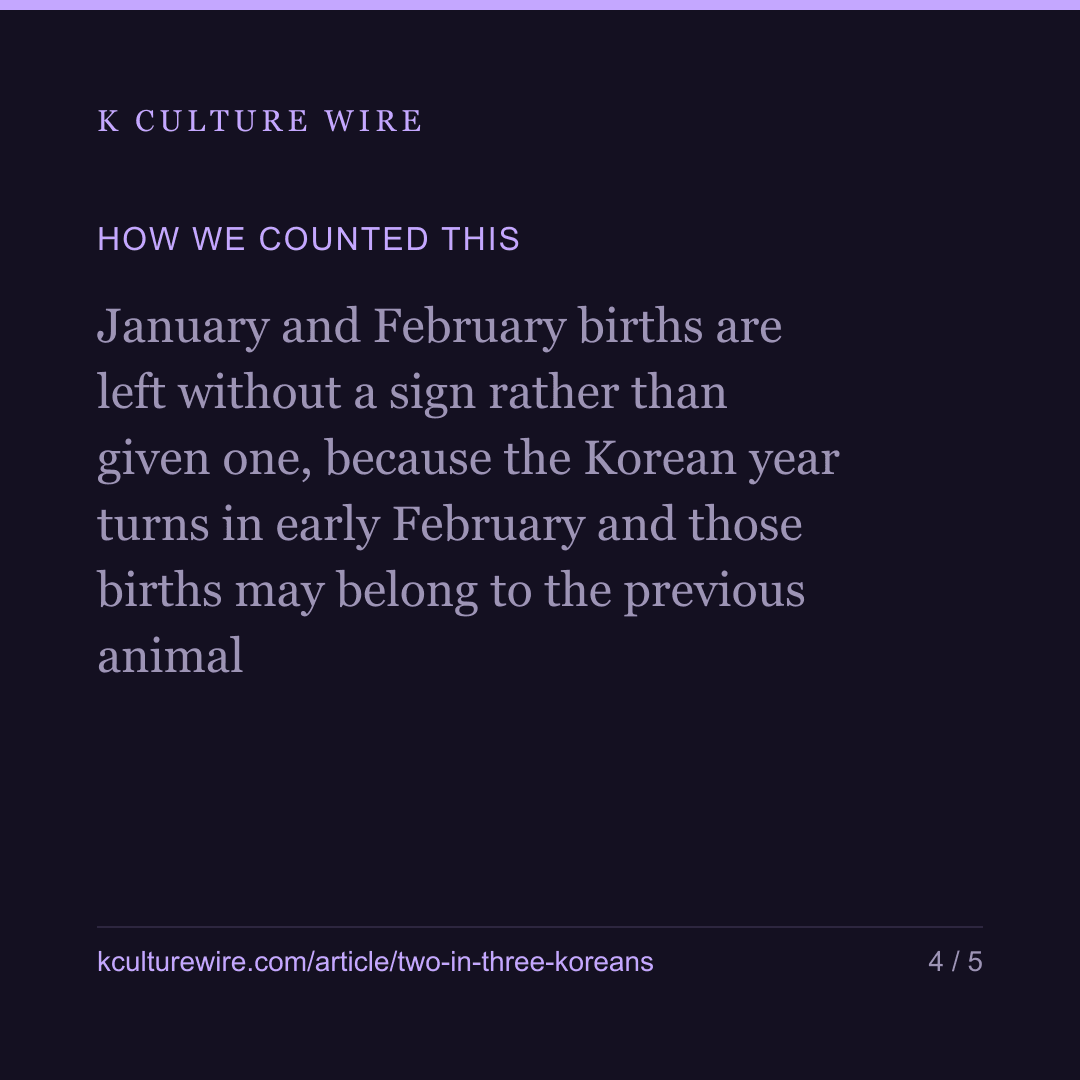
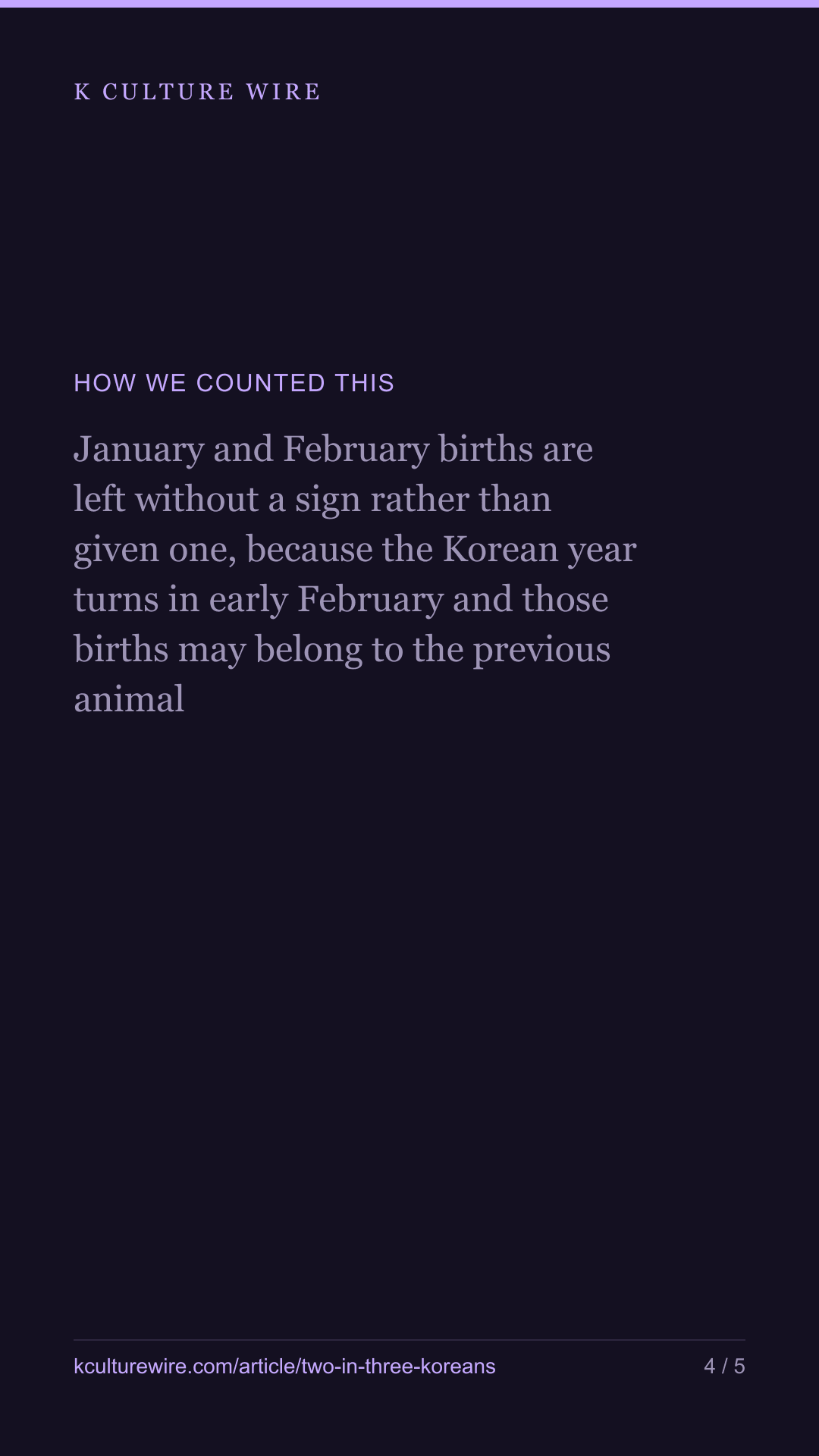
⚠ One catch before you announce yours: the Korean year does not start on 1 January. It turns in early February. If you were born in January, the animal you have been telling people is quite possibly the previous year’s.
So we counted
We keep a panel of 1,355 Korean actors who appear in the cast of titles that reached a Netflix country chart — the same people we measure in how far an actor’s titles travel. 1,047 of them have a birth year we can turn into an animal sign — the rest are January and February births we deliberately left blank, and people whose birth date is not recorded.
If the animal year had nothing to do with becoming one of these actors, chance would put 87.3 in each sign. Here is what is there:
| Animal year | Actors | Against 87.3 expected |
|---|---|---|
| Rat | 89 | +1.7 |
| Ox | 82 | -5.3 |
| Tiger | 78 | -9.3 |
| Rabbit | 86 | -1.3 |
| Dragon | 90 | +2.7 |
| Snake | 76 | -11.3 |
| Horse | 77 | -10.3 |
| Goat | 91 | +3.7 |
| Monkey | 91 | +3.7 |
| Rooster | 92 | +4.7 |
| Dog | 103 | +15.7 |
| Pig | 92 | +4.7 |
Chi-square 7.77, against a 5% threshold of 19.68. The distribution is indistinguishable from chance. Dog is the largest and snake the smallest, and neither gap is bigger than what random scatter produces across twelve boxes. The full table, with the debut ages of the same panel, is on the animal years page.
That is the whole finding, and it is a negative one. The year you were born does not pick out who ends up on a chart.
What that does and does not mean
It does not mean the practice is fake, and we are not going to pretend a count of actors settles something a count cannot reach. What it settles is narrow and worth having: if anyone tells you a particular animal year is the lucky one for a screen career, that claim is testable and it does not survive.
Saju is the other thing, and it is not what we tested. Saju (사주) means “four pillars”: the year, the month, the day and the hour you were born, read together. The animal year gives you one thing you share with roughly one person in twelve. Saju gives you four, and the combination is close to yours alone. A Korean fortune teller is not primarily interested in your dragon — they want the day and the hour.
One honest limit, and it is a big one
The fourth pillar is the hour of birth, and most people do not have it. Without it three pillars still stand, carrying the year, the season and the day. What cannot be built is the fourth. Any reading that claims full precision without knowing your birth time is claiming something it does not have.
It is also why you will not see us publish “here is a celebrity’s saju.” Public profiles carry birth dates and almost never birth times. We can tell you how a thousand Korean actors’ animal years are distributed. We cannot tell you any one of their charts, and we will not pretend otherwise.
⚠ There is a smaller version of the same problem inside our own count. Wikidata records a year-only birth date as 1 January, which put 34 people on that single day — nine times the daily average. Those are not January births; they are people whose day is unknown. We treat them as unknown. Had we not, this article would have opened by telling you Korean actors are unusually often born in January.
Where to start, if you want to
Find your animal year, and check the February cutoff before you commit to it. That is the free, social, low-stakes end of it.
If you want the four-pillar version, dig up your birth time first — a hospital record, a family register, a parent’s memory of “just before dinner.” Without it you get three-quarters of the picture, which is genuinely useful. But it is worth knowing which quarter is missing.
Planned and drafted with KLifeMap, the same team’s Korean-language life-and-career site. The counts and the tests are ours.
Where these numbers come from
Sources
- Wikidata — Public profile birth dates for the 1,355 Korean actors already carrying an item number in our Netflix cast panel · https://query.wikidata.org
- Korea fortune-telling perception survey 2026 — National survey of 1,200 people aged 13 to 69 · https://www.kculturewire.com/about
What we checked
- January and February births are left without a sign rather than given one, because the Korean year turns in early February and those births may belong to the previous animal
- Wikidata records a year-only birth date as 1 January, which put 34 people on that single day — nine times the daily average — so those dates are treated as unknown rather than as January births
- The distribution is tested against a flat one rather than described by eye, and the test statistic is published beside the threshold
What we left out, and why
- Any individual chart. A full saju needs the hour of birth and public profiles almost never carry it
- Any ranking of the signs. This publication does not rank, and a flat distribution has nothing to rank anyway
The data behind this
Written from the same data
Take this away — 10 cards
The figures in this article, as images. Free to repost with the address on them.


If you work in this business
Everything on this page is measured from the same weekly Netflix lists, per market and per title. We publish the pages free; what we sell is the same measurement cut to one company's catalogue — including the figures behind /community and /zodiac.
What a company sheet contains, and what it cannot tell you →