IU started at 15, Go Youn-jung at 23 — and outreads her
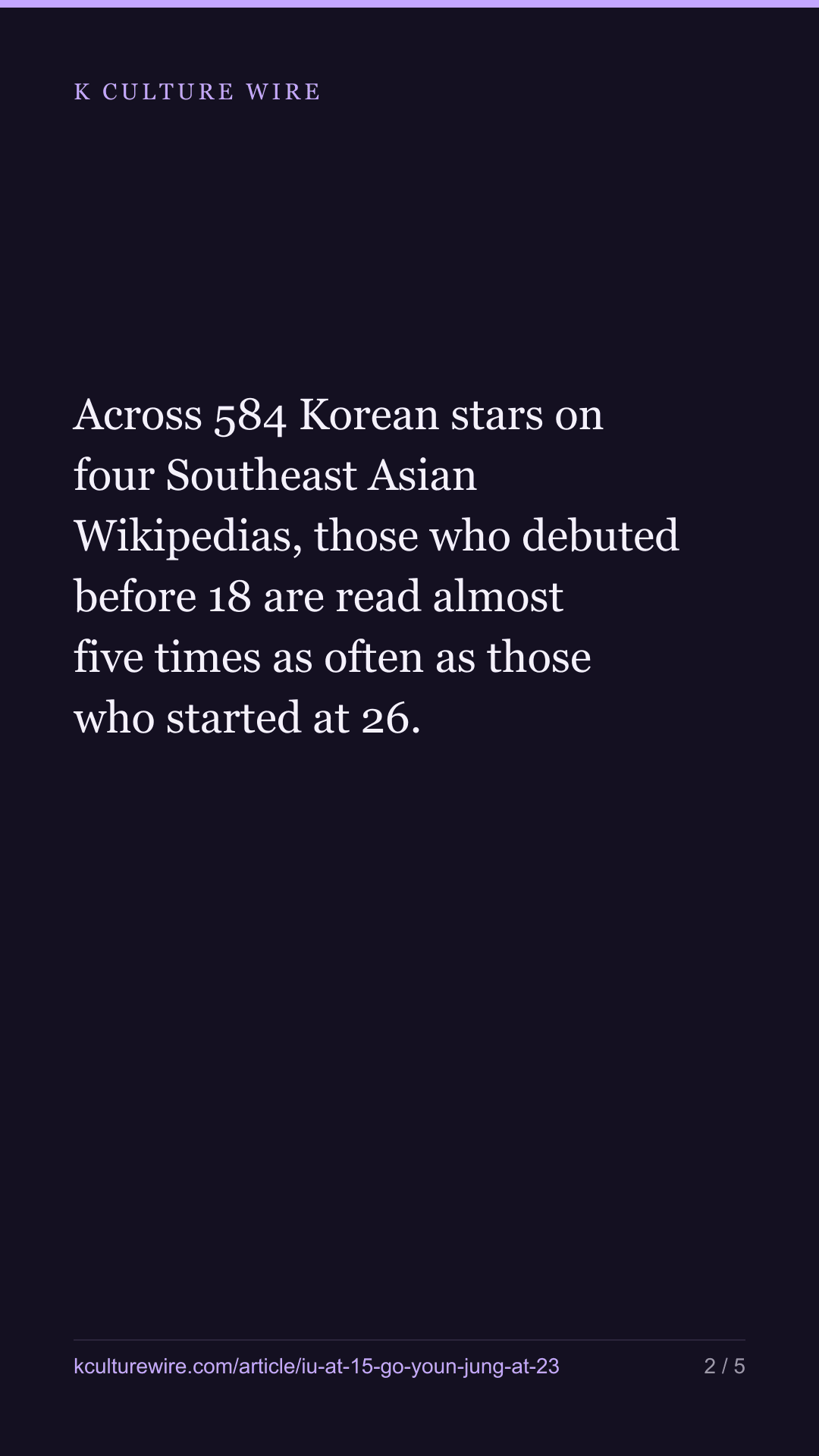
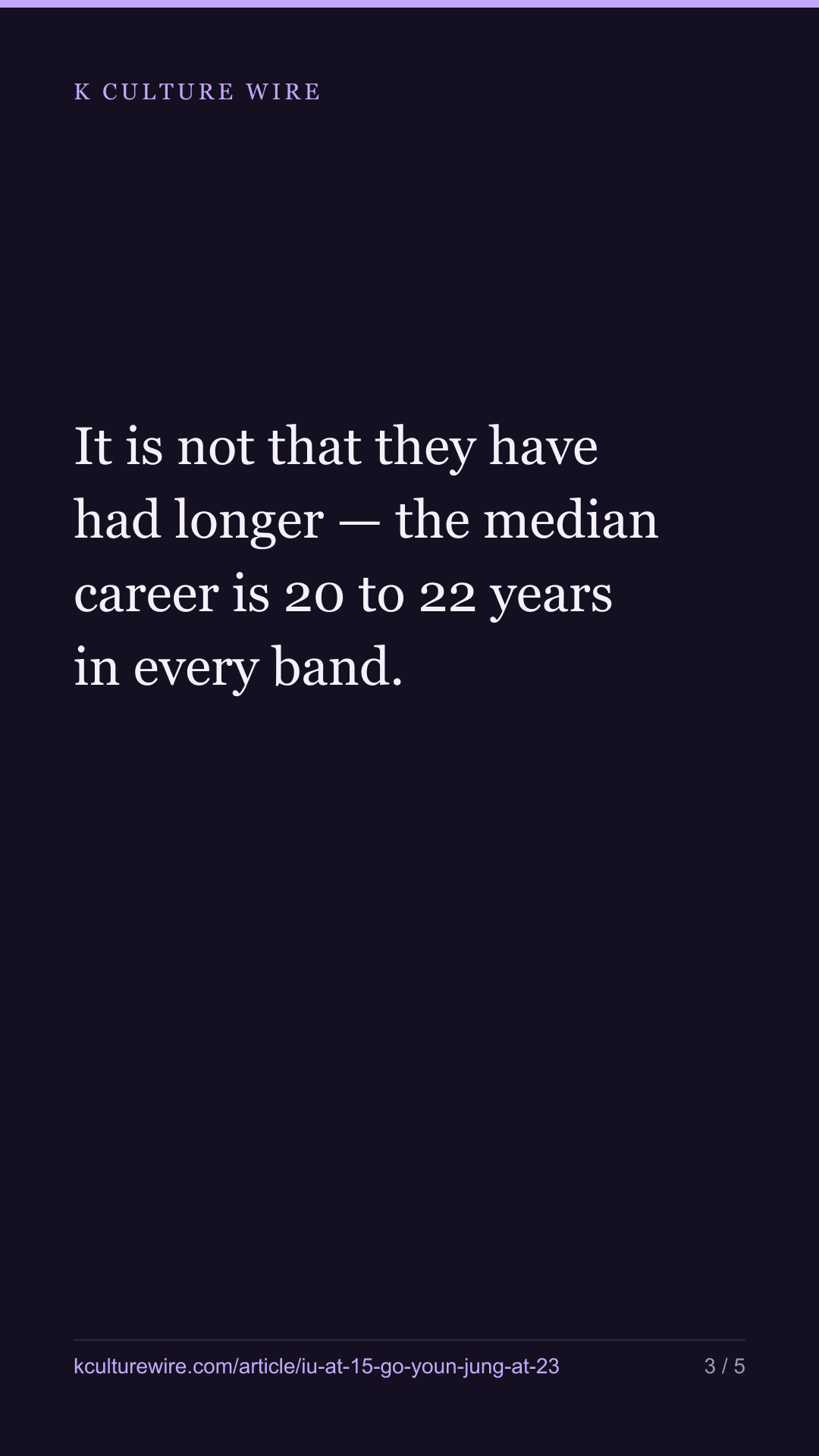
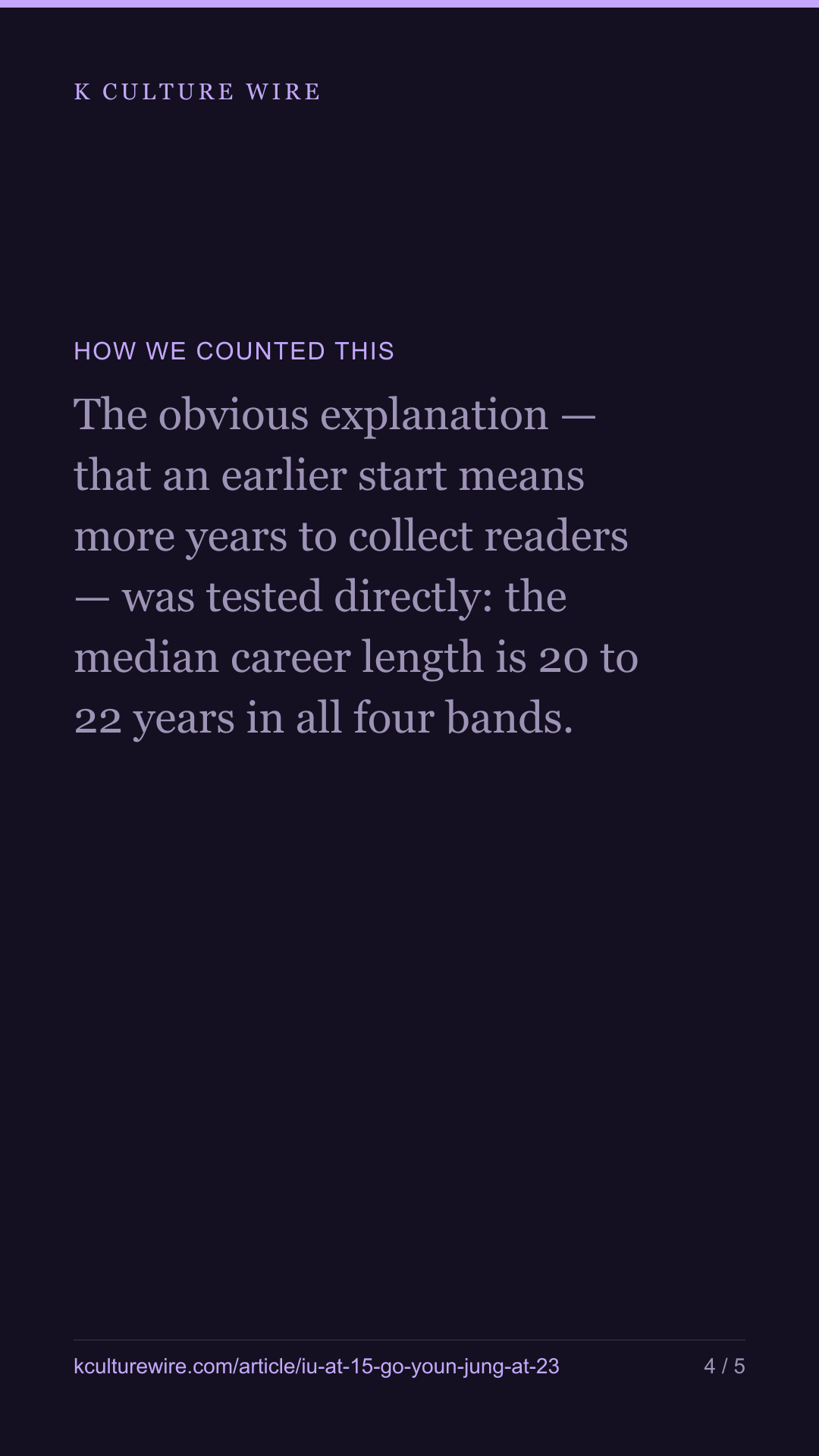
Across 584 Korean stars on four Southeast Asian Wikipedias, those who debuted before 18 are read almost five times as often as those who started at 26. It is not that they have had longer — the median career is 20 to 22 years in every band.
The table this is written from: /debut-age
IU released her first single at 15. Im Yoon-ah of Girls’ Generation debuted at 17, Bae Suzy of miss A at 16, Cha Eun-woo of ASTRO at 19. Ma Dong-seok did not start until he was 32.
Across the Indonesian, Vietnamese, Thai and Malay Wikipedias, the ones who started young are read far more today. Line up everyone who debuted before 18 and take the one in the middle — half above, half below — and that person draws 11.89 reads per million reads of those editions. That middle figure is the median, and it is what this piece uses throughout rather than an average, because one very famous name would drag an average upward and tell you nothing about the rest. The median one who started at 26 or later draws 2.43 — almost five times less.
Then there is Go Youn-jung, who started at 23 and is read more than anyone else in the panel.
The ladder
We can date the start of a career for 584 Korean stars. Sorted by how old they were, the middle of each group looks like this:
| Debut age | Stars | Median reads per million | Most-read in that band |
|---|---|---|---|
| Under 18 | 105 | 11.89 | IU, 208.57 |
| 18 to 21 | 253 | 6.68 | Cha Eun-woo of ASTRO, 200.33 |
| 22 to 25 | 159 | 4.80 | Go Youn-jung, 273.06 |
| 26 or older | 67 | 2.43 | Ma Dong-seok, 59.84 |
Every step falls. From end to end it is 4.89 times.
The obvious objection does not hold
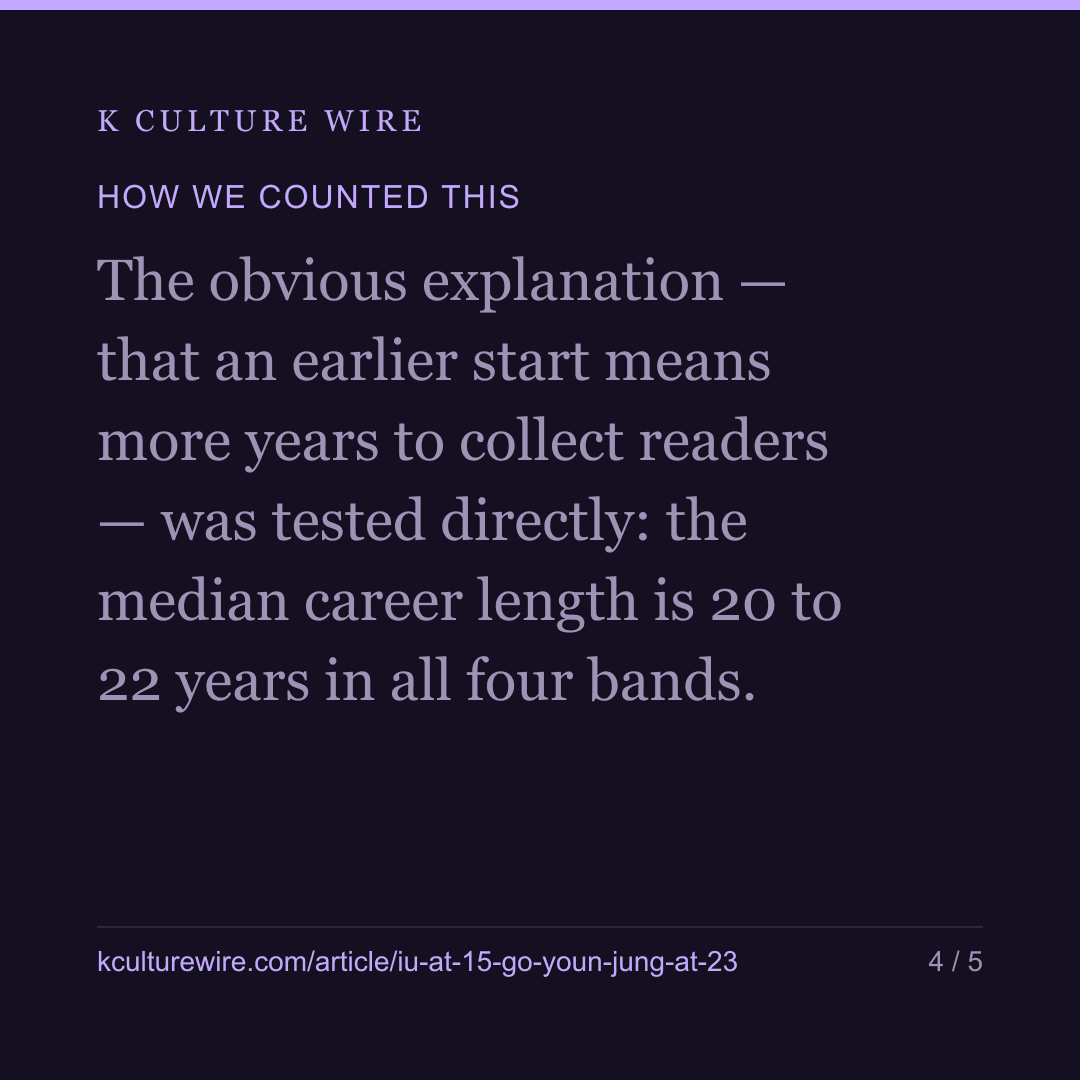
Someone who started at 15 has had more years to collect readers than someone who started at 32. It is the first thing anyone would say, and it is testable, so we tested it.
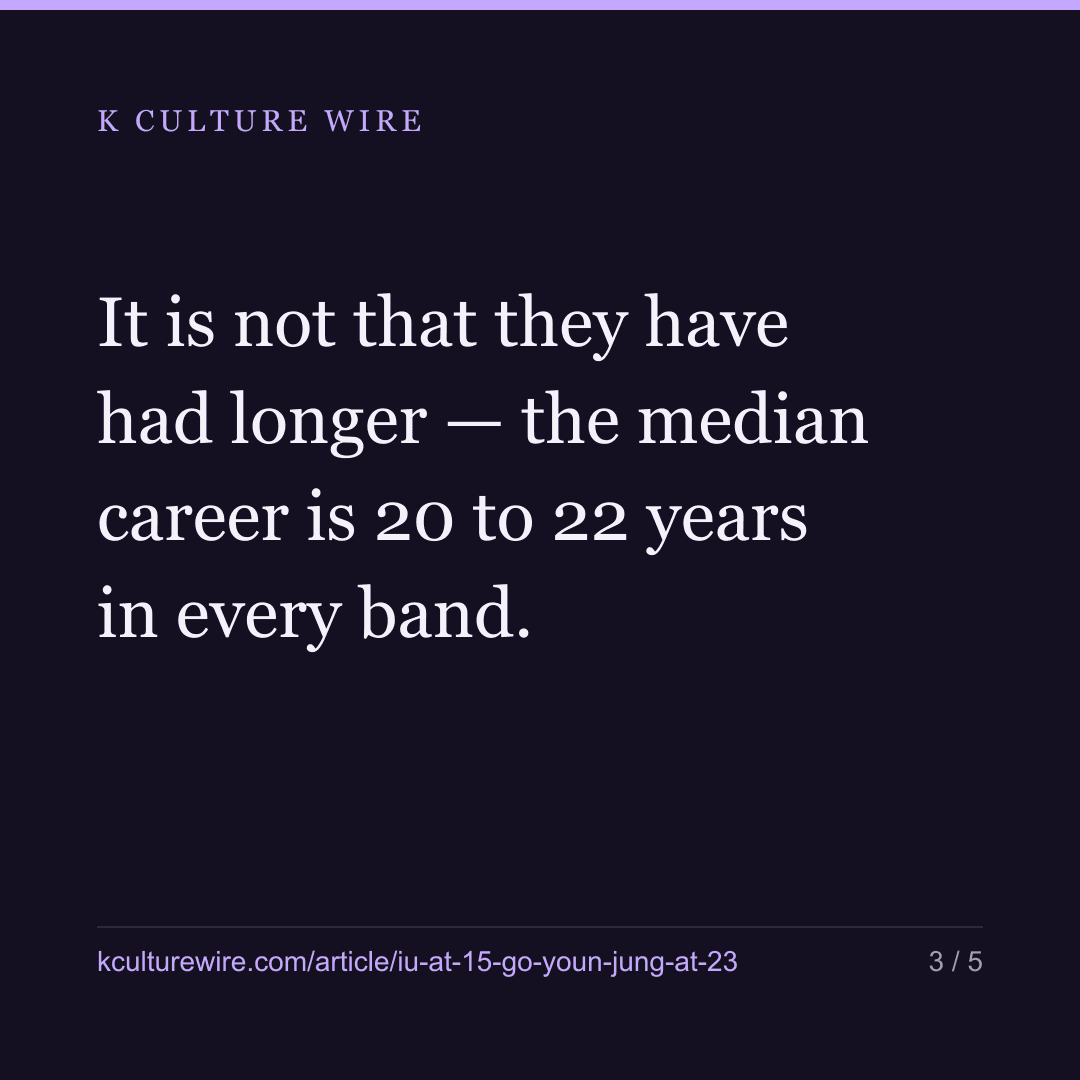
The median career length is 22 years for the under-18 band, 22 for the 18-to-21 band, 20 for 22-to-25, and 22 for those who began at 26 or later. Within two years of itself, everywhere. These are not young stars being compared against veterans. They are people who have all been working about as long, who started at different ages.
We went further and held career length inside a single window — only stars whose careers run 10 to 20 years — and measured again. The ladder survives at 4.63 times. One thing does change: the two youngest bands come together, 13.42 against 12.65, so it becomes three steps rather than four.
What it does not tell you about any one star
A median describes a group. The question a reader usually has is about a person.
Take one star at random from the under-18 band and one from the 26-and-over band. How often is the younger starter the more-read one? 72.7 per cent of the time. Fifty would mean debut age tells you nothing about an individual; a hundred would make it a rule. This is neither.
Go Youn-jung is the proof. She started at 23, in the second-lowest band, and at 273.06 reads per million she is read more than IU, more than Cha Eun-woo of ASTRO, more than anyone we measured. Kim Seon-ho also started at 23 and sits at 220.56. Both of them are above every single person in the band that is supposed to be ahead.
This figure has a name: the common-language effect size, proposed by McGraw and Wong in 1992 for exactly this problem — group differences reported in units nobody can picture. It equals the Mann-Whitney U statistic, from 1947, divided by the number of pairs.
Which way it runs
We do not know.
Starting young may build a readership that lasts. Or the kind of person who is put on stage at 15 may already be the kind of person a company invests in for twenty years. Or a third thing — an agency, a training system, one breakout role — may produce both the early start and the readers. Nothing here separates them.
The bands are ours: we cut at 18, 22 and 26 because those splits leave every band with enough people to measure, and a different cut would give different medians. Reads count people opening an encyclopaedia article, which is not fame and not income. And a start date on Wikidata is the date of a first credited work, which is not always the date someone would name themselves.
The four bands, the career-length control and the workings are on when they started.
Where these numbers come from
Sources
- Wikidata — Birth dates and work start dates (CC0) · https://www.wikidata.org/
- Wikimedia — Pageviews API, human traffic only, monthly, per edition · https://wikimedia.org/api/rest_v1/
What we checked
- The obvious explanation — that an earlier start means more years to collect readers — was tested directly: the median career length is 20 to 22 years in all four bands.
- The ladder was recomputed on stars whose careers all run 10 to 20 years, holding length constant. It survives at 4.63 times, though the two youngest bands merge.
- Every band median survives removing any single star; the largest swing is 7% of its own size.
The data behind this
Written from the same data
Take this away — 10 cards
The figures in this article, as images. Free to repost with the address on them.





If you work in this business
Everything on this page is measured from the same weekly Netflix lists, per market and per title. We publish the pages free; what we sell is the same measurement cut to one company's catalogue — including the figures behind /debut-age.
What a company sheet contains, and what it cannot tell you →
What do you make of this?
We counted it. What it means is yours to decide.