19 of our 2,238 Korean places are not in Korea
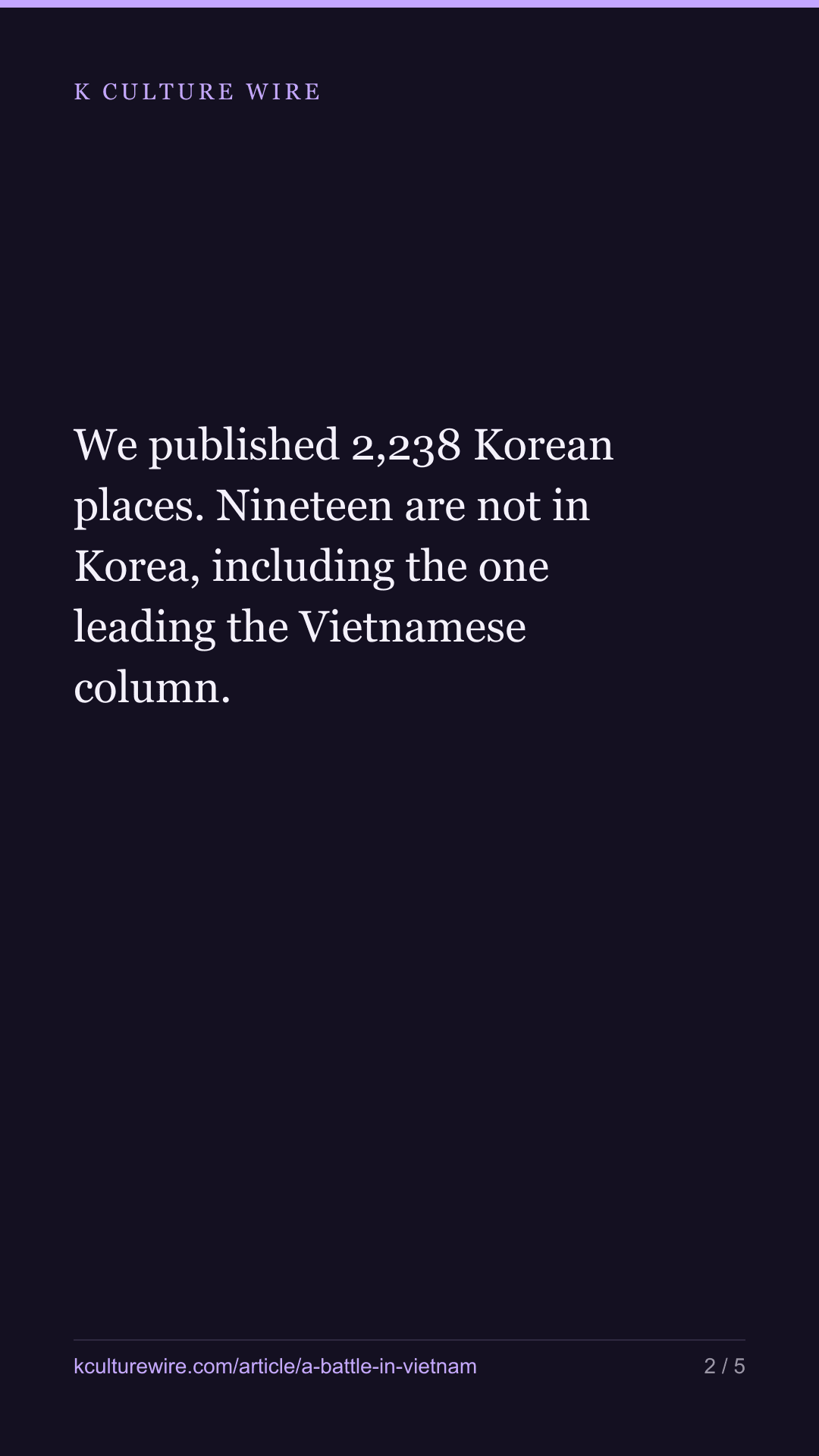
We published 2,238 Korean places. Nineteen are not in Korea, including the one leading the Vietnamese column. The field we selected on records who was involved, not only where a thing is — and our first check reused it and found nothing.
The table this is written from: /places
Since 9 August this site has carried a page answering a simple question: which parts of Korea do readers in Indonesia, Vietnam, Thailand and Malaysia look up? It ranked 2,238 places by how often their Wikipedia articles were opened.
At the top of the Vietnamese column sat the Battle of Khe Sanh.
Khe Sanh is in Quang Tri Province. The battle was fought there in 1968. It is not a Korean place, and it should never have been on that page.
How it got in
We did not choose the places by hand. An earlier version of the collector listed a dozen Wikidata types — palace, island, district — and came back with zero neighbourhoods and zero districts, because Korean administrative units carry their own type items that we had not guessed. So the collector was rewritten to ask a simpler question: everything whose country is South Korea and which has a coordinate.
That is where the mistake lives. Wikidata’s country property does not only record where something is. It also records who was involved. The Battle of Khe Sanh carries two countries — South Vietnam and South Korea — because South Korean troops fought in that war.
Eighteen more entered the same way. Two Korean Air crash sites, at the point where each aircraft came down rather than where the airline is based. The Order of Friars Minor, whose coordinate is in Rome. Jang Bogo Station, which is Korean and is in Antarctica. Two North Korean provinces, one of them typed on Wikidata as a province of South Korea. Three circles of latitude, whose recorded longitude is zero.
What our own check said first
We wrote a check for this. It asked Wikidata for the country of all 2,238 places and counted how many were not South Korea.
It found none.
Of course it did. The panel was selected on the country property, so a check that reads the country property will agree with the panel every time. It was not a check. It was the same question asked twice.
The instrument that works is the coordinate. A location does not follow a belligerent. We drew a box around Korea — latitude 32.5 to 39.0, longitude 124.0 to 132.5, deliberately generous, wide enough to hold Jeju and Dokdo — and tested every place against it.
Nineteen fall outside. Together they were 4.61 per cent of every read in the panel, and one of them led a column.
| Removed | What it is | Reads per million | Where it actually is |
|---|---|---|---|
| Battle of Khe Sanh | battle | 63.42 | 16.65, 106.72 |
| East China Sea | marginal sea | 13.55 | 30.00, 125.00 |
| Yellow Sea | sea | 11.87 | 35.00, 123.00 |
| Korean Air Lines Flight 007 crash | airspace intrusion | 11.72 | 46.57, 141.28 |
| East Asian Football Federation | governing body | 11.50 | 35.49, 137.27 |
| Order of Friars Minor | mendicant order | 7.99 | 41.90, 12.45 |
| Korean Air Flight 858 | aviation accident | 4.80 | 14.55, 97.38 |
| Jang Bogo Station | Antarctic research station | 0.12 | −74.62, 164.20 |
Eleven smaller ones are listed on the page itself.
What changes
The Vietnamese column now opens with President of South Korea at 46.88 reads per million, then Seoul at 45.91. The panel holds 2,219 places rather than 2,238. The page’s headline finding — that an entertainment company is looked up more than Seoul is — does not move, because none of the nineteen were near it.
We have listed the nineteen on the page with their coordinates rather than removing them quietly. A correction that only says “we took some things out” asks you to trust exactly the judgement that just failed.
The part worth keeping
The box is ours. We drew it, we drew it wide, and a place sitting a few kilometres outside it would be dropped for a reason that is our decision rather than a fact. We would rather keep a borderline Korean place than lose one, so the box errs large. Socotra Rock, a submerged reef South Korea and China both claim, sits just outside it and is among the nineteen.
The more useful lesson is the one about our first check. A check built from the same field as the thing it checks cannot fail, and a check that cannot fail is not evidence of anything. That was also true of a measure we published yesterday: a leave-one-out test that could detect instability in a median but could never establish stability, because the method understates how much a median moves.
Both times the fix was the same. Reach for a different instrument, and be specific about what the old one could never have seen.
The full list, the box, and the page it corrects are at which parts of Korea get looked up.
Where these numbers come from
Sources
- Wikidata — Country (P17) and coordinate location (P625), CC0 · https://www.wikidata.org/
- Wikimedia — Pageviews API, human traffic only, monthly, per edition · https://wikimedia.org/api/rest_v1/
What we checked
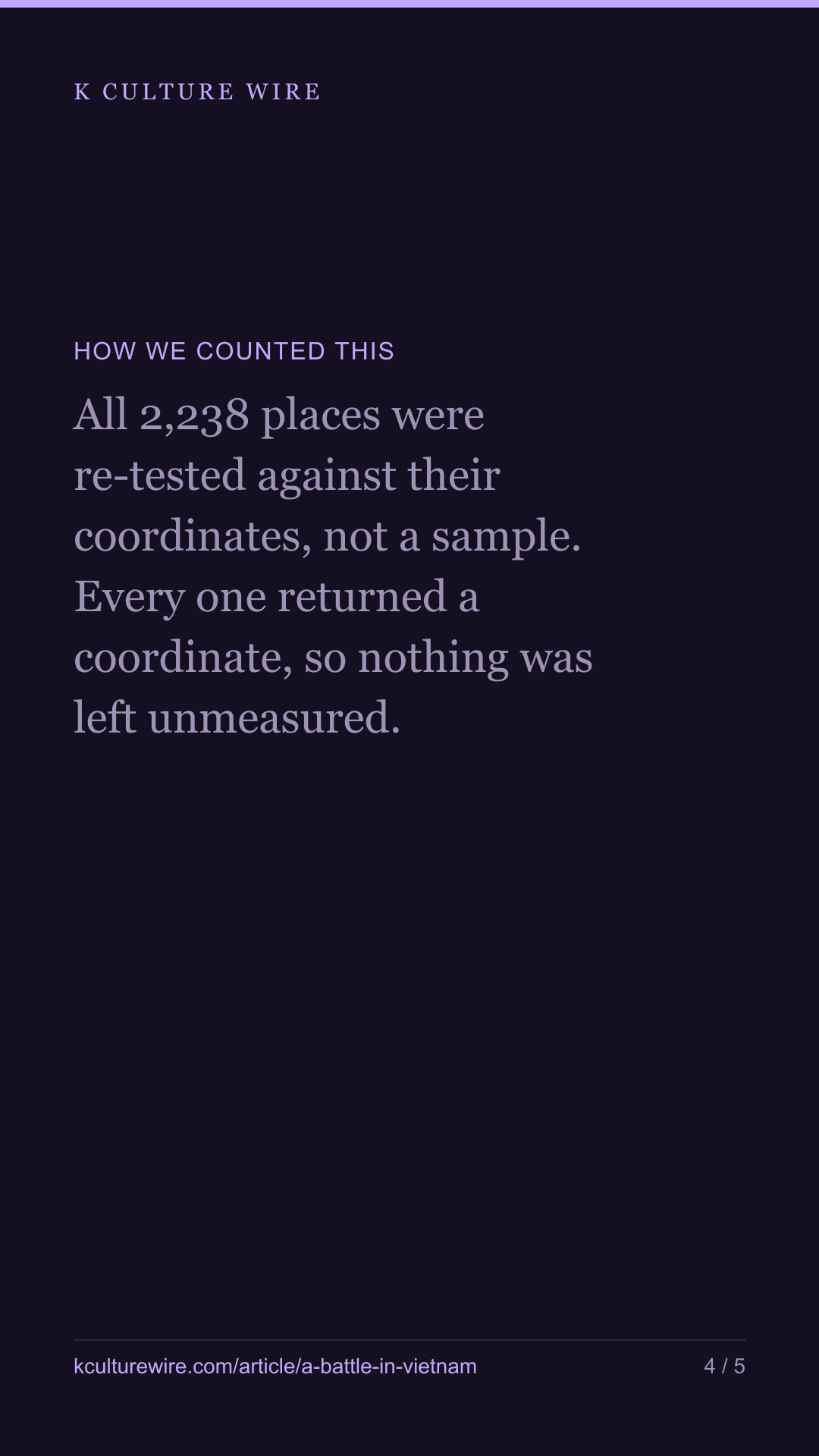
- All 2,238 places were re-tested against their coordinates, not a sample. Every one returned a coordinate, so nothing was left unmeasured.
- The nineteen removals were checked one by one by name and coordinate rather than by rule alone.
The data behind this
Written from the same data
Take this away — 10 cards
The figures in this article, as images. Free to repost with the address on them.



If you work in this business
Everything on this page is measured from the same weekly Netflix lists, per market and per title. We publish the pages free; what we sell is the same measurement cut to one company's catalogue — including the figures behind /places.
What a company sheet contains, and what it cannot tell you →