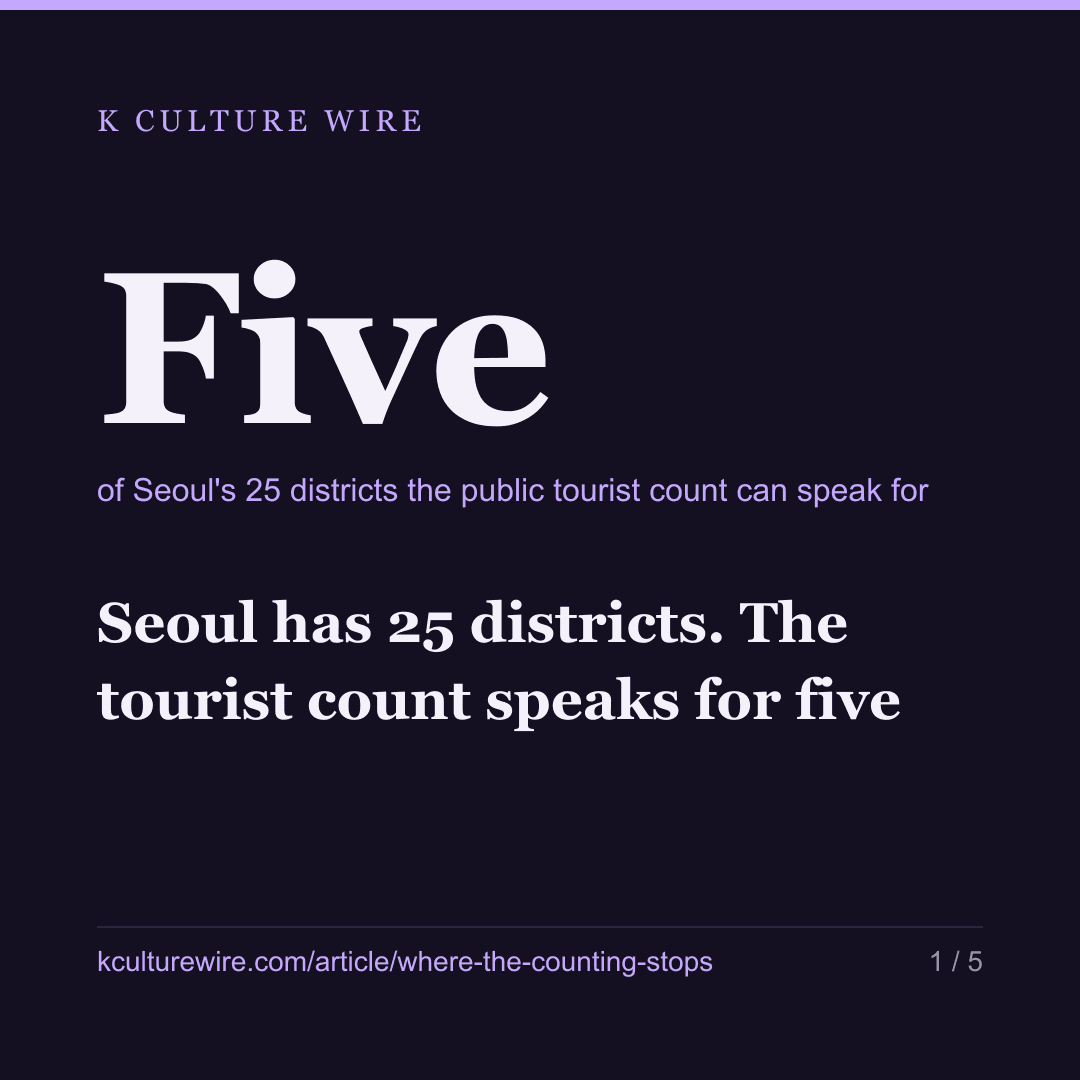
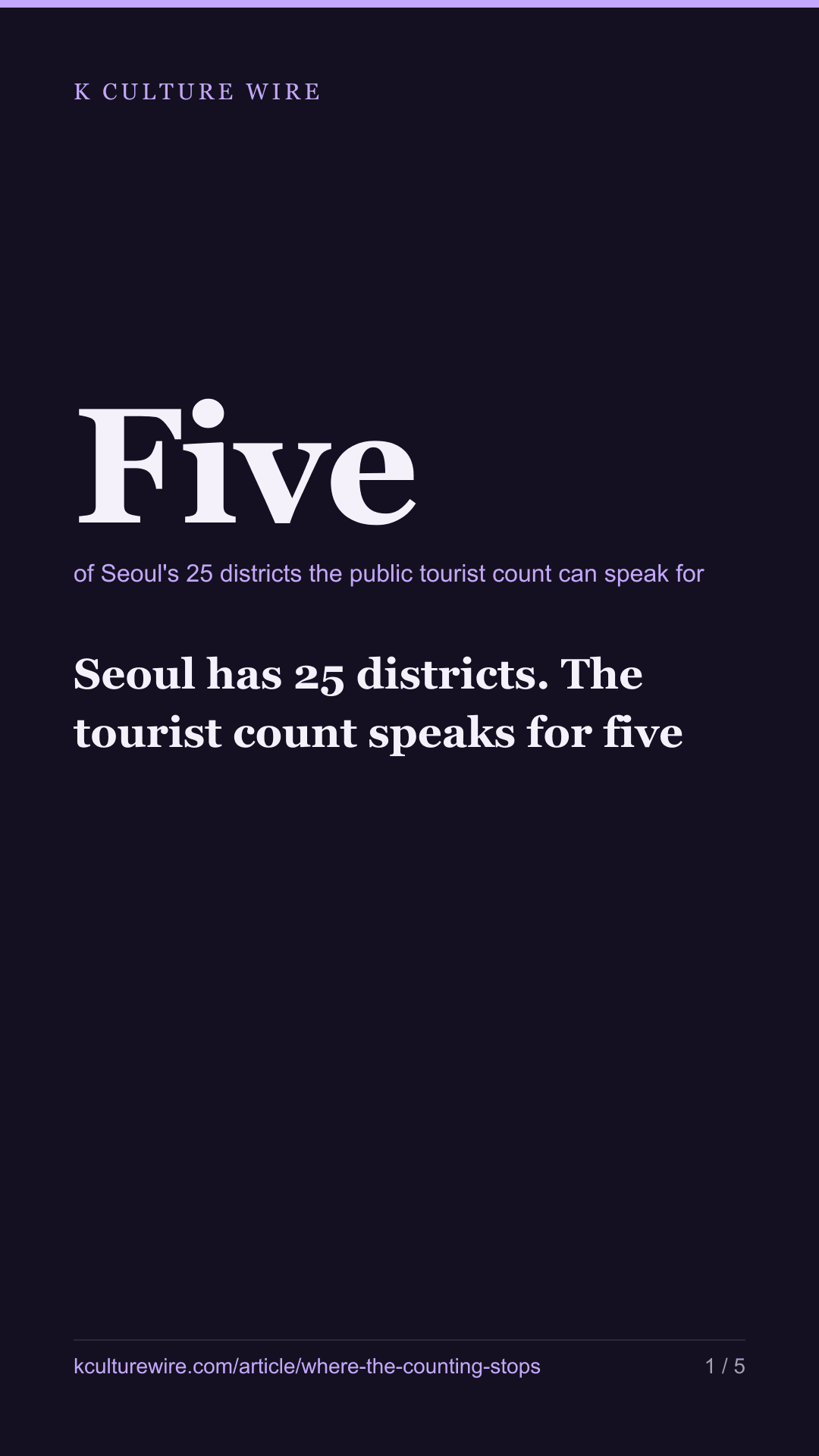
Seoul has 25 districts. The tourist count speaks for five
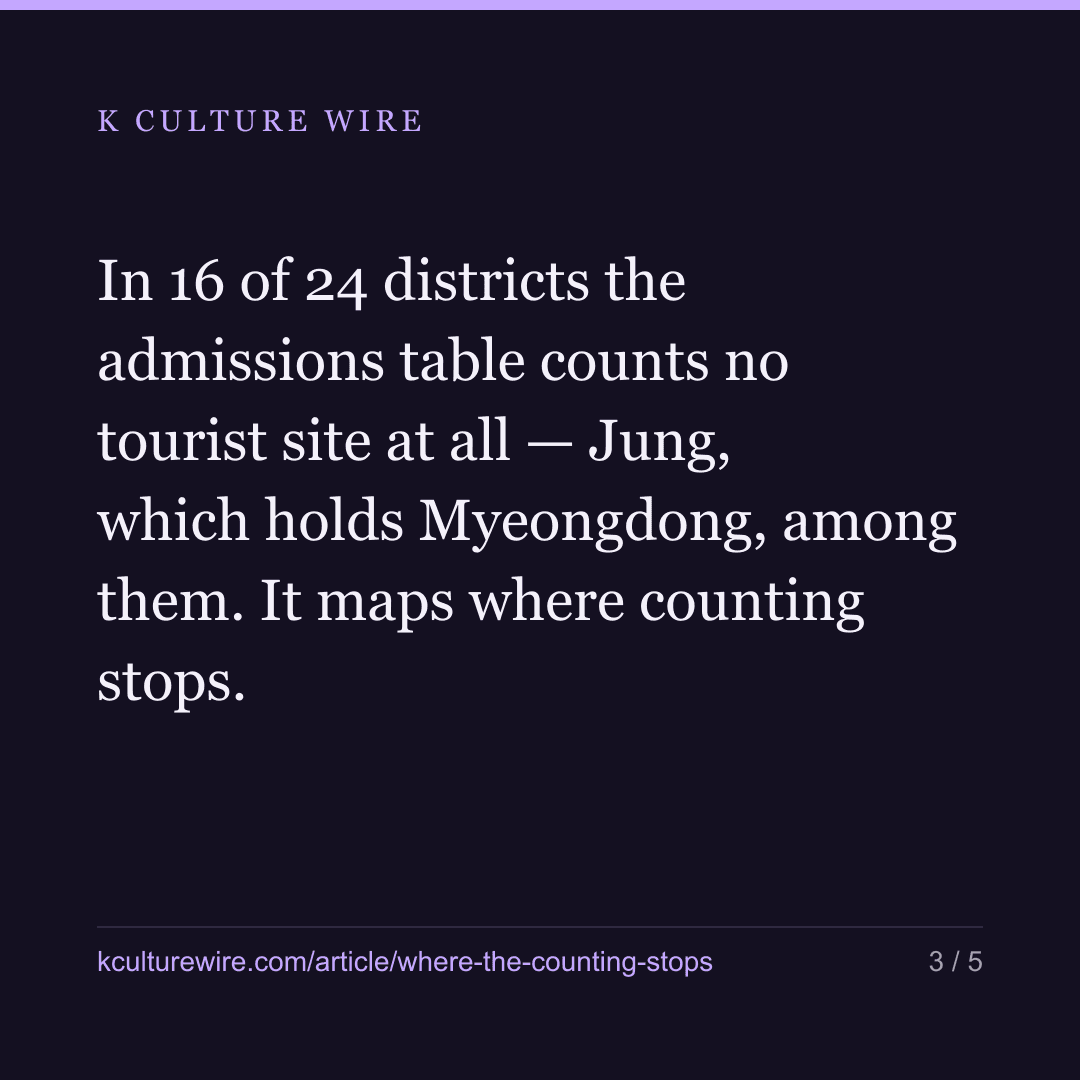
We tried to set what Southeast Asia reads about Seoul beside where foreign visitors walk. In 16 of 24 districts the admissions table counts no tourist site at all — Jung, which holds Myeongdong, among them. It maps where counting stops.
The table this is written from: /read-vs-visited
Two weeks ago we published a table of which Korean places Southeast Asia reads about, and printed a caution under it: reading is not visiting. We wrote that sentence without measuring it. This week we went to measure it, and could not.
Korea publishes admissions to paid tourist sites by district. Set it beside the reading and you can compare five of Seoul’s districts. Five.
| District | Read (per million) | Foreign admissions | Foreign share |
|---|---|---|---|
| Yongsan | 5.46 | 172,077 | 4.12% |
| Jongno | 2.87 | 1,683,727 | 19.48% |
| Dongdaemun | 1.31 | 4,551 | 4.16% |
| Seodaemun | 1.21 | 17,656 | 2.74% |
| Nowon | 0.96 | 136 | 0.22% |
These are not the five most visited districts in Seoul. They are the five where both numbers exist.
What happened to the other nineteen
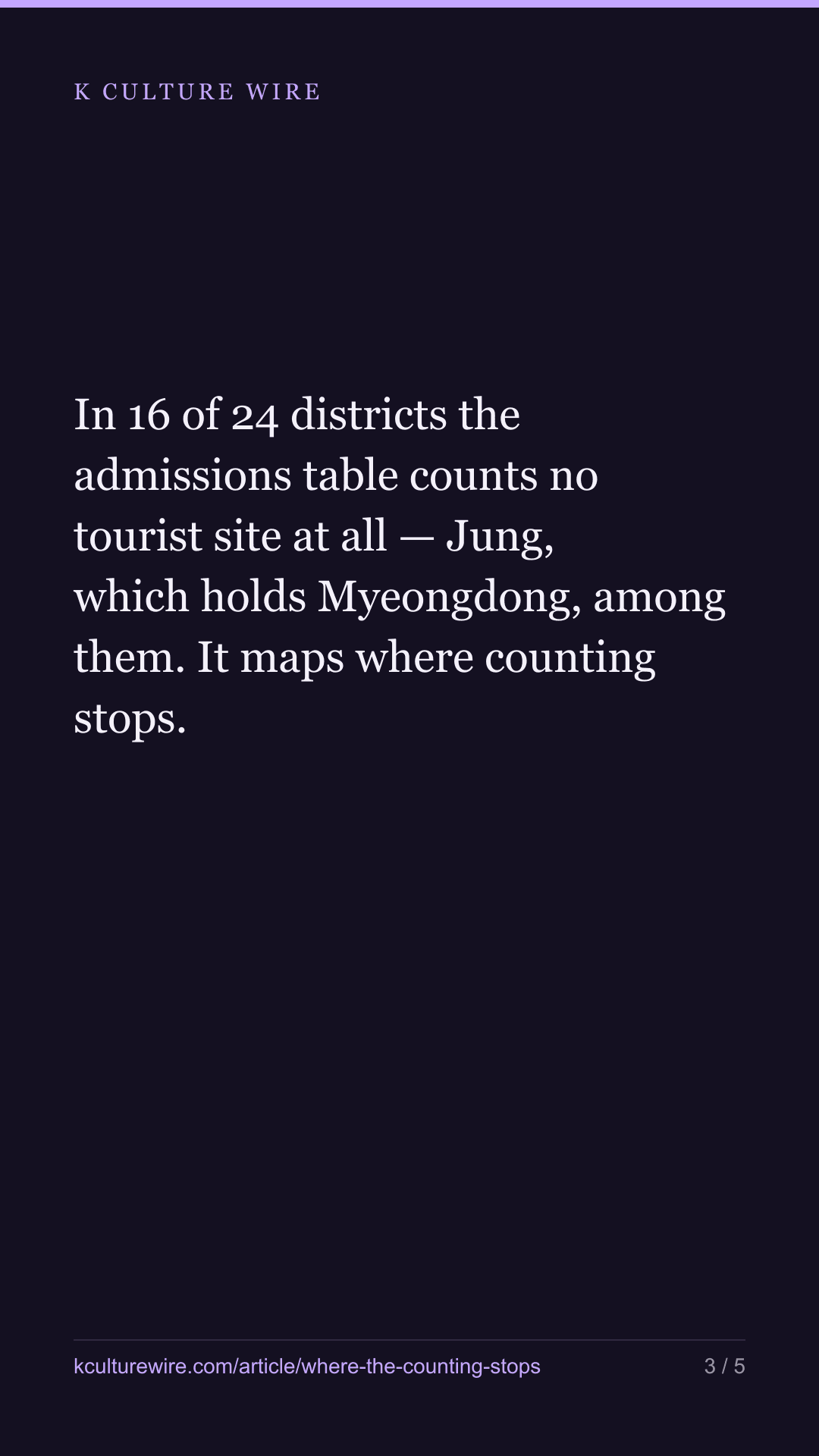
In 16 of them the admissions table counts no tourist site at all. Jung is one — the district that holds Myeongdong. So is Mapo, which holds Hongdae. Seongdong, Gwangjin, Yeongdeungpo, Seocho: no counted site.
Three more count admissions and then record foreign visitors as zero. Gangnam is one of those three. So is Songpa, which reports 7,706,775 admissions and no foreign visitors at all — the district that contains Lotte World.
We did not correct those rows to something likelier. A zero we replace with a guess is worse than a zero we leave alone and mark. They are out of the table above, and named in the one below it on the page.
The ruler is a turnstile
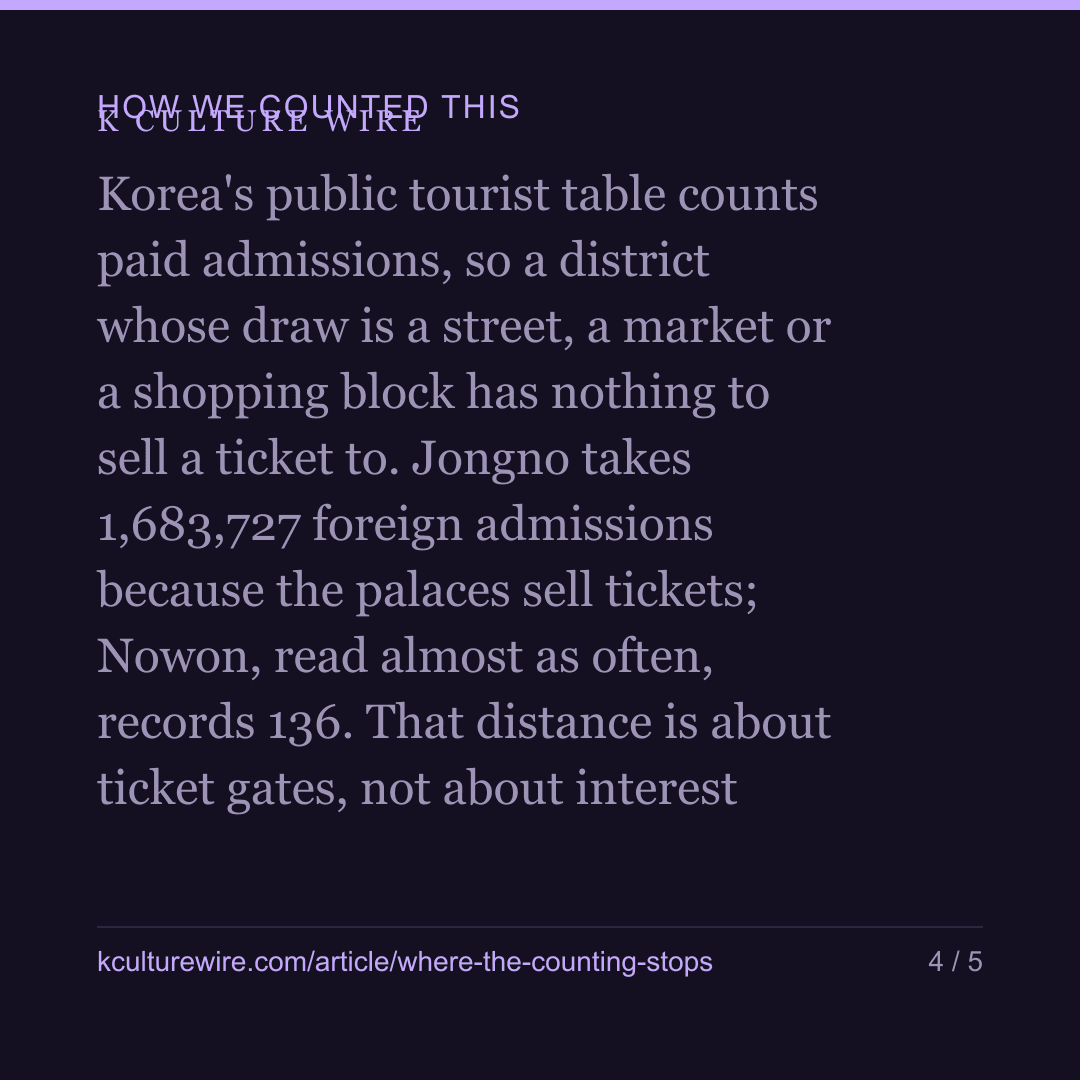
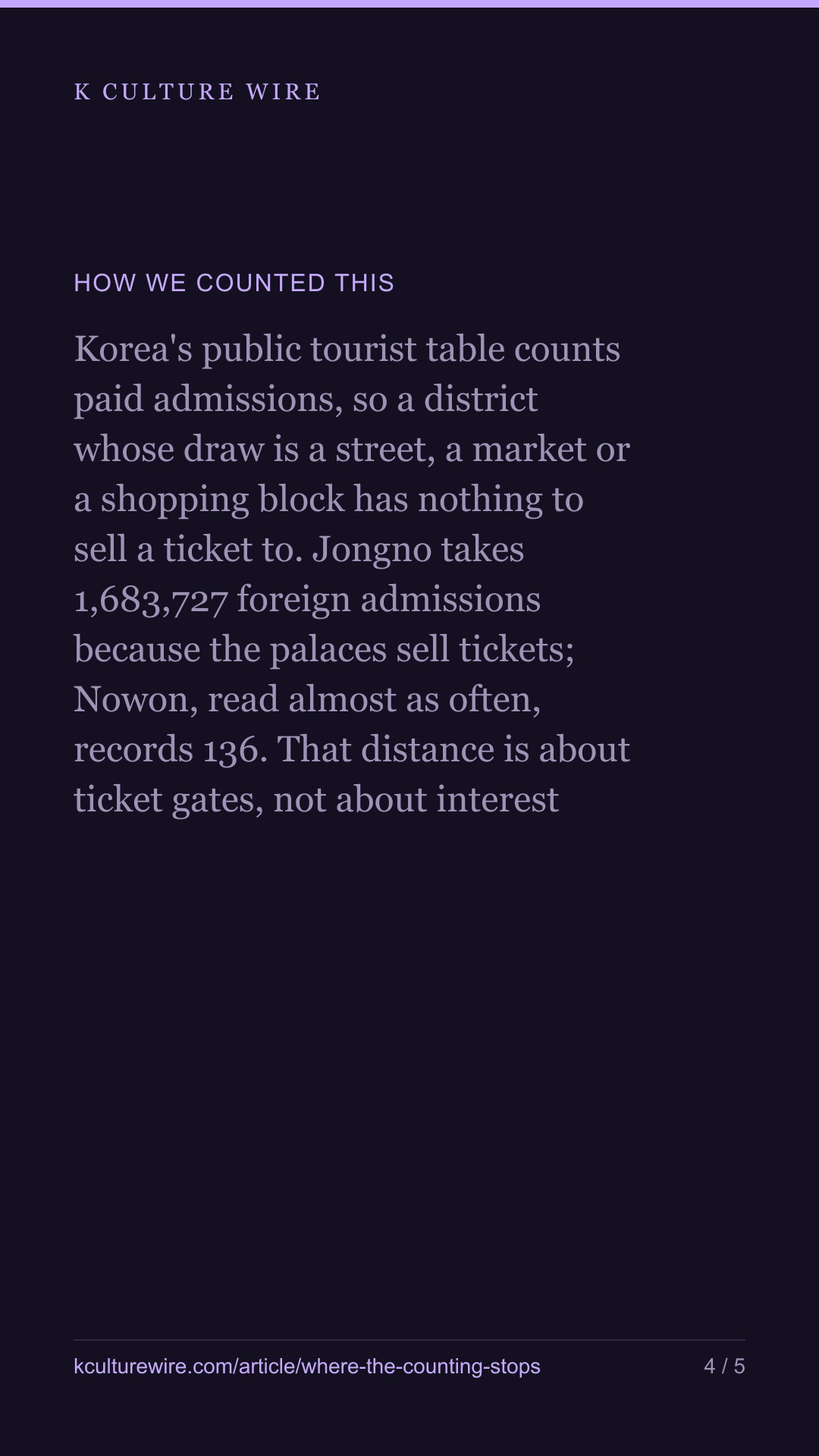
None of this means Myeongdong is empty or that Gangnam has no foreign visitors. It means the table was built to count paid admissions, and a district whose draw is a street, a market or a shopping block has nothing to sell a ticket to. Jongno takes 1,683,727 of the foreign admissions in our five because the palaces sell tickets. Nowon, read almost as often, records 136.
That distance is about ticket gates. It is not about interest.
The other ruler is incomplete too. The four Southeast Asian Wikipedias hold an article for 24 of Seoul’s 25 districts; Yangcheon has none in any of them. Neither ruler sees the whole city.
Why we are publishing a failure
Because the shape of the gap is itself the finding, and because anyone who reaches for this table to argue about where tourists go should know it can only be asked about five districts of Seoul.
It also names precisely what we are missing. The reading data can see every district and cannot see a single restaurant. The admissions data can see a turnstile and cannot see a street. Between them there is no public source that says where a visitor actually spent an afternoon in Mapo.
The tables behind this are at kculturewire.com/read-vs-visited and kculturewire.com/places.
Where these numbers come from
Sources
- KOSIS — Paid tourist-site admissions by district, Ministry of the Interior and Safety, 2023
- Wikidata — Seoul district identity and Korean labels
- Wikimedia — Pageviews API, Indonesian, Vietnamese, Thai and Malay editions, August 2025 to July 2026
What we checked
- Korea's public tourist table counts paid admissions, so a district whose draw is a street, a market or a shopping block has nothing to sell a ticket to. Jongno takes 1,683,727 foreign admissions because the palaces sell tickets; Nowon, read almost as often, records 136. That distance is about ticket gates, not about interest
- Of Seoul's 25 districts the admissions table can speak for five. This cannot be used to argue about where tourists go in the other twenty
- The other ruler is incomplete too: the four Southeast Asian Wikipedias hold an article for 24 of the 25 districts, and Yangcheon has none in any of them. Neither ruler sees the whole city
- The reading data can see every district and cannot see a single restaurant. The admissions data can see a turnstile and cannot see a street. Between them no public source says where a visitor actually spent an afternoon
The data behind this
Written from the same data
Take this away — 10 cards
The figures in this article, as images. Free to repost with the address on them.

If you work in this business
Everything on this page is measured from the same weekly Netflix lists, per market and per title. We publish the pages free; what we sell is the same measurement cut to one company's catalogue — including the figures behind /read-vs-visited and /places.
What a company sheet contains, and what it cannot tell you →