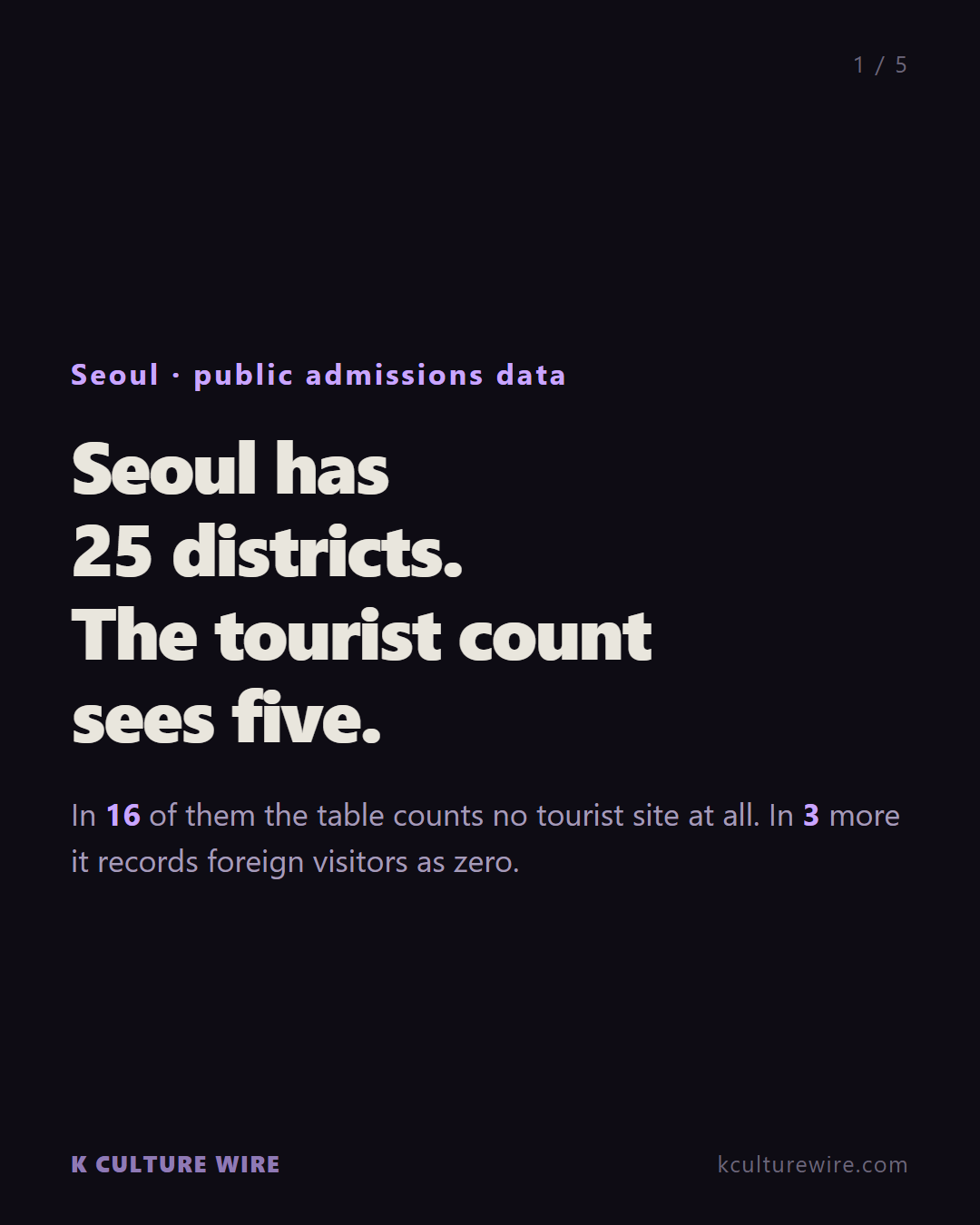
Seoul has 25 districts. The tourist count can speak for five of them
Do people read about the same parts of Seoul that foreign visitors actually walk into?
We cannot say. We set out to put reading next to walking and found the public table can only be asked about 5 of 24 districts — too few to answer, and Gangnam is not among them. What the gap shows is where the counting stops, not where people go.
Where the counting stops
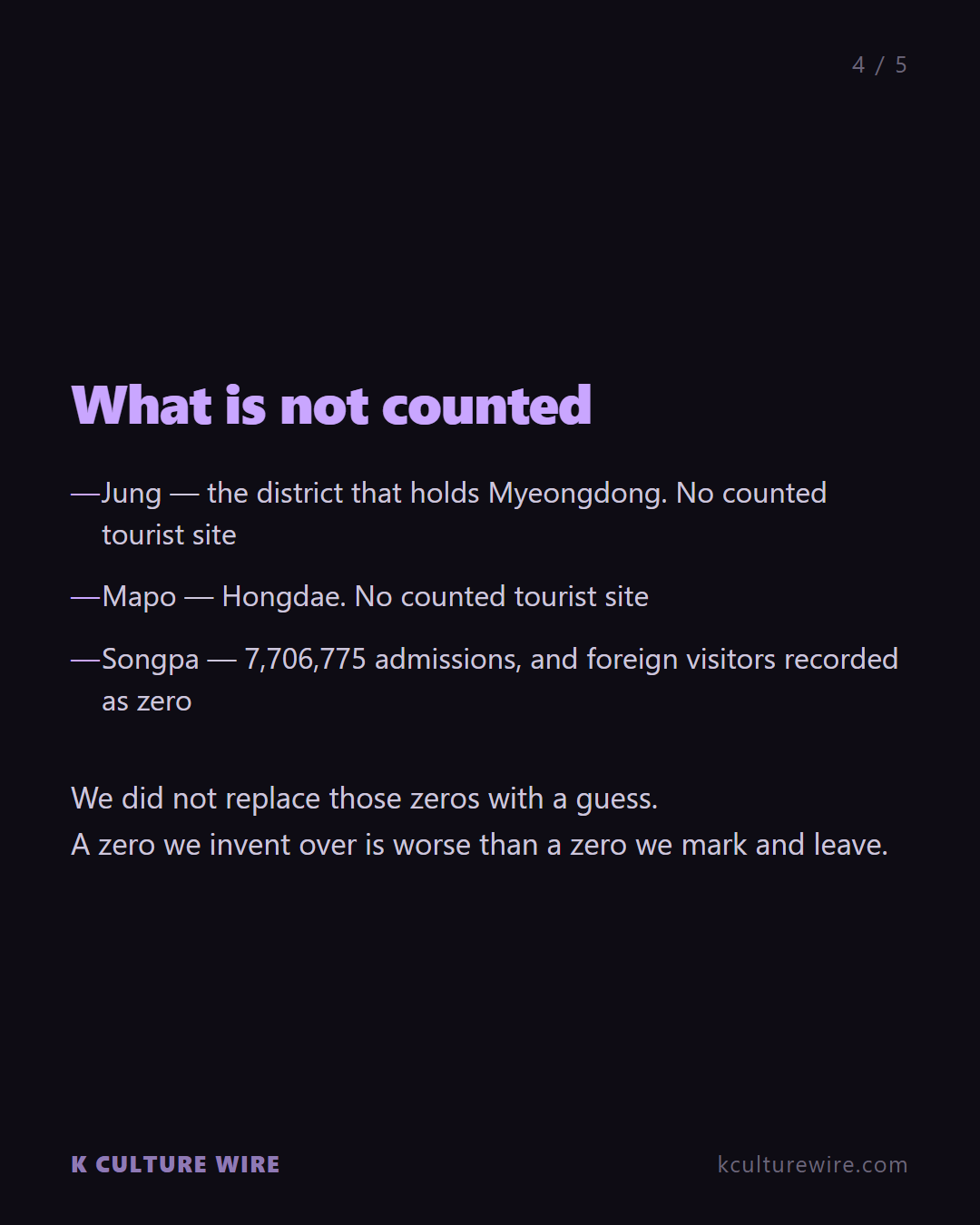
Korea's public admissions table can speak for 5 of Seoul's 24 districts. In 16 of them it counts no tourist site at all — among them Jung (Myeongdong) and Mapo (Hongdae). In 3 more it counts admissions but records foreign visitors as zero: Gangnam, Songpa, Gangseo.
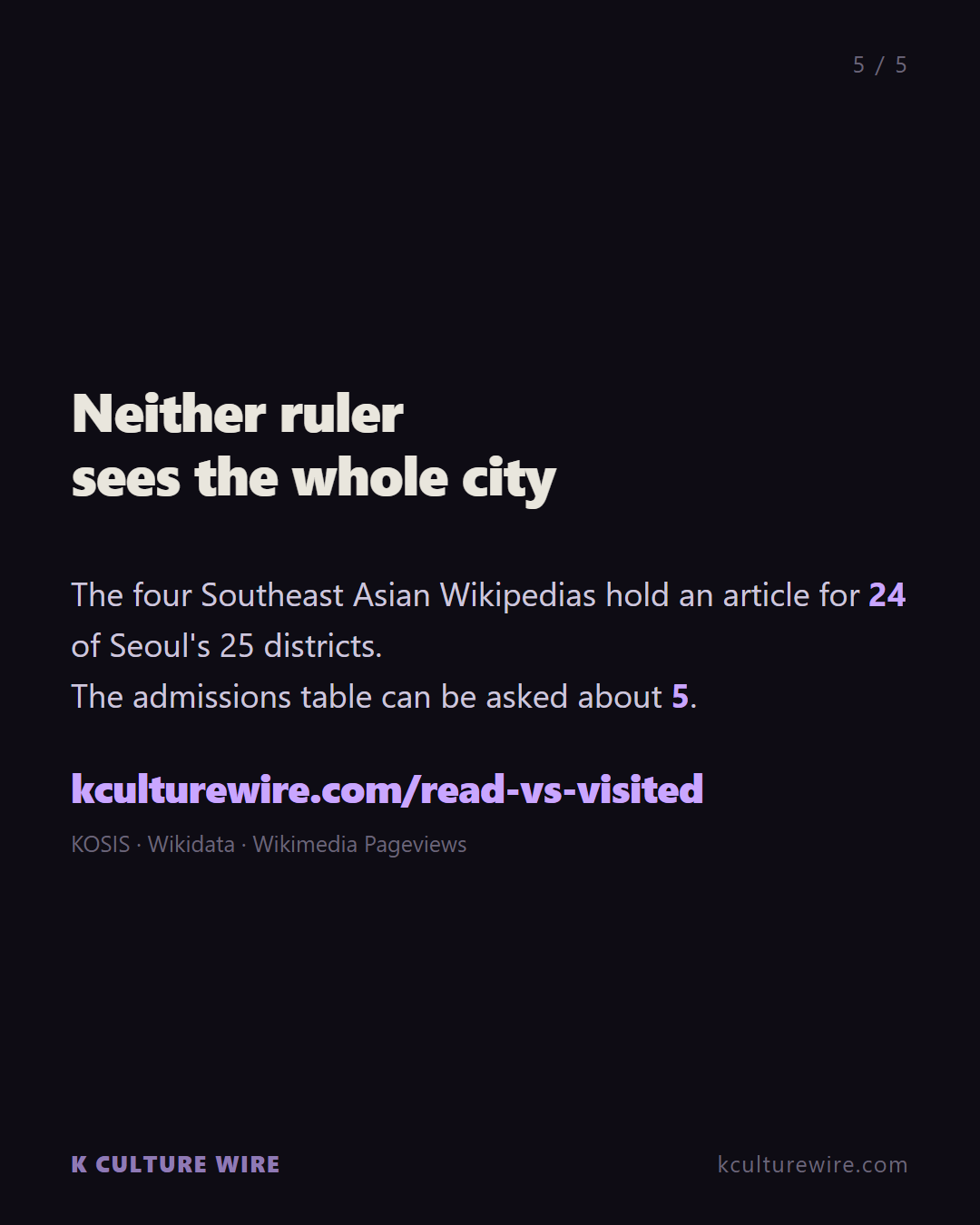
Seoul has 25 districts. The Southeast Asian Wikipedias hold an article for 24 of them — Yangcheon has none in any of the four. The admissions table can be asked about 5. Neither ruler sees the whole city.
The five districts both rulers can see
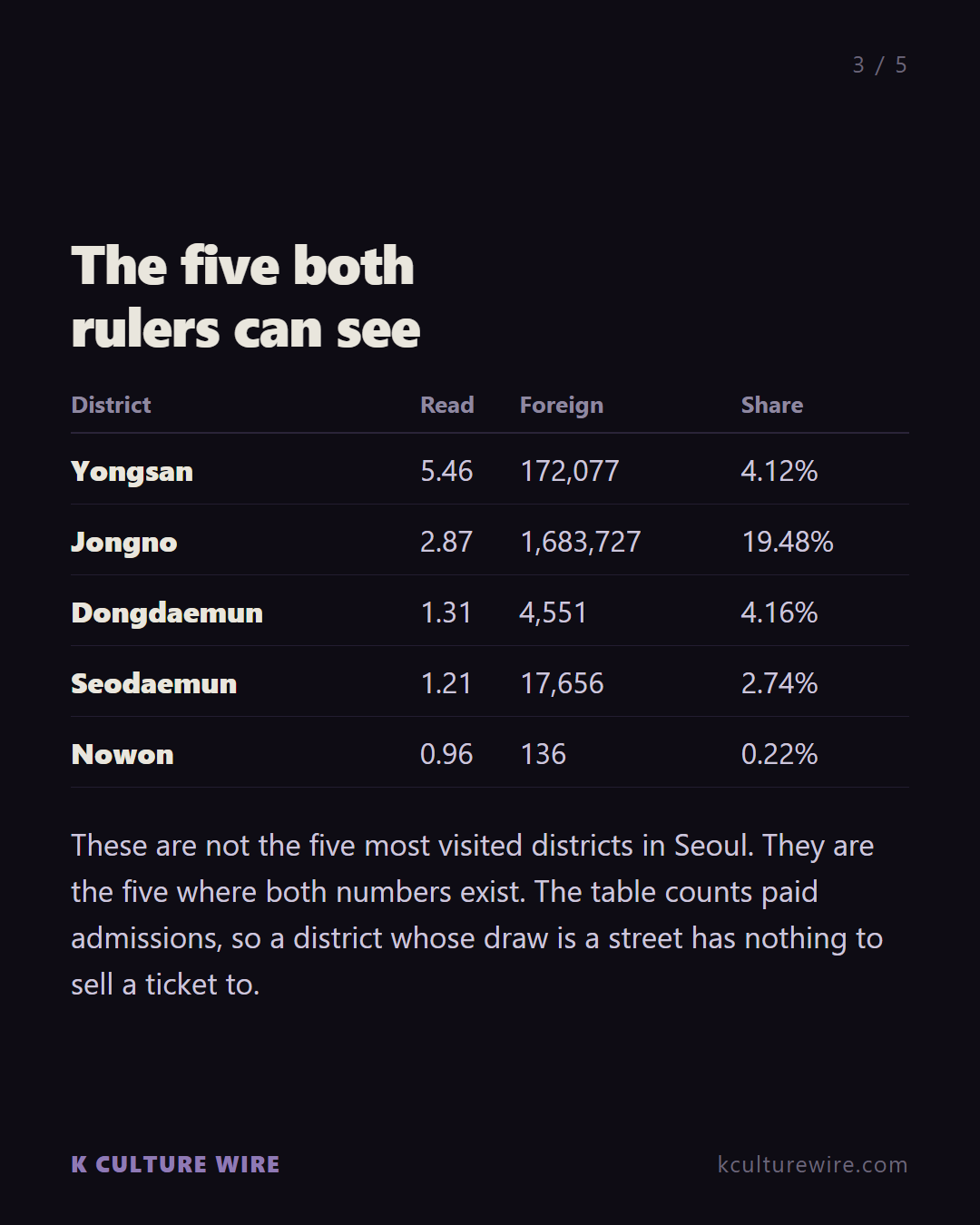
Reading is reads per million reads of that Wikipedia edition. Visiting is foreign admissions to counted paid tourist sites. These are not the five most visited districts in Seoul. They are the five where both numbers exist. Read the rows, not the order.
| District | Read (per million) | Foreign admissions | Foreign share |
|---|---|---|---|
| Yongsan | 5.46 | 172,077 | 4.12% |
| Jongno | 2.87 | 1,683,727 | 19.48% |
| Dongdaemun | 1.31 | 4,551 | 4.16% |
| Seodaemun | 1.21 | 17,656 | 2.74% |
| Nowon | 0.96 | 136 | 0.22% |
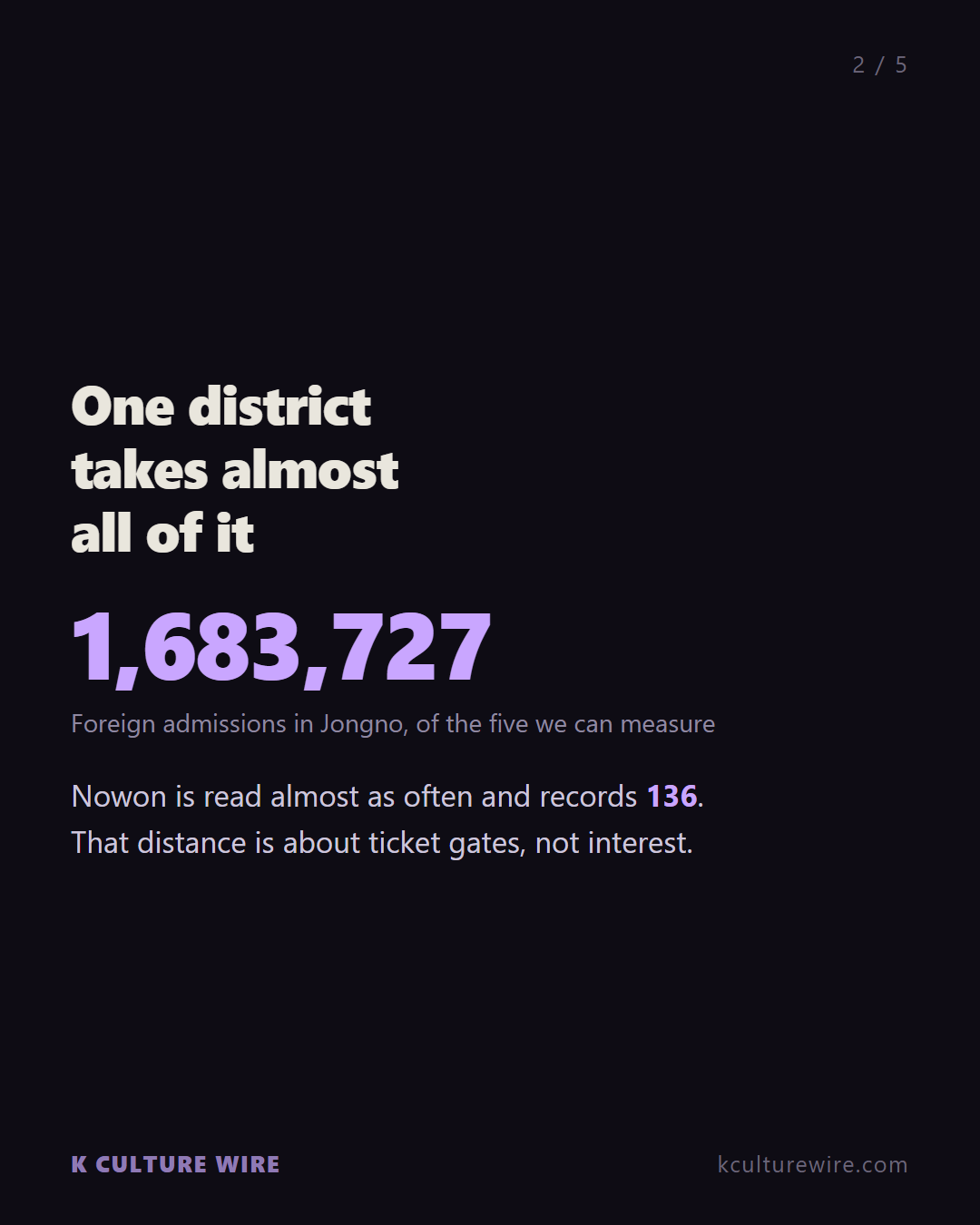
Jongno takes 1,683,727 of these admissions — the palaces sell tickets, and a ticket is what this table counts. Nowon, with a comparable amount of reading, records 136. That distance is about ticket gates, not about interest.
The districts we had to leave out
| District | Why it is not in the table above |
|---|---|
| Gangnam | admissions recorded, foreign visitors recorded as zero |
| Mapo | no counted tourist site in this district |
| Seocho | no counted tourist site in this district |
| Gangbuk | no counted tourist site in this district |
| Songpa | admissions recorded, foreign visitors recorded as zero |
| Jung | no counted tourist site in this district |
| Dongjak | no counted tourist site in this district |
| Yeongdeungpo | no counted tourist site in this district |
| Seongdong | no counted tourist site in this district |
| Gangseo | admissions recorded, foreign visitors recorded as zero |
| Gwangjin | no counted tourist site in this district |
| Dobong | no counted tourist site in this district |
| Gangdong | no counted tourist site in this district |
| Seongbuk | no counted tourist site in this district |
| Gwanak | no counted tourist site in this district |
| Jungnang | no counted tourist site in this district |
| Geumcheon | no counted tourist site in this district |
| Guro | no counted tourist site in this district |
| Eunpyeong | no counted tourist site in this district |
Gangnam, Songpa and Gangseo each record admissions and then a foreign-visitor count of zero. We did not correct those rows to something we think is likelier. We left them out and said so.
How far apart the two rankings actually are
Not far enough to answer the question. Across the districts we can compare, the biggest disagreement between reading order and visiting order is one place: Yongsan District is read 1st and visited 2nd, while Jongno District is the pair the other way round. 1 district holds the same position on both. With gaps this small and a table this short, we cannot say that curiosity and arrival disagree. We are saying the count is too thin to tell — not that they agree.
A read is curiosity, not a trip. It cannot say who came, only who looked. Arrival counts by nationality are published separately by the Korea Tourism Organization and are the right instrument for visits.
Absent, not zero. Yangcheon has no encyclopaedia article we could read at all, so it carries no reading figure here. We list it rather than letting it vanish from the denominator.
Zooming out — the same question, nationwide
The five-district table above is a Seoul-only comparison. A separate count, from the same admissions source, asked the wider version of the question: is the capital even where most counted foreign visits happen at all?
| Where (2023 admissions) | Foreign admissions | Share |
|---|---|---|
| Capital region — Seoul, Gyeonggi, Incheon | 3,358,821 | 42.2% |
| Everywhere else | 4,603,017 | 58% |
| Top counted district — Gangneung, Gangwon | 1,847,775 | 23.4% of the district total |
58 percent of counted foreign admissions are already outside the capital region, and the single biggest counted district is Gangneung, not a Seoul district. Full breakdown, with the 112-of-206 districts that count no foreign visitor at all: Korea's biggest counted foreign draw is not in Seoul.
What this page cannot tell you
These two rulers count different people. The reading is from four Southeast Asian Wikipedias; the admissions count every foreign visitor, from anywhere.
They also cover different time. The reading is the twelve months to July 2026; the admissions are the calendar year 2023.
These are paid tourist sites only. A district whose draw is a street, a market or a shopping area — Gangnam among them — records few admissions here, and that is the ruler talking, not the visitors. It also counts admissions, not people: one visitor entering three sites is three.
The source records a foreign-visitor count of 0 for districts that plainly receive foreign visitors — Songpa, which holds Lotte World, is one of them with 7.7m admissions and 0 foreigners. We do not correct the source. We mark those rows and leave them out of any share we publish.
Reading — Wikidata (CC0) for places and article links; Wikimedia Pageviews API for reads, 2025-08 through 2026-07, 12 months, human traffic only. Visiting — KOSIS, paid tourist-site admissions, Ministry of the Interior and Safety, 2023.
Card set — free to share
Five cards, 1080×1350. Every figure on them is in the table on this page. Take them.
14 seconds, with sound
A man and a woman read out the two figures above — Seoul has 25 districts and the public tourist count can speak for 5. Free to repost with the address on it.
All our short films — each one built from a table on this site
What we wrote from this data
- Korea's biggest counted foreign draw is not in Seoul. It is Gangneung
A forum called spreading visitors beyond the capital the unfinished task. In the admissions table 58 percent of foreign entries are already outside it, and the top district is Gangneung, not Jongno. But 112 of 206 districts count nobody.
11 September 2026
- Southeast Asia looks up a Korean trip in December, not June
Reads of Korean travel articles in four Southeast Asian Wikipedias peak in December; flights on the Asia routes peak in January. The steadier signal is the other end — both fall to their lowest point in the same month.
15 August 2026
- Seoul has 25 districts. The tourist count speaks for five
We tried to set what Southeast Asia reads about Seoul beside where foreign visitors walk. In 16 of 24 districts the admissions table counts no tourist site at all — Jung, which holds Myeongdong, among them. It maps where counting stops.
15 August 2026