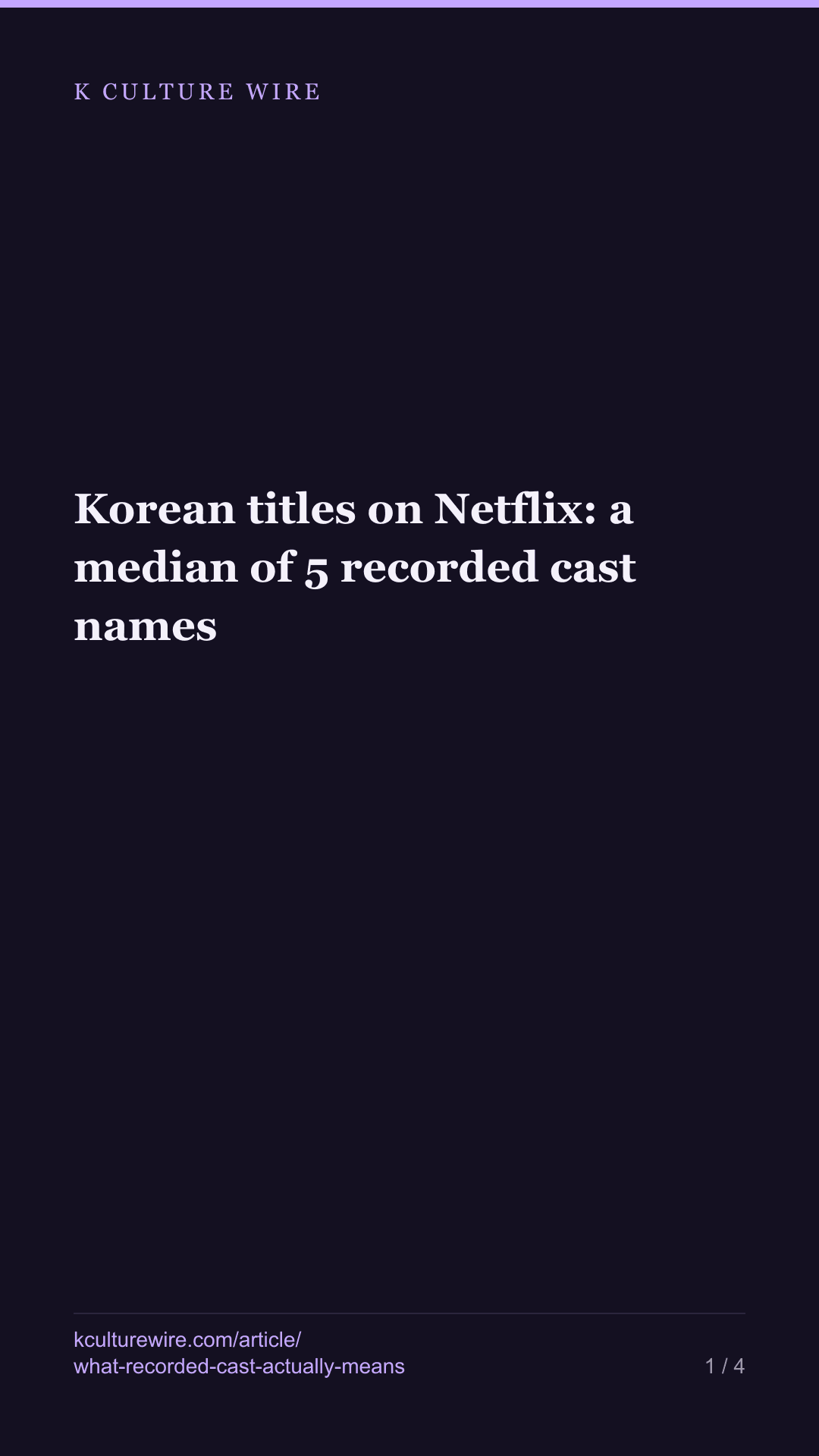
Korean titles on Netflix: a median of 5 recorded cast names
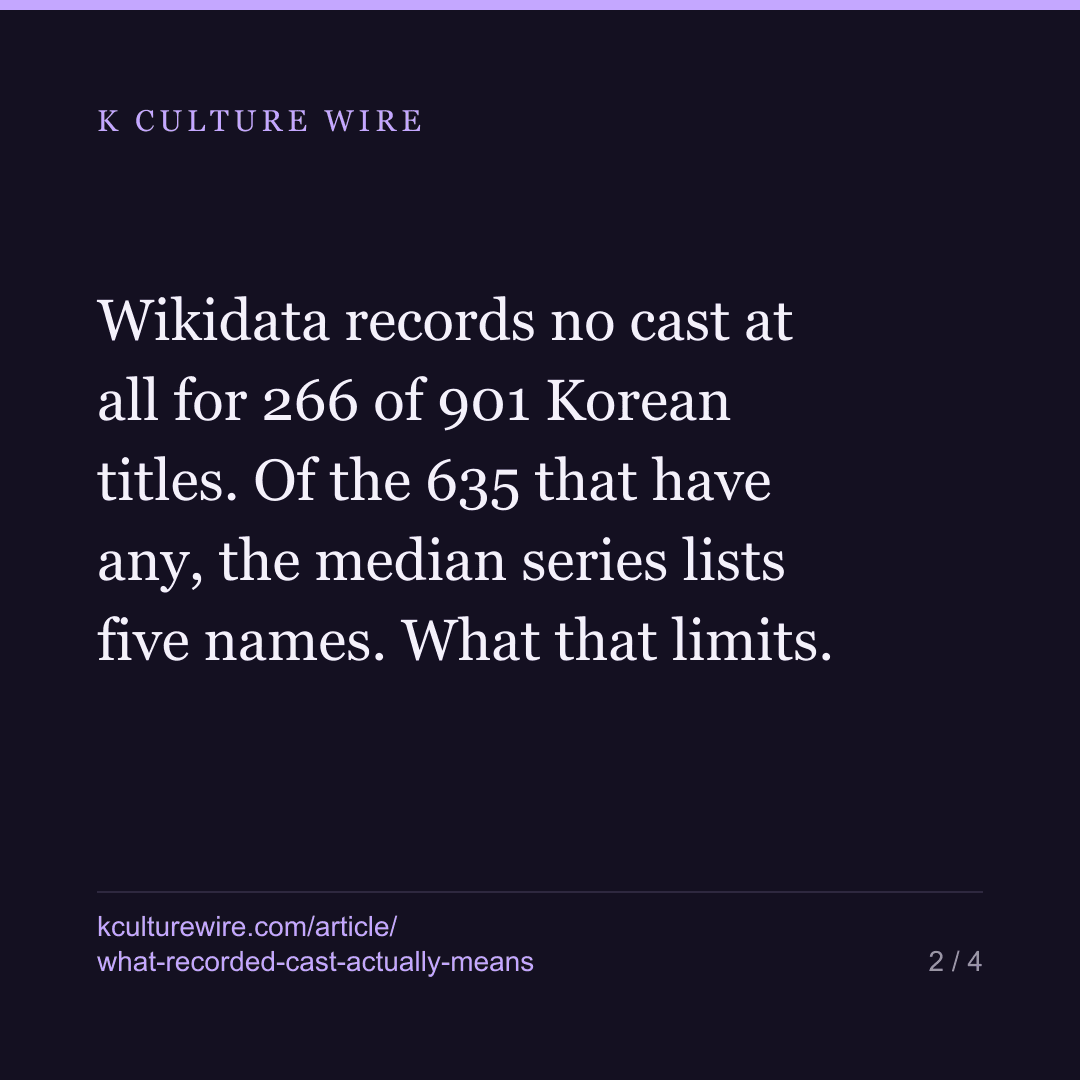
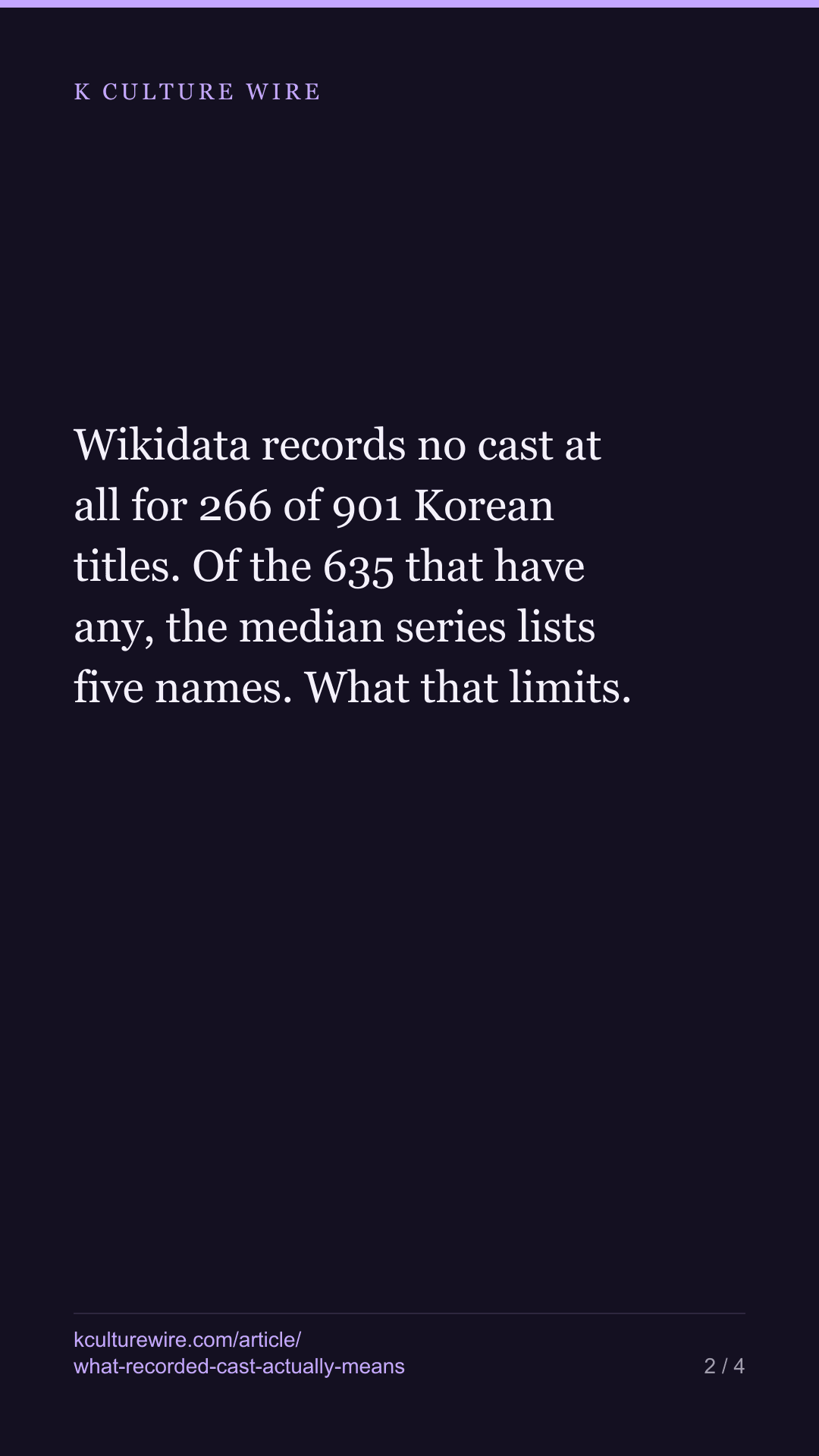
Wikidata records no cast at all for 266 of 901 Korean titles. Of the 635 that have any, the median series lists five names. What that limits.
The table this is written from: /actors
We have published several things this week that come from one join: which Korean actor appears in which Korean title that reached a Netflix Top 10. Before any of it is used, here is what the join is actually made of.
| Titles | Median cast recorded | |
|---|---|---|
| Films | 369 | 4 |
| Series | 297 | 4 |
A sixteen-episode drama is represented here by a median of four names. Seventy-six titles have exactly one person recorded. And 277 of the 943 Korean titles we matched carry no cast statement at all, so they are not in the join in any form.
That is the whole foundation: 3,579 casting slots, 1,391 people, 666 titles.
What thin records do to each figure
The useful thing about this particular gap is that its direction is knowable even where its size is not.
“48.4% of people appear in exactly one title” is a ceiling, not an estimate. Every missing credit turns a repeat worker into a one-timer. It cannot work the other way. The true share of one-timers is lower, by an amount we cannot compute.
“61.6% of multi-title actors work in both film and series” is a floor. A missing credit can only make a crosser look like a specialist. The true crossing rate is higher.
“96.7% of titles form one connected body” is also a floor. Adding a cast member can create a link between two titles; it can never remove one. More complete records would make the catalogue look more connected, not less.
“The busiest actors are film actors” is the one that could genuinely reverse. Series casts are long and recorded thinly — that is exactly where the missing names should be. If they were filled in, the series slot count would rise and the gap would narrow. We flagged that in the piece itself rather than here, because a limit that could overturn a finding belongs beside the finding.
Why we use it anyway
Because the alternative is not a better dataset. Netflix publishes no cast. No open source lists who appeared in Korean films and series with identifiers you can join on. Wikidata is thin, and it is the only thing there is.
So the rule we work to is: publish the figure as it comes out, state which way the error runs, and never apply a correction factor we cannot defend. A number with a known direction of bias is usable. A number silently adjusted towards what we expected is not.
What we changed to make the join usable at all
Until 7 August 2026 we had stored, for each actor, how many charting titles they appeared in — and not which ones. Every question of the form did this show move its cast was therefore unanswerable, and rebuilding the link took a full day of re-querying.
The join is now keyed on Wikidata Q-numbers for both the person and the title, not on names, because names change and identifiers do not. Matching these two sources on title text attaches cast to only 317 of 1,005 titles — chart names and article titles disagree constantly. On Q-numbers it reaches 666 of 943.
The file is in our data bundle as cast-title-join.csv, with a column dictionary that says what a
blank cell means in each column, and a coverage file that carries every number above.
These limits sit under every network figure we publish, and under the tables themselves. Read what is in the data and what is missing →
What changed on 2 September 2026
We re-collected the cast data on 25 August 2026 and recounted every figure here. The foundation moved to 3,579 casting slots, 1,391 people and 666 titles, and the share of people appearing in exactly one title from 48.5% to 48.4%.
The finding did not change. What “recorded cast” means is still a floor and not a census.
What changed on 3 September 2026
We re-collected the keyed title roster from Wikidata. One more charted title matched a Korean Wikidata item, and it has no cast recorded.
| Was | Now | |
|---|---|---|
| Charted titles matched to a Korean Wikidata item | 942 | 943 |
| Of those, titles with at least one cast member | 666 | 666 (unchanged) |
| Titles with no cast recorded | 276 | 277 |
The join did not change. What grew is the roster it is measured against, so the gap we name here is one title wider than it was.
Where these numbers come from
Sources
- Wikidata — Cast member (P161) with citizenship (P27 = Q884) on Korean titles that appeared in a Netflix Top 10, joined on Q-numbers · https://query.wikidata.org
- Netflix — Top 10 weekly lists (Tudum), used to decide which Korean titles enter the set · https://www.netflix.com/tudum/top10
What we checked
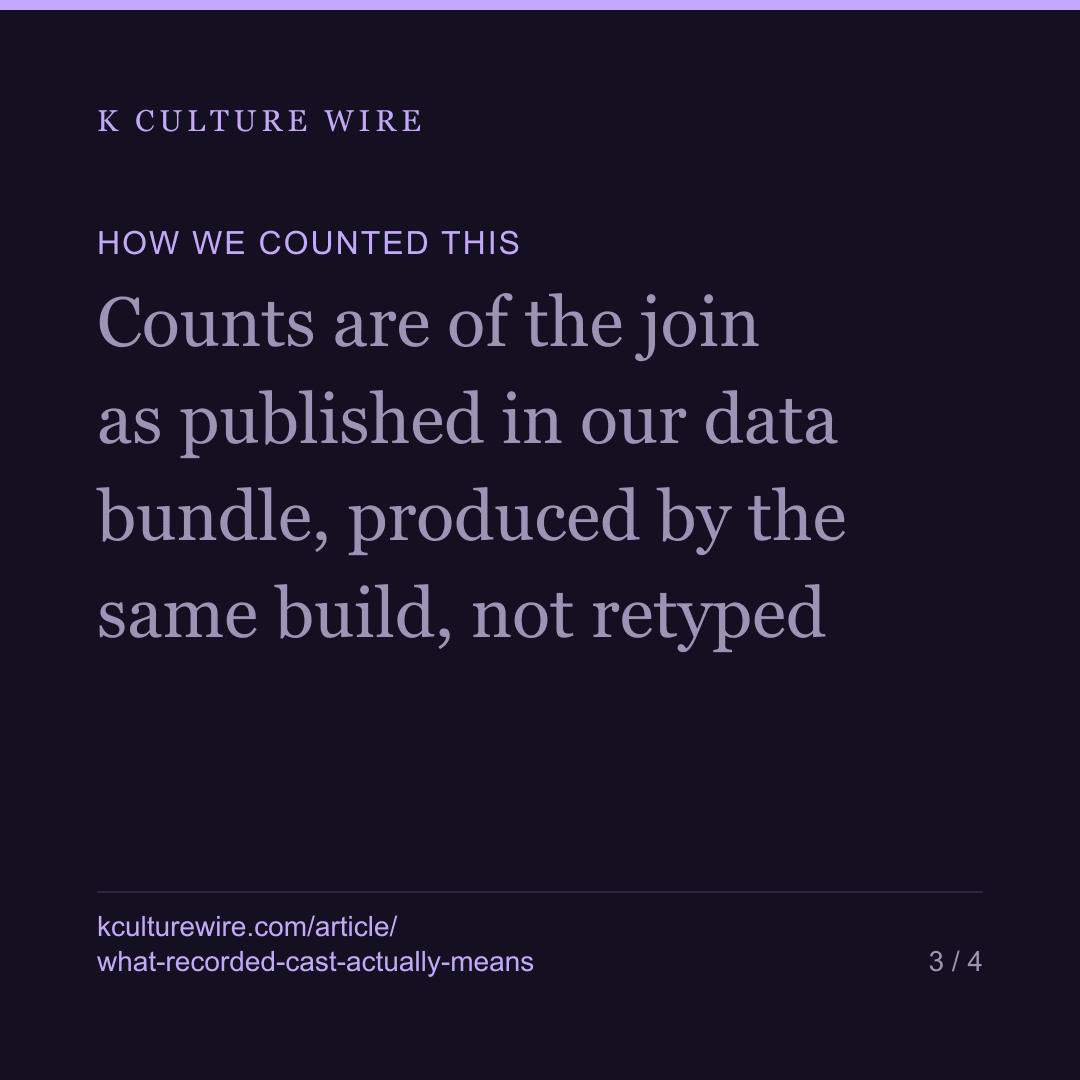
- Counts are of the join as published in our data bundle, produced by the same build, not retyped
- The 266 titles with no cast are those matched to a Korean Wikidata item that carries no P161 statement at all. They are absent from the join rather than present with an empty cast
- Medians are given separately for film and series because their recorded cast sizes differ and a combined median would hide that
What we left out, and why
- Any estimate of true cast size. We do not know how many people were actually credited in these productions and we are not going to model it
- Any correction factor. Every figure we publish from this join is reported as it comes out of the data, with the direction of the likely error stated instead
- Crew, directors, writers and uncredited appearances. P161 records cast
The data behind this
Written from the same data
Take this away — 8 cards
The figures in this article, as images. Free to repost with the address on them.

If you work in this business
Everything on this page is measured from the same weekly Netflix lists, per market and per title. We publish the pages free; what we sell is the same measurement cut to one company's catalogue — including the figures behind /actors and /titles.
What a company sheet contains, and what it cannot tell you →