Squid Game leads by hours, All of Us Are Dead by countries
Netflix publishes one ranking of Korean shows: hours viewed. Count countries instead and 11 of the top 15 move at least three places. Extraordinary Attorney Woo goes from 2nd to 49th.
The table this is written from: /which-ranking
Ask which Korean show on Netflix was the biggest and you will get one number back: hours viewed. It is the figure Netflix itself publishes, the one every article quotes, and by it Squid Game is first with 5.05 billion hours — seven times the show behind it.
That is a real measurement. It is also a choice, and the choice was made for you.
Change the ruler and the list comes apart
Netflix publishes a second set of files: the weekly top 10 for each country. From those we can count two things Netflix does not rank anybody by — how many countries a title charted in, and how many weeks it stayed on a chart somewhere.
Of the fifteen biggest Korean titles by hours, eleven move at least three places when you order them by countries instead.
| Title | By hours | By countries |
|---|---|---|
| Squid Game | 1 | 2 |
| Extraordinary Attorney Woo | 2 | 49 |
| All of Us Are Dead | 3 | 1 |
| Queen of Tears | 4 | 74 |
| The Glory | 5 | 7 |
| When Life Gives You Tangerines | 7 | 89 |
When Life Gives You Tangerines is 82 places apart on the two lists. It is enormous by hours and, by the count of countries whose top 10 it entered, unremarkable. Neither of those sentences is wrong.
The two titles the hours ranking never shows you
All of Us Are Dead charted in 93 countries — more than any other Korean title we hold, and one place ahead of Squid Game on that ruler. By hours it is third, and third is where it stays in everybody’s summary.
Further out of sight: I am Solo spent 112 weeks on country top 10s, the longest run of any Korean title in the five years of files. It is nowhere near the hours top fifteen. A dating show held a place on a national chart for more than two years and the ranking everybody quotes has no row for it at all.
Why the two rulers disagree
They are not measuring the same event.
- Hours viewed is a worldwide total. A title can pile up enormous hours inside a handful of large markets and never appear on a small country’s chart.
- Countries charted counts doors opened. A title can enter ninety top 10s without ever topping one of them, and accumulate a fraction of the hours.
So a show can be huge and narrow, or wide and light. English has one word for both — biggest — and that word quietly picks the first meaning every time.
What we are not going to tell you
We are not going to say that countries is the honest ruler and hours is the marketing one. We publish both because the right answer depends on what you are deciding. A distributor buying rights for one territory does not want the same number as a subtitling team planning language coverage, and neither wants the number a fan is arguing about.
What we will say is that “the biggest Korean show on Netflix” is not a fact you can look up. It is a question with at least three defensible answers, and the one you usually get is the one Netflix chose to publish.
The full fifteen, with all three rankings and the charts, is at which ranking is the real one.
So: a show watched enormously in a few countries, or a show that charted in ninety and topped none — which one travelled further? We are not picking. Comments open on that page when they are ready.
Where these numbers come from
Sources
- Netflix — Tudum global weekly top 10 — hours viewed, published by Netflix itself · https://www.netflix.com/tudum/top10
- Netflix — Tudum per-country weekly top 10 files — countries and weeks counted by us · https://www.netflix.com/tudum/top10
What we checked
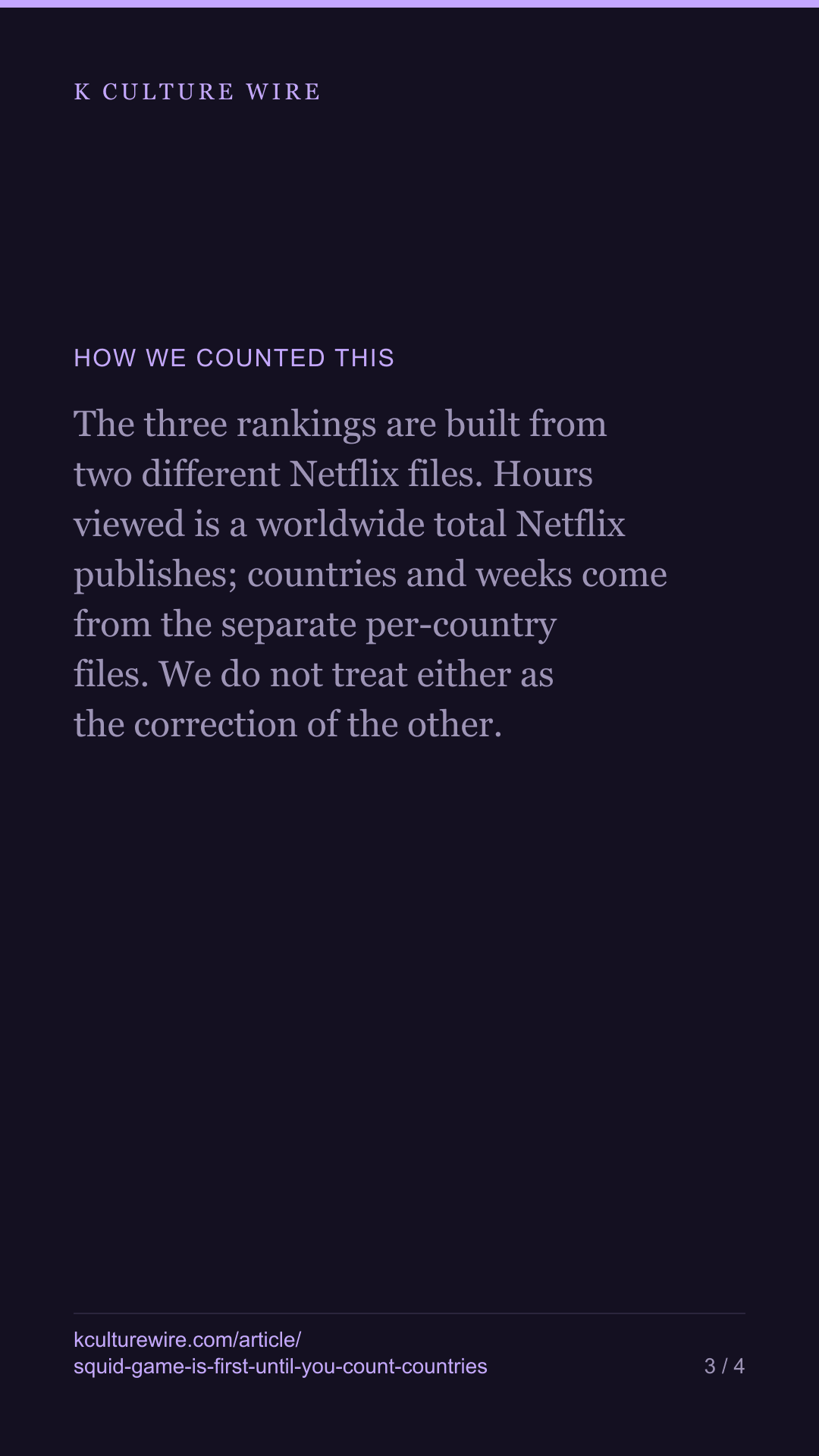
- The three rankings are built from two different Netflix files. Hours viewed is a worldwide total Netflix publishes; countries and weeks come from the separate per-country files. We do not treat either as the correction of the other.
- Titles in the hours top 15 that are not in our own table of Korean titles are left out rather than scored zero, and the count of those is printed on the page.
What we left out, and why
- Any claim that one of the three rankings is the real one. We publish all three side by side.
- Viewer counts. Hours viewed is hours. Netflix publishes no number of people, and no hours by country at all.
- Availability. A title absent from a country's chart may still have been watchable there.
The data behind this
Written from the same data
Take this away — 8 cards
The figures in this article, as images. Free to repost with the address on them.


If you work in this business
Everything on this page is measured from the same weekly Netflix lists, per market and per title. We publish the pages free; what we sell is the same measurement cut to one company's catalogue — including the figures behind /which-ranking.
What a company sheet contains, and what it cannot tell you →