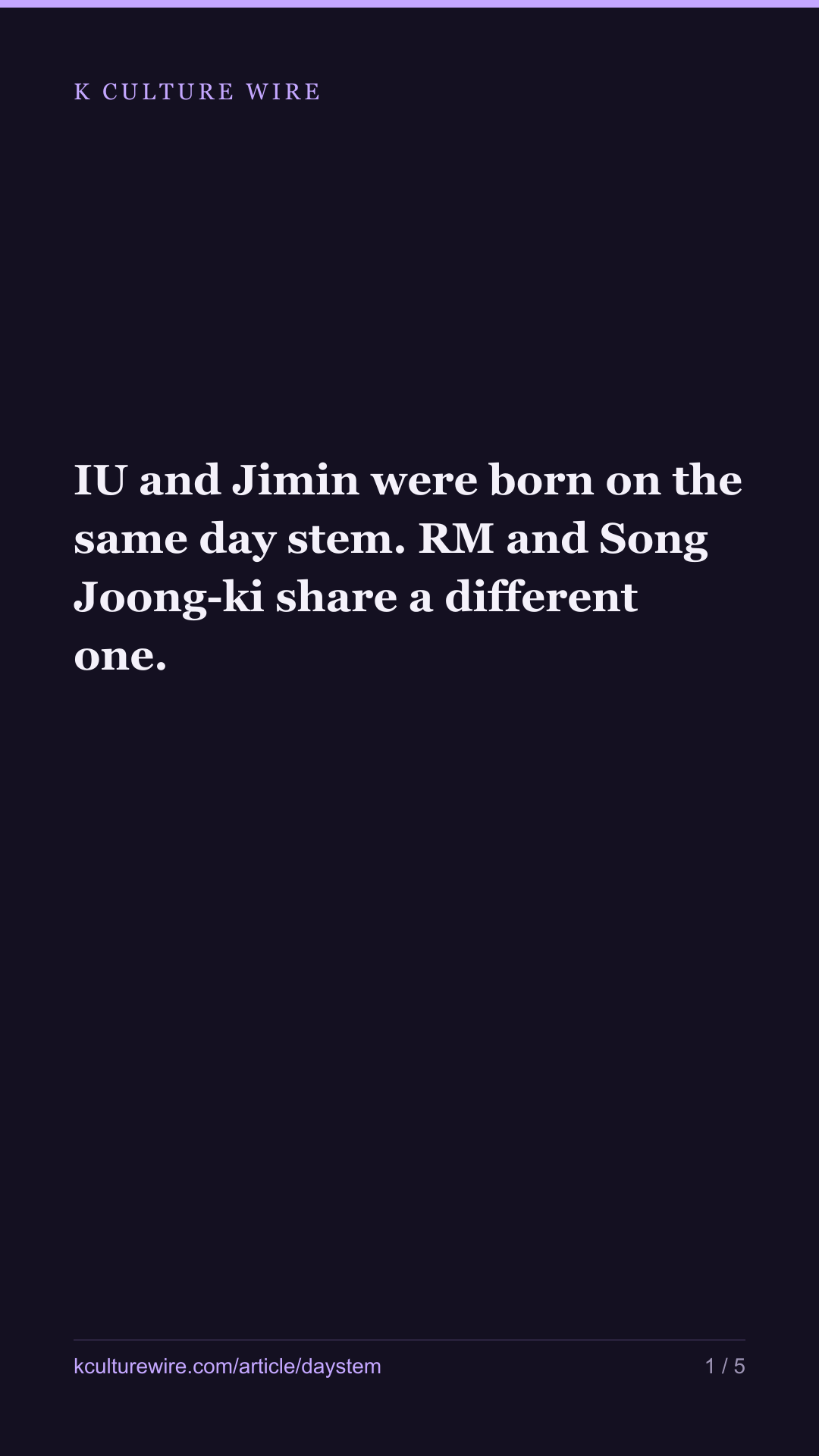
IU and Jimin share a day stem. RM and Song Joong-ki another
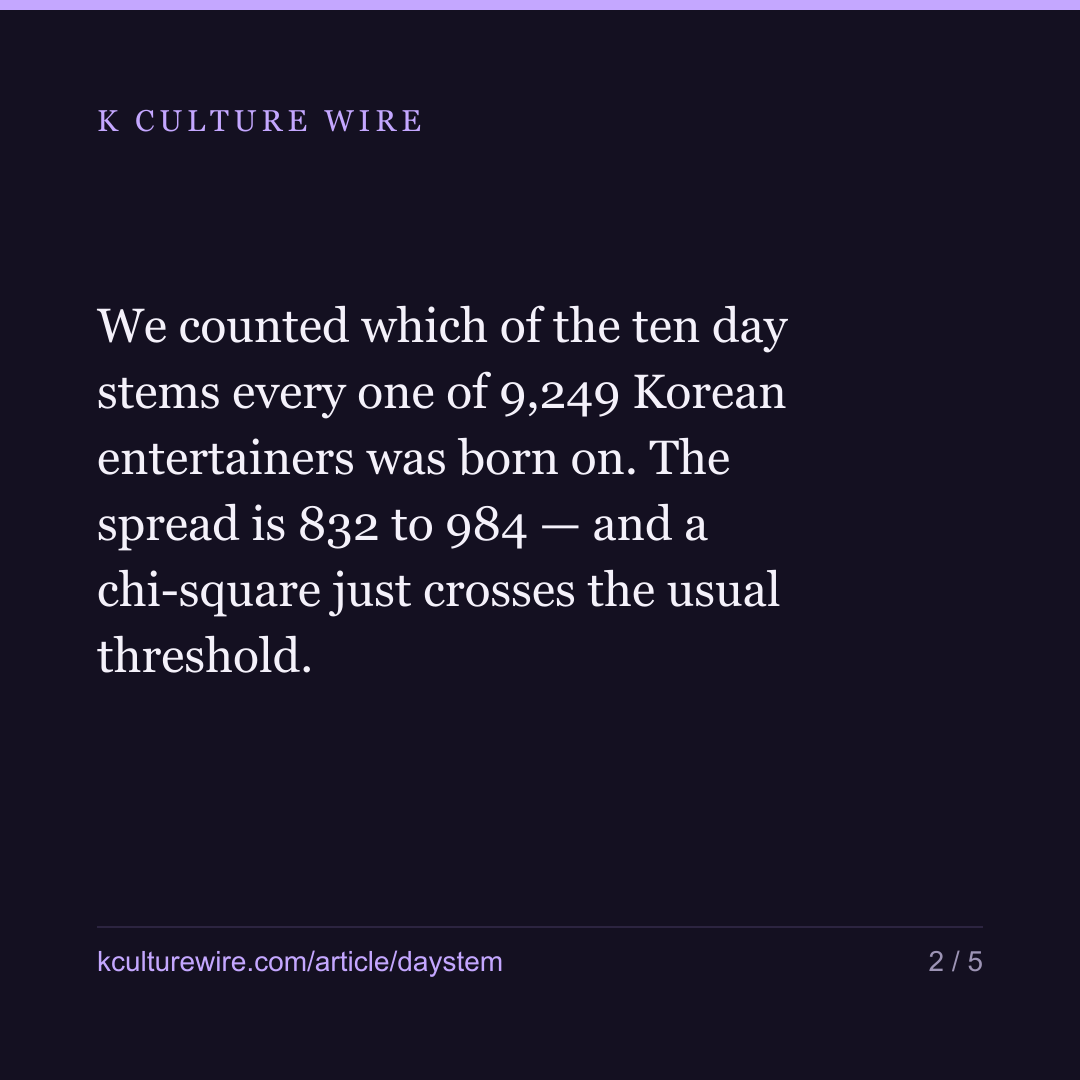
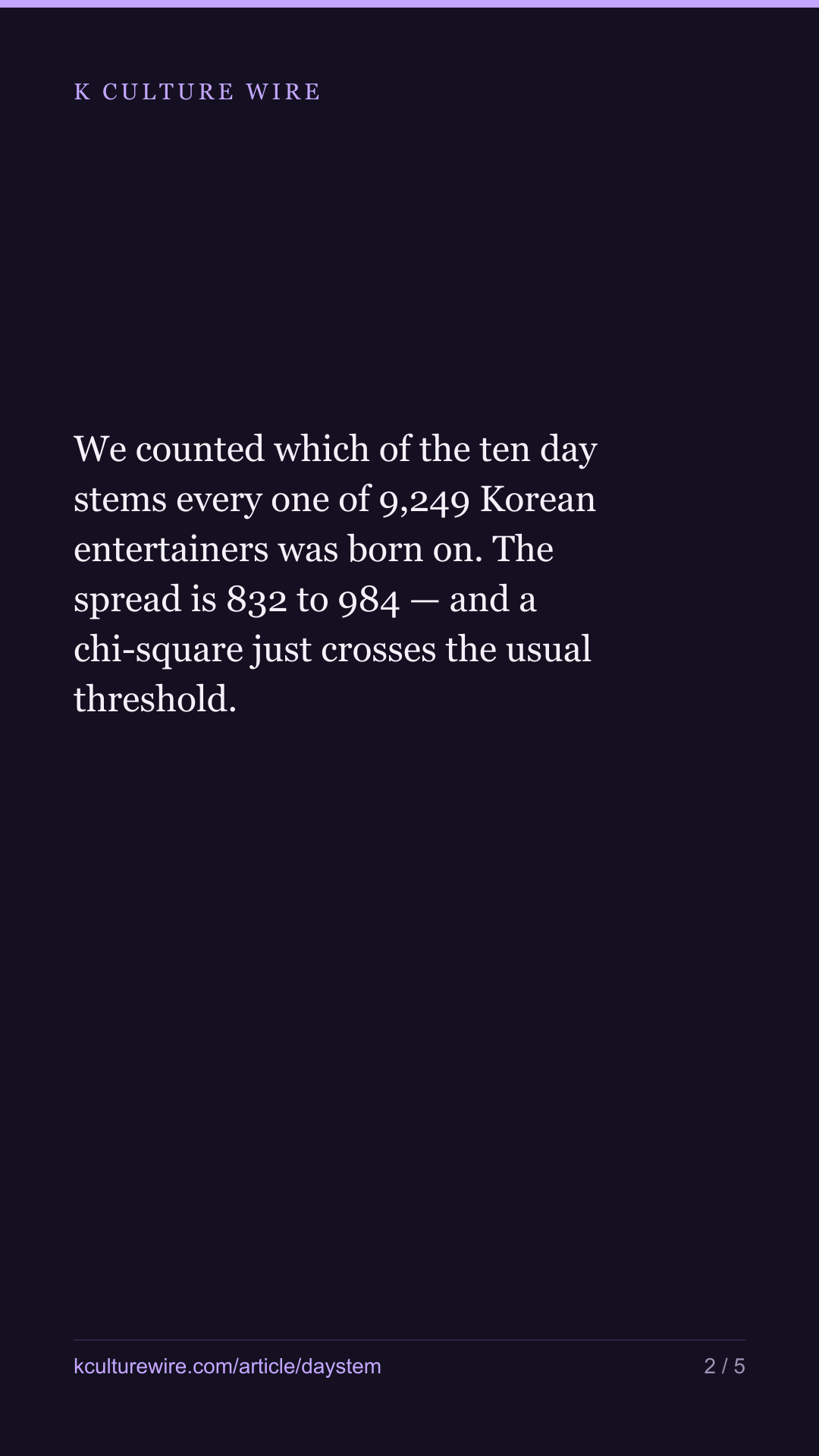
We counted which of the ten day stems each of 9,249 Korean entertainers was born on. The spread runs 832 to 984, and a chi-square just crosses the usual threshold. We print that number even though it argues against us.
The table this is written from: /day-pillar
IU and Jimin were born on the same day stem. RM and Song Joong-ki share a different one. Jennie, Psy and Lee Min-ho share a third.
That is a fact about dates, and it is the whole of what we are claiming.
What we counted
Every Korean actor, singer and songwriter we hold a full date of birth for — 9,249 people — was placed in one of the ten day stems of the sexagenary cycle. The stem comes from the date alone. It needs no hour, no place and no interpretation.
| Day stem | People | Most-read names inside it |
|---|---|---|
| 庚 gyeong | 984 | Lee Jung-jae, Jung Ho-yeon, Momo |
| 辛 sin | 964 | Song Joong-ki, RM, Kim Soo-hyun |
| 甲 gap | 949 | ROSÉ, Jisoo, Kim Seok-jin |
| 乙 eul | 944 | V, J-Hope, Im Yoon-ah |
| 丁 jeong | 940 | IU, Jimin, Kang Seul-gi |
| 丙 byeong | 927 | Jungkook, Chun Jung-myung, Daniel Dae Kim |
| 癸 gye | 914 | Yun Hyon-seok, Cho Jung-seok, BoA |
| 戊 mu | 905 | Irene, Gong Yoo, Taeyeon |
| 壬 im | 890 | Psy, Jennie, Lee Min-ho |
| 己 gi | 832 | Suga, Bae Suzy, Ken Jeong |
The names inside each stem are ordered by how often their English Wikipedia article was opened, not by anything about the stem. Each stem has its own page with every name in it.
The number that argues against us
We expected the ten cells to come out flat, and to be able to say the spread was indistinguishable from chance. That is not what we got.
Chi-square 17.9, against the usual 16.92 threshold at nine degrees of freedom. It crosses. Read the way that statistic is normally read, it says not chance.
We do not believe it means anything about the people, and we are not going to pretend the number says something softer than it does. Here is why we distrust our own figure.
- An even split was never the right expectation. Day stems run in a ten-day cycle. Calendars do not divide into ten, birth dates cluster by season and by year, and a decade of Korean entertainment debuts is not a random draw across the calendar.
- 9,249 is a large sample. With numbers this size, a gap of 984 against 832 — about 18% — is enough to cross a threshold that was never built for this question.
- Who gets a full birth date is not random. Wikidata holds a complete date for some people and only a year for others. The ones with complete dates skew towards those who have been documented longest. That alone can bend a spread.
Any one of those is a better explanation than the day someone was born deciding anything.
What this is not
This is a count of birth dates. It is not a reading of anyone, and it is not a horoscope. A day stem is one of four pillars, and the other three need the year, month and hour of birth. We do not hold hours, and we would not publish a reading from them if we did.
This is statistics, not you.
One more honest note
Before building these pages we measured what people actually search for. The phrase “byeong day stem” returned zero autocomplete suggestions. Star names return ten. So we do not expect this page to be found by anyone typing the words in its title, and we are not going to claim otherwise. It exists because the ten stem pages are a real index of 9,249 people, and because the honest version of a number that crosses a threshold is worth writing down.
Where these numbers come from
Sources
- Wikidata — Dates of birth (P569) for Korean entertainers, converted to the sexagenary day pillar · https://query.wikidata.org
- Wikimedia — Pageviews, English Wikipedia, to order names inside each stem by how often they are looked up · https://wikimedia.org/api/rest_v1/
What we checked
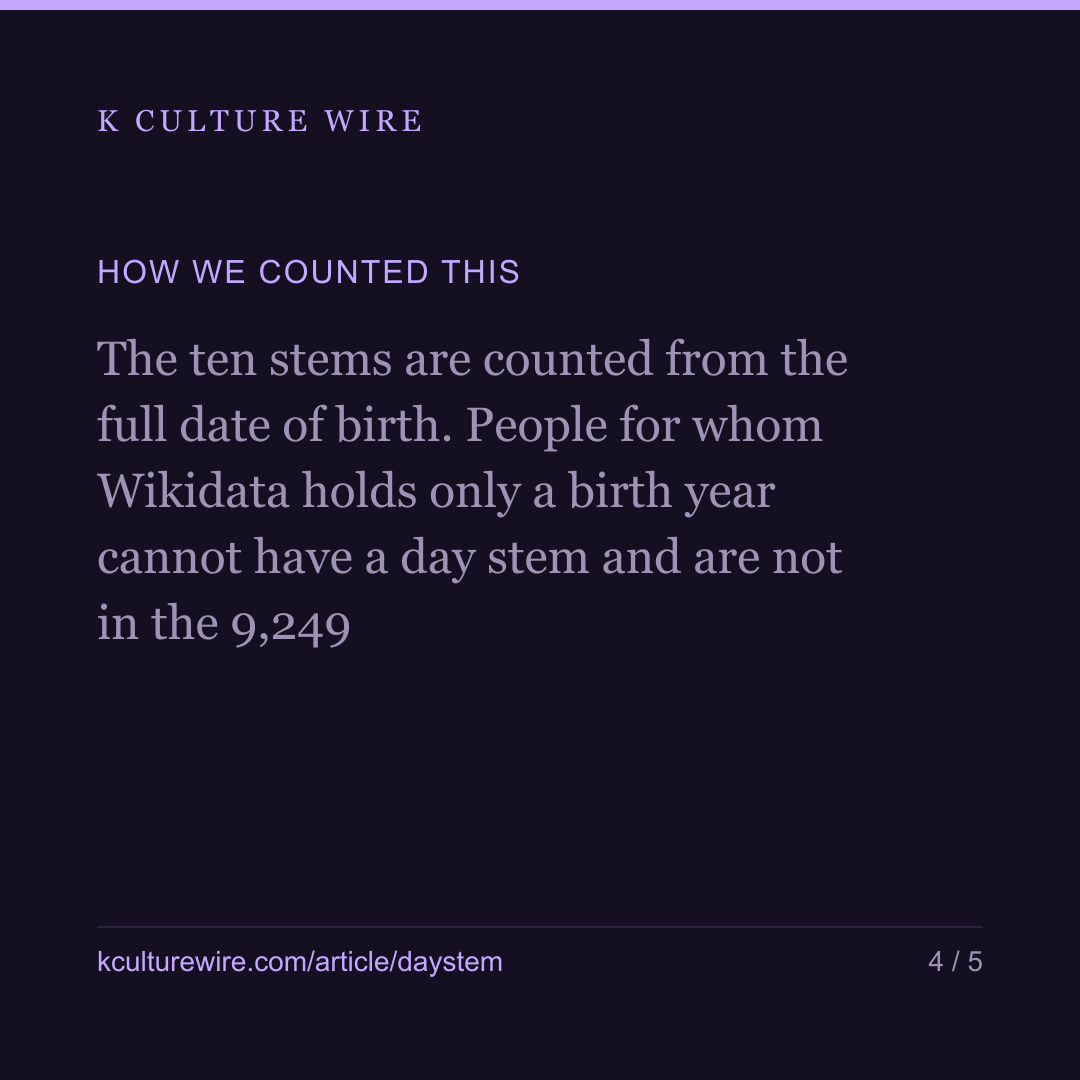
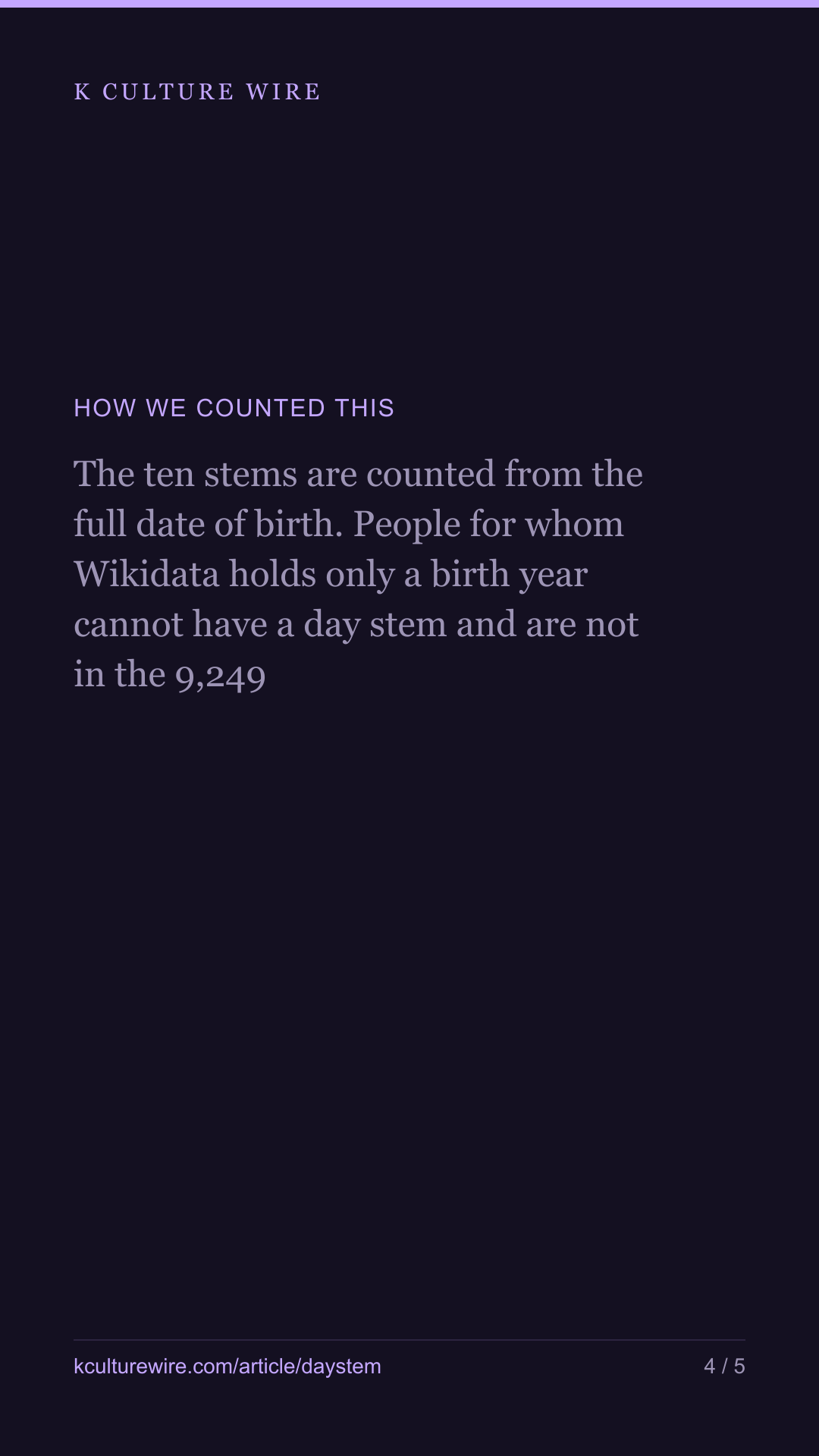
- The ten stems are counted from the full date of birth. People for whom Wikidata holds only a birth year cannot have a day stem and are not in the 9,249
- Chi-square is computed against an even split across ten cells (expected 924.9 each). That expectation is itself questionable, and the article says so
The data behind this
Written from the same data
Take this away — 10 cards
The figures in this article, as images. Free to repost with the address on them.

If you work in this business
Everything on this page is measured from the same weekly Netflix lists, per market and per title. We publish the pages free; what we sell is the same measurement cut to one company's catalogue — including the figures behind /day-pillar and /stem/jeong and /stem/sin and /stem/im.
What a company sheet contains, and what it cannot tell you →
What do you make of this?
We counted it. What it means is yours to decide.