Actors with five charting titles are read seven times as often, and that still tells you little about any one of them
An actor with five charting titles is read about ten times as often as an actor with one. How much does that tell you about any one actor?
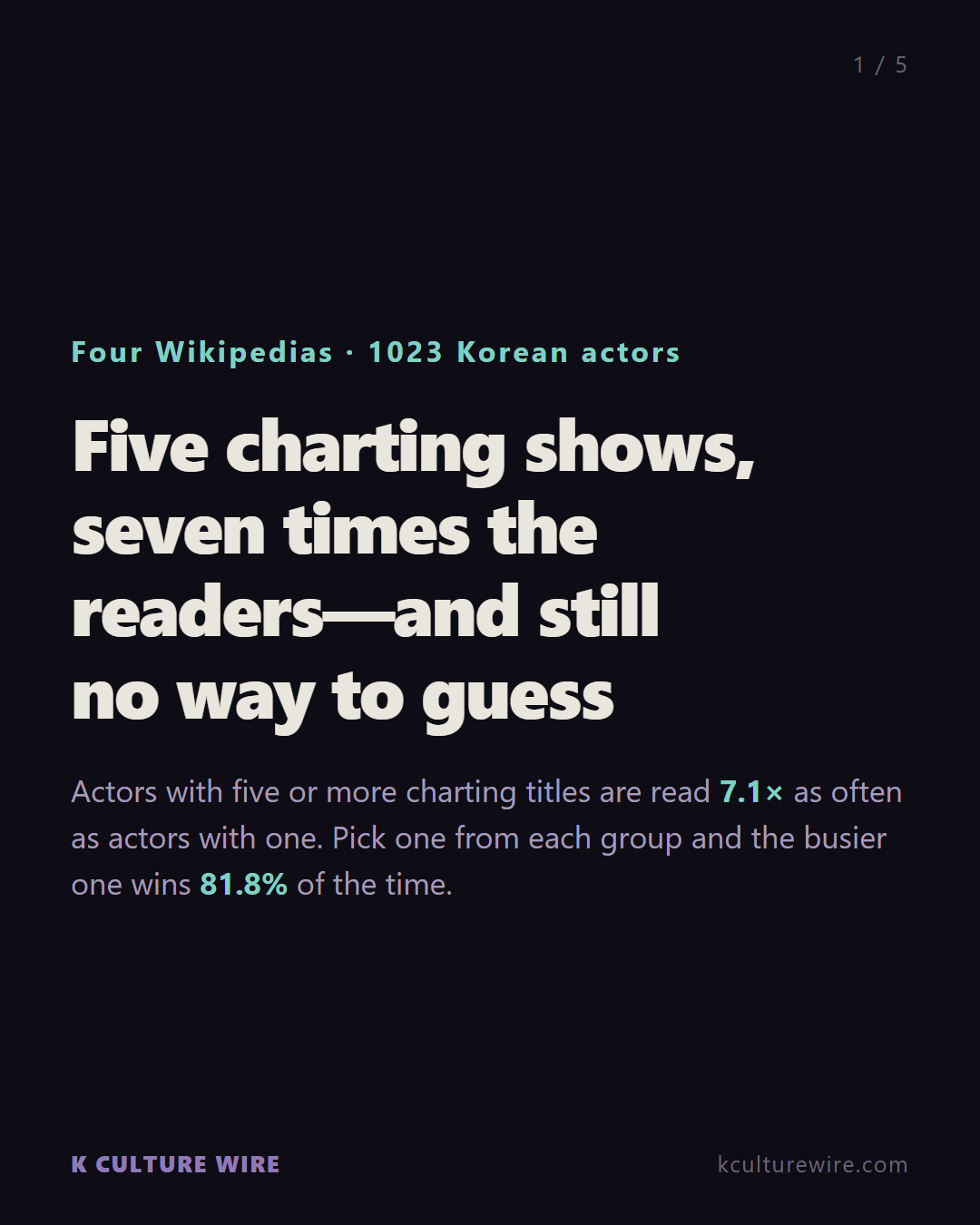
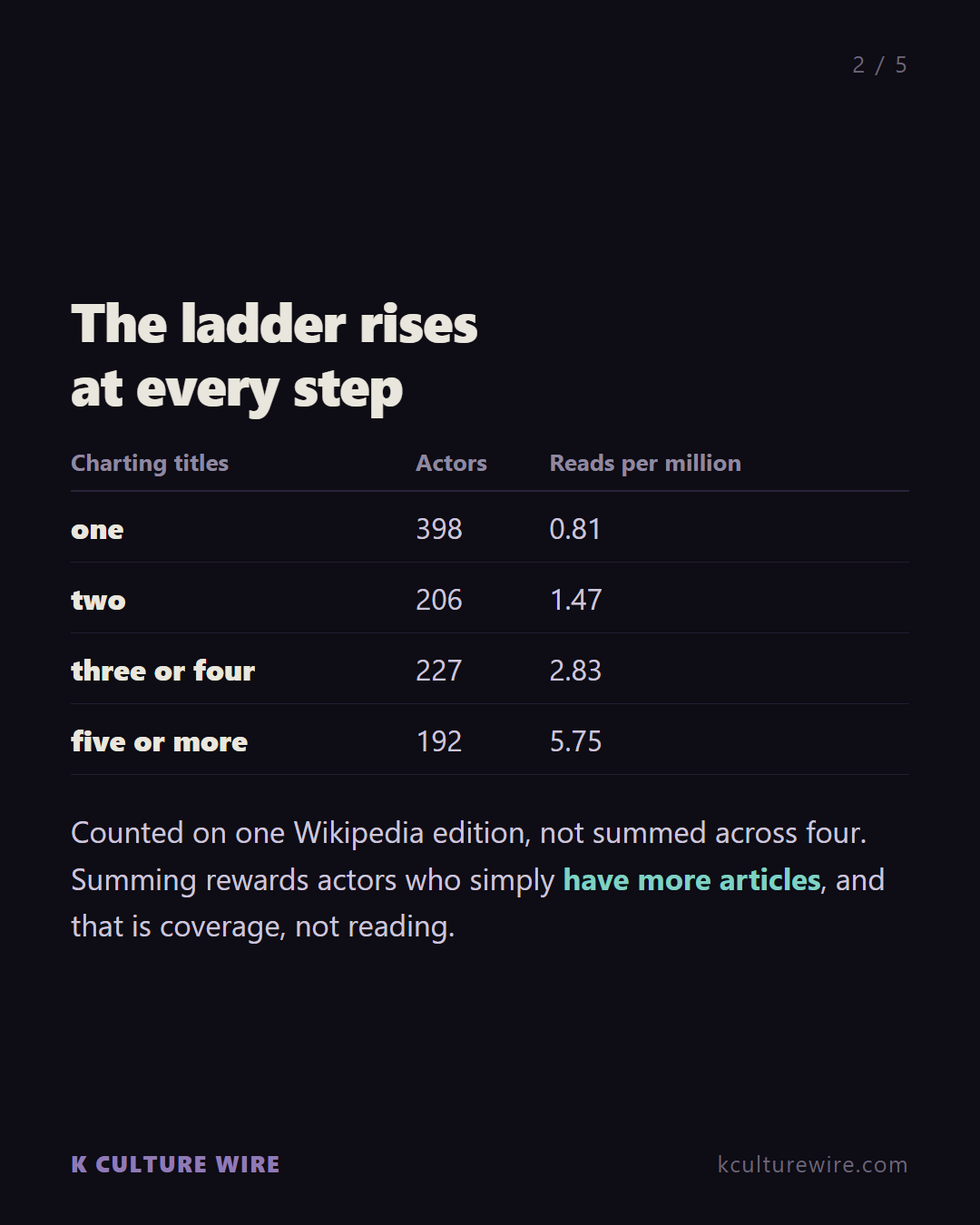
Of 1023 Korean actors we can measure, those with one charting title are read 0.81 times per million reads of the Indonesian Wikipedia. Those with five or more are read 5.75. The median rises at every step in between. Now pick one actor from each of those two groups at random: the busier one is the more-read one 81.8% of the time.
The ladder
Two columns, because one of them is misleading on its own. The summed column adds an actor's reads across the editions that have an article about them — and actors with more titles have articles in more editions, so that column is partly counting coverage. The one edition column holds coverage constant by looking only at the Indonesian Wikipedia.
| Charting titles | Actors | Summed across editions | One edition only | Has all four articles |
|---|---|---|---|---|
| one | 398 | 1.19 | 0.81 | 14.1% |
| two | 206 | 2.12 | 1.47 | 19.9% |
| three or four | 227 | 4.72 | 2.83 | 21.1% |
| five or more | 192 | 11.89 | 5.75 | 31.8% |
Both columns rise at every step. Summed, the top band is 9.99× the bottom; measured on one edition it is 7.1×. The gap between those two multiples is the part of the raw ladder that was coverage rather than reading. We report the smaller one.
The other way to hold coverage constant is to compare only actors who have an article in all four editions. We do not use it. Having four articles is a consequence of being read, not a fact settled beforehand, so selecting on it changes who is in each band — a collider (Cole et al. 2010). The counts are on this page so you can see how coverage varies, and no median is drawn from them.
What the ladder does not say
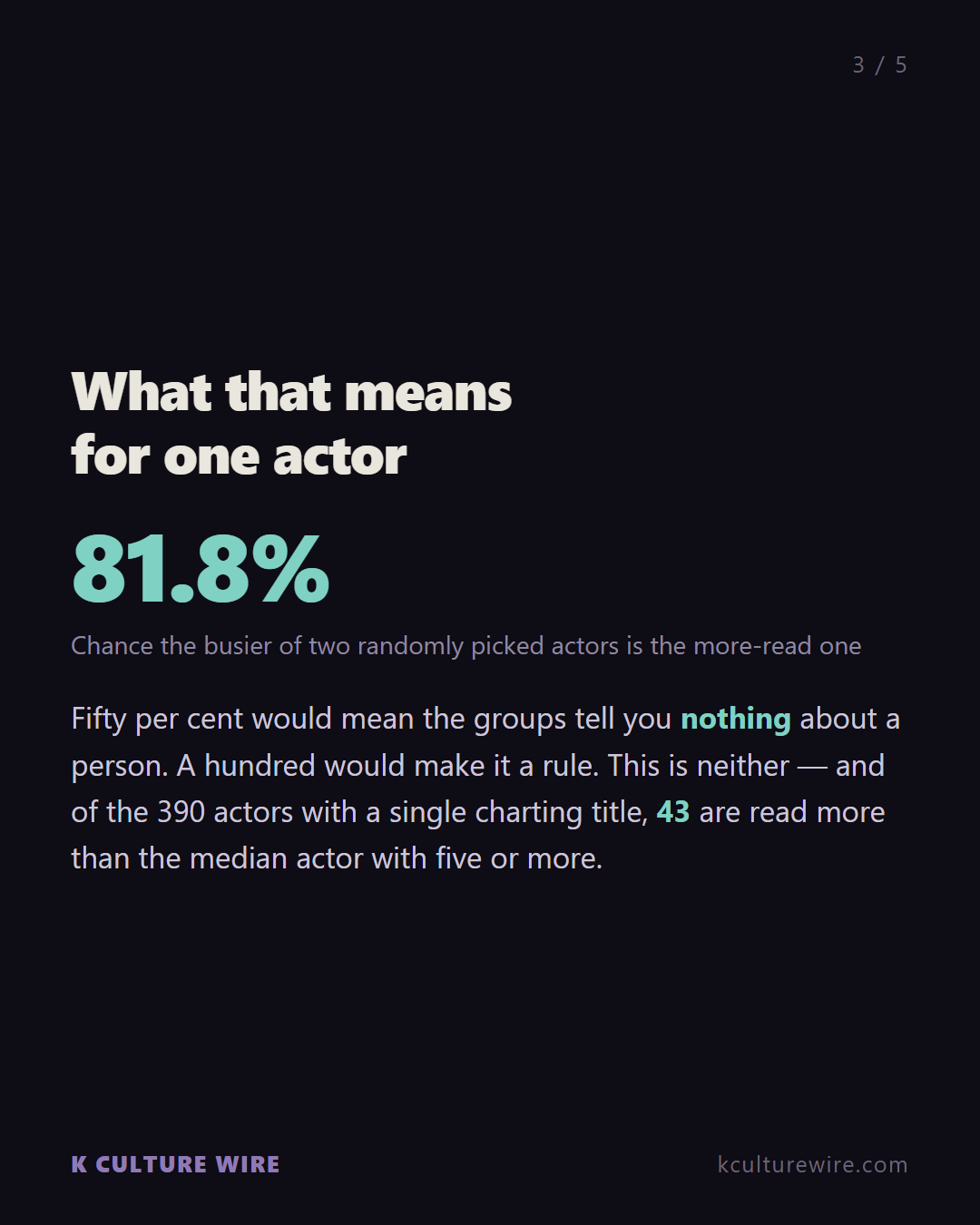
A median is a fact about a group. Readers usually want a fact about a person, and those are different sizes. So we also measured the one that answers the second question: take one actor from the top band and one from the bottom band at random, and how often is the busier one the more-read one?
| Measured on | Top band outreads bottom band |
|---|---|
| One edition only | 81.8% |
| Summed across editions | 79.3% |
The chance that a randomly chosen actor from the top band is read more than a randomly chosen actor from the bottom band, counting ties as half. This is the common-language effect size (McGraw and Wong 1992); it equals the Mann-Whitney U statistic divided by the number of pairs (Mann and Whitney 1947). Fifty per cent would mean the bands tell you nothing at all about an individual. A hundred would mean every actor in the top band outreads every actor in the bottom one.
So the bands overlap, heavily. Of the 390 actors with a single charting title, 43 (11%) are read more than the median actor with five or more. Going the other way, 17 of 192 actors with five or more (8.9%) are read less than the median actor with one. A seven-times gap between the middles is not a rule about people at the edges.
Which way does it run?
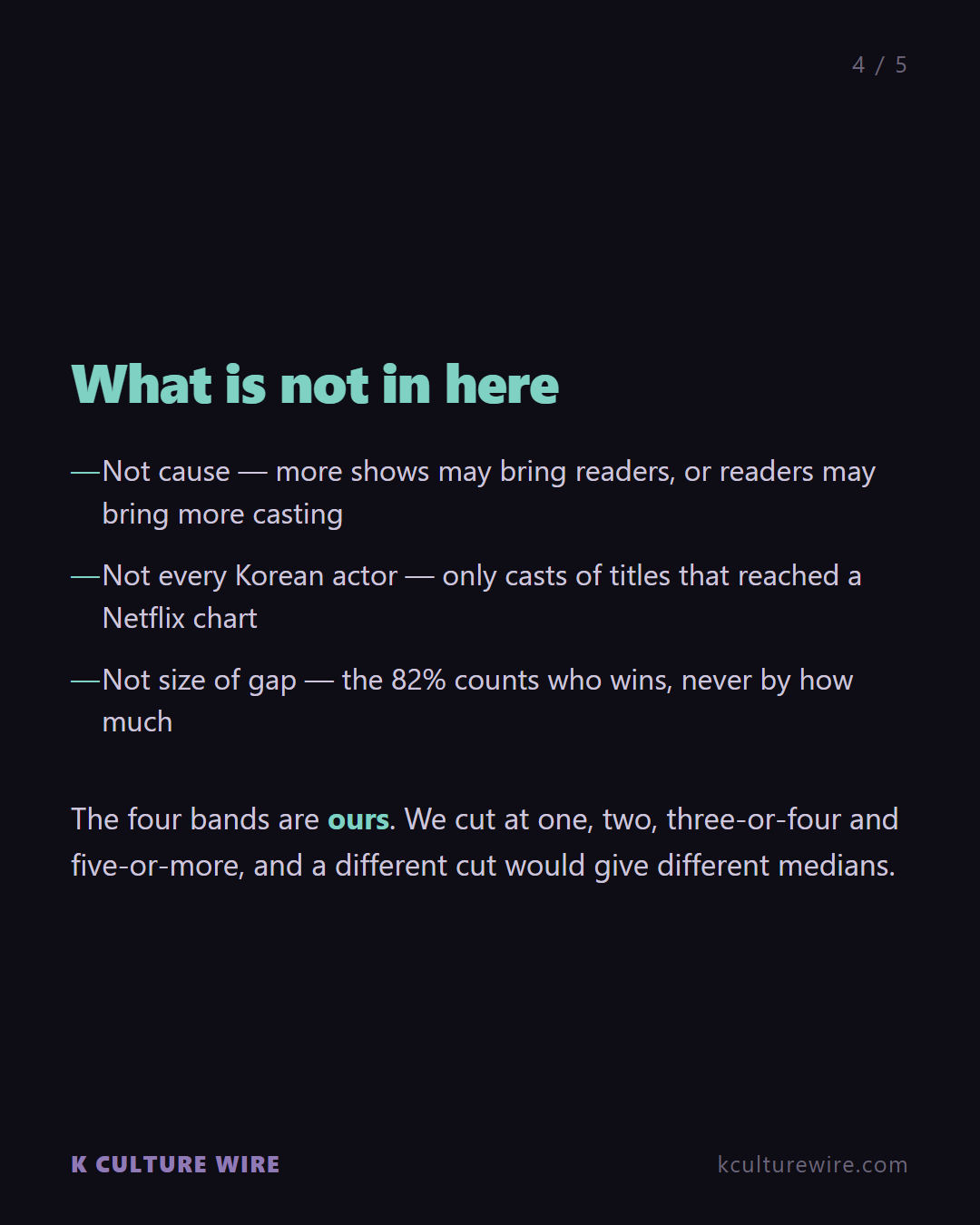
We do not know, and nothing on this page can settle it. More charting titles may bring more readers. Being read may be what gets an actor cast again. Something we have not measured — an agency, a network, a single breakout year — may drive both. All three would produce the table above.
We have measured the neighbouring question before: whether a title travelling to more countries goes with more lookups. That is on how far a title travelled, and it has the same limit.
How the bands were cut
The four bands are ours. We cut at one, two, three-or-four and five-or-more titles because those splits leave every band with enough actors to measure; a different cut would give different medians.
Every median on this page survives removing any single actor from its band, which rules out one way it could be fragile and does not show that it is stable. The check is a jackknife, which is known to understate how much a median moves, so a swing it finds is real while a swing it misses may be one it cannot see. The method and its limits are here.
What this page cannot tell you
Not cause. We measured that the two go together. Which one moves the other, or whether a third thing moves both, is not on this page and we are not going to guess.
Not about an individual actor. The bands differ, and they still overlap heavily — the figures for that overlap are on this page.
Not every Korean actor. The panel is the cast of titles that reached a Netflix country chart, and an actor who has never been in one is not counted.
Not fame. This counts people opening an encyclopaedia article in four languages.
This is not every Korean celebrity. It is the cast of Korean titles that reached a Netflix country chart, which is the panel the rest of our data is built on. A singer or idol who never appeared in one of those titles is not here.
Reads — Wikimedia Pageviews API, human traffic only, 2025-08 through 2026-07, 12 months, human traffic only. Cast and charting titles — Wikidata and Netflix country charts. Reads are expressed per million reads of that edition, so a small Wikipedia is not penalised for being small.
Card set — free to share
Five cards, 1080×1350. Every figure on them is in the table on this page. Take them.
14 seconds, with sound
Fourteen seconds: the ladder of median reads by number of charting titles, the chance one actor from the top band outreads one from the bottom, and where the two bands overlap. Free to repost with the address on it.
All our short films — each one built from a table on this site
What we wrote from this data
- Sing and act, and 10 Wikipedias write you up. Singers get 1
Across 9,246 Korean entertainers, the 992 credited with both singing and acting sit in a median of 10 Wikipedia language editions, against 1 for either alone. Hold that count fixed and actors are still opened more often.
3 September 2026
- Actors with 5 charting titles are read 7x more
Korean actors with five or more charting titles are read seven times as often as actors with one, across four Southeast Asian Wikipedias. Pick one from each group at random and the busier one wins 82% of the time — a long way from a rule.
16 August 2026
How this was measured
We report the median rather than the mean. A handful of very large values would pull a mean away from where most of the sample actually sits, and in reads-per-title data those large values are the norm, not an error. Reads are expressed per million reads of that Wikipedia in that month, so that a large edition and a small one can be compared without the larger one winning by size alone. Stability of a median is checked with a jackknife — remove one observation, recompute, repeat for each (Quenouille 1949, Tukey 1958). Each band is summarised by its median, and every median is reported twice — once from the four-edition sum and once from a single edition, which holds article coverage constant. Beside the medians we report the chance that one actor from the top band outreads one actor from the bottom band, so a group-level ladder is never presented as a fact about a person.
What this cannot tell you
A median tells you where the middle sits and nothing about the shape around it, so it should be read next to the range or the full distribution, not alone. Dividing by an edition's own total means a month when that edition was unusually busy lowers every article in it. The ratio measures share of attention inside an edition, not how many people read something. The jackknife understates how much a median varies, because removing one observation barely moves a median, and it is not consistent for the median (Miller 1974). A swing it finds is therefore real; a swing it misses is not evidence of stability. Establishing stability would need a delete-d jackknife or a bootstrap (Efron 1979), which we have not built. This cannot tell you which way it runs. More titles may bring more readers, being read may bring more casting, or something we have not measured may drive both, and nothing on this page separates them. The panel is the cast of Korean titles that reached a Netflix country chart, so an actor whose work never charted is absent entirely, and the number of charting titles is capped by what Netflix publishes. The pair probability is built from ranks, so it says how often the top band wins and nothing about by how much.
Why this is split by Wikipedia edition
The raw figure adds up an actor's reads across only the editions that have an article about them, and actors with more titles have articles in more editions. So the raw ladder is partly counting article coverage rather than reading. Measuring a single edition holds that constant, and the ladder survives it.
The editions used here are id, vi, th, ms — 4 of them, each counted on its own so that an actor is not rewarded for simply appearing in more of them.