You cannot ask what a Korean hit leaves behind. The article is born with the show
A Korean title lands, the encyclopaedia fills with it, and then it empties again. When the wave has passed, is the floor higher than it was before it arrived?
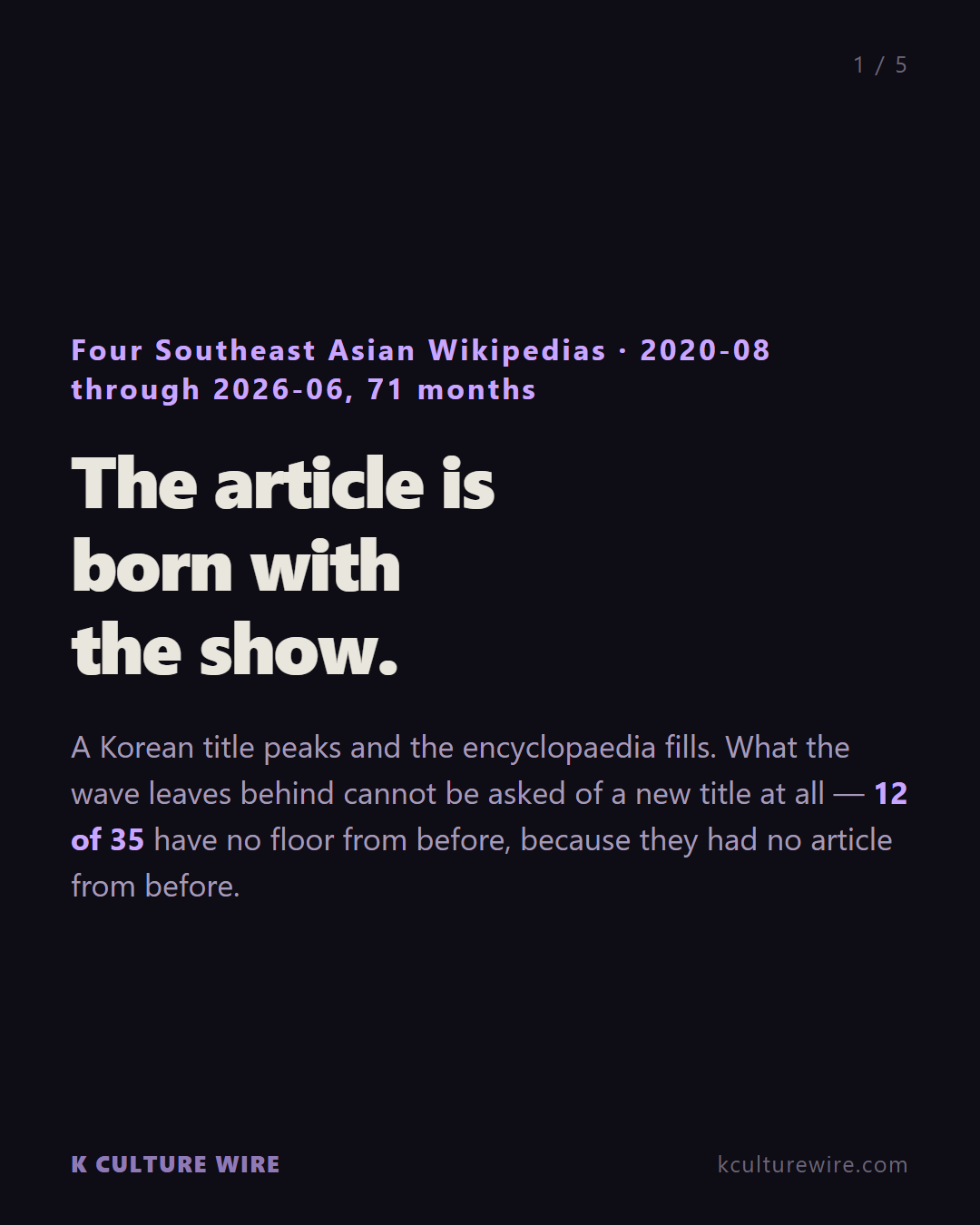
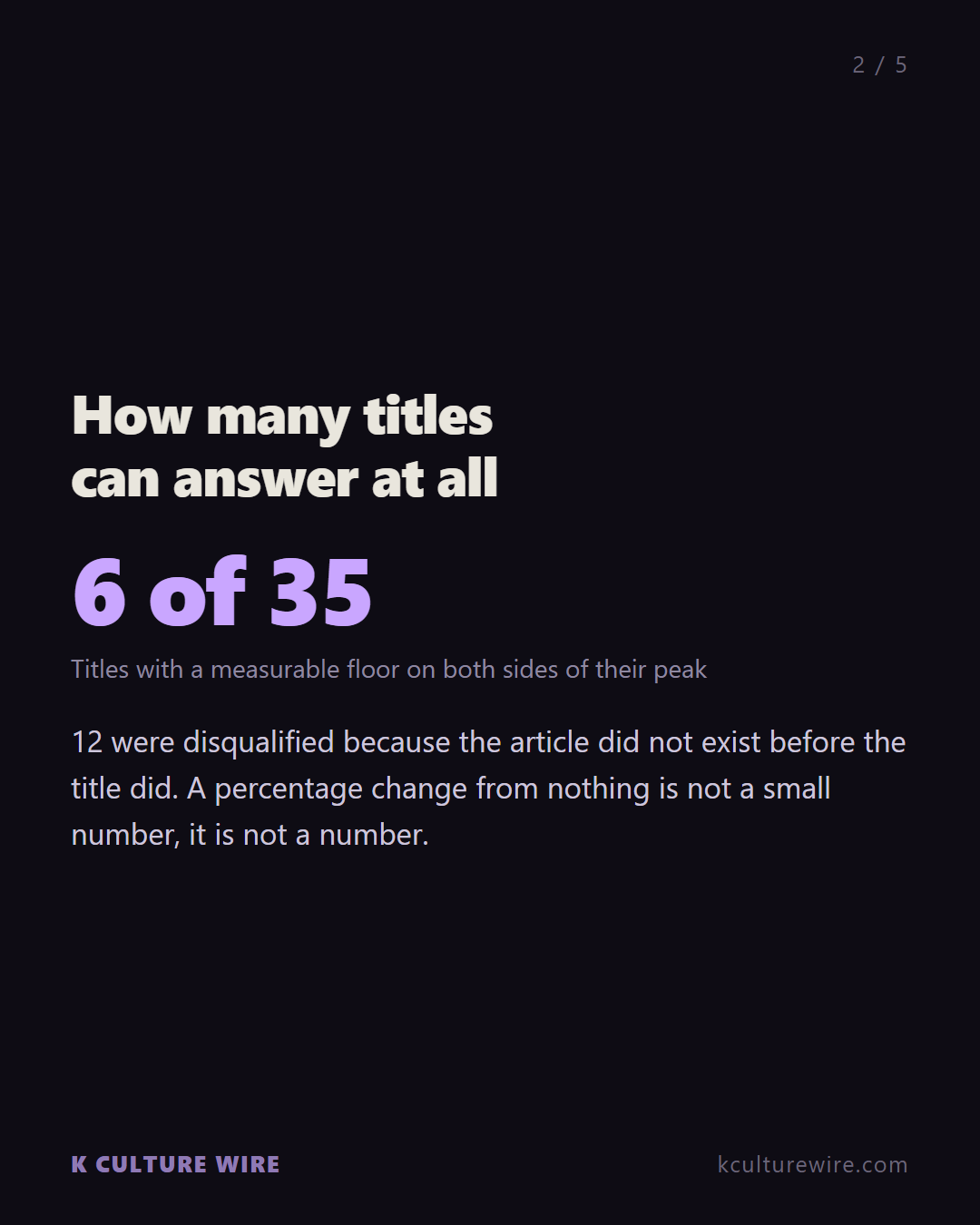
For most of what Korea has exported in the last five years, that question has no answer — and not because the data is thin. There is no before. The encyclopaedia article is created when the title arrives. 22 of the 35 titles we fetched are disqualified for that reason alone.
The article is born with the show
A percentage change from nothing is not a small number; it is not a number. These titles have no floor from before the wave because they had no article before the wave.
| Title | Article first seen | Peak |
|---|---|---|
| Squid Game | 2021-09 | 2021-10 |
| All of Us Are Dead | 2022-02 | 2022-02 |
| Alchemy of Souls | 2022-12 | 2023-01 |
| Itaewon Class | 2022-05 | 2022-10 |
| Vincenzo (TV series) | 2021-06 | 2021-06 |
| Queen of Tears | 2024-04 | 2024-04 |
| Mask Girl | 2023-08 | 2023-09 |
| The King: Eternal Monarch | 2022-04 | 2022-04 |
| Hotel del Luna | 2021-11 | 2021-11 |
| Start-Up (South Korean TV series) | 2021-10 | 2021-10 |
| Burning (2018 film) | 2024-02 | 2024-09 |
| Minari (film) | 2021-04 | 2021-04 |
| Hospital Playlist | 2021-06 | 2021-07 |
| My Mister | 2021-02 | 2021-06 |
| D.P. (TV series) | 2024-11 | 2025-05 |
| Little Women (South Korean TV series) | 2022-09 | 2022-09 |
| Big Mouth (South Korean TV series) | 2023-11 | 2024-04 |
| Lovely Runner | 2024-06 | 2024-06 |
| The Atypical Family | 2024-06 | 2024-06 |
| A Killer Paradox | 2024-02 | 2024-02 |
| Extreme Job | 2024-11 | 2025-03 |
| Exhuma | 2024-05 | 2024-05 |
This is a limit of the question, not of the window. Widening the window does not create a floor that never existed. Anything that arrives and creates its own article is unmeasurable here permanently.
The 9 titles that already had a floor
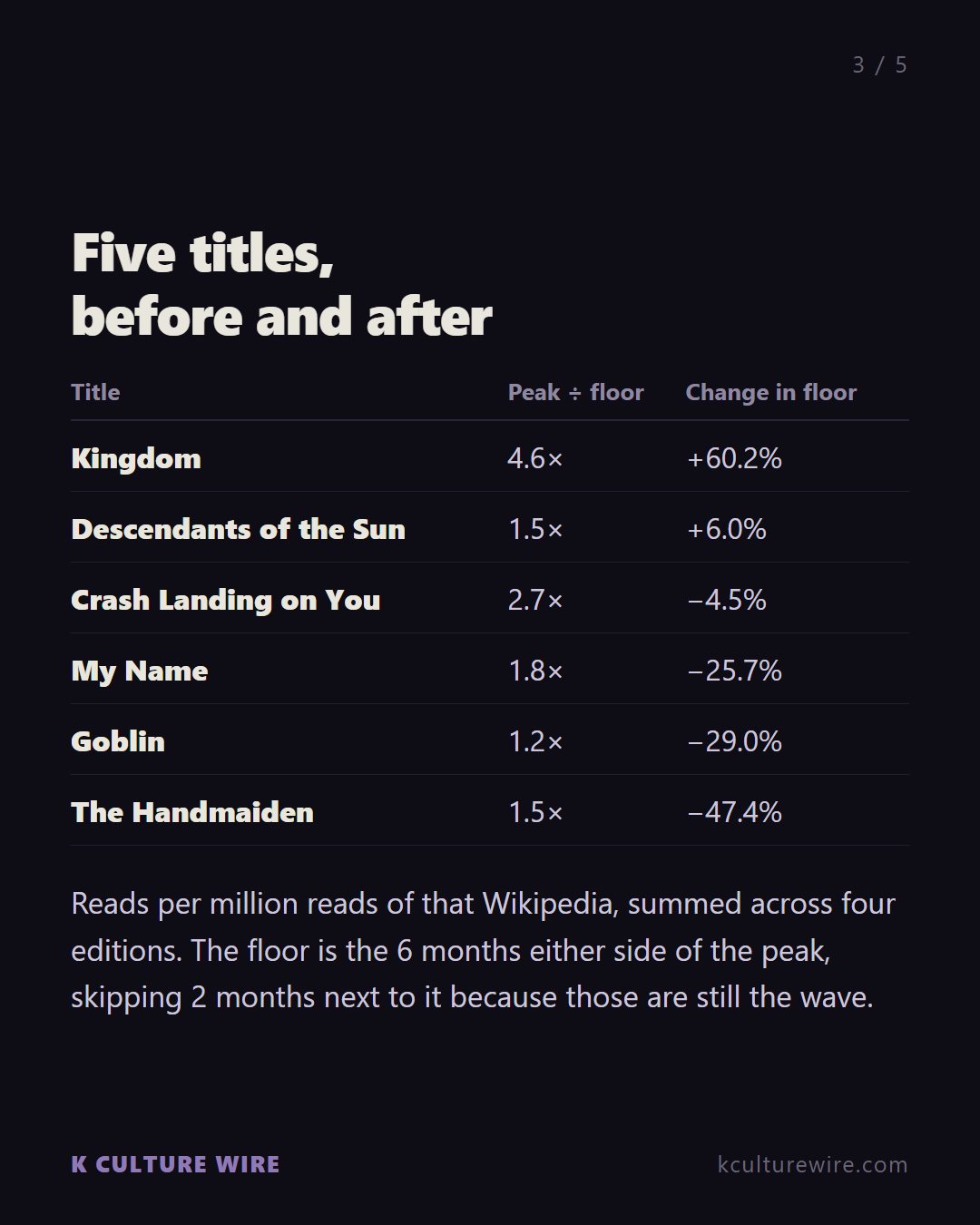
Reads are per million reads of that Wikipedia, summed across Indonesia, Vietnam, Thailand, Malaysia. The floor is the 6 months before the peak and the 6 after, skipping 2 months either side because those are still the wave. Window — 2020-08 through 2026-06, 71 months.
| Title | Peak | Peak ÷ floor | Floor before | Floor after | Change |
|---|---|---|---|---|---|
| Kingdom (South Korean TV series) | 2025-02 | 4.6× | 43.2 | 69.3 | +60.2% |
| Descendants of the Sun | 2025-04 | 1.5× | 138.1 | 146.3 | +6.0% |
| Marry My Husband | 2025-07 | 2.2× | 67.7 | 69.1 | +2.0% |
| Reply 1988 | 2021-08 | 2.3× | 117.2 | 117.2 | −0.0% |
| Crash Landing on You | 2021-08 | 2.7× | 222.5 | 212.4 | −4.5% |
| My Name (TV series) | 2024-01 | 1.8× | 45 | 33.5 | −25.7% |
| Goblin (TV series) | 2021-10 | 1.2× | 224 | 159.1 | −29.0% |
| The Roundup (2022 film) | 2024-05 | 2.2× | 23.9 | 13 | −45.8% |
| The Handmaiden | 2022-09 | 1.5× | 116.1 | 61.1 | −47.4% |
Median peak 2.2 times the surrounding months; median floor afterwards −4.5%. 3 of 9 ended higher. We report the median rather than the mean because with 9 titles one of them moves the mean on its own — the mean reads −9.4%.
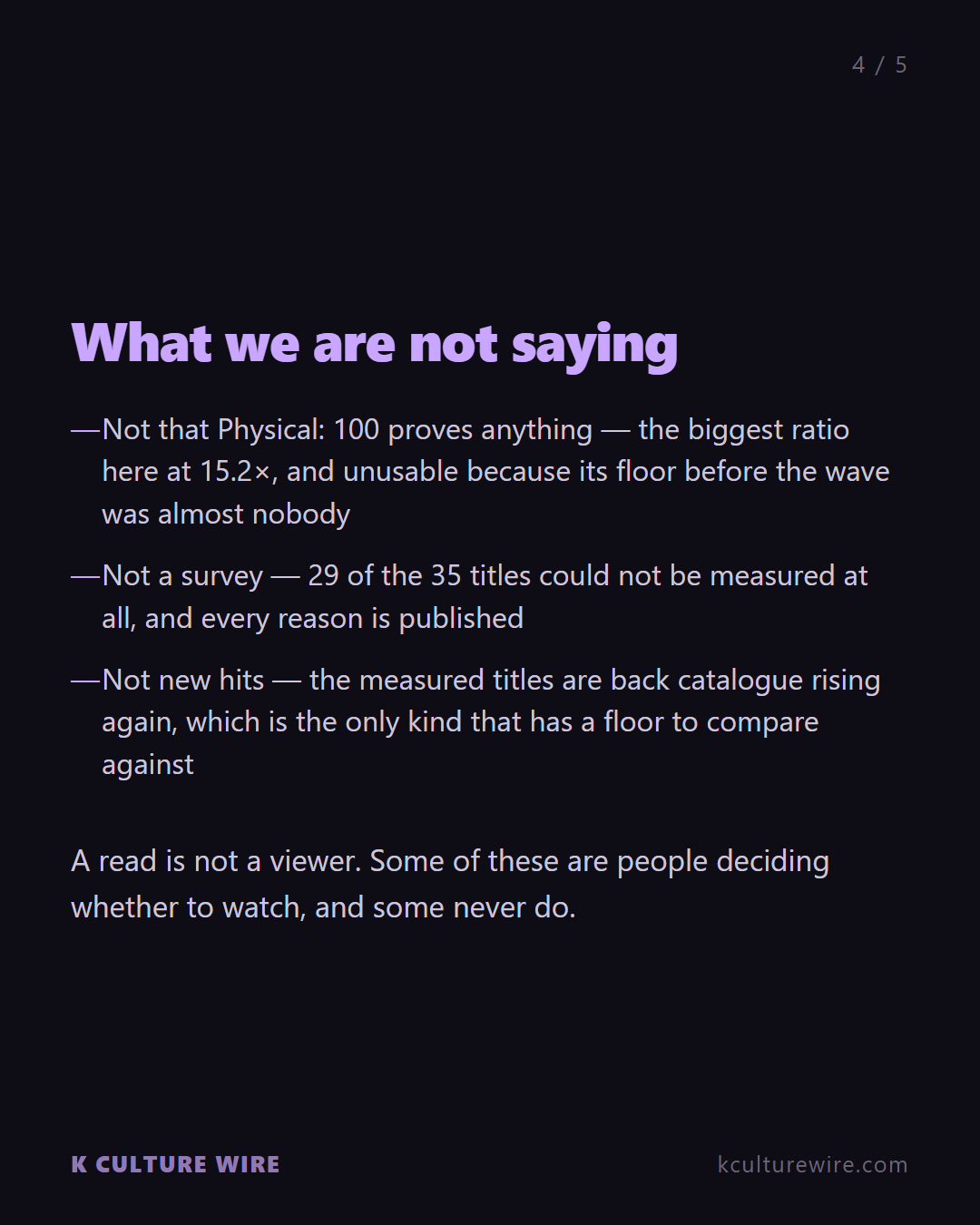
These are not hits arriving. They are back catalogue rising again, which is the only kind of title that can answer this question at all.
⚠ Do not lean on that median. Remove any single title from the 9 above and it moves to somewhere between −15.1% and −2.3% — a swing of 2.86 times its own size. removing a single item moves the answer by a large fraction of itself, which means the sample is not yet large enough for this median to be reported as a finding — not that the figure is wrong. We ran this check on this page after correcting it twice in one day; the method is here.
Everything we could not use
| Why not | Titles | How many |
|---|---|---|
| the article did not exist for the first part of the window, so there is no floor from before the title arrived — a new title cannot be asked this question at all | Squid Game, All of Us Are Dead, Alchemy of Souls, Itaewon Class, Vincenzo (TV series), Queen of Tears, Mask Girl, The King: Eternal Monarch, Hotel del Luna, Start-Up (South Korean TV series), Burning (2018 film), Minari (film), Hospital Playlist, My Mister, D.P. (TV series), Little Women (South Korean TV series), Big Mouth (South Korean TV series), Lovely Runner, The Atypical Family, A Killer Paradox, Extreme Job, Exhuma | 22 |
| not enough months in the four editions | Sweet Home (South Korean TV series), Hellbound, The Glory (TV series), Extraordinary Attorney Woo, Moving (TV series), The8 Show, Business Proposal (TV series), Reborn Rich, Mr. Sunshine (TV series), Misaeng, Stranger (South Korean TV series), The Silent Sea, Doctor Slump, Gyeongseong Creature, The Wailing (film) | 15 |
| the peak sits too close to the end of the window | Oldboy (2003 film), Culinary Class Wars, Twenty-Five Twenty-One, Signal (South Korean TV series), Move to Heaven, Juvenile Justice (TV series), Memories of Murder | 7 |
| the peak sits too close to the start of the window | Parasite (2019 film), Train to Busan, Prison Playbook | 3 |
| the floor before the wave was only 1.3 per million, too thin for a percentage to mean anything | Physical: 100 | 1 |
| the floor before the wave was only 3.9 per million, too thin for a percentage to mean anything | Broker (2022 film) | 1 |
| the floor before the wave was only 8.4 per million, too thin for a percentage to mean anything | A Taxi Driver | 1 |
The largest peak-to-floor ratio in the whole dataset belongs to Physical: 100 at 15.2× in 2024-03, and we cannot report it. Its floor before the wave was 1.3 per million — a rise between two quantities that are both, in practice, nobody.
Each title rose in its own month
Each title peaked in its own month, which is what measuring titles rather than months requires.
The peaks — 2021-08 · 2021-10 · 2022-09 · 2024-01 · 2024-05 · 2025-02 · 2025-04 · 2025-07. An earlier version of this page, built on a shorter window, had 9 peaks landing in three clusters of neighbouring months, which meant we might have been measuring those months rather than those titles. That objection is answered.
What this page cannot tell you
We measured 9 titles. That is a small number and it is the number we have: of the twenty we fetched, some have no article in these editions, some peaked too near the edge of the window to have a floor on both sides, one had a second wave sitting where its floor should be, and one had a floor too thin to take a percentage. Every one of them is listed with its reason.
The titles are ones we expected to have had a wave, not the most-read Korean titles and not a random sample. A set chosen this way leans toward titles that travelled.
A read is not a viewer. Someone opening an encyclopaedia article about a series may have watched it, may be deciding whether to, or may have seen the name somewhere and been curious. What this dates is when the looking happened.
We are not saying the wave caused the floor to move, in either direction. Twelve months either side of a peak contain everything else that happened in those months too.
⚠ 2026-07 is excluded. It arrived at 3919 against a mean of 119640.7 over the twelve months before it — Wikimedia's monthly totals were still filling when we fetched, and reading that month as a collapse in attention would have been wrong.
Reads — Wikimedia Pageviews API, human traffic only, monthly.
Card set — free to share
Five cards, 1080×1350. Every figure on them is in the table on this page. Take them.

14 seconds, with sound
A man and a woman read out how many titles could be measured on both sides of their peak, and why most of them could not be. Free to repost with the address on it.
All our short films — each one built from a table on this site
What we wrote from this data
- Squid Game lost half its readers in a month. Goblin took 7
Twenty-six Korean titles could be timed from their peak across four Southeast Asian Wikipedias. The median fell below half in two months, nine of them in a single month, and nineteen later rose above half again.
15 August 2026 · corrected
- Removing 1 title moved one median by 89%, the other by 0
Removing a single title left one of our medians exactly where it was and moved the other by 89% of itself. The interquartile range rated the two almost identically. We ran neither before publishing.
15 August 2026 · corrected
- You cannot ask what a Korean hit leaves behind
Of 59 Korean titles fetched across four Southeast Asian Wikipedias, nine could be measured before and after their peak. Twenty-two were disqualified because their article did not exist before the title arrived.
15 August 2026 · corrected
How this was measured
- Months of floor — 6
- Months of wave — 2
- Counted as too thin below — 10
- Counted as a second wave above — 3
- Note — For each title we find its highest month, then average the six months before it and the six after, skipping two months either side of the peak because those are still the wave. A title is only reported if both sides fit inside the window, if the floor before the wave is thick enough for a percentage to mean anything, and if no month in the after-floor is more than three times the before-floor — that last one is a second wave, not a floor.
What this cannot tell you
A median tells you where the middle sits and nothing about the shape around it, so it should be read next to the range or the full distribution, not alone. The jackknife understates how much a median varies, because removing one observation barely moves a median, and it is not consistent for the median (Miller 1974). A swing it finds is therefore real; a swing it misses is not evidence of stability. Establishing stability would need a delete-d jackknife or a bootstrap (Efron 1979), which we have not built. Dividing by an edition's own total means a month when that edition was unusually busy lowers every article in it. The ratio measures share of attention inside an edition, not how many people read something. A new title has no floor before its wave at all, because the encyclopaedia article is created when the title arrives — those titles are excluded rather than counted as flat. This page was corrected twice on the day it was published, once because a 48-month window made its own highest month look like a peak, and once because widening the title set moved the answer; both are recorded on the article.