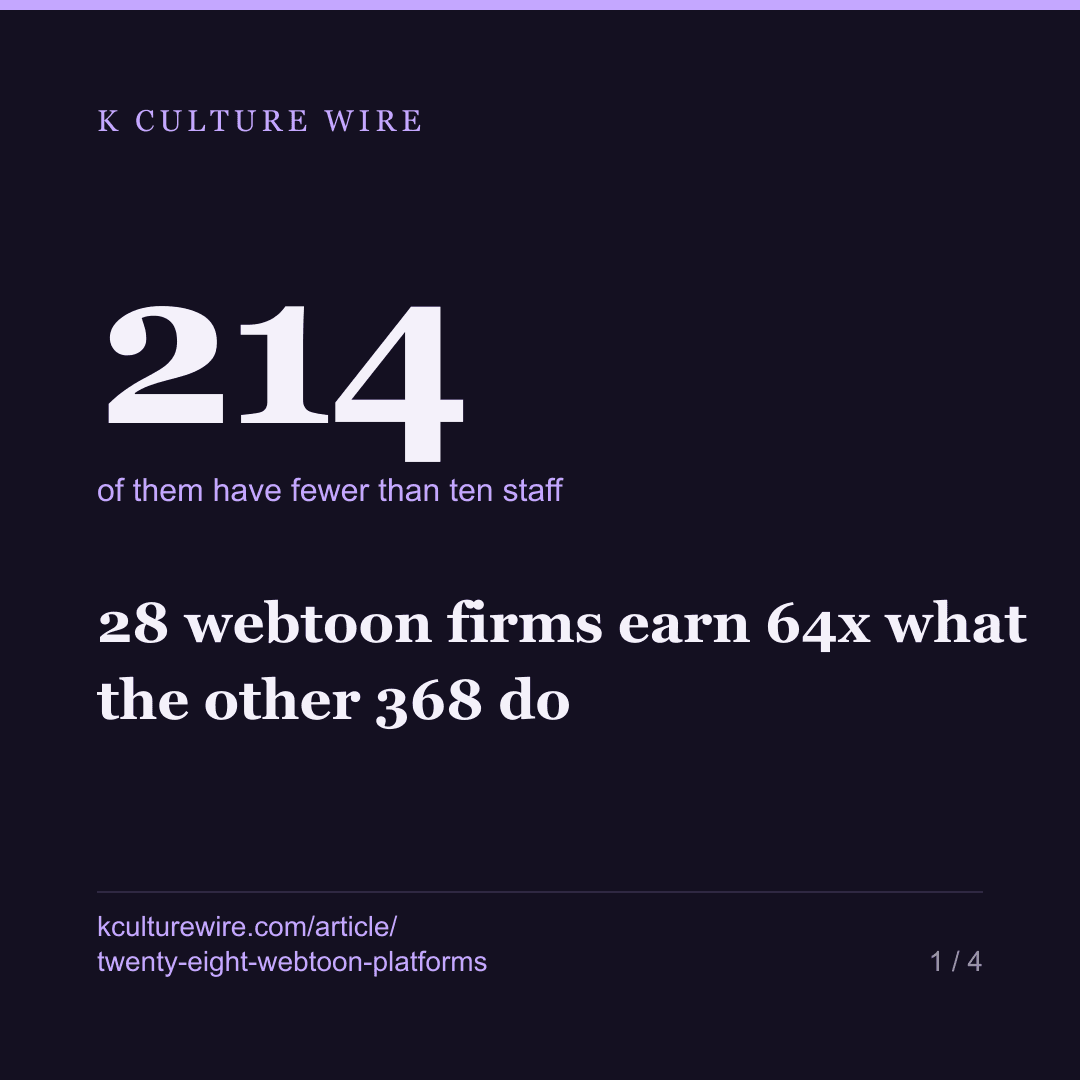
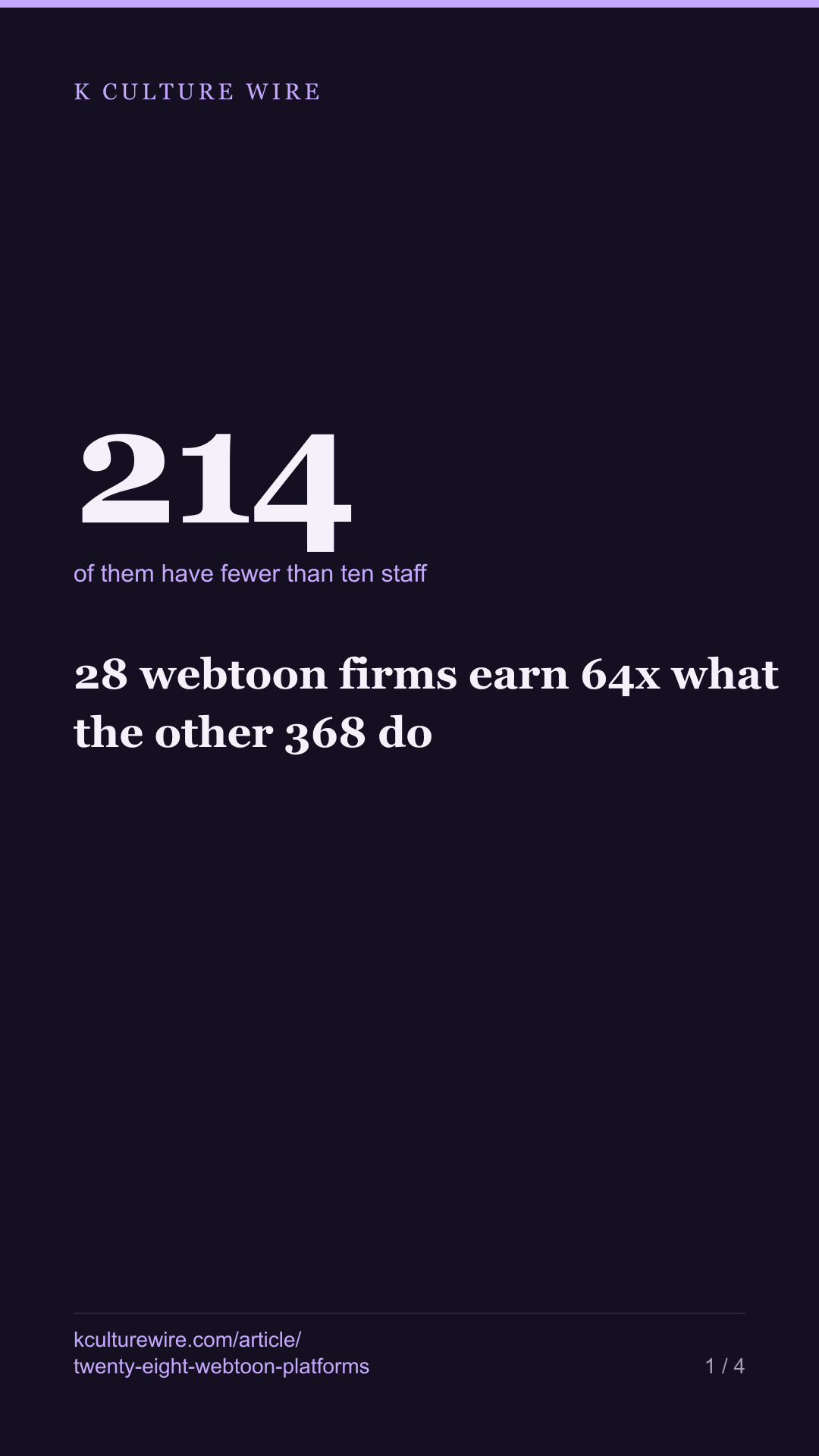
28 webtoon firms earn 64x what the other 368 do
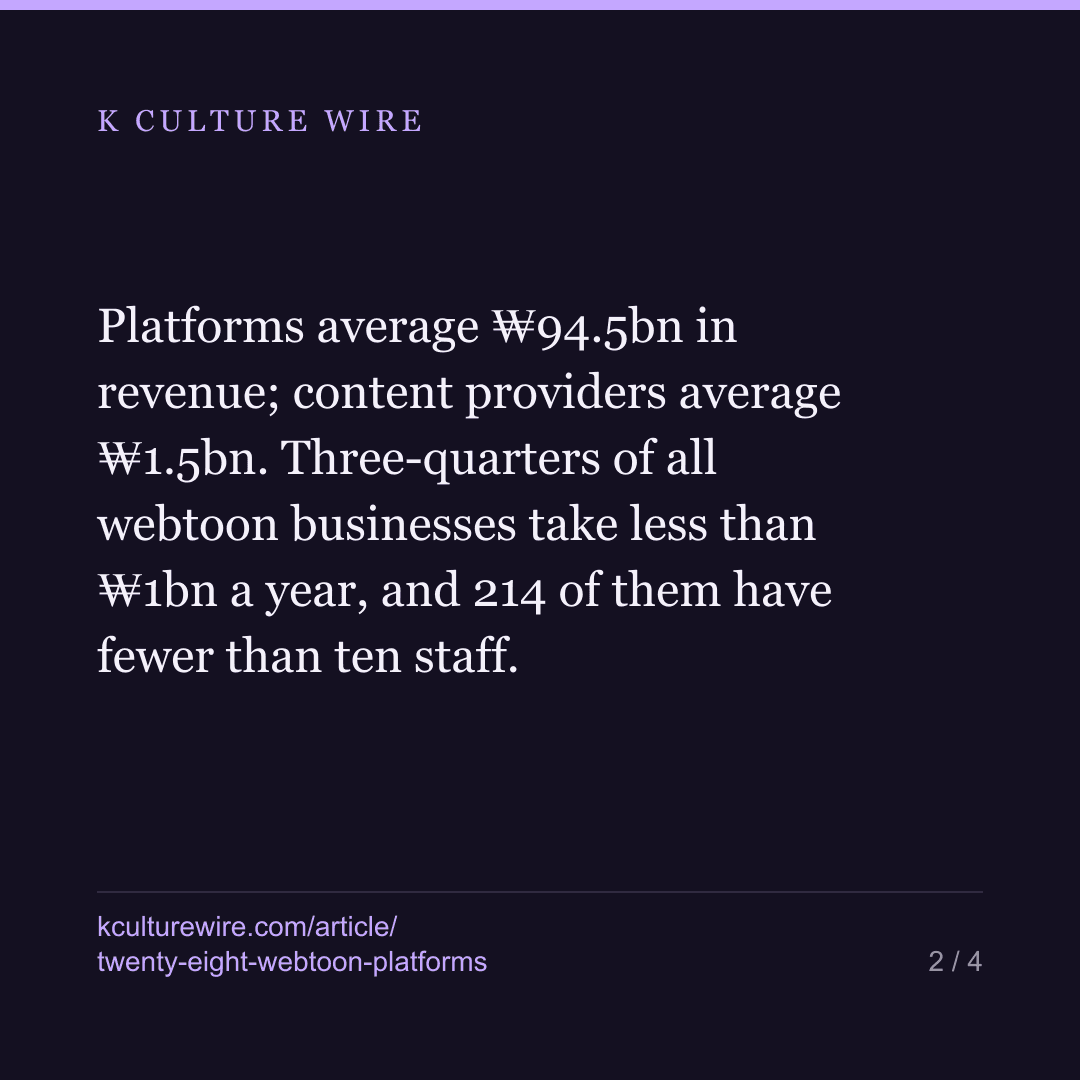
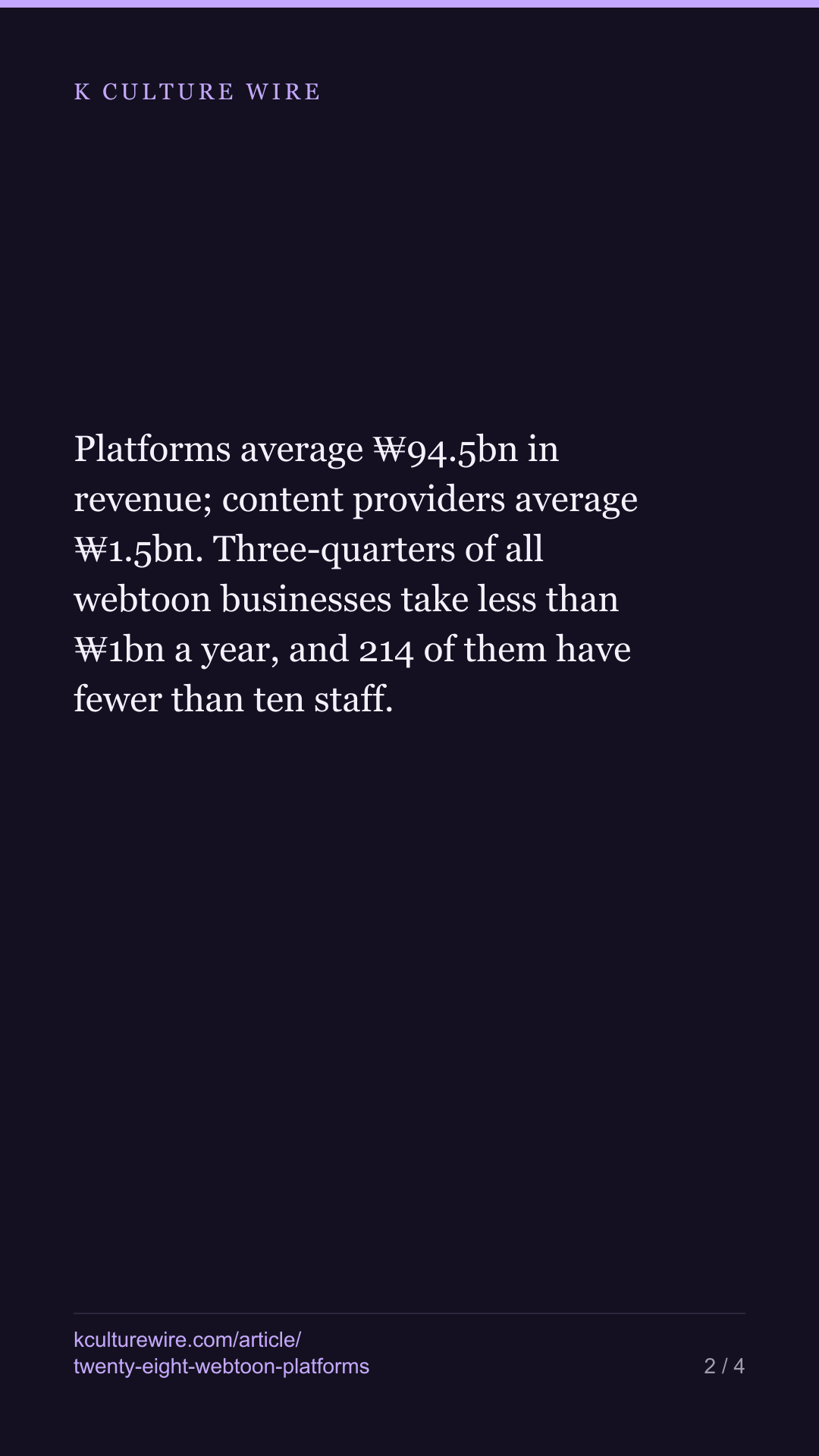
Platforms average ₩94.5bn in revenue; content providers average ₩1.5bn. Three-quarters of all webtoon businesses take less than ₩1bn a year, and 214 of them have fewer than ten staff.
The table this is written from: /webtoon
Korea’s webtoon industry, as its own government survey counts it, is 396 businesses. Split them the way the survey does and the sector turns out to be two things sharing a name.
| Businesses | Average revenue | Under ₩1bn | ₩10bn+ | |
|---|---|---|---|---|
| Platforms | 28 | ₩94.5bn | 51.8% | 39.3% |
| Content providers | 368 | ₩1.5bn | 78.3% | 5.3% |
| All | 396 | ₩8.1bn | 76.4% | 7.7% |
A platform averages 64 times the revenue of a content provider. The 28 of them are 7% of the businesses in the survey.
The shape underneath the average
An average of ₩8.1bn across the sector would suggest a mid-sized industry. The band columns say something else: 76.4% of all webtoon businesses take less than ₩1bn a year, and only 7.7% clear ₩10bn.
Sorted by staff instead, the same shape appears:
| Businesses | Average revenue | Under ₩1bn | |
|---|---|---|---|
| Under 10 staff | 214 | ₩0.3bn | 92.8% |
| 10–49 staff | 129 | ₩1.3bn | 68.9% |
| 50+ staff | 53 | ₩56.1bn | 28.3% |
214 of 396 businesses — more than half — have fewer than ten people. Their average annual revenue is ₩330m. The 53 businesses with fifty or more staff average ₩56.1bn, roughly 170 times as much.
What each kind of business actually does
The survey also splits by main line of work, and the split tracks the platform divide almost exactly.
| Main business | Businesses | Average revenue |
|---|---|---|
| Webtoon service provision | 31 | ₩85.3bn |
| Other | 24 | ₩2.0bn |
| Distribution and brokerage | 65 | ₩1.6bn |
| Publishing | 28 | ₩1.5bn |
| Planning and production | 247 | ₩1.4bn |
Planning and production is the largest group and the second-smallest by revenue. 247 of the 396 businesses make the work; they average ₩1.4bn. The 31 that run the service where it is read average 61 times that.
How much of this is actually webtoons
One column in the survey is easy to miss and worth more than most of the rest: what share of a business’s revenue comes from webtoons at all.
59.5% of businesses take three-quarters or more of their revenue from webtoons. Among the very small — under ten staff — it is 67.5%. Among businesses over ₩10bn it drops to 41.3%.
So the large end is diversified and the small end is not. The businesses least able to absorb a bad year are the ones with the least else to fall back on.
What this survey does not tell you
It counts businesses, not artists. Nothing here says how revenue is divided between a platform, a production studio and the person drawing. That is the question most often asked about this industry and this dataset cannot answer it.
It is 2024. The survey runs behind, and 2024 is the most recent reference year published. We add later years when they appear.
And the two 28s are different sets. Twenty-eight businesses are platforms; twenty-eight are publishers by main line of work. They are separate cuts of the same 396 and the coincidence of the number means nothing.
Twenty-eight platforms and 368 suppliers is one cut. The survey has another. Read the two economies inside webtoons →
Where these numbers come from
Sources
- Korea Creative Content Agency — Webtoon Industry Survey (웹툰산업실태조사), reference year 2024, via KOSIS tables DT_467002_A005 and DT_467002_A004 · https://kosis.kr
What we checked
- Every figure is as the survey publishes it. The two groups — platforms and content providers — are the survey's own split, not ours
- Average revenue is the survey's mean per business in millions of won, converted to billions for reading. Means are used because the survey publishes means; the revenue-band columns are given beside them so a reader can see the skew the mean hides
- The revenue bands and the staff bands are separate cuts of the same 396 businesses, so their counts each sum to 396 and are not additive with each other
What we left out, and why
- Any figure for 2025 or 2026. The survey runs behind; 2024 is the most recent reference year published
- Any claim about individual companies. The survey publishes group aggregates only, and we do not know which businesses are in which band
- Creator earnings. This survey covers businesses, not the artists who supply them, and nothing here says how revenue is split with them
The data behind this
Written from the same data
Take this away — 8 cards
The figures in this article, as images. Free to repost with the address on them.
If you work in this business
Everything on this page is measured from the same weekly Netflix lists, per market and per title. We publish the pages free; what we sell is the same measurement cut to one company's catalogue — including the figures behind /webtoon.
What a company sheet contains, and what it cannot tell you →