Lee Byung-hun and Ma Dong-seok: the busiest are film actors
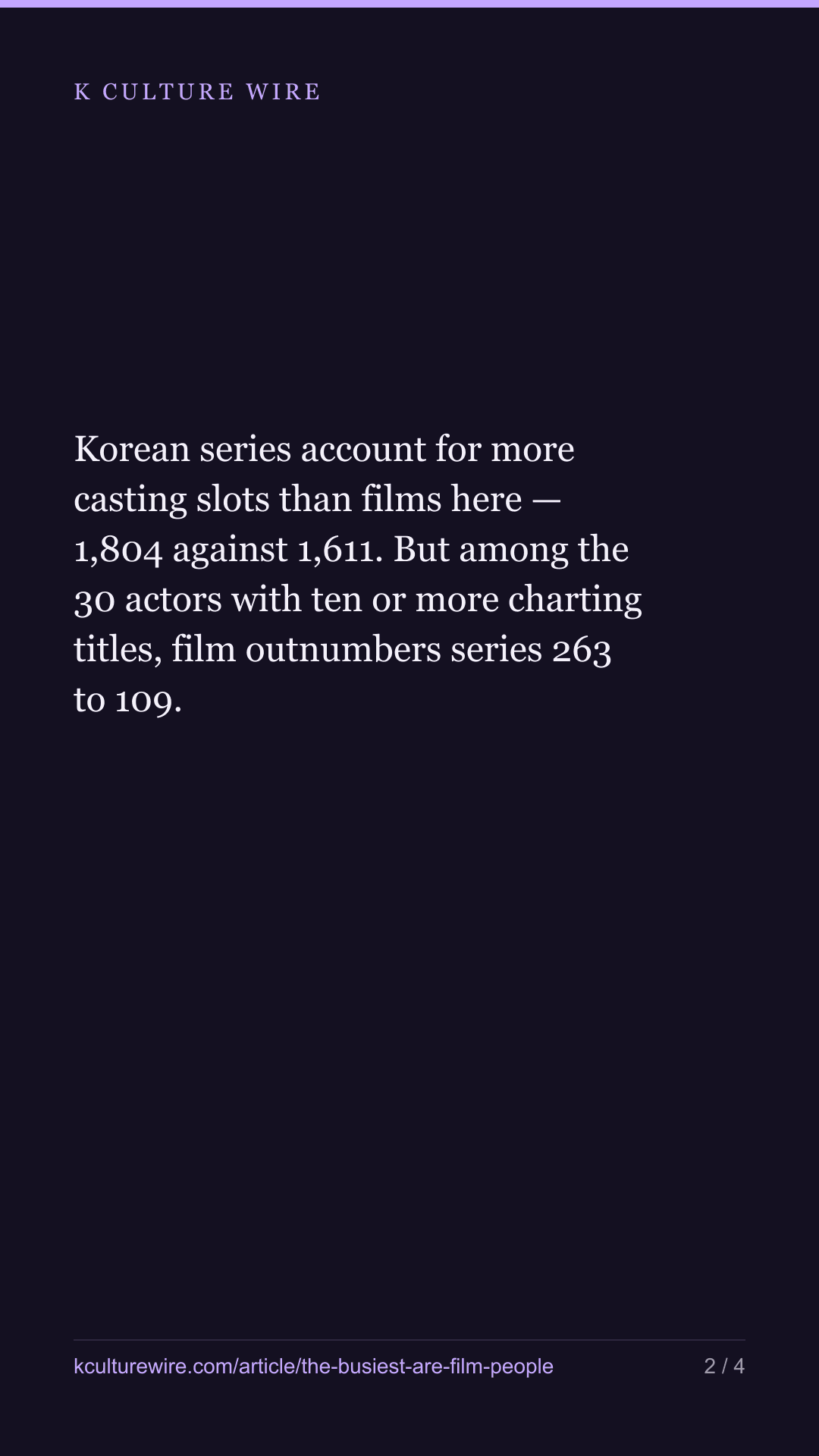
Korean series account for more casting slots than films here — 1,804 against 1,611. But among the 30 actors with ten or more charting titles, film outnumbers series 263 to 109.
The table this is written from: /actors
Count casting slots — one person in one title — and this panel leans television. 1,854 series slots against 1,725 film slots, across 666 titles.
Now look at the 38 people who appear in ten or more of these titles. Their slots split the other way, and not narrowly.
331 film. 137 series.
| Titles | Film | Series | |
|---|---|---|---|
| Hwang Jung-min | 20 | 19 | 1 |
| Ma Dong-seok | 21 | 20 | 1 |
| Sul Kyung-gu | 17 | 17 | 0 |
| Lee Byung-hun | 18 | 13 | 5 |
| Ha Jung-woo | 17 | 16 | 1 |
| Kim Eui-sung | 15 | 9 | 6 |
| Kim Hae-suk | 14 | 6 | 8 |
| Jin Seon-kyu | 14 | 11 | 3 |
The most prolific person in the panel has one series credit in twenty-one titles. The second has one in eighteen. Sul Kyung-gu has none at all.
Why this is not a contradiction
A series occupies an actor for months and yields one credit. A film occupies weeks and yields one credit too. Anyone accumulating a large number of credits is therefore far more likely to be doing it through film, whatever the medium’s relative size — and the top of this list is what that arithmetic looks like.
So the finding is not that Korean television employs fewer people. It employs more, and the slot count says so. The finding is that “appears in the most titles” is close to a definition of film actor, and any ranking built on title counts will quietly select for film without saying so.
That matters if you were about to use a count like this as a proxy for prominence. It is a proxy for throughput, and throughput is a property of format before it is a property of a person.
The exceptions are the interesting rows
Kim Hae-suk is the only name in the top eight with more series than film. Kim Eui-sung is close to even at 9 and 6. Both are character actors who work constantly in both, which is exactly the profile the arithmetic above says should be rare.
What could be producing this instead
Series casts are long and recorded thinly. A sixteen-episode drama may credit forty people; Wikidata records the median series here with 4. If the missing names are disproportionately series supporting cast, the true series slot count is higher and this gap narrows. We cannot measure how much, and we are not going to model it.
And this is only what charted. A television actor with thirty credits, none of which reached a Netflix Top 10, does not appear at all.
The busiest are film people. Removing them does not break anything. Read why the network holds without them →
What changed on 2 September 2026
We re-collected the cast data on 25 August 2026 and recounted every figure here. The panel moved to 3,579 casting slots across 666 titles and 1,391 people, and the group appearing in ten or more titles from 39 people to 38.
The finding did not change. The busiest people still lean the other way from the panel as a whole: 331 film slots against 137 series, where the earlier count said 341 against 138.
Where these numbers come from
Sources
- Wikidata — Cast member (P161) with citizenship (P27 = Q884) on Korean titles that appeared in a Netflix Top 10, joined on Q-numbers; film or series from each title's instance-of statement · https://query.wikidata.org
- Netflix — Top 10 weekly lists (Tudum), used to decide which Korean titles enter the set · https://www.netflix.com/tudum/top10
What we checked
- A casting slot is one person in one title. The panel holds 3,579 of them across 666 titles and 1,391 people
- The comparison is slot against slot, not title against title, so it is not distorted by films and series having different cast sizes on average
- The 30 are everyone with ten or more titles in this set, not a hand-picked list
- No pageview data is used. Nothing here depends on whether a person has an English Wikipedia article
What we left out, and why
- Any claim about earnings, billing or role size. P161 records a cast member and nothing about the part
- Any claim that Wikidata's cast lists are complete. Series casts run long and are recorded thinly, which is a plausible reason the effect looks as large as it does — and we cannot rule it out
- Anything that did not chart. A prolific television actor whose work never reached a Netflix Top 10 is absent
The data behind this
Written from the same data
Take this away — 8 cards
The figures in this article, as images. Free to repost with the address on them.







If you work in this business
Everything on this page is measured from the same weekly Netflix lists, per market and per title. We publish the pages free; what we sell is the same measurement cut to one company's catalogue — including the figures behind /actors.
What a company sheet contains, and what it cannot tell you →