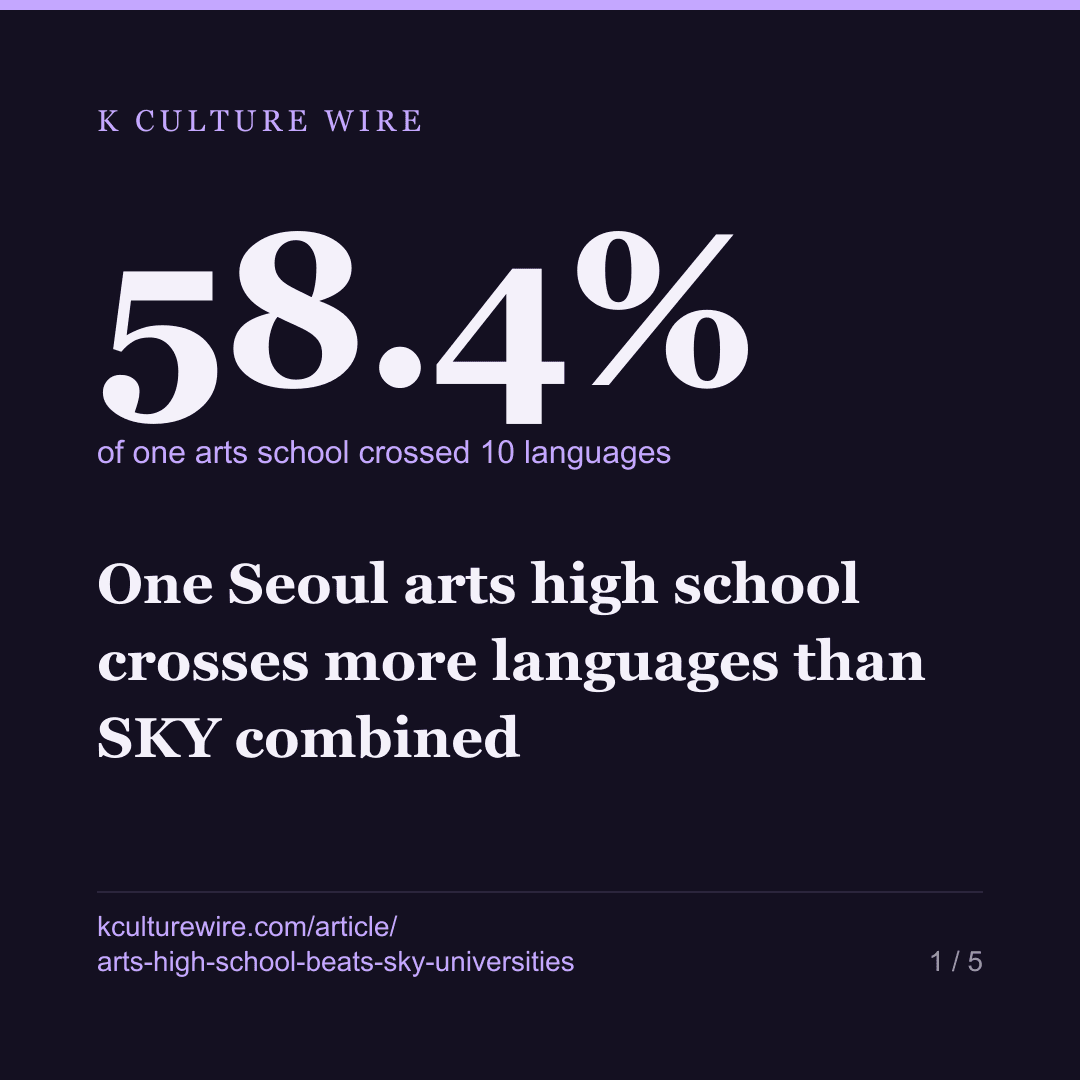
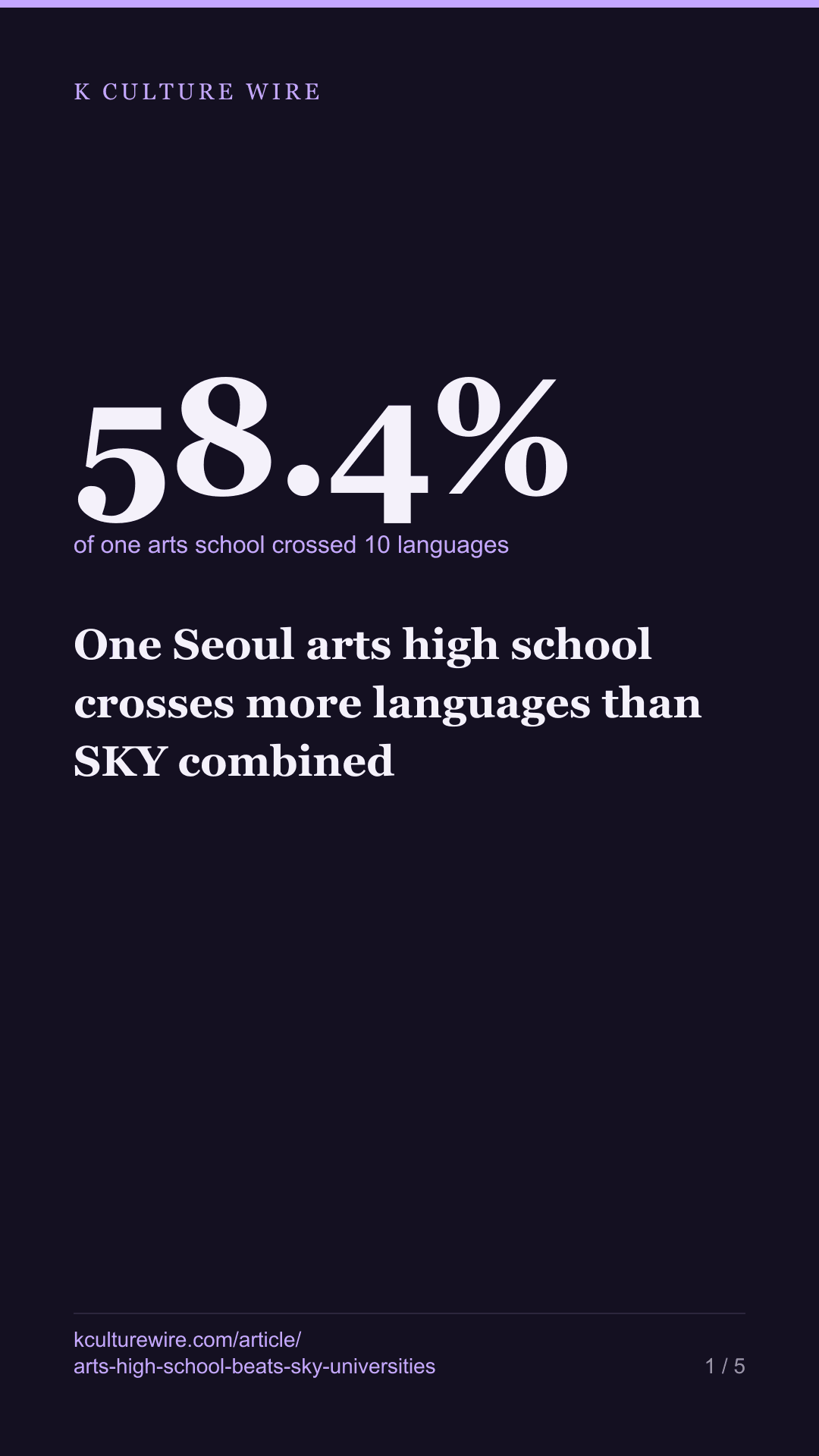
One Seoul arts high school crosses more languages than SKY combined
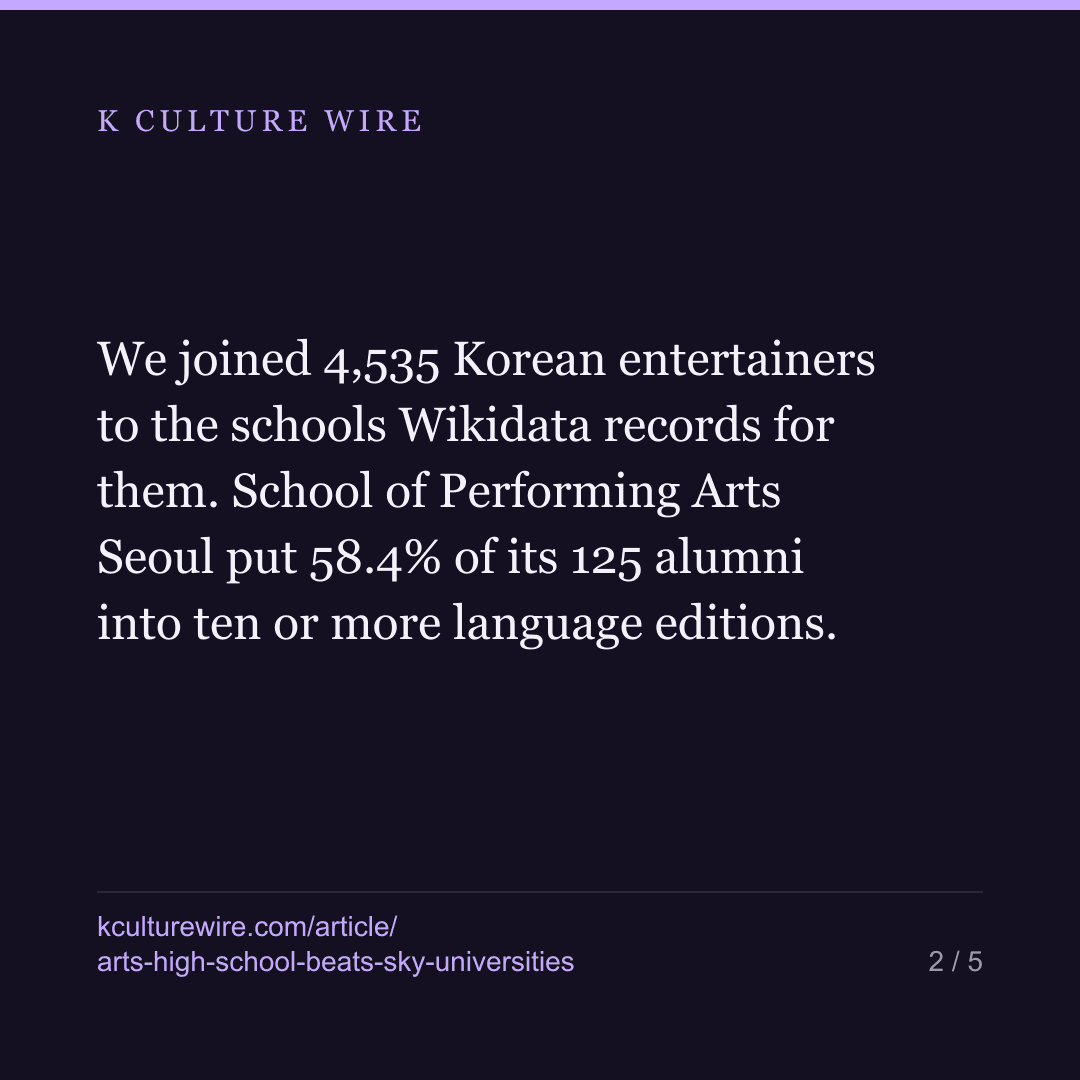
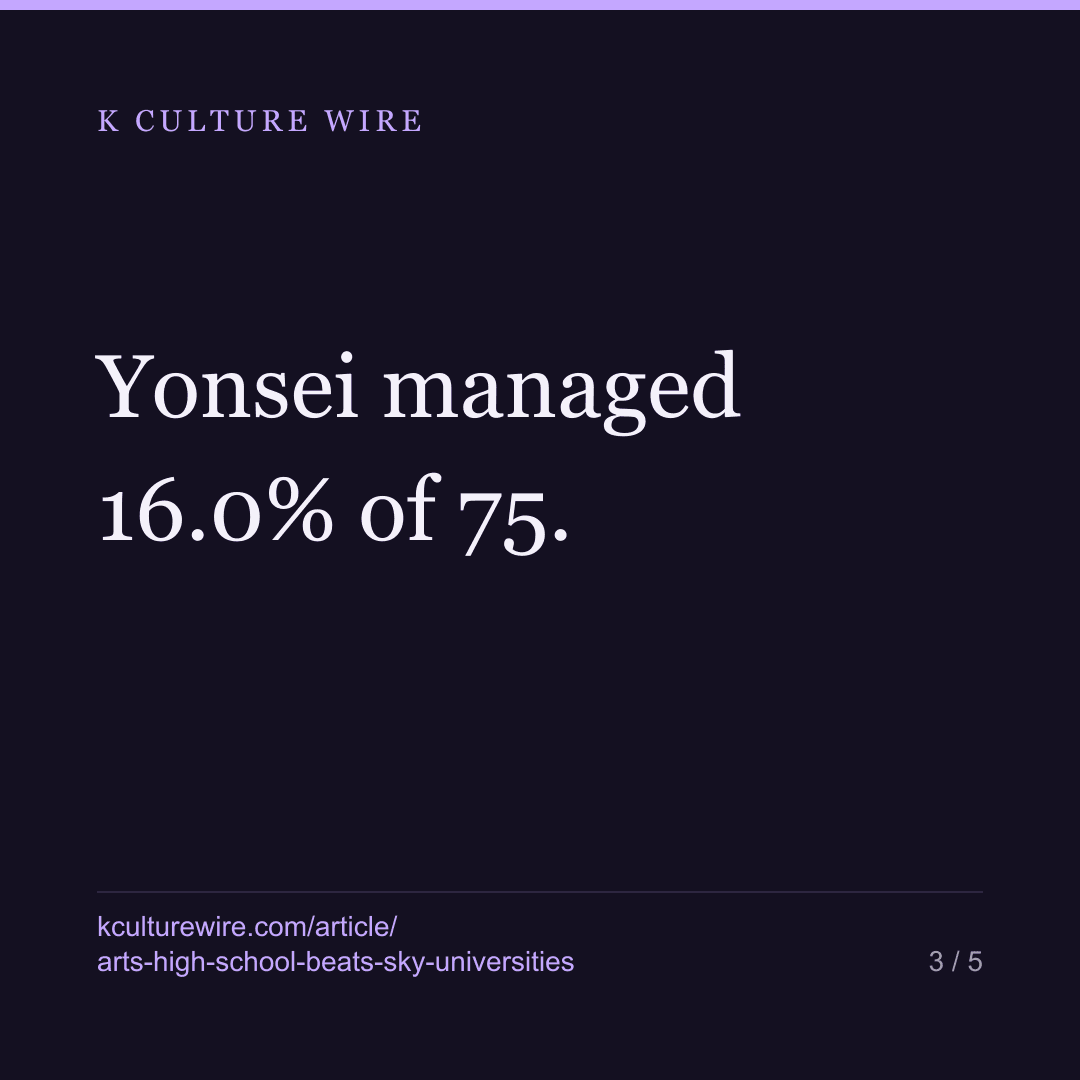
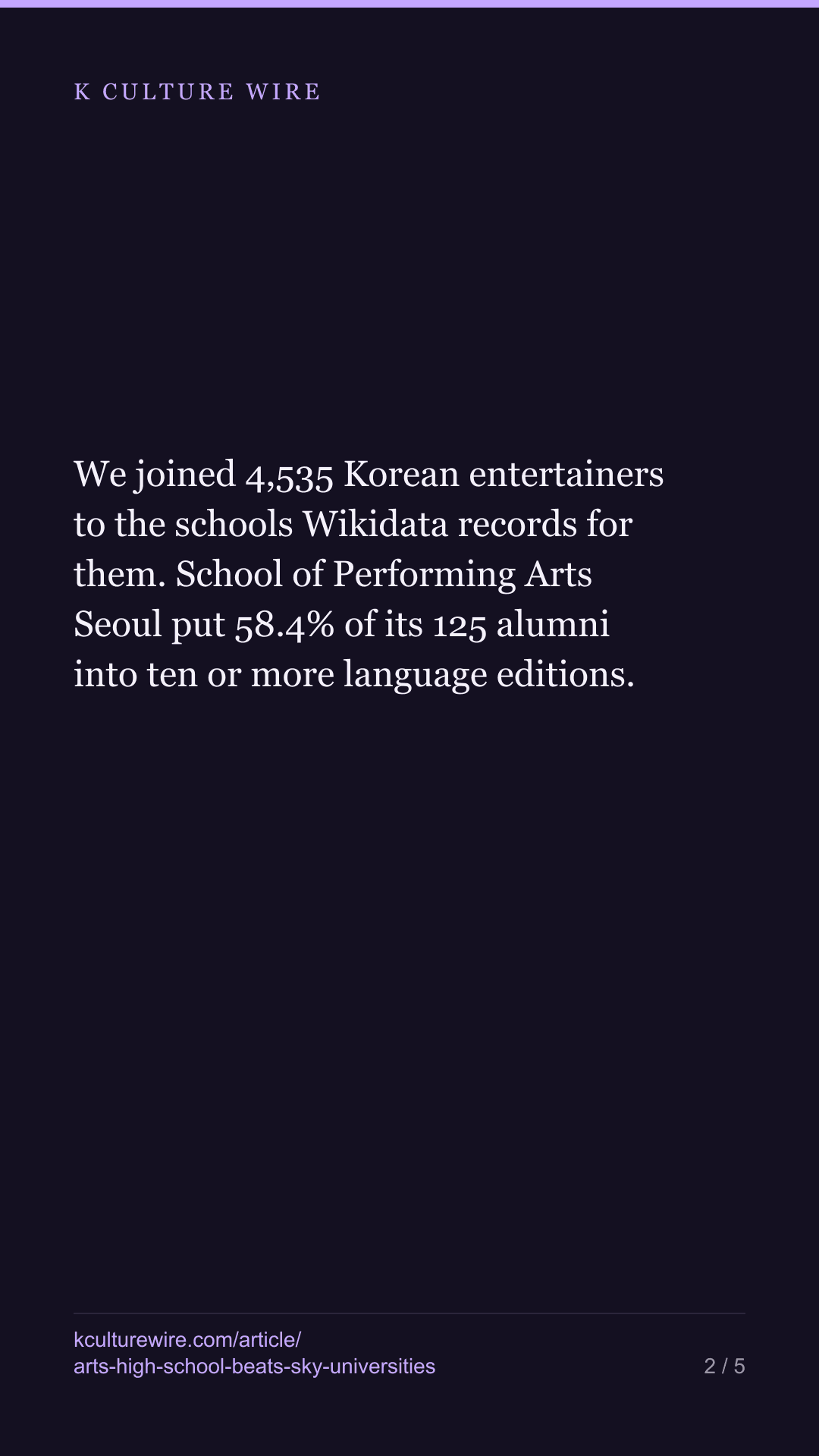
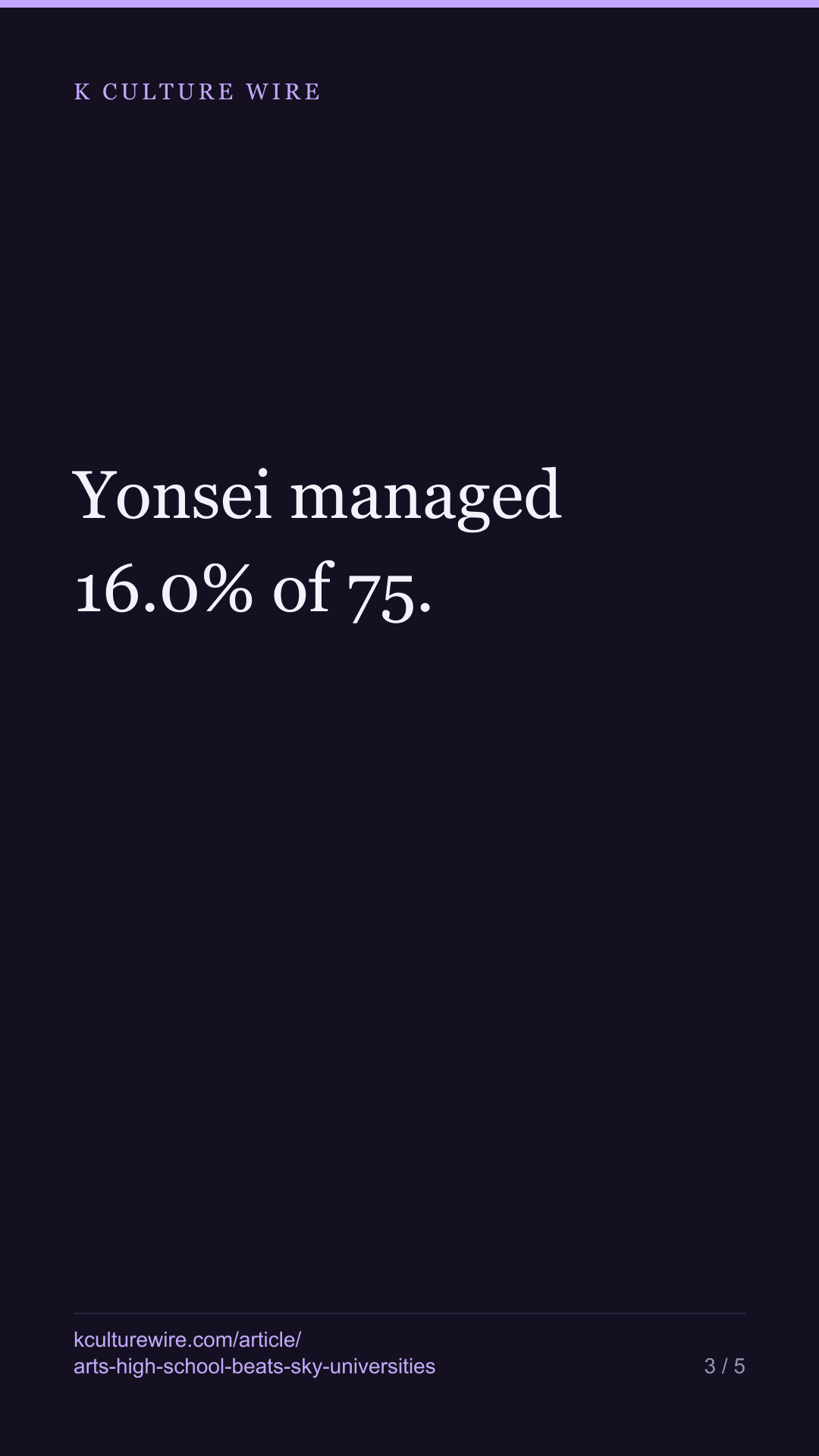
We joined 4,535 Korean entertainers to the schools Wikidata records for them. School of Performing Arts Seoul put 58.4% of its 125 alumni into ten or more language editions. Yonsei managed 16.0% of 75.
The table this is written from: /school
Korean pop culture is exported. The people who carry it are educated in Korea, and Korea keeps a public record of where. Wikidata holds a school for 4,535 Korean entertainers. Nobody had counted what those schools have in common.
We joined that table to a second one holding each person’s birth year and their sitelink count — the number of Wikipedia language editions that carry an article about them. Every one of the 4,535 matched. The measure is narrow and worth stating plainly: a sitelink count says how many language communities wrote about a person. It does not say how many people watched them.
The top of the table is a high school
Twenty-three schools have 40 or more recorded alumni. All 23 are below, in full, ordered by the share reaching ten or more language editions. The school at the top is not a university.
| School | Alumni recorded | Reached 10+ languages | Share | Median languages |
|---|---|---|---|---|
| School of Performing Arts Seoul | 125 | 73 | 58.4% | 13 |
| Konkuk University | 76 | 43 | 56.6% | 11 |
| Hanlim Multi Art School | 123 | 65 | 52.8% | 11 |
| Sungkyunkwan University | 78 | 38 | 48.7% | 9 |
| Hanyang University | 139 | 65 | 46.8% | 9 |
| Kyung Hee University | 145 | 65 | 44.8% | 8 |
| Myongji University | 62 | 27 | 43.5% | 8 |
| Dongguk University | 200 | 83 | 41.5% | 6 |
| Sangmyung University | 49 | 20 | 40.8% | 3 |
| Korea National University of Arts | 115 | 45 | 39.1% | 7 |
| Seoul National University | 50 | 19 | 38.0% | 7 |
| Kyonggi University | 46 | 17 | 37.0% | 7 |
| Anyang Arts High School | 42 | 15 | 35.7% | 3 |
| Chung-Ang University | 310 | 108 | 34.8% | 6 |
| Sejong University | 72 | 25 | 34.7% | 7 |
| Dankook University | 143 | 48 | 33.6% | 4 |
| Dong-Ah Institute of Media and Arts | 82 | 26 | 31.7% | 4 |
| Seoul Institute of the Arts | 352 | 109 | 31.0% | 6 |
| Korea University | 72 | 22 | 30.6% | 4 |
| Dongduk Women’s University | 206 | 59 | 28.6% | 2 |
| Sungshin Women’s University | 40 | 11 | 27.5% | 2 |
| Ewha Womans University | 48 | 10 | 20.8% | 1 |
| Yonsei University | 75 | 12 | 16.0% | 2 |
The three bolded rows are SKY — Seoul National, Korea and Yonsei, the universities Korean parents name when they name the top. Between them they have 197 recorded entertainers and 53 who reached ten languages. School of Performing Arts Seoul has 125 and 73.
The median is the sharper number
The share above uses a threshold, and thresholds can be argued with. The median is harder to argue with, because it describes the ordinary graduate rather than the successful one.
At School of Performing Arts Seoul the median alumnus sits in 13 language editions. At Yonsei the median sits in 2. At Ewha it sits in 1 — meaning the typical recorded entertainer from Ewha has a Korean Wikipedia page and nothing else.
Two people explain the arts-school figure better than any rate does. Jungkook of BTS and Jisoo of BLACKPINK both attended School of Performing Arts Seoul, and both appear in 68 language editions — the joint highest in the school’s list. Kang Seul-gi of Red Velvet is at 59, Bae Suzy at 51.
Hanlim Multi Art School, second among the arts schools, reads the same way: Kim Da-hyun of TWICE at 41, Cha Eun-woo at 39, Krystal Jung at 36, Son Chaeyoung of TWICE at 35, Lee Taemin of SHINee at 34.
What the elite universities produce instead
Yonsei’s list is not empty of names. It is led by J.Y. Park, the producer who founded JYP Entertainment, at 28 language editions, then the actor Park Gyu-young at 23. Seoul National’s is led by the actor Kim Tae-hee at 39 and Lee Soo-man, who founded SM Entertainment, at 30. Korea University’s by Ok Taec-yeon of 2PM at 29 and the actor Jeon Do-yeon at 25.
The pattern in those three lists is actors, producers and founders — people whose work reaches audiences through Korean-language institutions. The arts high schools produce idols, and idol groups are marketed to language communities one at a time.
The largest school is not the strongest
Seoul Institute of the Arts records 352 entertainers, more than any other school in the data, and 109 of them reached ten languages. That is the largest absolute count in the table and a 31.0% share — below Seoul National University’s. Chung-Ang University is similar: 310 recorded, 34.8%.
Volume and reach are separate axes here, and a ranking by one is not a ranking by the other. Anyone comparing schools should say which they mean.
Where this stops
Arts high schools audition applicants. Agencies recruit at them. A student is often already signed before the first class. So none of these figures separate what a school taught from whom it admitted, and this count cannot tell those apart — nothing here says a school caused anything.
The 4,535 people are those Wikidata records a school for. Our birth table holds 9,249. The other 4,714 are not people without schools; they are people whose schools nobody wrote down.
This is a count of public records, not a ranking of schools.
The table behind this is at kculturewire.com/school.
Where these numbers come from
Sources
- Wikidata — educated_at for Korean entertainers, 4,535 people with at least one school recorded; joined on Q-id to a birth and sitelink table of 9,249 people · https://www.wikidata.org/
What we checked
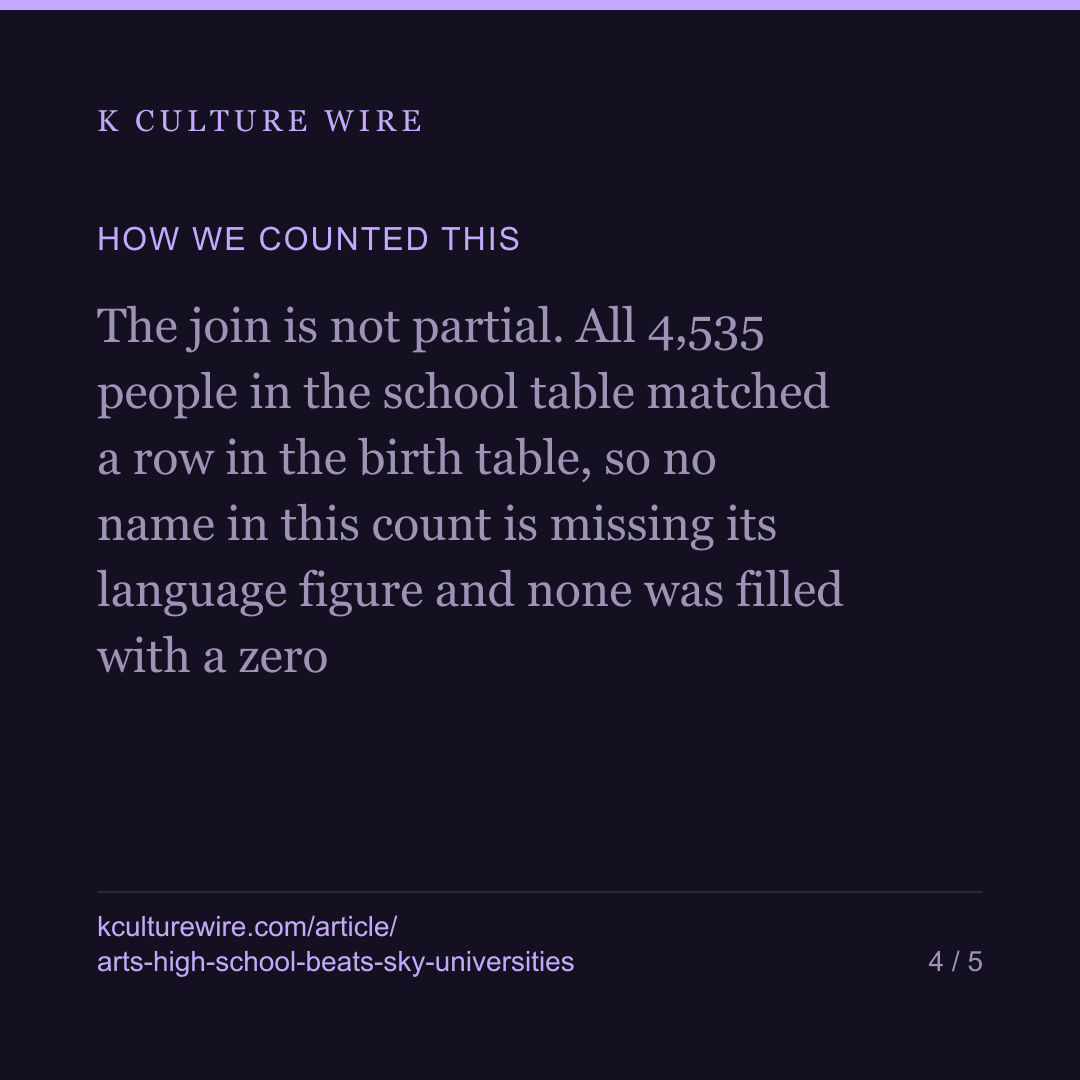
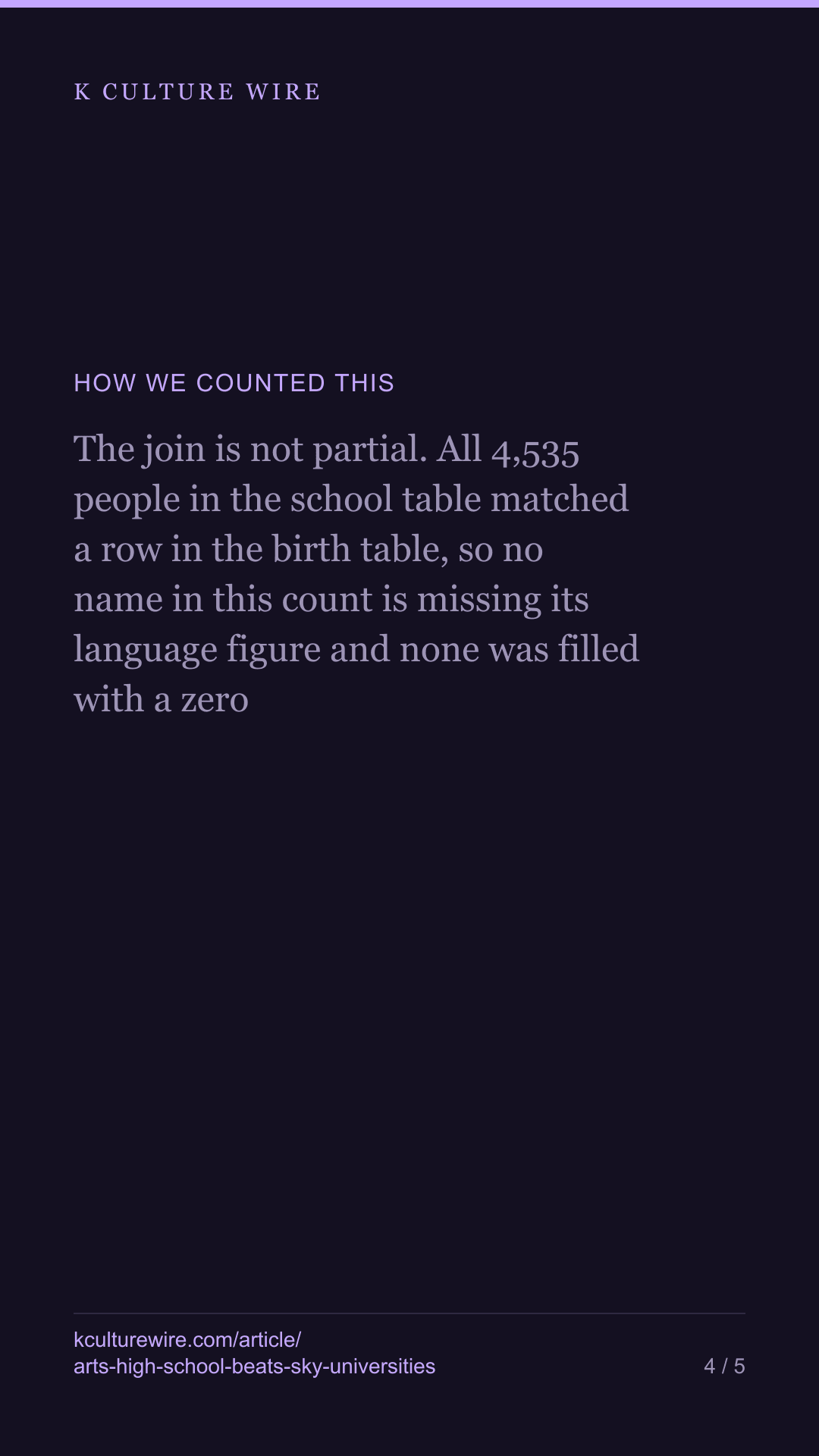
- The join is not partial. All 4,535 people in the school table matched a row in the birth table, so no name in this count is missing its language figure and none was filled with a zero
- A person with several schools is counted once at each school. The 4,535 people spread across 1,519 schools, so the column totals are larger than the number of people
- The same school written twice for one person is counted once, tested against a case where it appears twice
- Rates are reported only for the 23 schools with 40 or more recorded alumni. Below that a single famous graduate moves the rate by several points
- Sitelink counts were read from the same table for every person, so the comparison between schools is on one measure, not two
What we left out, and why
- Popularity. A sitelink count is the number of Wikipedia language editions carrying that person, which is how many language communities wrote about them, not how many people watched or listened
- Whether a person graduated. Wikidata's educated_at does not separate graduating, transferring and dropping out, and we did not
- Anyone whose school is not recorded in Wikidata. Absent is unmeasured, not a person without a school. 4,535 of 9,249 people in our birth table have a school
- Whether the school caused anything. Arts high schools select for talent before they teach it, and agencies recruit at them, so selection and schooling are tangled in every figure here
- Trainees who never debuted, who leave no Wikidata entry at all and are therefore invisible to this count
The data behind this
Written from the same data
Take this away — 10 cards
The figures in this article, as images. Free to repost with the address on them.
If you work in this business
Everything on this page is measured from the same weekly Netflix lists, per market and per title. We publish the pages free; what we sell is the same measurement cut to one company's catalogue — including the figures behind /school.
What a company sheet contains, and what it cannot tell you →