Southeast Asia's Korean travel pages fell by a third. Its Korean culture pages did not.
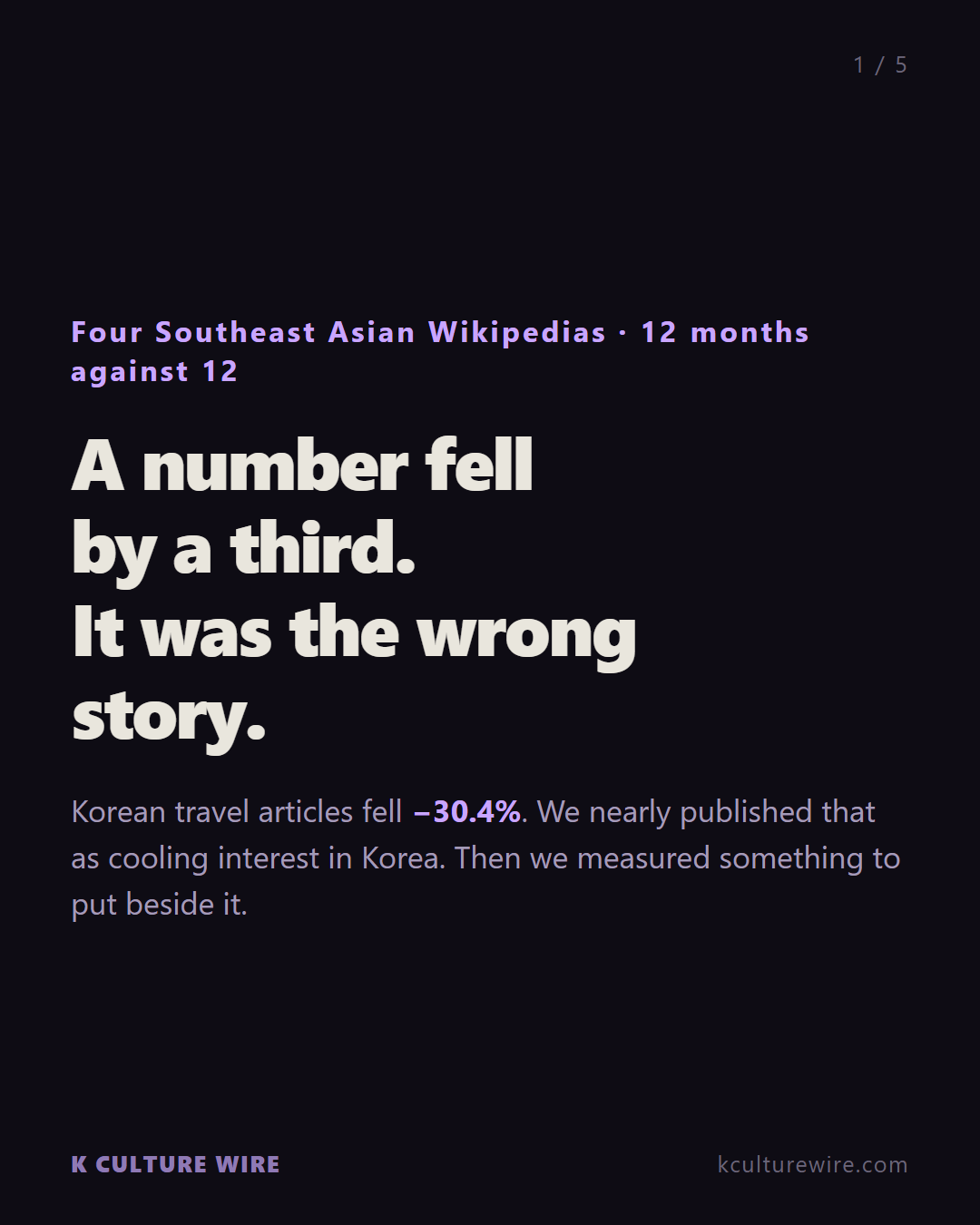
Reads of Korean travel articles in Southeast Asia fell by about a third in a year. What fell — interest in Korea, or the habit of using an encyclopaedia to plan a trip?
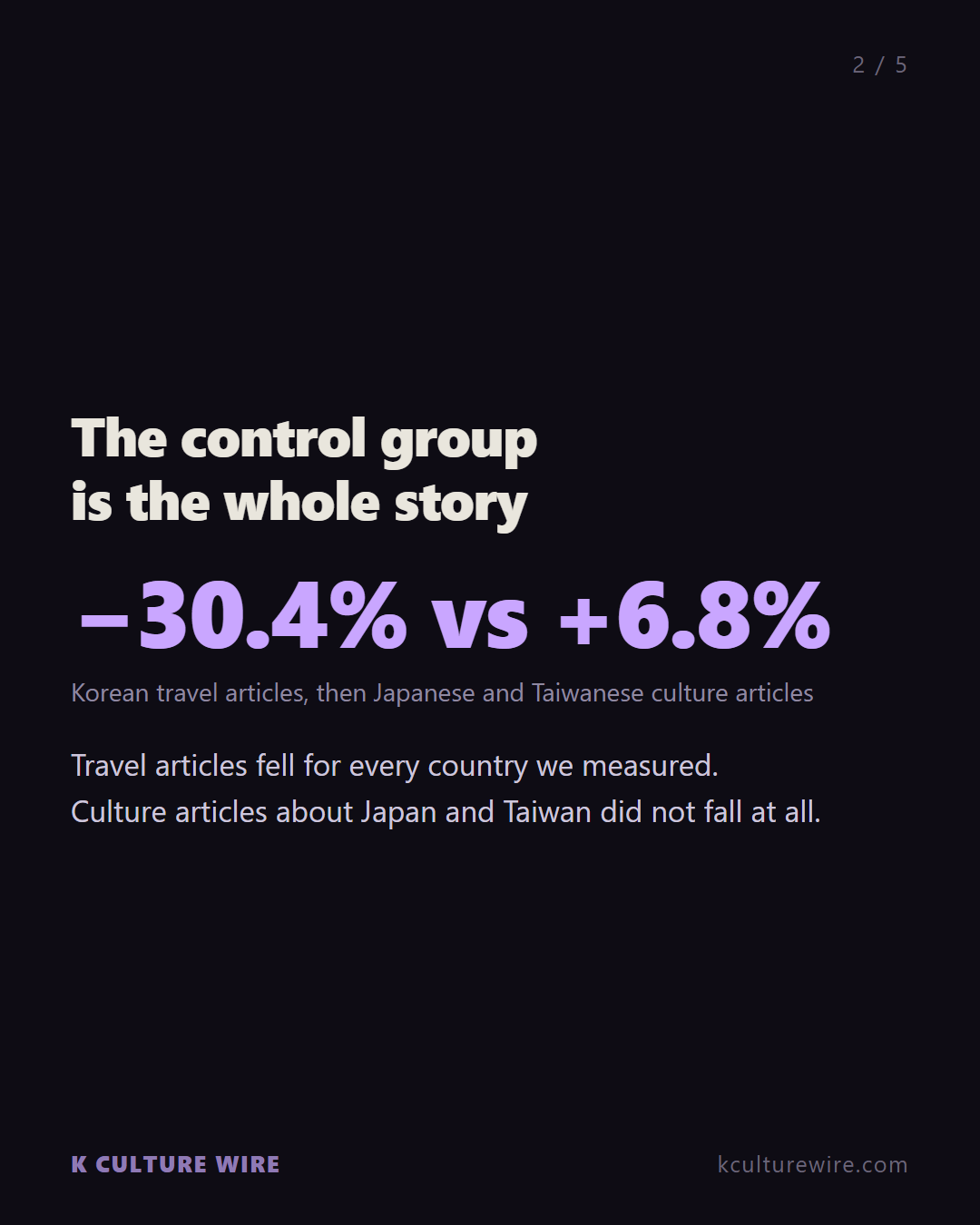
Korean travel articles fell 30% across the four editions. The matched Japanese and Taiwanese travel articles fell 17%, and the Japanese and Taiwanese culture articles did not fall at all — they rose 6.8%. Whatever this is, it is happening to travel articles, not to Korea.
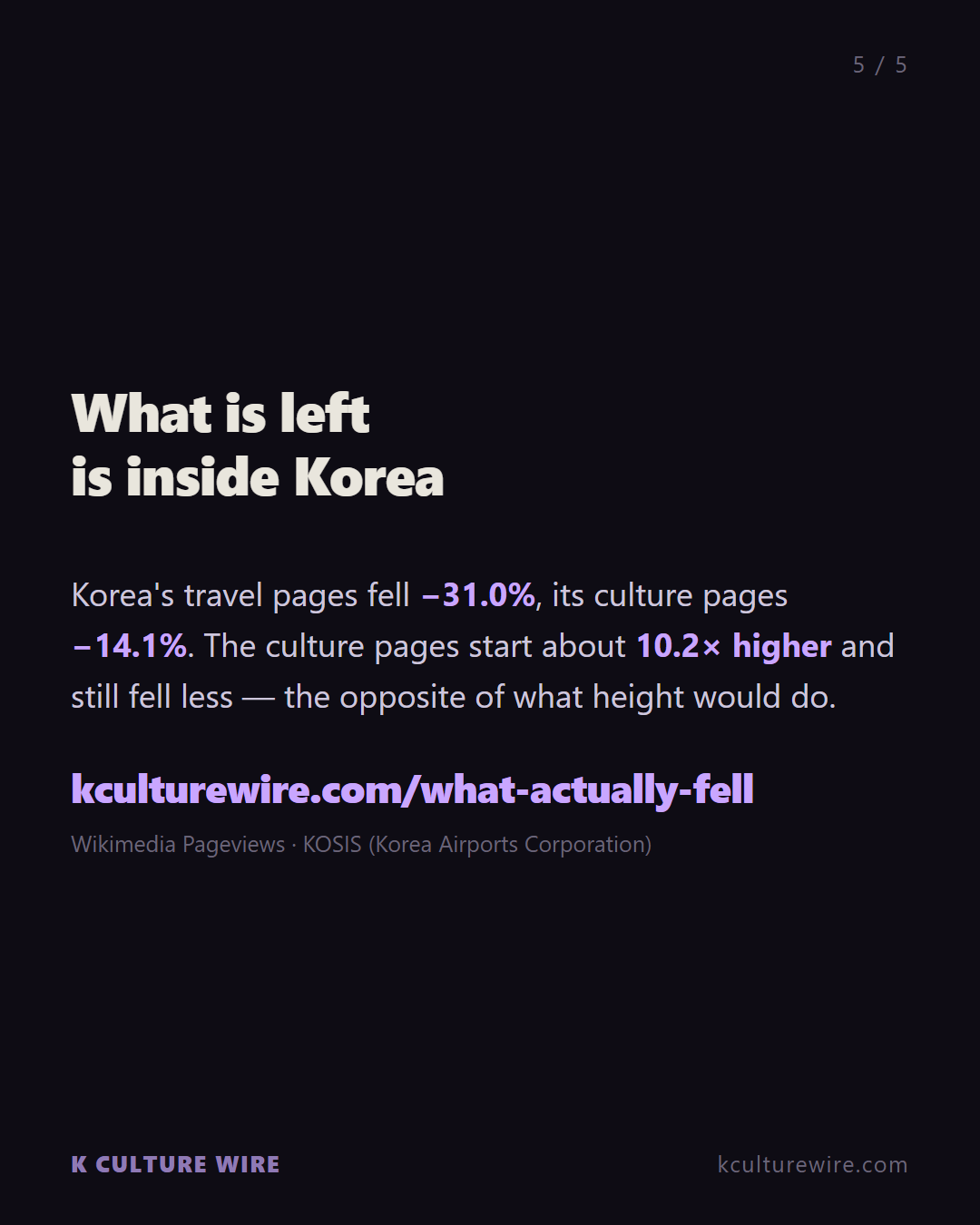
The clearest line is inside Korea's own articles. Its travel pages fell 31% and its culture pages — the country itself, its pop music, its dramas, its language, its alphabet — fell 14%. The culture pages start about 10.2 times higher and still fell less, which is the opposite of what a starting level would do.
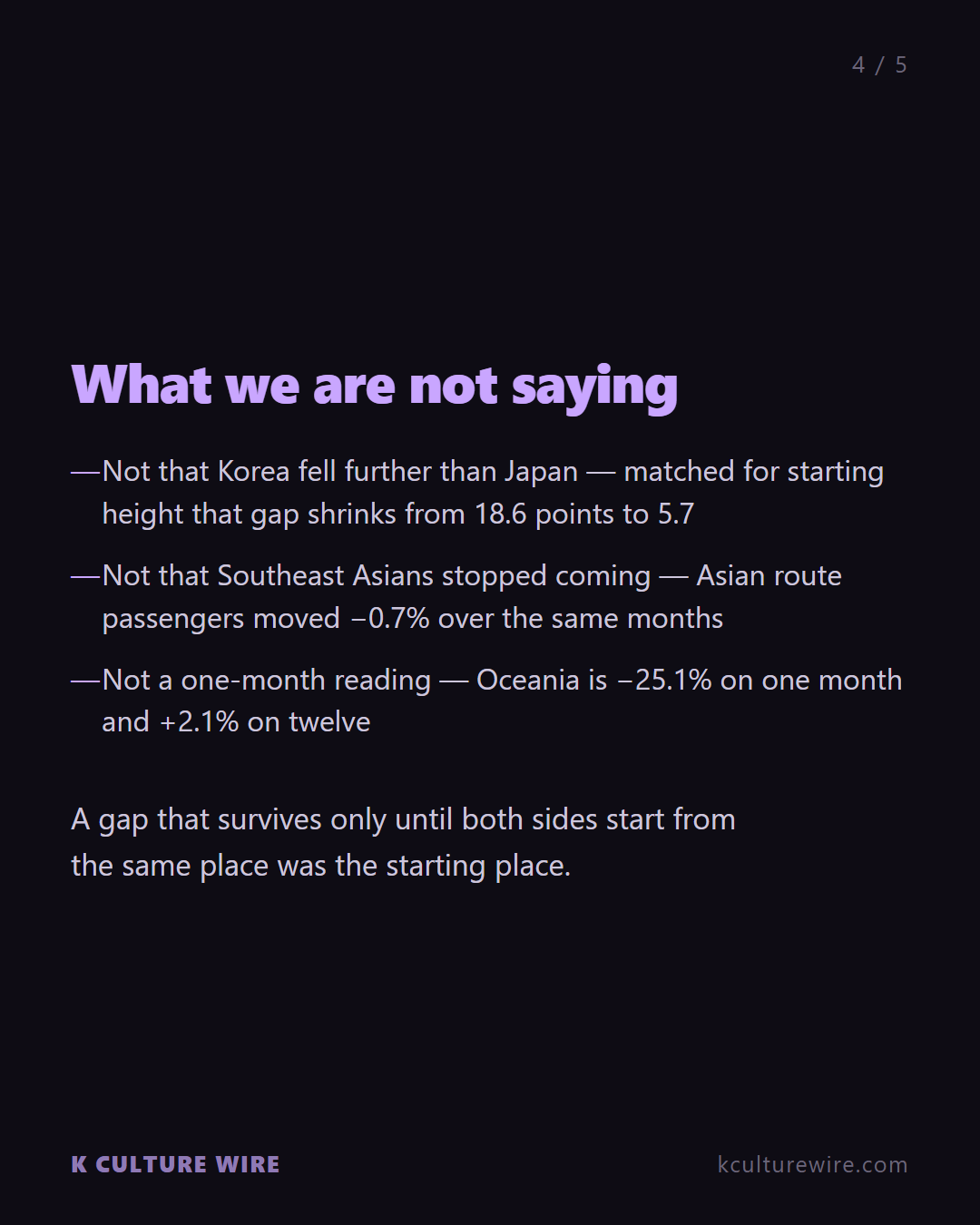
Over exactly the same twenty-four months, air passengers on Asian routes into and out of Korea moved down 0.7%. The flights did not fall. The looking-up did.
Four numbers, one window
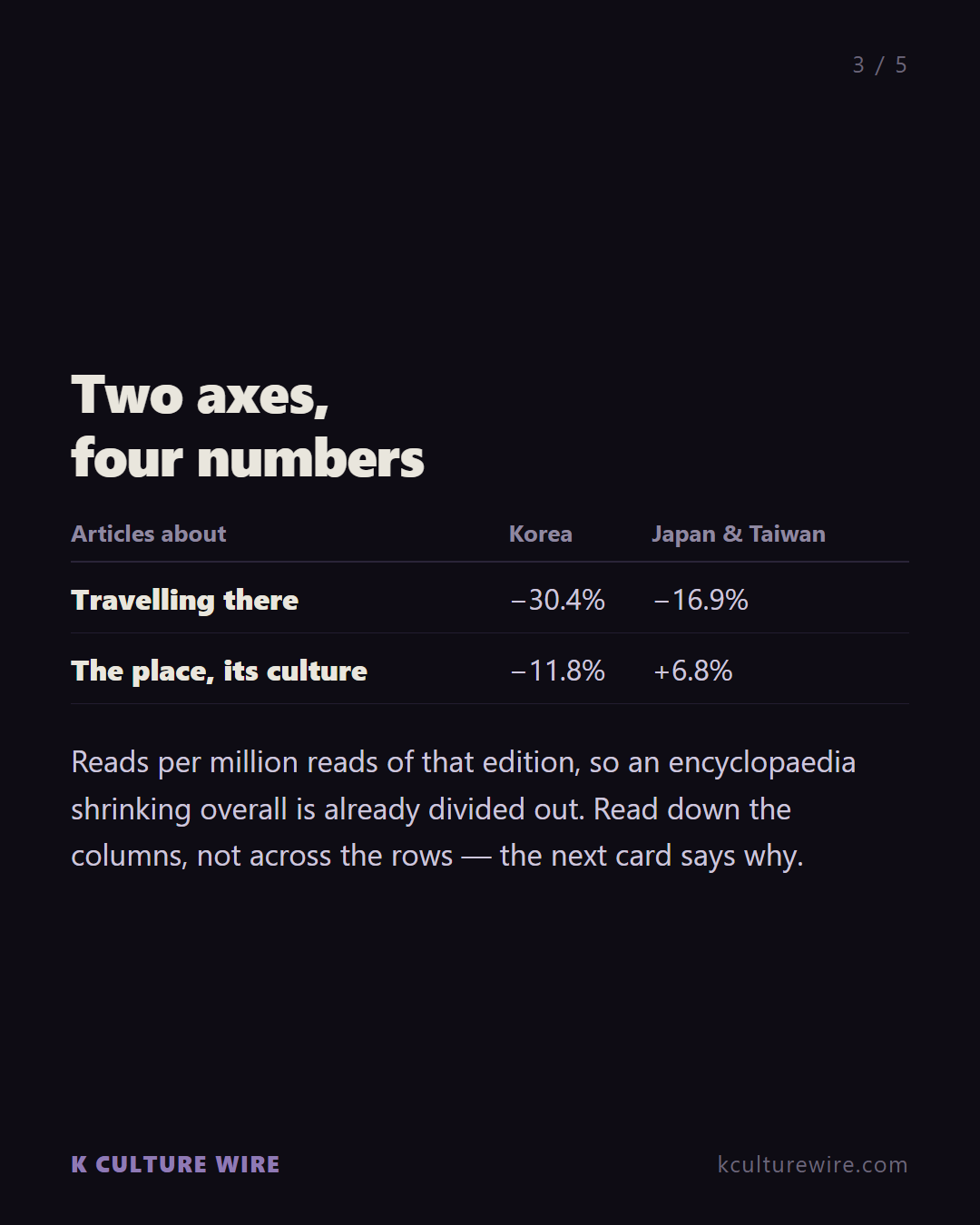
Reads are per million reads of that Wikipedia, so an encyclopaedia that is shrinking overall has already been divided out. 2024-07–2025-06 against 2025-07–2026-06 — twelve months each side, so no month is compared against a different season.
| Articles about | Korea | Japan and Taiwan | Pairings |
|---|---|---|---|
| Travelling there | −30.4% | −16.9% | 43 |
| The place and its culture | −11.8% | +6.8% | 40 |
Read down the columns and the story is the same on both sides: travel articles fell, culture articles did not. Read across the rows and it looks like a Korean story. It is not — the next section is our own check refusing to let us say so.
The comparison we had to throw away
Korea fell further than Japan and Taiwan in both rows. But Korea's articles also started higher, and an article that starts higher has further to fall. So we matched the pairs — only those where the two sides began within a factor of two of each other — and measured again.
| Articles about | Gap, all pairings | Gap, matched for height | Matched pairings |
|---|---|---|---|
| Travelling there | −13.4% | −8.1% | 13 of 23 still fell further |
| The place and its culture | −18.6% | −5.7% | 7 of 11 still fell further |
Both gaps shrink and the counts land near even. A gap that survives only until the two sides start from the same place was the starting place. So we do not report that Korea fell further than Japan, and nothing below rests on it.
What is left standing is inside Korea's own pages
Both rows here are Korean articles, in the same four editions, over the same months — no other country involved, so no starting-height problem between them. Except there is one, and it points the wrong way for the easy explanation.
| Korean articles about | Where they started | Change | Article–edition pairs |
|---|---|---|---|
| Travelling there | 57.7 per million | −31.0% | 26 |
| The place and its culture | 589.3 per million | −14.1% | 23 |
The culture pages sit about 10.2 times higher and fell about 17 points less. Height makes a steeper fall easier, not harder. Whatever separates these two rows, it is not where they began.
Meanwhile the aeroplanes
Over exactly the same twenty-four months, down 0.7% on the Asia routes. People did not stop going. They stopped opening an encyclopaedia article about the trip first — and the next section is us failing to explain why.
| Route region | Twelve months against twelve |
|---|---|
| Japan | +13.5% |
| China | +21.2% |
| Asia (excluding Japan and China) | −0.7% |
| The Americas | +5.3% |
| Europe | +9.5% |
| Middle East | −13.6% |
| Africa | −14.8% |
| Oceania | +2.1% |
| Other | not enough months |
The explanation we tried, and could not keep
A tempting explanation for the travel fall is that questions with one settled answer — the visa rule, how the transit card works, which airport — have been leaving encyclopaedias, while the pages you browse for pleasure have not. We split the travel articles that way and measured. The split does not hold.
| Korean travel articles | Change | Article–edition pairs |
|---|---|---|
| Settled answer — visa policy, transit card, main airport, high-speed rail, capital subway | −33.5% | 11 |
| Browsing — shopping district, nightlife district, resort island, national cuisine, country tourism | −29.2% | 15 |
The two halves of the travel axis are 4.3 points apart, against 18.6 points between travel and culture. And the kind that fell least of all — nightlife district, at -10.7% — sits on the browsing side, which is at least the direction the explanation predicts.
⚠ The two halves are our own division, not the data's — the article kinds are listed above so you can divide them another way. Whichever way it is divided, this split would have to be about 4.3 times larger before it explained more than the difference between travel and culture already does.
The same table, two rulers
The same air table, read two ways. One month against the same month a year earlier, and twelve months against the twelve before them. Where the two disagree in sign, the shorter ruler is reporting a month, not a year. One month here is 2025-06 → 2026-06.
| Route region | One month | Twelve months |
|---|---|---|
| Japan | +12.7% | +13.5% |
| China | +18.0% | +21.2% |
| Asia (excluding Japan and China) | −9.6% | −0.7% |
| The Americas | +9.9% | +5.3% |
| Europe | +7.4% | +9.5% |
| Middle East | −31.1% | −13.6% |
| Africa | −7.2% | −14.8% |
| Oceania | −25.1% | +2.1% |
Oceania is the reason this page compares twelve months against twelve. Read one month against the same month a year earlier, it is −25.1%. Read the year against the year before it, it is +2.1%. Same table, same source, opposite direction — and the shorter ruler is the one that would have made the better headline.
Every kind we measured
| Kind | Axis | Korea | Japan / Taiwan | Pairings |
|---|---|---|---|---|
| Country tourism | travel | −35.1% | −37.6% | 4 |
| Visa policy | travel | −14.8% | −31.4% | 2 |
| Main airport | travel | −33.2% | −31.8% | 7 |
| High-speed rail | travel | −22.9% | −23.7% | 4 |
| Capital subway | travel | −40.3% | +5.3% | 7 |
| National cuisine | travel | −27.0% | −30.4% | 7 |
| Shopping district | travel | −27.6% | −8.6% | 5 |
| Nightlife district | travel | −10.7% | −18.0% | 1 |
| Resort island | travel | −32.1% | +6.5% | 6 |
| The country itself | culture | −14.6% | +39.2% | 8 |
| Pop music | culture | +22.9% | +11.2% | 7 |
| Television drama | culture | −21.2% | +48.1% | 5 |
| Cinema | culture | +6.2% | −9.7% | 2 |
| Language | culture | −38.2% | −22.4% | 8 |
| Cultural export wave | culture | −25.3% | +15.3% | 2 |
| Writing system | culture | −8.2% | −24.2% | 8 |
Editions — Indonesia, Vietnam, Thailand, Malaysia. A kind is missing from this table's count where an article does not exist in an edition, or where a month could not be fetched; those pairings are dropped rather than counted as zero.
What this page cannot tell you
We cannot say interest in Korea cooled. On the trip axis the Korean articles did fall further than the controls, but the Korean ones also started higher, and articles that start higher have further to fall. Matching for starting height cuts the gap roughly in half and leaves the count of cells near even. That is not a finding.
We cannot compare Korea against Japan and Taiwan on the culture axis either, and here our own check is what stopped us: once the pairs are matched for starting height, the gap falls from 18.6 points to 5.7. A gap that survives only until the two sides start from the same place was the starting place.
The KOSIS air table has no Southeast Asia row. Its "Asia" line puts Indonesia, Vietnam, Thailand and Malaysia together with India and Central Asia. It is the closest ruler we have to the four editions we read, and it is not the same ruler.
These reads are not travellers. Some are homework, some are curiosity, and some never become a trip. What a read can date is when the looking happened, not whether anyone went.
The cells are pairings of an article kind with an edition, so the same article appears in several of them. They are not independent observations and we do not treat them as a sample.
Flights — KOSIS international air passengers by region. Reads — Wikimedia pageviews, human traffic only.
Card set — free to share
Five cards, 1080×1350. Every figure on them is in the table on this page. Take them.
14 seconds, with sound
A man and a woman read out the four numbers, and the one that is not negative — the Japanese and Taiwanese culture articles, which rose. Free to repost with the address on it.
All our short films — each one built from a table on this site
What we wrote from this data
- New Korean groups look 69% down. We are not publishing it
Wikidata records 691 Korean musical groups with a formation year. The 2023-25 average is 31% of the 2015-17 average. Then we ran the same count for Japan, the United States and the United Kingdom — and all three fell too.
22 August 2026
- Korean travel pages fell 30%. Culture pages did not
Reads of Korean travel articles in four Southeast Asian Wikipedias fell 30% in a year. Korean culture articles fell 14%, Japanese and Taiwanese culture articles rose, and air passengers on the Asia routes barely moved.
15 August 2026 · corrected