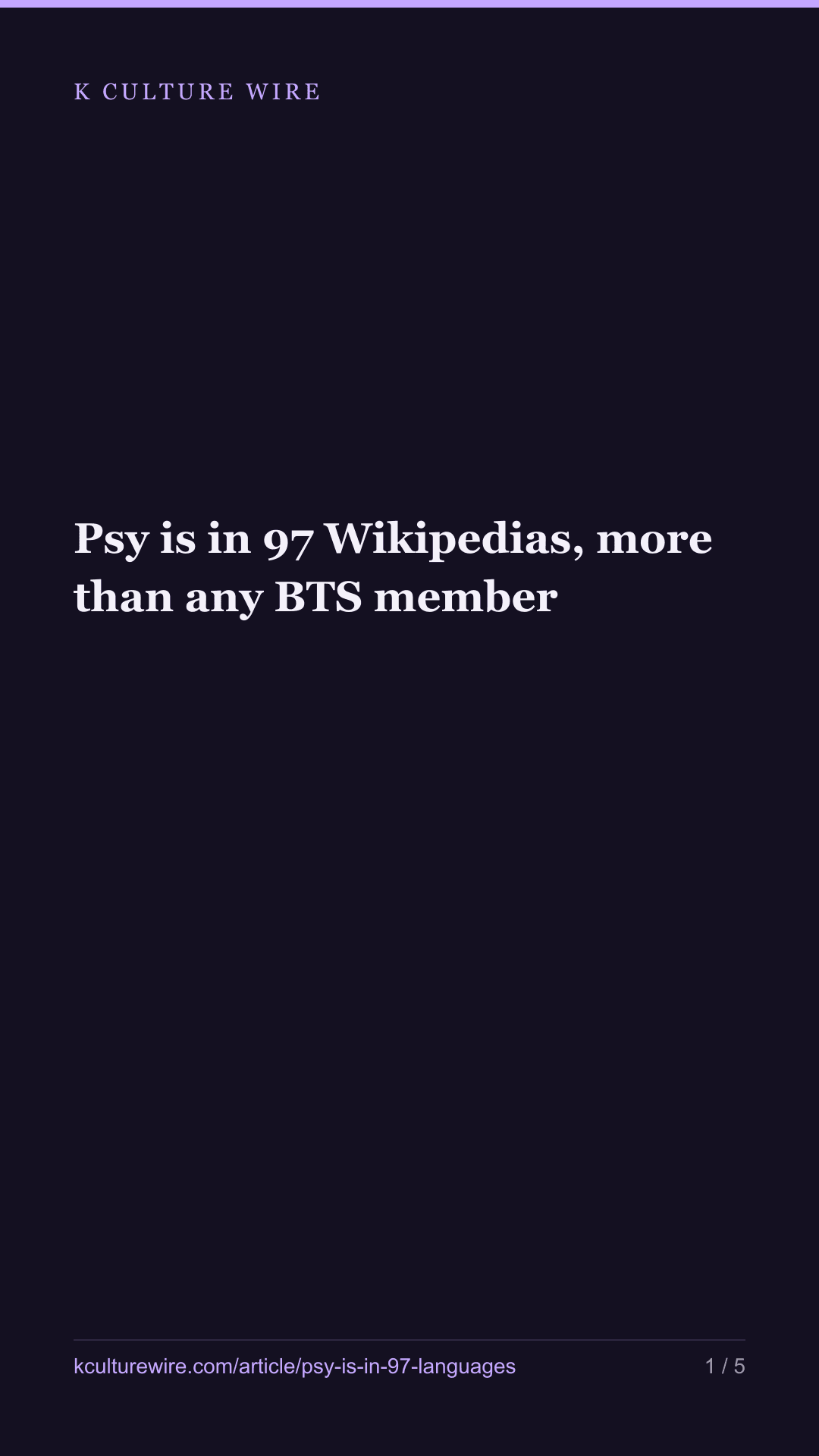
Psy is in 97 Wikipedias, more than any BTS member
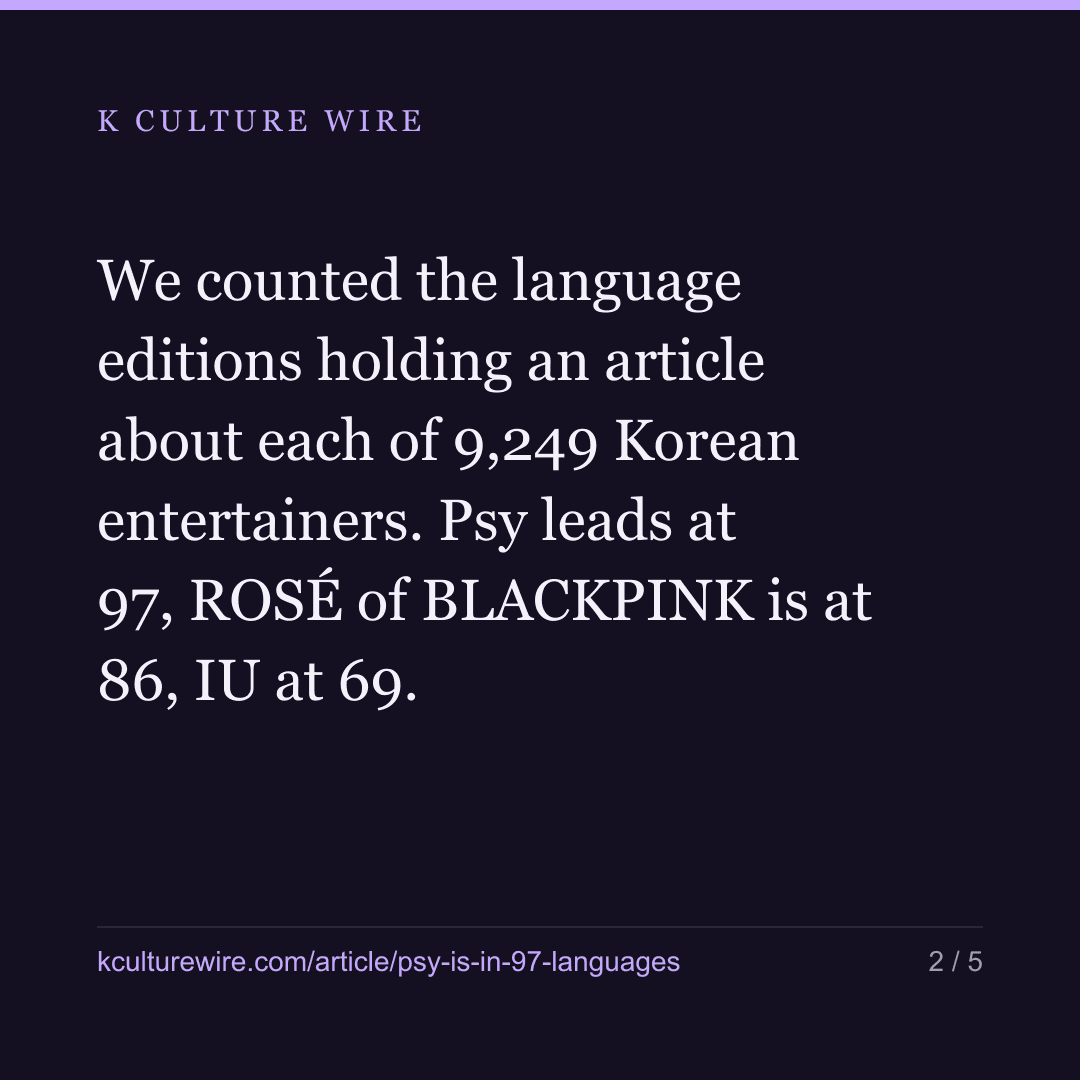
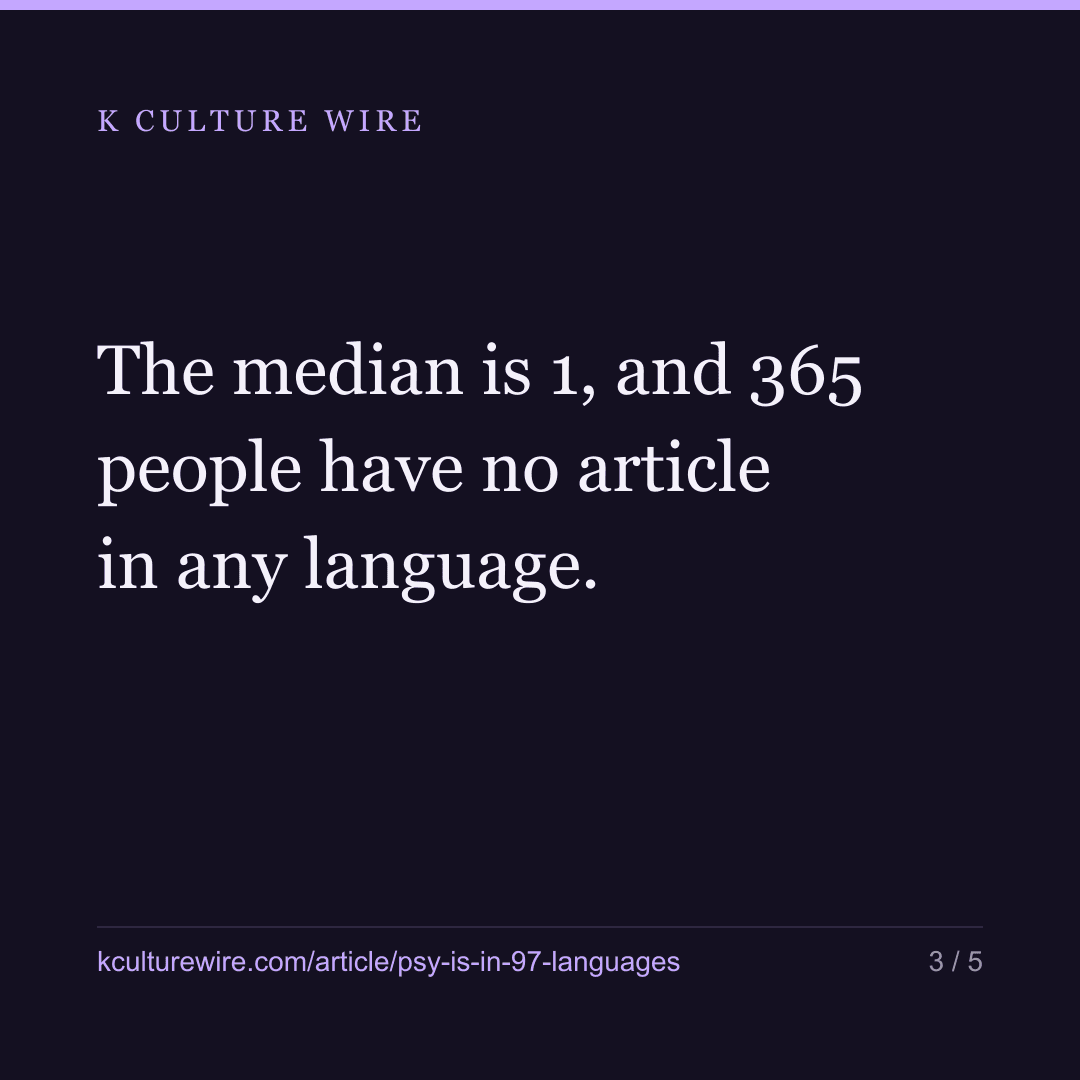
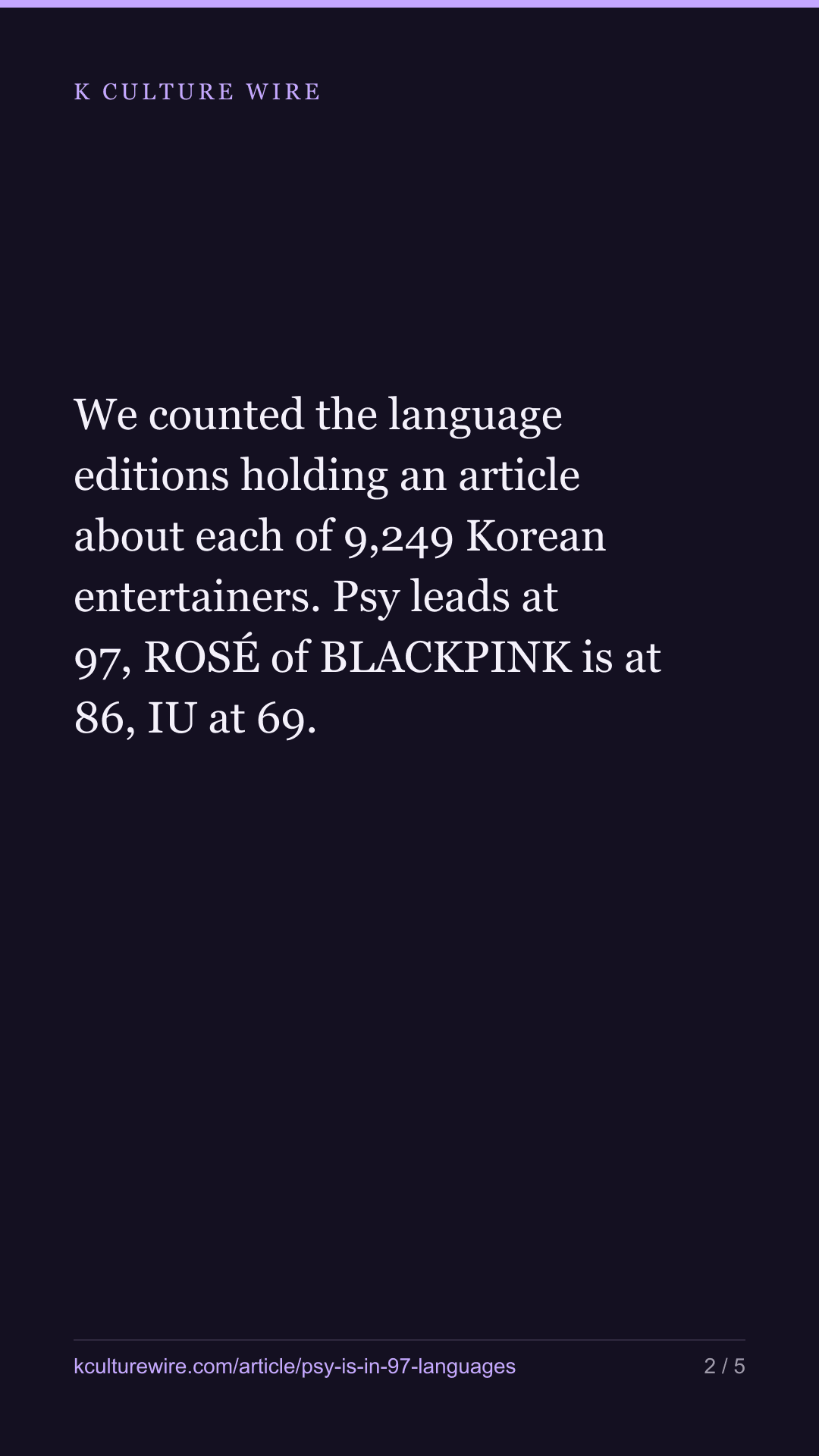
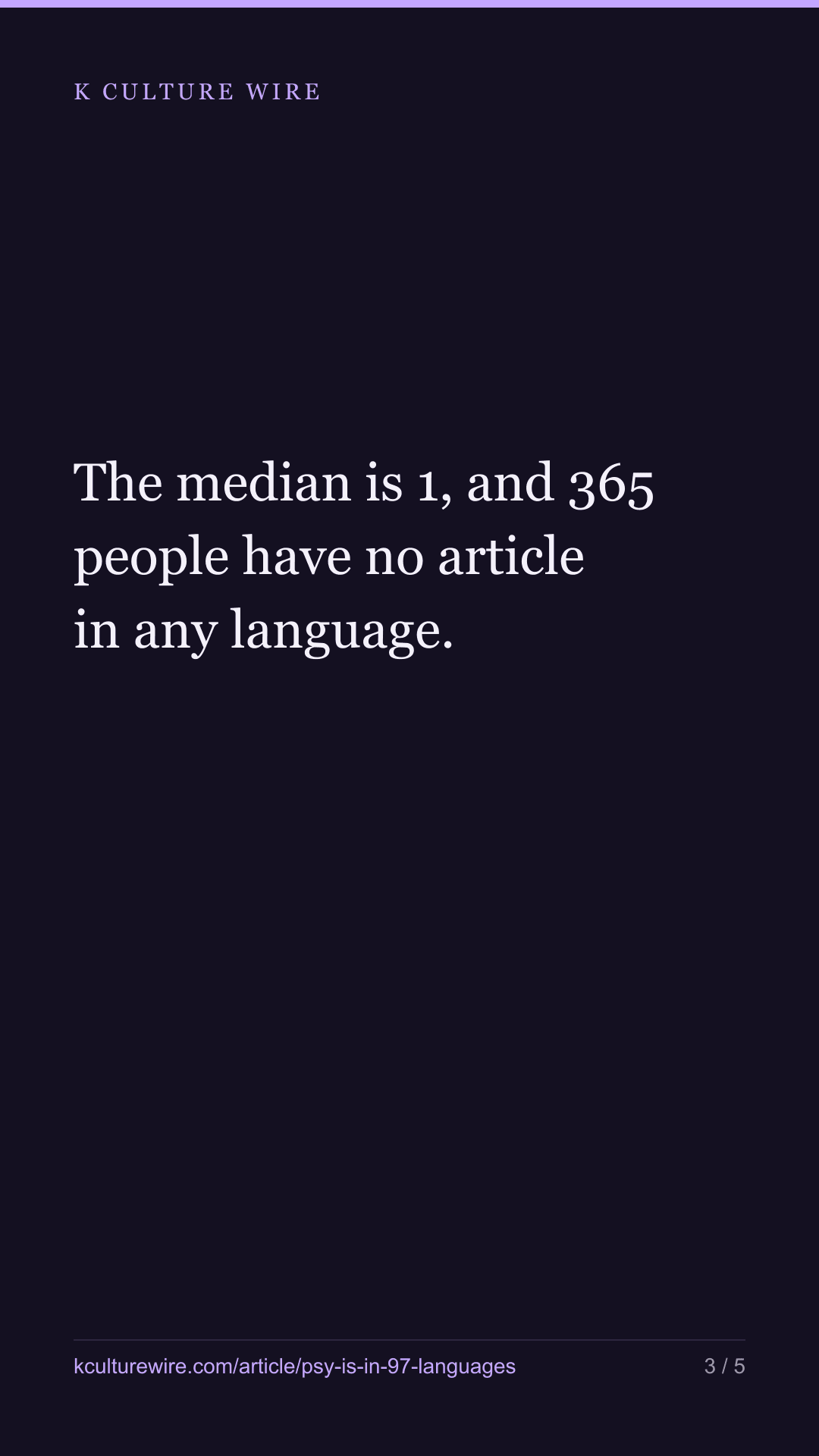
We counted the language editions holding an article about each of 9,249 Korean entertainers. Psy leads at 97, ROSÉ of BLACKPINK is at 86, IU at 69. The median is 1, and 365 people have no article in any language.
The table this is written from: /how-many-languages
Wikipedia has more than 300 language editions. Pick a Korean entertainer at random and count how many of them hold an article about that person.
The answer, for the median of 9,249 people, is one.
At the other end is Psy, with 97. That is more than ROSÉ of BLACKPINK at 86, more than Lee Min-ho at 78, more than Jennie at 78, more than Song Joong-ki at 72, more than IU at 69, more than Jisoo at 68 or Jungkook of BTS at 68, more than V of BTS at 61.
One song from 2012 sits above every member of the two biggest groups in the world.
The distribution, which is nearly all bottom
| At least | People | Share |
|---|---|---|
| 1 edition | 8,884 | 96.1% |
| 2 editions | 4,304 | 46.5% |
| 3 editions | 3,451 | 37.3% |
| 5 editions | 2,814 | 30.4% |
| 10 editions | 1,654 | 17.9% |
| 20 editions | 478 | 5.2% |
| 50 editions | 26 | 0.3% |
Twenty-six people out of 9,249 reach fifty editions. Nobody reaches a hundred.
We are not giving you a mean. A mean on a distribution whose median is 1 and whose maximum is 97 describes neither end.
365 people have zero. They have a Wikidata item and no article in any language, and they stay in the denominator. Dropping them would turn 9,249 into 8,884 and quietly raise every percentage above.
The objection we had to test first
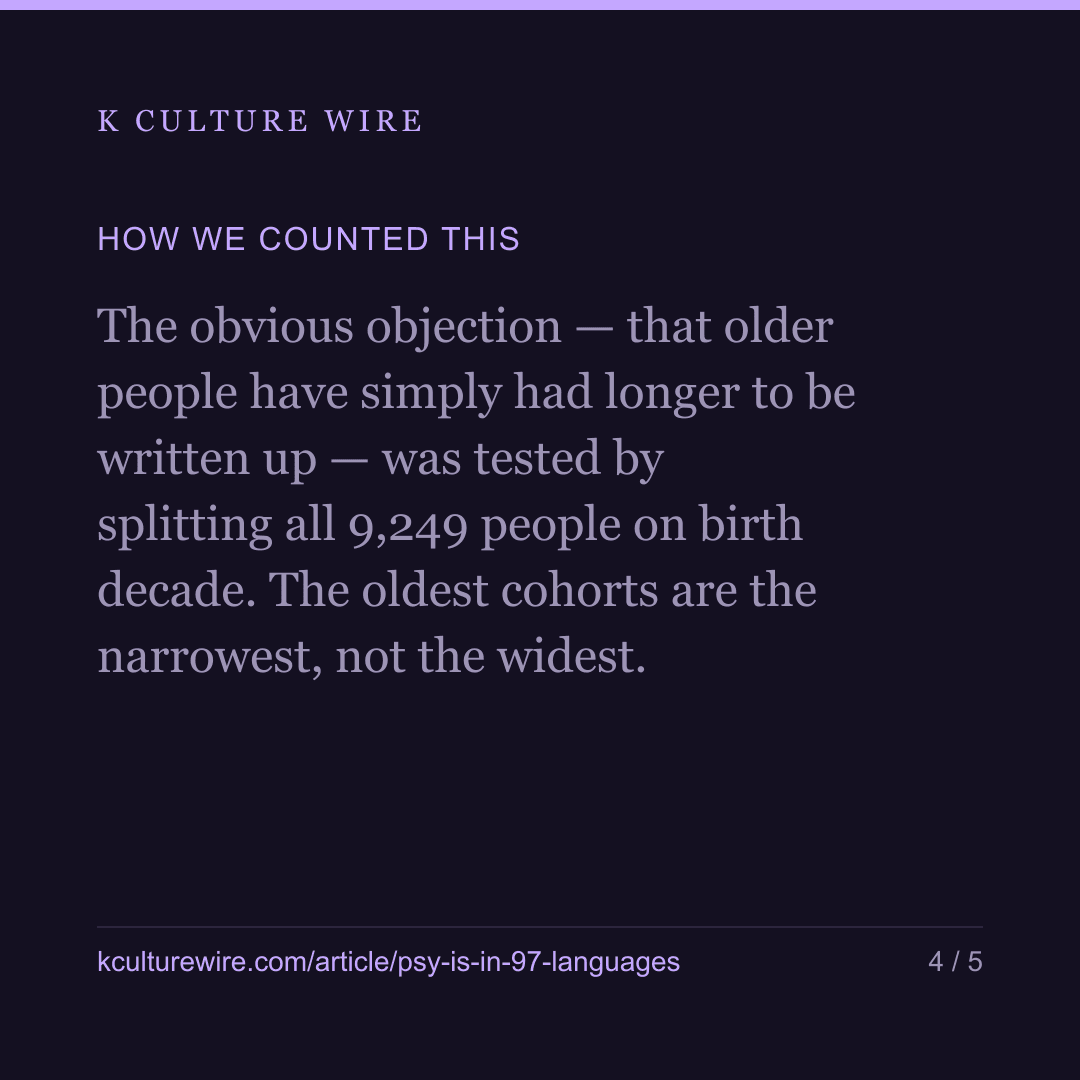
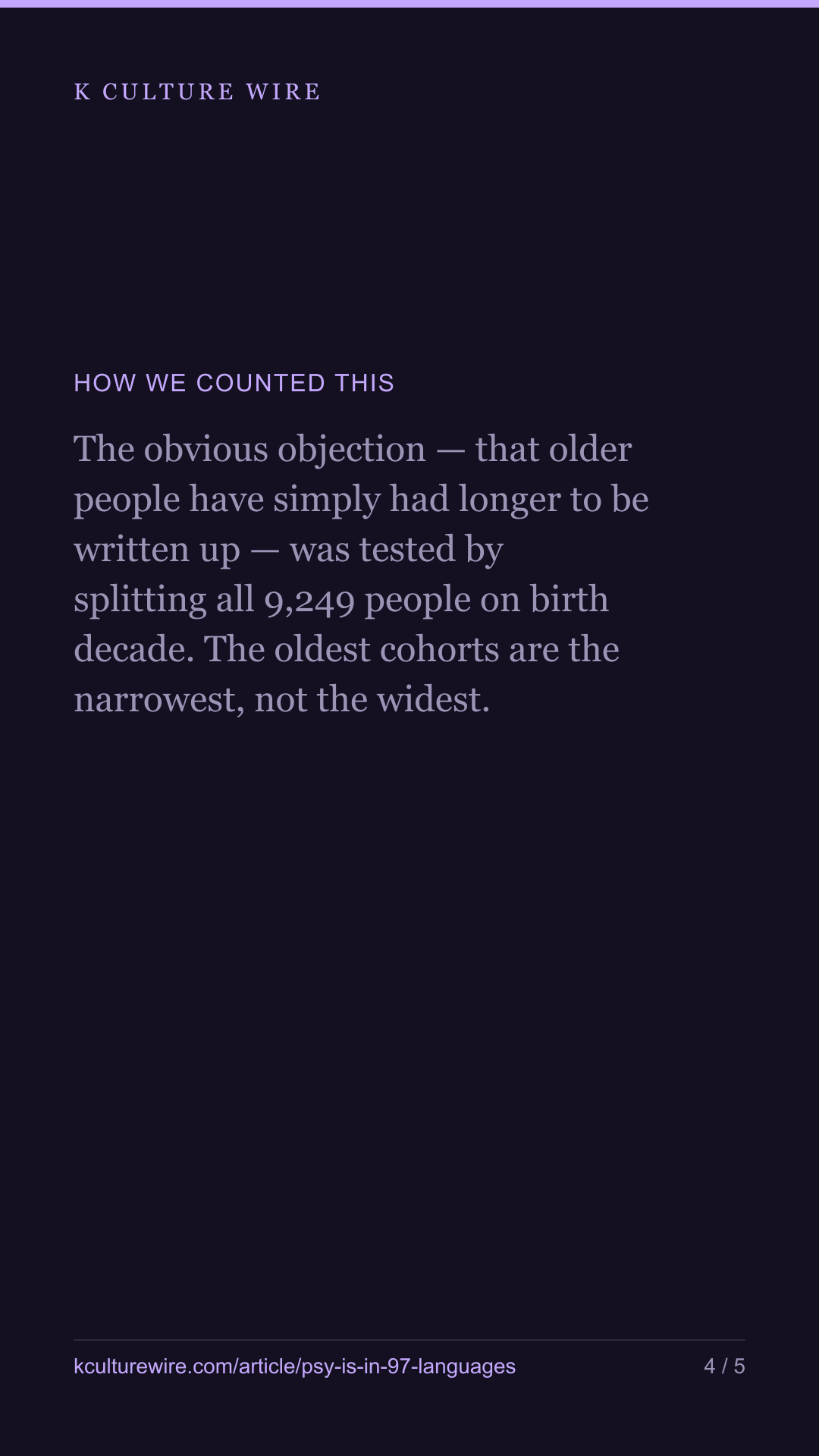
Psy’s song is fourteen years old. Jennie’s Wikidata item is not. If edition count were mostly a measure of how long editors have had, the oldest people in the panel would be the widest — and the whole finding would be about time rather than reach.
So we split all 9,249 people by the decade they were born in.
| Born | People | Median editions | Reaching 20 editions |
|---|---|---|---|
| 1940s | 220 | 1 | 1.8% |
| 1950s | 377 | 1 | 0.8% |
| 1960s | 746 | 1 | 1.3% |
| 1970s | 1,538 | 1 | 3.6% |
| 1980s | 2,635 | 1 | 6.8% |
| 1990s | 2,660 | 2 | 7.4% |
| 2000s | 843 | 1 | 3.3% |
The oldest cohorts are the narrowest. Fewer than two per cent of people born in the 1940s, 1950s or 1960s reach twenty editions. The widest cohort is the one born in the 1990s, at 7.4% — the generation of ROSÉ, Jennie, Jungkook, IU and Jisoo.
So the spread is not an artefact of editors having had longer. Psy, born in 1977, is an outlier inside a thinner generation rather than a beneficiary of a head start.
We ran that control because we had been caught by the same mechanism a few hours earlier, in the other direction: new Korean group formations looked 69% down since 2015, and the fall turned out to be how fast the source records them. One control killed a headline that morning. The same control saved one in the afternoon.
What the panel is not
The panel is selected on Wikidata occupations, and a few people arrive with it who are not entertainers. Yun Hyon-seok, at 80 editions, was a poet and an activist. Kim Ki-duk, at 66, was a film director. Both are in the top twenty of a list titled “entertainers”, and we have left them there with a mark beside their names rather than quietly deleting the rows and reporting a cleaner number.
An edition count is also not popularity. It counts how many communities of Wikipedia editors wrote an article, which depends on who edits those editions and what they think is worth an entry. It is not listeners, not viewers, not tickets, and not income. It does not say which languages, only how many.
The full table, the thresholds and the birth-decade control are on how many languages.
Where these numbers come from
Sources
- Wikidata — Korean entertainment occupations, with date of birth and sitelink count, CC0 · https://www.wikidata.org/
What we checked
- The obvious objection — that older people have simply had longer to be written up — was tested by splitting all 9,249 people on birth decade. The oldest cohorts are the narrowest, not the widest.
- People with zero editions are kept in the denominator; dropping them would raise every share on the page.
- The panel comes from Wikidata occupations and carries a poet and a film director, both named rather than removed.
The data behind this
Written from the same data
Take this away — 10 cards
The figures in this article, as images. Free to repost with the address on them.
If you work in this business
Everything on this page is measured from the same weekly Netflix lists, per market and per title. We publish the pages free; what we sell is the same measurement cut to one company's catalogue — including the figures behind /how-many-languages.
What a company sheet contains, and what it cannot tell you →
What do you make of this?
We counted it. What it means is yours to decide.